×

Mauritania🇲🇷 | best attractionsExplore the 12 Best attractions in Mauritania

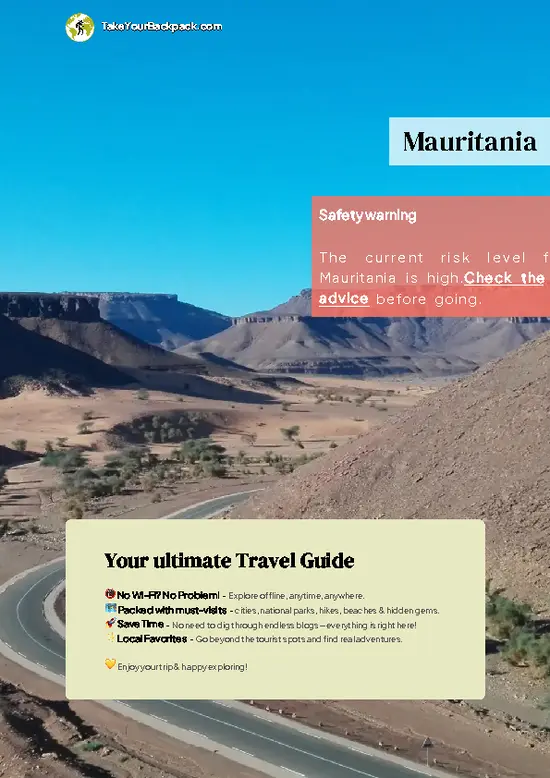
Mauritania’s best attractions unfold across vast desert expanses, rugged Atlantic coastlines, and ancient trading towns, each offering distinct challenges and rewards for backpackers. The country’s regional contrasts shape every journey: the Sahara’s relentless heat demands early starts and careful planning, while the cooler coastal zones invite slower exploration but require navigating limited infrastructure. Independent travelers will find that choosing the right destination here directly influences the trip’s vibe—whether it’s the raw solitude of the Adrar plateau or the bustling markets of Nouakchott. Seasonality also plays a critical role, with the cooler months easing travel and enhancing safety. Understanding these factors is essential to balancing budget, cultural immersion, and ease of travel in Mauritania.

By Johan Kruseman 🇳🇱 | Updated May 31, 2026
Explore the best festivals in Mauritania

Why go?Understanding Their Importance

Mauritania’s attractions stand apart because they demand more than a casual glance—they require commitment to the journey and a willingness to embrace its raw edges. The country’s vast desert landscapes and sparse population mean that travel here is often a trade-off between accessibility and immersion. Roads can be rough, distances long, and infrastructure limited, but these challenges strip away the usual tourist trappings, leaving a space where the environment and culture feel unfiltered and immediate.

Unlike destinations where attractions cluster conveniently, Mauritania’s points of interest are spread across harsh terrain, making travel time a significant factor. This means visitors must weigh the effort of reaching a site against the depth of experience it offers. The reward is a profound … read more 👉
Mauritania’s attractions stand apart because they demand more than a casual glance—they require commitment to the journey and a willingness to embrace its raw edges. The country’s vast desert landscapes and sparse population mean that travel here is often a trade-off between accessibility and immersion. Roads can be rough, distances long, and infrastructure limited, but these challenges strip away the usual tourist trappings, leaving a space where the environment and culture feel unfiltered and immediate.

Unlike destinations where attractions cluster conveniently, Mauritania’s points of interest are spread across harsh terrain, making travel time a significant factor. This means visitors must weigh the effort of reaching a site against the depth of experience it offers. The reward is a profound connection to the land’s stark beauty and the endurance of its people, whose traditions have adapted to the unforgiving Sahara climate over centuries. The climatic extremes—scorching days and cold nights—shape not only the landscape but the rhythm of life, adding a tactile dimension to every visit.

Culturally, Mauritania sits at a crossroads of Arab-Berber and Sub-Saharan African influences, reflected in its music, architecture, and social customs. However, limited tourism infrastructure means that travelers should prepare for minimal conveniences and a need for self-sufficiency. This makes Mauritania especially suited for those who seek authenticity over ease, where the payoff is not just a view or a monument, but a rare encounter with a living, breathing frontier.
Why These Made the Cut
The list of best attractions in Mauritania is created based on cultural significance or entertainment value. If you feel a attraction is missing in this list, please let us know.

When to go?Timing Your Visit for the Best Experience

Seasonal Rhythms and Travel Realities

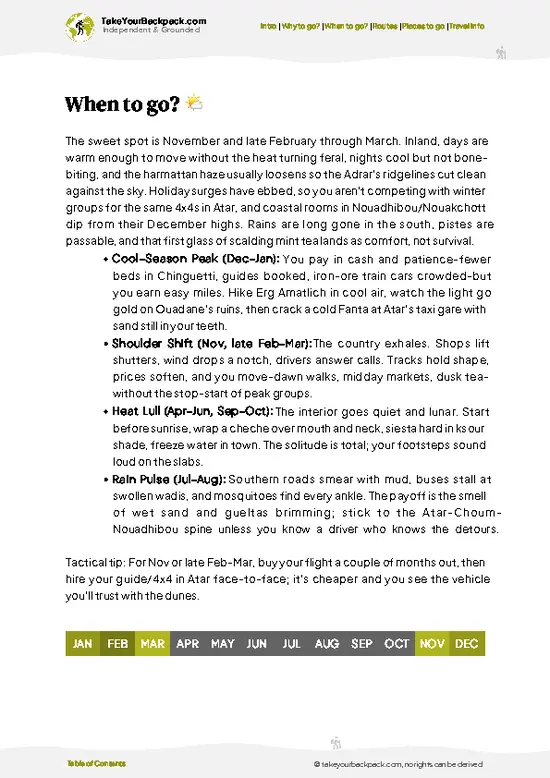
Mauritania’s climate is dominated by the Sahara’s harsh hand, shaping every step of your journey. The dry season, stretching from late fall through early spring, offers the most manageable conditions. Days are warm but not scorching, and nights drop to a cool, sometimes sharp chill. This window is when the desert’s vastness feels accessible rather than punishing, making it the prime time to explore the country’s rugged landscapes and cultural sites without battling extreme heat.

The shoulder months on either side of this period bring a mix of trade-offs. Temperatures start climbing, and the sun’s intensity becomes relentless by midday. This means shorter windows for outdoor activity and a greater need for hydration and shade. However, these months … read more 👉

Seasonal Rhythms and Travel Realities

Mauritania’s climate is dominated by the Sahara’s harsh hand, shaping every step of your journey. The dry season, stretching from late fall through early spring, offers the most manageable conditions. Days are warm but not scorching, and nights drop to a cool, sometimes sharp chill. This window is when the desert’s vastness feels accessible rather than punishing, making it the prime time to explore the country’s rugged landscapes and cultural sites without battling extreme heat.

The shoulder months on either side of this period bring a mix of trade-offs. Temperatures start climbing, and the sun’s intensity becomes relentless by midday. This means shorter windows for outdoor activity and a greater need for hydration and shade. However, these months often see fewer visitors, which can translate to more solitude and slightly lower costs.

When the summer months arrive, the heat becomes a defining challenge. Temperatures soar well above comfortable levels, and the air thickens with dust and dry wind. Travel slows, and many attractions become difficult or unsafe to visit during peak daylight hours. This season demands careful planning and a willingness to accept limited activity periods.

Rainfall is minimal and unpredictable, rarely altering travel plans but occasionally transforming the landscape with sudden bursts of green. Overall, timing your visit to avoid the peak heat while embracing the cooler dry season unlocks the full sensory experience Mauritania offers—where every step through the sand feels earned and every sunset is a hard-won reward.

attraction hoppingPlanning Your Route Efficiently

Combining Mauritania’s Attractions Efficiently

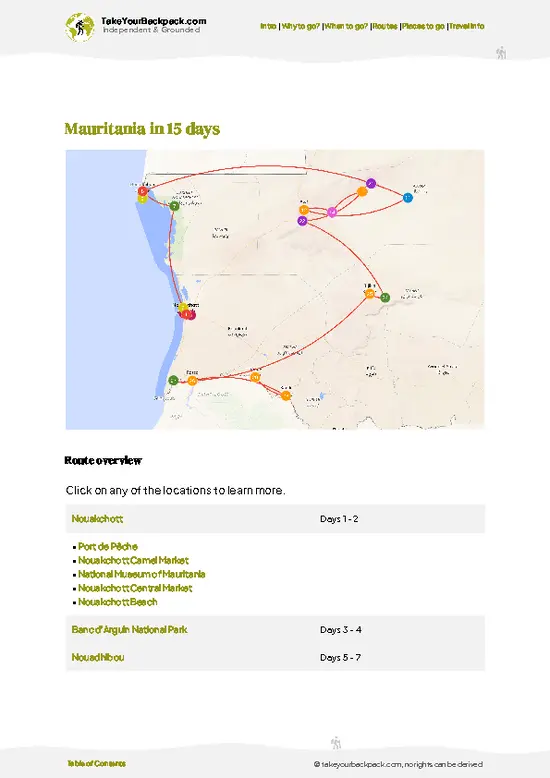
Mauritania’s vastness demands a strategic approach to stitching together its key sights. The country naturally divides into clusters: the coastal Nouakchott area, the Saharan interior, and the remote Adrar region. Tackling these zones in a logical sequence—starting from the capital and moving inward—minimizes backtracking and wasted travel time.

Expect to spend at least two to three days in each major cluster to absorb the atmosphere without feeling rushed. Desert excursions or visits to ancient trading posts require more than a quick stop; the terrain and travel conditions slow progress, so build in buffer days.

A common trap is overloading the itinerary with too many distant stops, chasing quantity over quality. This often leads to exhausting … read more 👉

Combining Mauritania’s Attractions Efficiently

Mauritania’s vastness demands a strategic approach to stitching together its key sights. The country naturally divides into clusters: the coastal Nouakchott area, the Saharan interior, and the remote Adrar region. Tackling these zones in a logical sequence—starting from the capital and moving inward—minimizes backtracking and wasted travel time.

Expect to spend at least two to three days in each major cluster to absorb the atmosphere without feeling rushed. Desert excursions or visits to ancient trading posts require more than a quick stop; the terrain and travel conditions slow progress, so build in buffer days.

A common trap is overloading the itinerary with too many distant stops, chasing quantity over quality. This often leads to exhausting drives and superficial experiences. Prioritize depth in fewer places rather than a checklist of fleeting glimpses.

Balancing speed and immersion is key. Faster travel cuts costs but sacrifices the chance to savor the shifting light over dunes or the texture of local markets. Conversely, lingering too long in one spot can strain budgets and patience.

Flexibility is essential. Road conditions and weather can alter plans, so allow wiggle room. Comfort levels vary widely—some travelers embrace rugged nights under stars, others prefer basic lodges. Align your route with your tolerance for roughing it versus convenience.

Ultimately, the payoff is in the moments when the effort crystallizes: the silence of the desert at dawn, the taste of fresh camel milk after a dusty trek, or the slow unfolding of Mauritania’s layered history in a single village.

The ListTop attractions of Mauritania

1 Ancient Ksour of Ouadane

desert ruins, stone alleys, Saharan plateau

Walk through labyrinthine passages and crumbling walls where centuries-old architecture reveals the adaptation of life to harsh desert conditions.

2 Old Quarter and Friday Mosque of Chinguetti

sandstone minaret, narrow lanes, religious center

Visit a centuries-old mosque and surrounding streets, witnessing the architectural and spiritual heart of a historic caravan town.

3 Old Town and Rock-Painted Walls of Oualata

painted facades, geometric motifs, mudbrick houses

Admire colorful wall decorations and distinctive designs that distinguish Oualata’s homes, reflecting artistic traditions unique to the region.

4 Manuscript Libraries of Chinguetti

ancient manuscripts, family collections, desert libraries

Examine handwritten texts preserved for generations, offering insight into Islamic scholarship and the intellectual legacy of the trans-Saharan trade.

5 Manuscript Libraries of Oualata

calligraphy, private archives, medieval texts

Discover rare volumes and intricate script in intimate settings, reflecting the town’s role as a center of learning and cultural exchange.

6 National Museum of Mauritania

archaeological exhibits, ethnographic displays, prehistoric artifacts

Survey objects spanning from prehistoric tools to contemporary art, providing a chronological overview of Mauritania’s diverse cultures.

7 Nouakchott Camel Market

livestock trading, camel herders, open-air pens

Observe the negotiation and movement of camels in a bustling environment that remains central to local commerce and nomadic traditions.

8 Port de Pêche

fishing boats, Atlantic shoreline, daily catch

Watch fishermen unload their boats and mend nets along the coast, offering a glimpse into the routines of Mauritania’s maritime communities.

9 Nouakchott Central Market

produce stalls, textiles, daily commerce

Navigate crowded aisles filled with fresh goods and household items, experiencing the rhythms of urban life and local trade.

10 Atar Regional Museum

regional artifacts, Berber heritage, local crafts

Browse displays of traditional tools, textiles, and archaeological finds that illustrate the daily life and history of the Adrar region.

11 Old Fortified Quarter of Ouadane

defensive walls, abandoned dwellings, elevated outlooks

Climb through weathered structures perched above the desert, where strategic placement once protected residents from raids and sandstorms.

12 National Library of Mauritania

public reading rooms, national archives, research collections

Access a broad range of documents and publications that trace the evolution of Mauritanian society, language, and governance.

Loading the map 🌍

Expert viewInsights from Locals and Experts

Expert Commentary


Mauritania’s attractions don’t line up like a neatly packaged tour; they demand a mindset that embraces vastness and the unexpected. You won’t be ticking off a dozen sights in a week here. Instead, aim for a handful—two to four major experiences—that you can savor without rushing. The country’s scale and infrastructure mean travel between points is often slow, sometimes grueling, but that’s part of the deal. The reward is in the space itself: the endless horizon, the shifting dunes, the silence that presses in after the road dust settles.

Budgeting your time and money requires a realistic lens. Transport options are limited and often basic—expect to spend more time on the road than on the attraction itself. This isn’t a place for quick hits or last-minute changes. You’ll … read more 👉

Expert Commentary


Mauritania’s attractions don’t line up like a neatly packaged tour; they demand a mindset that embraces vastness and the unexpected. You won’t be ticking off a dozen sights in a week here. Instead, aim for a handful—two to four major experiences—that you can savor without rushing. The country’s scale and infrastructure mean travel between points is often slow, sometimes grueling, but that’s part of the deal. The reward is in the space itself: the endless horizon, the shifting dunes, the silence that presses in after the road dust settles.

Budgeting your time and money requires a realistic lens. Transport options are limited and often basic—expect to spend more time on the road than on the attraction itself. This isn’t a place for quick hits or last-minute changes. You’ll want to allocate several days for each major stop, factoring in the unpredictability of local transport and the need to acclimate to the heat and isolation. Costs can vary wildly depending on your style—budget travelers can get by with modest guesthouses and shared rides, but the remote nature of many sites means splurging on private transport or guided tours can save hours, sometimes days, of waiting and uncertainty.

The cultural fabric here is tightly woven with tradition and hospitality, but it’s also conservative and cautious. Respect for local customs isn’t optional; it’s the key to unlocking genuine interactions and avoiding friction. Dress modestly, especially outside urban centers, and approach encounters with patience and humility. Women traveling alone or in small groups should be particularly mindful of social norms and consider local advice on safe areas and times to travel. Language barriers can be significant, so having a guide or translator isn’t just a convenience—it’s often essential for navigating both logistics and cultural nuances.

Safety is a layered issue. The country’s remoteness can be a double-edged sword: it offers solitude and raw landscapes but also means medical help and emergency services are scarce. Political stability fluctuates, and some border areas are best avoided. Staying informed through trusted local contacts or guides is crucial. On the ground, the biggest risks come from the environment itself—extreme heat, sandstorms, and rough terrain. Preparation means carrying ample water, sun protection, and reliable navigation tools. The payoff for enduring these challenges is a landscape that feels untouched by mass tourism, where the light at dusk turns the desert into a canvas of deep reds and purples, and the silence is broken only by the wind and your own footsteps.

Planning your itinerary is a balancing act between ambition and pragmatism. The distances between attractions are vast, and the roads can be punishing. Prioritize sites that offer a mix of cultural insight and natural spectacle to maximize your experience. Trying to cram too many stops will leave you exhausted and shortchanging the moments that matter. Instead, choose fewer places and dive deeper—spend time with local communities, watch the desert change color as the sun sets, and let the slow pace recalibrate your sense of time.

One of the most vivid memories I carry from Mauritania is the moment after a long, dusty drive when the sun finally dips below the dunes. The air cools rapidly, and the first cold drink tastes like a reward earned through grit and patience. That’s the essence of traveling here: the hard parts are real, but they set the stage for moments that feel profoundly earned. This isn’t a destination for the casual tourist or the impatient traveler. It’s for those who want to feel the weight of the desert underfoot and the quiet pulse of a culture that moves at its own pace.

In sum, approach Mauritania’s attractions with respect for the effort involved. Choose a manageable number of sites, prepare for slow travel, and embrace the cultural and environmental realities. The payoff is a rare kind of travel experience—one where the journey itself is as meaningful as the destination, and where every sight feels like a hard-won prize.

✈️ The backpacker research shortcutMauritania Travel Guide

An offline-friendly backpacking guide with optimized travel routes, ranked highlights, transport advice, and the best areas to stay.
example page 0 from our offline Travel Guide for Mauritaniaexample page 1 from our offline Travel Guide for Mauritaniaexample page 2 from our offline Travel Guide for Mauritaniaexample page 3 from our offline Travel Guide for Mauritaniaexample page 4 from our offline Travel Guide for Mauritaniaexample page 5 from our offline Travel Guide for Mauritaniaexample page 6 from our offline Travel Guide for Mauritaniaexample page 7 from our offline Travel Guide for Mauritania
The digital guide (269 pages) contains:
63 highlights, ranked by travel appeal
Optimized 5, 10 & 15-day travel routes
Cities, national parks, landmarks, beaches
How to get around
Offline-friendly for travel without Wi-Fi
👉 Click to see all 30+ guide features

📅 Plan smarter in minutes, not weeks
Month by month travel advice
Festivals & national holidays
Budget expectations

🗺️ Go to the right places, skip the overrated ones
Honest pros & cons of destinations
Top hikes, parks & viewpoints
Lesser-known places most travelers miss
Clear “worth it vs skip it” guidance

🛏️ Travel smoothly without rookie mistakes
Best areas to stay
Transport systems explained simply
Common scams & safety advice
SIM cards, money & practical tips

🌍 Understand the country, not just visit it
Culture & traditions
52 Essential phrases & customs
Festivals worth planning around
Traveler-friendly historical context
Insights that make places more meaningful

📱 Built for real travel conditions
Fully downloadable PDF
Works completely offline
Optimized for phone use
Useful in remote areas & buses
Everything in one place
Save weeks of stressful planning
Get instant access to your full guide. 30‑day money-back guarantee.


By proceeding you agree to our terms.
Sent to your inbox immediately after payment • 100% Secure Checkout
Best Backpacking Travel Advisor 2025 tourism awardBest Backpacking
Travel Advisor
2025
What others say about Take Your Backpack Guides:
⭐⭐⭐⭐⭐
Fantastic, amazing amount of information!
⭐⭐⭐⭐⭐
My goodness this is amazing, it's what I've been looking for hats off too you!
⭐⭐⭐⭐⭐
I think this is absolutely BRILLIANT
⭐⭐⭐⭐
Very complete and informative. It's still missing places, but I gotta to commend you
⭐⭐⭐⭐⭐
This is truly amazing, thank you, can't wait to explore it with my kids!
⭐⭐⭐⭐⭐
Awesome resource, thank you!
⭐⭐⭐⭐⭐
This is amazing! Can't wait to explore the ones I haven't seen
⭐⭐⭐⭐
I love this! Well done, great idea.
⭐⭐⭐⭐⭐
Thanks for taking the time to make this gem!
⭐⭐⭐⭐⭐
This might be the best website I've ever seen.
⭐⭐⭐⭐⭐
Congratulations, and thank you so much for your work; it's incredibly valuable.
⭐⭐⭐⭐
In all seriousness I think you did a great job pointing out the important spots
⭐⭐⭐⭐⭐
10/10 very good
⭐⭐⭐⭐⭐
As someone who's only just starting to visit regularly this is awesome, thank you.
⭐⭐⭐⭐
Thank you very much! I'm going to visit my dad, it's going to be very useful!
⭐⭐⭐⭐⭐
This is really cool! We'll be travelling for the first time and this definitely come in handy.
⭐⭐⭐⭐⭐
You are now our minister of culture, congratulations 👨‍💼
⭐⭐⭐⭐⭐
Just wanted to tell you that this is a pearl! Going to follow your recommendations.
⭐⭐⭐⭐⭐
This is so cool. I'll definitely be using the resource for my travels soon.
⭐⭐⭐⭐⭐
This is very impressive! Good work.
⭐⭐⭐⭐⭐
This is an amazing and informative site. Very well done!

🛏️ Where to stay?Where to Stay in Mauritania

There are very few traditional hostels in Mauritania, but budget accommodation exists as small guesthouses, auberges and cheap hotels mainly in coastal cities and desert towns; expect basic facilities, intermittent hot water, simple bedding and variable cleanliness.

In Nouakchott most budget options concentrate in Tevragh Zeina (safer, closer to restaurants and expat services but pricier), Sebkha (cheaper, near markets and bus routes but dustier and busier), and the central/port area (convenient for transport and the fish market but noisier and less polished).

In Nouadhibou the city centre/port area has the widest low-cost choices near transport yet fewer amenities and occasional security … read more 👉
There are very few traditional hostels in Mauritania, but budget accommodation exists as small guesthouses, auberges and cheap hotels mainly in coastal cities and desert towns; expect basic facilities, intermittent hot water, simple bedding and variable cleanliness.

In Nouakchott most budget options concentrate in Tevragh Zeina (safer, closer to restaurants and expat services but pricier), Sebkha (cheaper, near markets and bus routes but dustier and busier), and the central/port area (convenient for transport and the fish market but noisier and less polished).

In Nouadhibou the city centre/port area has the widest low-cost choices near transport yet fewer amenities and occasional security checks, while desert hubs like Atar and Chinguetti offer very basic guesthouses ideal for accessing dunes and ruins but demand advance planning, cash payments and tolerance for spartan conditions.

If you enjoy meeting fellow travelers, consider choosing hostels with high ratings for atmosphere. On the other hand, if you prefer having your own space, a hotel might be a better option.

MauritaniaMore of Mauritania

👋 Meet the founderWho’s Behind Take Your Backpack?

Johan, backpacker and founder of TakeYourBackpackHi, I’m Johan (Netherlands 🇳🇱), the creator of TakeYourBackpack. Over the past decade, I’ve backpacked through 80+ countries across six continents, gaining extensive experience with independent travel, long-term trips, and overland routes.

This site is built on a combination of firsthand travel experience and carefully curated insights from other backpackers. Many guides are based on places I’ve personally visited, while others bring together tips, observations, and practical advice shared by trusted travelers I’ve met along the way.

The goal is to provide realistic, experience-driven guidance — not generic itineraries — so you can explore destinations with better context, clearer expectations, and more confidence.

Get full Mauritania guide •
Instant download • 63 highlights • Full Offline guide