×

Netherlands🇳🇱 | best festivalsYour Guide to the 10 Best festivals in The Netherlands

Festivals in the Netherlands run on flat geography and dense rail, so almost everything is reachable without a car. The country splits into clear types. The Randstad (Amsterdam, Rotterdam, Utrecht) hosts large electronic music and city events with high ticket prices, hotel costs that spike and heavy crowds. The south, especially Limburg and Brabant, leans toward carnival traditions that are loud, local and cheaper. The north and the Wadden coast offer smaller, field-based gatherings with easier camping. For backpackers and other independent travelers, the useful question is whether you want scale, tradition or space, because each region delivers one of those far better than the others.

By Johan Kruseman 🇳🇱 | Updated October 18, 2026
Explore the best regions in The Netherlands

Why go?Key Factors That Shape the Experience

The Netherlands suits festivals because everything is close together. A country about 300 km from top to bottom, with frequent intercity trains and a national OV-chipkaart and contactless system, lets you reach most venues in under three hours. Dense cities also mean strong event infrastructure: professional production, reliable crowd management and free or cheap drinking water at many larger events.

Culture matters just as much. A tolerant, public-minded outlook and a long habit of street celebration, from Catholic-rooted carnival in the south to the Protestant-leaning, more restrained north, give each region its own mood. The country is also a global hub for electronic music, so large events draw international crowds and top-level lineups.

Know the downsides before you choose. The climate … read more 👉
The Netherlands suits festivals because everything is close together. A country about 300 km from top to bottom, with frequent intercity trains and a national OV-chipkaart and contactless system, lets you reach most venues in under three hours. Dense cities also mean strong event infrastructure: professional production, reliable crowd management and free or cheap drinking water at many larger events.

Culture matters just as much. A tolerant, public-minded outlook and a long habit of street celebration, from Catholic-rooted carnival in the south to the Protestant-leaning, more restrained north, give each region its own mood. The country is also a global hub for electronic music, so large events draw international crowds and top-level lineups.

Know the downsides before you choose. The climate is unpredictable: wind and rain can arrive at any outdoor event, even in summer. Large events sell out months ahead, and accommodation in host cities rises sharply. Prices are among the higher ones in Europe, and most venues are cashless, so a card is needed. Many events also use tokens or a prepaid wristband for drinks, which you should top up carefully, since refunds can involve a fee or an online process.
Our Approach to Ranking
The list of best festivals in The Netherlands is created based on energy, traditions, crowd experience, activities, and overall excitement. If you feel a festival is missing in this list, please let us know.

When to go?Timing Your Visit for the Best Experience

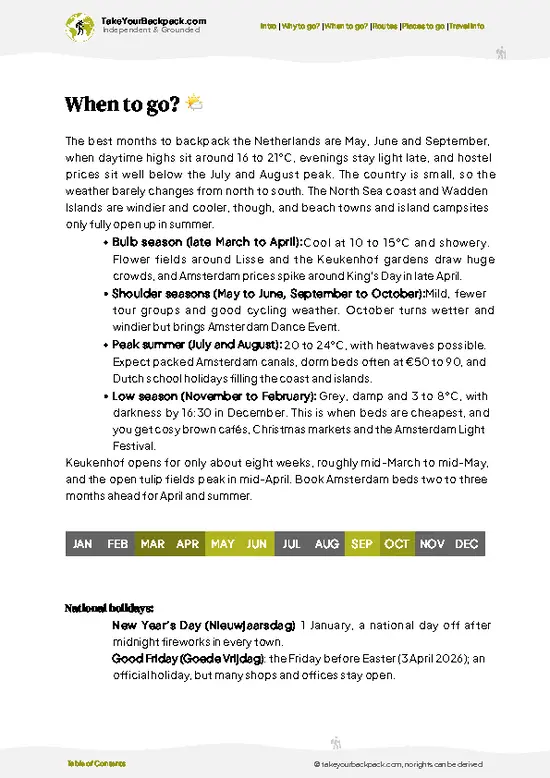
Best months and weather: The best months for festivals in the Netherlands are May to September, when daytime highs run about 16 to 24°C and daylight lasts until 9 or 10 pm in midsummer. This is when outdoor events are concentrated, though rain falls year-round, roughly 60 to 80 mm a month, so a light rain shell matters more than sunscreen.
Shoulder seasons and peaks: April and October are the shoulder months, with highs around 10 to 15°C. Fewer large outdoor events run, but indoor and club-based programs fill the gap and rooms in Amsterdam can cost 20 to 30 percent less than in summer. Late July and August sit at the top of the price curve, and dorm beds and hotel rooms in Amsterdam can run 30 to 50 percent above spring rates. Weekends in peak months sell out first.
Winter and regional differences: … read more 👉
Best months and weather: The best months for festivals in the Netherlands are May to September, when daytime highs run about 16 to 24°C and daylight lasts until 9 or 10 pm in midsummer. This is when outdoor events are concentrated, though rain falls year-round, roughly 60 to 80 mm a month, so a light rain shell matters more than sunscreen.
Shoulder seasons and peaks: April and October are the shoulder months, with highs around 10 to 15°C. Fewer large outdoor events run, but indoor and club-based programs fill the gap and rooms in Amsterdam can cost 20 to 30 percent less than in summer. Late July and August sit at the top of the price curve, and dorm beds and hotel rooms in Amsterdam can run 30 to 50 percent above spring rates. Weekends in peak months sell out first.
Winter and regional differences: Winter, from December to February, is cold at 1 to 6°C, damp and dark by 4:30 pm. Indoor events still run, and prices are lowest. Carnival in the south falls in February or early March, depending on Easter, and during those days Limburg and Noord-Brabant fill up while trains and bars run late. Coastal and northern areas are windier and a few degrees cooler than the Randstad, so pack an extra layer for dunes and Wadden events.

festival hoppingHow to Combine festivals Into One Trip

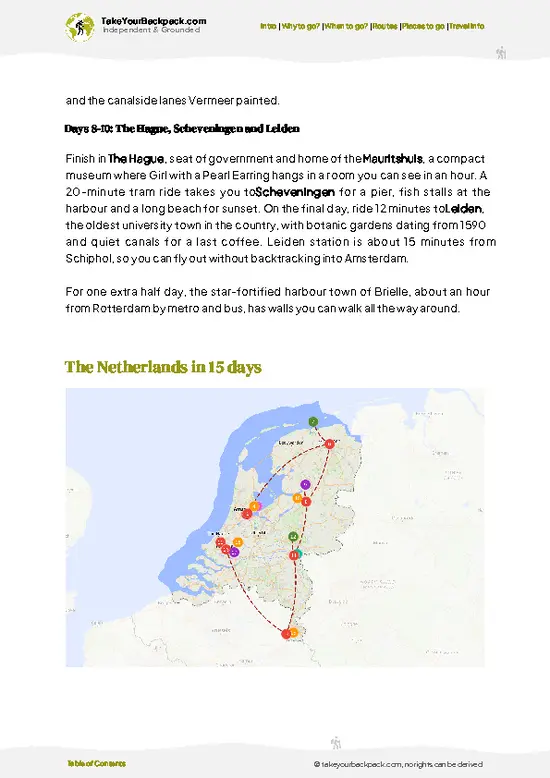
How many days and where to start: A trip combining several festivals in the Netherlands needs 7 to 14 days, with 1 to 3 days at each stop. The country is compact, so the limiting factor is your energy and ticket dates, not distance. Amsterdam or Utrecht make the best anchor points because trains fan out from both, and Utrecht Centraal is the country’s busiest rail junction.
Grouping regions and direction: The Randstad cluster of Amsterdam, Utrecht, Rotterdam and The Hague links by train in 30 to 60 minutes. The south (Eindhoven, Den Bosch, Maastricht) is 1 to 2.5 hours from Utrecht, and the north (Groningen, Friesland, the Wadden islands) is 2 to 3 hours away, with a ferry added for the islands. Travel in a loop: Randstad first, then outward to either south or north, and back by a different … read more 👉
How many days and where to start: A trip combining several festivals in the Netherlands needs 7 to 14 days, with 1 to 3 days at each stop. The country is compact, so the limiting factor is your energy and ticket dates, not distance. Amsterdam or Utrecht make the best anchor points because trains fan out from both, and Utrecht Centraal is the country’s busiest rail junction.
Grouping regions and direction: The Randstad cluster of Amsterdam, Utrecht, Rotterdam and The Hague links by train in 30 to 60 minutes. The south (Eindhoven, Den Bosch, Maastricht) is 1 to 2.5 hours from Utrecht, and the north (Groningen, Friesland, the Wadden islands) is 2 to 3 hours away, with a ferry added for the islands. Travel in a loop: Randstad first, then outward to either south or north, and back by a different line, so you do not double back over the same corridor.
Planning mistakes: The first mistake is booking back-to-back days at camping events. Recovery, packing and queues for shuttles easily eat half a day, so leave one free day between them. The second is staying in the host city when it is priced at peak. Staying in Utrecht, Haarlem or Leiden and commuting by train saves money. The third is planning around the last train, since late services thin out after midnight. Check night connections or a festival shuttle before you commit.

The ListTop festivals of The Netherlands

1 King’s Day

Vrijmarkt, orange outfits, street games, Koningsnacht

Dress in orange, sell or hunt for secondhand finds at the vrijmarkt, and catch live music from Koningsnacht onward.

2 Amsterdam Dance Event

Club nights, daytime conferences, warehouse parties, canal boats

Pick between industry talks by day and club, warehouse and boat events by night, with plenty of free or low-cost options across Amsterdam.

3 Pride Amsterdam

Canal Parade, Amstel banks, Pride Walk, street parties

Claim a spot along the Amstel for the boat parade, then join the walk and the street parties around Zeedijk and Reguliersdwarsstraat.

4 Lowlands

Campsite community, mixed stages, cabaret, Bravo tent

Move between genre-crossing stages, theater and talks by day, then end late in the Bravo tent after camping nearby.

5 North Sea Jazz

Indoor stages, jazz and beyond, short sets, overlapping rooms

Hop between indoor stages for short, packed sets, accepting that overlapping schedules will force some hard choices.

6 Pinkpop

Headliner main stage, Limburg camping, train access, festival heritage

Arrive by train at the Pinkpop station, camp nearby and catch main stage headliners alongside Limburg food and drink.

netherlands-festival-pinkpop
© Google | Peter Driessen

7 International Film Festival Rotterdam

Tiger Competition, Big Screen, expanded cinema, De Doelen

Plan a film marathon around the Tiger Competition, experimental installations and screenings centered on De Doelen and Cinerama in Rotterdam.

8 Oerol

Terschelling island, dune theater, mudflat shows, bike hopping

Cycle across the island to site-specific theater in dunes, forests, barns and even the Wadden Sea mudflats.

9 Eurosonic Noorderslag

Groningen venues, new European acts, church shows, Noorderslag

Walk between dozens of venues, from theaters to churches, to catch emerging European acts before a closing day devoted to Dutch music.

netherlands-festival-eurosonic-noorderslag
© Google | Johan Vink

10 Paaspop

Easter weekend, giant campsite, costumes, genre mix

Spend Easter camping in Schijndel, moving between techno, hardstyle, rock and hip-hop stages among costumed crowds.

11 Roadburn Festival

Artist-in-residence, 013 stages, Cul de Sac, record market

Trust the curator’s picks across 013, Cul de Sac and Extase, and browse the record stalls between sets in Tilburg.

12 Bospop

Classic rock, pine forest, on-site camping, all ages

Camp among the trees and watch a classic rock main stage draw grandparents, parents and teenagers to the same sandy ground.

13 Hello Festival

Bike arrival, cashless wristband, local crowd, Amersfoort

Cycle to the gates with locals, pay by wristband, eat from the stalls and spend spare time in Amersfoort’s old town.

14 Into the Grave

Metal bands, Oldehoofsterkerkhof square, Oldehove tower, Leeuwarden

Headbang to metal bands on the old churchyard square beside Leeuwarden’s leaning Oldehove tower, then explore the Frisian capital.

15 Dynamo Metal Fest

Metal weekend, campsite culture, Dutch and Belgian fans, small stages

Pitch a tent for a heavy metal and hard rock weekend, then wander to the smaller stages to find bands you didn’t plan on.

16 Carnaval

Lampegat, key handover, brass bands, costume code

Follow the key handover, the parades and the brass bands through three days when Eindhoven answers to another name and everyone dresses the part.

Think you know The Netherlands?

Prove you’re a true local — uncover 6 lesser-known festivals in The Netherlands that locals tend to keep to themselves.
Loading the map 🌍

Expert viewInsights from Locals and Experts

How many festivals to book: Plan on two to four festivals in a trip of one to two weeks. Tickets for big events are often 50 to 150 euros per day, and each one costs you a day of recovery, so more than four turns the trip into a recovery schedule. Fewer than two wastes the one thing the Netherlands does well, which is a dense calendar. An experienced traveler picks one anchor event and fills the rest with smaller, cheaper ones.
Choosing by travel style: If you want music and crowds, book the large electronic events early, since they sell out in waves and prices climb each wave. If you want local color on a budget, choose carnival or town celebrations, where entry is usually free and you pay only for drinks. If you want space and quiet, small field festivals in the north and east have lower … read more 👉
How many festivals to book: Plan on two to four festivals in a trip of one to two weeks. Tickets for big events are often 50 to 150 euros per day, and each one costs you a day of recovery, so more than four turns the trip into a recovery schedule. Fewer than two wastes the one thing the Netherlands does well, which is a dense calendar. An experienced traveler picks one anchor event and fills the rest with smaller, cheaper ones.
Choosing by travel style: If you want music and crowds, book the large electronic events early, since they sell out in waves and prices climb each wave. If you want local color on a budget, choose carnival or town celebrations, where entry is usually free and you pay only for drinks. If you want space and quiet, small field festivals in the north and east have lower prices and relaxed camping. Match the type to your energy, not your Instagram feed.
What it costs: Expect 70 to 120 euros a day as an independent traveler in a festival week, against 50 to 80 euros on ordinary days. Dorm beds run 30 to 60 euros, rising sharply in peak summer. Day tickets for large events cost 50 to 150 euros, and smaller events 15 to 60 euros. Drinks at events cost around 4 to 7 euros each. Trains between cities cost 10 to 30 euros a leg, so an off-peak day pass or the discount from a cheap rail card can save money. Many events sell sealed prepaid tokens or a wristband, so budget 40 to 80 euros extra per day for them.
Safety and etiquette: The Netherlands is safe overall, but pickpocketing concentrates around crowds, stations and canal-side bars, so keep a phone in a front pocket or zipped bag. Bike lanes are a real hazard. Cyclists do not stop for pedestrians, so never stand on the red paving. Drug testing services run at many large dance events, and anything sold in the crowd is of unknown strength, so use the official services instead of dealers. Public drinking and noise rules vary by city, and police issue small fines for litter or urinating in public. Carry a reusable cup if the event allows it, as the deposit system means you must return cups to get your money back. Keep your ID and a card at hand, since most entrances check both and cash is often refused.

✈️ The backpacker research shortcutThe Netherlands Travel Guide

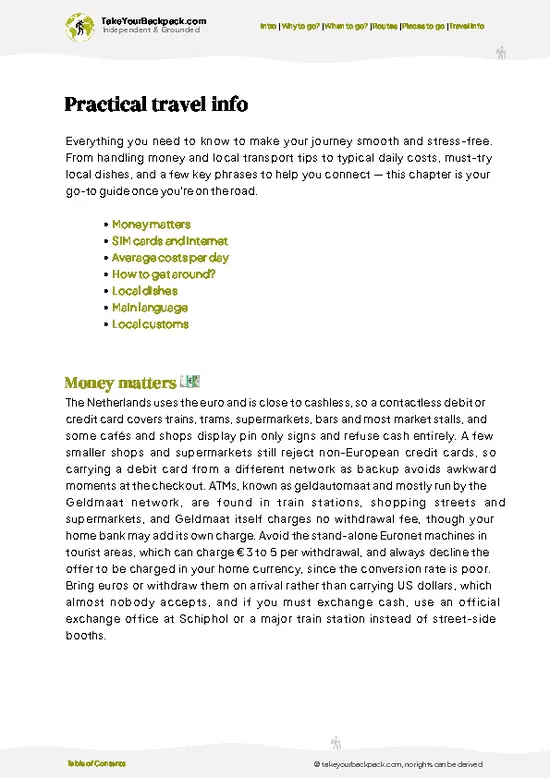
An offline-friendly backpacking guide with optimized travel routes, ranked highlights, transport advice, and the best areas to stay.
example page 0 from our offline Travel Guide for Netherlands
example page 1 from our offline Travel Guide for Netherlands
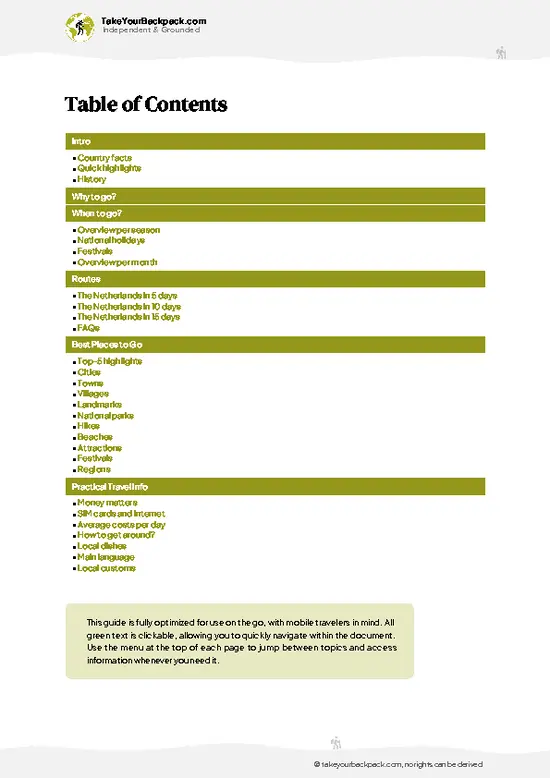
example page 2 from our offline Travel Guide for Netherlands
example page 3 from our offline Travel Guide for Netherlands
example page 4 from our offline Travel Guide for Netherlands
example page 5 from our offline Travel Guide for Netherlands
example page 6 from our offline Travel Guide for Netherlands
example page 7 from our offline Travel Guide for Netherlands
The digital guide (373 pages) contains:
✅ 127 highlights, ranked by travel appeal
✅ Optimized 5, 10 & 15-day travel routes
✅ Cities, national parks, landmarks, beaches
✅ How to get around
✅ Offline-friendly for travel without Wi-Fi
👉 Click to see all 30+ guide features

📅 Plan smarter in minutes, not weeks
✅ Month by month travel advice
✅ Festivals & national holidays
✅ Budget expectations

🗺️ Go to the right places, skip the overrated ones
✅ Honest pros & cons of destinations
✅ Top hikes, parks & viewpoints
✅ Lesser-known places most travelers miss
✅ Clear “worth it vs skip it” guidance

🛏️ Travel smoothly without rookie mistakes
✅ Best areas to stay
✅ Transport systems explained simply
✅ Common scams & safety advice
✅ SIM cards, money & practical tips

🌍 Understand the country, not just visit it
✅ Culture & traditions
✅ 52 Essential phrases & customs
✅ Festivals worth planning around
✅ Traveler-friendly historical context
✅ Insights that make places more meaningful

📱 Built for real travel conditions
✅ Fully downloadable PDF
✅ Works completely offline
✅ Optimized for phone use
✅ Useful in remote areas & buses
✅ Everything in one place
Stop searching, start planning
Get instant access to your full guide. 30‑day money-back guarantee.
+ Add another guide for just

By proceeding you agree to our terms.
Sent to your inbox immediately after payment • 100% Secure Checkout
Best Backpacking Travel Advisor 2025 tourism awardBest Backpacking
Travel Advisor
2025
What others say about Take Your Backpack Guides:
⭐⭐⭐⭐⭐
Fantastic, amazing amount of information!
⭐⭐⭐⭐⭐
My goodness this is amazing, it's what I've been looking for hats off too you!
⭐⭐⭐⭐⭐
I think this is absolutely BRILLIANT
⭐⭐⭐⭐
Very complete and informative. It's still missing places, but I gotta to commend you
⭐⭐⭐⭐⭐
This is truly amazing, thank you, can't wait to explore it with my kids!
⭐⭐⭐⭐⭐
Awesome resource, thank you!
⭐⭐⭐⭐⭐
This is amazing! Can't wait to explore the ones I haven't seen
⭐⭐⭐⭐
I love this! Well done, great idea.
⭐⭐⭐⭐⭐
Thanks for taking the time to make this gem!
⭐⭐⭐⭐⭐
This might be the best website I've ever seen.
⭐⭐⭐⭐⭐
Congratulations, and thank you so much for your work; it's incredibly valuable.
⭐⭐⭐⭐
In all seriousness I think you did a great job pointing out the important spots
⭐⭐⭐⭐⭐
10/10 very good
⭐⭐⭐⭐⭐
As someone who's only just starting to visit regularly this is awesome, thank you.
⭐⭐⭐⭐
Thank you very much! I'm going to visit my dad, it's going to be very useful!
⭐⭐⭐⭐⭐
This is really cool! We'll be travelling for the first time and this definitely come in handy.
⭐⭐⭐⭐⭐
You are now our minister of culture, congratulations 👨‍💼
⭐⭐⭐⭐⭐
Just wanted to tell you that this is a pearl! Going to follow your recommendations.
⭐⭐⭐⭐⭐
This is so cool. I'll definitely be using the resource for my travels soon.
⭐⭐⭐⭐⭐
This is very impressive! Good work.
⭐⭐⭐⭐⭐
This is an amazing and informative site. Very well done!

🛏️ Where to stay?Best Stay Options in The Netherlands

Budget accommodation in the Netherlands is easy to find, with hostel dorms in Amsterdam typically running €30 to €70 a night in summer and noticeably less in Rotterdam, Utrecht and smaller cities like Haarlem. In Amsterdam, Centrum puts you within walking distance of the canal ring and the busiest nightlife but is loud, pricey and crowded around De Wallen, while De Pijp and Oud-West offer good bars, cafés and safe, livelier-but-local streets a 10 to 20 minute tram ride out, and Oost and Amsterdam-Noord are quieter and cheaper at the cost of a longer commute. Rotterdam’s Centrum and Witte de Withkwartier give you nightlife and architecture on foot at lower prices, and Utrecht’s compact Binnenstad … read more 👉
Budget accommodation in the Netherlands is easy to find, with hostel dorms in Amsterdam typically running €30 to €70 a night in summer and noticeably less in Rotterdam, Utrecht and smaller cities like Haarlem. In Amsterdam, Centrum puts you within walking distance of the canal ring and the busiest nightlife but is loud, pricey and crowded around De Wallen, while De Pijp and Oud-West offer good bars, cafés and safe, livelier-but-local streets a 10 to 20 minute tram ride out, and Oost and Amsterdam-Noord are quieter and cheaper at the cost of a longer commute. Rotterdam’s Centrum and Witte de Withkwartier give you nightlife and architecture on foot at lower prices, and Utrecht’s compact Binnenstad keeps everything walkable and calm, with Amsterdam about 30 minutes away by train.

If you enjoy meeting fellow travelers, consider choosing hostels with high ratings for atmosphere. On the other hand, if you prefer having your own space, a hotel might be a better option.

The NetherlandsWhere to Go Next

👋 Meet the founderWho’s Behind Take Your Backpack?

Johan, backpacker and founder of TakeYourBackpackHi, I’m Johan (Netherlands 🇳🇱), the creator of TakeYourBackpack. Over the past 3 decades, I’ve backpacked through 90+ countries across six continents, gaining extensive experience with independent travel, long-term trips, and overland routes.

This site is built on a combination of firsthand travel experience and carefully curated insights from other backpackers. Many guides are based on places I’ve personally visited, while others bring together tips, observations, and practical advice shared by trusted travelers I’ve met along the way.

The goal is to provide realistic, experience-driven guidance — not generic itineraries — so you can explore destinations with better context, clearer expectations, and more confidence.