×

Netherlands🇳🇱 | best hikesYour Guide to the 9 Best hikes in The Netherlands

Hiking in the Netherlands means walking a country that is almost entirely flat, so the challenge is not elevation but variety: dunes and beaches along the North Sea coast, heathland and forest on the sandy eastern and central ridges, peat and mudflats in the north, and a hilly corner in Limburg. Because trains and buses cover nearly every trailhead, independent travelers can skip rental cars entirely. Costs run higher in the densely populated west, while the east and south offer cheaper lodging and emptier paths. National parks are free to enter, and the long-distance Wandelnet routes are well marked, so planning is simple.

By Johan Kruseman 🇳🇱 | Updated October 18, 2026
Explore the best beaches in The Netherlands

Why go?Key Factors That Shape the Experience

The Netherlands is unusual because its landscape is engineered as much as natural. Centuries of land reclamation, dike building and water management created polder, canals and sea defenses that you can walk along, and the country’s highest point sits only about 322 meters above sea level. That shapes what hiking here offers: low effort, high variety, and routes measured in distance rather than climbs.

The dense rail and bus network is the second reason it works. Most trailheads connect to a station, and many long-distance paths run from one town to the next, so you can walk point to point without a car. Marked knooppunten (numbered junction) networks and the Wandelnet long-distance paths make navigation easy, with signposting that rivals anywhere in Europe.

Before choosing the Netherlands, … read more 👉
The Netherlands is unusual because its landscape is engineered as much as natural. Centuries of land reclamation, dike building and water management created polder, canals and sea defenses that you can walk along, and the country’s highest point sits only about 322 meters above sea level. That shapes what hiking here offers: low effort, high variety, and routes measured in distance rather than climbs.

The dense rail and bus network is the second reason it works. Most trailheads connect to a station, and many long-distance paths run from one town to the next, so you can walk point to point without a car. Marked knooppunten (numbered junction) networks and the Wandelnet long-distance paths make navigation easy, with signposting that rivals anywhere in Europe.

Before choosing the Netherlands, know three things. Wind and rain arrive in every season, especially on the coast, so waterproofs matter more than boots built for mountains. Wild camping is generally illegal, and camping is mostly confined to designated campsites, which limits true backpacking and makes accommodation planning necessary. Finally, mountain scenery is absent, so those chasing peaks should look to neighboring countries. Come for subtle landscapes, tidal flats, and easy logistics.
Why These Made the Cut
The list of best hikes in The Netherlands is created based on scenery, challenge, trail quality, landmarks, and overall enjoyment. If you feel a hike is missing in this list, please let us know.

When to go?Timing Your Visit for the Best Experience

Best months: The best months for hiking in the Netherlands are May to September, when daytime highs of 15 to 23°C and long daylight (up to about 16 hours in June) give you comfortable walking and the most reliable conditions. Spring brings blooming heath and bulb fields, while late August and September bring purple heather in areas like the Veluwe.

Shoulder seasons: April and October are good value. Temperatures sit around 10 to 15°C, crowds thin, and accommodation prices fall, often 10 to 25 percent below summer rates in coastal towns. Expect more showers, and the days shorten fast in October.

Winter and rain: From November to March highs drop to 3 to 8°C, with frequent drizzle, strong wind and short days of 8 hours or fewer. Rain is spread through the year at roughly 700 to 850 mm annually, … read more 👉
Best months: The best months for hiking in the Netherlands are May to September, when daytime highs of 15 to 23°C and long daylight (up to about 16 hours in June) give you comfortable walking and the most reliable conditions. Spring brings blooming heath and bulb fields, while late August and September bring purple heather in areas like the Veluwe.

Shoulder seasons: April and October are good value. Temperatures sit around 10 to 15°C, crowds thin, and accommodation prices fall, often 10 to 25 percent below summer rates in coastal towns. Expect more showers, and the days shorten fast in October.

Winter and rain: From November to March highs drop to 3 to 8°C, with frequent drizzle, strong wind and short days of 8 hours or fewer. Rain is spread through the year at roughly 700 to 850 mm annually, so no month is reliably dry. Winter suits experienced walkers who like empty paths, but some seasonal coastal cafes and campsites close.

Regional timing: On the Wadden coast, mudflat walking depends on tides and is typically offered from spring through autumn. Coastal dunes fill on warm summer weekends and Dutch school holidays, so book campsites early for July and August. Inland forests in the east and south stay quieter even then.

hike hoppingHow to Combine hikes Into One Trip

Trip length: A trip combining several Dutch hikes needs 7 to 12 days, because short distances make the country easy to cover but each region deserves at least a full day on foot. Allow 1 to 2 days per stop, with longer stays only if you are walking a multi-day trail.

Grouping regions: The Netherlands is small, so regions group by landscape type. Start in the west with the dune coast, reachable from Amsterdam or The Hague within 30 to 60 minutes by train. Then go east to the central forests and heath around Arnhem and Apeldoorn, about 1 to 1.5 hours from the coast. From there head south to Limburg’s hills near Maastricht, around 2 to 2.5 hours by train from the center, or north to Groningen and the Wadden coast, roughly 2 to 2.5 hours. A west to east to south direction keeps backtracking low … read more 👉
Trip length: A trip combining several Dutch hikes needs 7 to 12 days, because short distances make the country easy to cover but each region deserves at least a full day on foot. Allow 1 to 2 days per stop, with longer stays only if you are walking a multi-day trail.

Grouping regions: The Netherlands is small, so regions group by landscape type. Start in the west with the dune coast, reachable from Amsterdam or The Hague within 30 to 60 minutes by train. Then go east to the central forests and heath around Arnhem and Apeldoorn, about 1 to 1.5 hours from the coast. From there head south to Limburg’s hills near Maastricht, around 2 to 2.5 hours by train from the center, or north to Groningen and the Wadden coast, roughly 2 to 2.5 hours. A west to east to south direction keeps backtracking low and finishes with the most varied terrain.

Planning mistakes: The most common error is overpacking the schedule, because short train rides hide the time spent on local buses to trailheads, which can add 30 to 60 minutes each way. Plan one hike a day. A second error is ignoring tides and ferry timetables in the Wadden area, which can cancel an outing. Check them the day before. Finally, travelers book weekend stays too late, so reserve accommodation ahead when your stop falls on a Friday or Saturday.

The ListTop hikes of The Netherlands

1 Pieterpad

Wadden Sea marsh, Groningen, Drenthe heath, Sint Pietersberg

Trace the country from salt marshes at Pieterburen through Groningen and Drenthe heath to the hill above Maastricht, stage by stage.

netherlands-hike-pieterpad
© Google |

2 Krijtlandpad

Chalk hollow lanes, orchard slopes, Geul meadows, Wittem

Climb sunken lanes cut into chalk banks, cross orchard slopes and Geul valley meadows, then reach open plateau viewpoints around Wittem.

netherlands-hike-krijtlandpad
© Google |

3 NS Walk Veluwezoom

Posbank heath, Zijpenberg ridges, red deer, brook valleys

Tackle ridge paths and open heathland in red deer and wild boar country, then descend through estates and spring-fed brooks between train stations.

netherlands-hike-ns-walk-veluwezoom
© Google |

4 Sprengenberg Route (Sallandse Heuvelrug)

Sprengenberg lookout, open heath, grazing herds, glacial ridge

Start from a bus stop in Holten and climb a glacial ridge to a viewpoint, crossing heath, beech and pine woods where herds graze.

netherlands-hike-sprengenberg-route-sallandse-heuvelrug
© Google | Ewa Kuświk

5 Maarten van Rossumpad

Long-distance stages, Steenwijk ramparts, country estates, Venlo finish

Walk a multi-week route from the fortified town of Steenwijk through heath, forest and castle grounds, finishing in Venlo.

netherlands-hike-maarten-van-rossumpad
© Google |

6 Zuiderzeepad

Former Zuiderzee coast, Elburg, dike paths, Flevoland polders

Walk old harbor towns and long dike paths beside the Veluwemeer and Gooimeer, with train stations close enough to split stages almost anywhere.

netherlands-hike-zuiderzeepad
© Google |

7 Westerborkpad

Camp Westerbork, railway track, radio telescope, Hooghalen Heath

Pair a morning at the memorial center with a walk along the railway track, over Hooghalen Heath and past the radio telescope.

8 Highlight Route, Utrechtse Heuvelrug

Kaapse Bossen, Huis Doorn, Austerlitz pyramid, Leersumse Veld

Link forest, a country house and an Napoleonic-era monument on a ridge route that starts from bus stops around Driebergen-Zeist.

netherlands-hike-highlight-route-utrechtse-heuvelrug
© Google |

9 Ooijpolder

Waal dikes, Konik horses, Galloway cattle, Ooij village

Follow dikes and signed paths across a working floodplain, passing grazing Konik horses and Galloway cattle between Millingen aan de Rijn and Ooij.

Loading the map 🌍

Expert viewInsights from Locals and Experts

How many hikes to plan: I advise four to six hikes on a first trip. The country is small and travel is easy, so the limit is not distance but variety: that number lets you cover the main landscapes (coast, heath, forest, wetland, hills) without repeating similar flat terrain. Beyond six, the walks start to blur together and you spend more time on buses than on paths.

Choosing by travel style: For first-timers and short trips, favor coastal dunes and forest loops, which are well signed and reachable by train. For solo backpackers wanting solitude, pick the eastern and southern regions, where trails are quieter and lodging is cheaper. For experienced walkers, the multi-day Wandelnet long-distance paths and the tidal flat crossings give the greatest challenge. Families and slower walkers do … read more 👉
How many hikes to plan: I advise four to six hikes on a first trip. The country is small and travel is easy, so the limit is not distance but variety: that number lets you cover the main landscapes (coast, heath, forest, wetland, hills) without repeating similar flat terrain. Beyond six, the walks start to blur together and you spend more time on buses than on paths.

Choosing by travel style: For first-timers and short trips, favor coastal dunes and forest loops, which are well signed and reachable by train. For solo backpackers wanting solitude, pick the eastern and southern regions, where trails are quieter and lodging is cheaper. For experienced walkers, the multi-day Wandelnet long-distance paths and the tidal flat crossings give the greatest challenge. Families and slower walkers do best with short circular routes.

What it costs: Budget US$60 to 110 a day (about €55 to 100) when traveling independently, since the Netherlands is one of Western Europe’s pricier countries. Hostel dorms run about €30 to 55 a night, campsites €15 to 35 a pitch, and a basic supermarket lunch about €6 to 10. National park entry is mostly free, trail maps and apps are low-cost or free, and tidal flat walks with a certified guide usually cost €15 to 40 per person. Regional train and bus transport typically adds €10 to 30 a day, and an OV-chipkaart or contactless payment is cheaper than paper tickets. Cooking in hostels saves the most money.

Safety and local rules: The main danger is tides and weather, not terrain. Wadden flats must be crossed only with a licensed guide, because water returns quickly and fog can hide the route. On coastal paths, strong wind and sudden rain are common, so pack a windproof shell. Ticks live in heath and forest, so check your skin after walks and wear long trousers in tall grass.

Culturally, wild camping is largely prohibited, and fines apply, so use designated campsites or the small minicampings on farms, which are inexpensive and welcoming. Stay on marked paths in nature reserves, since they protect nesting birds, and respect closures during breeding season. Bikes share many paths, so keep to the side and listen for bells. Cyclists are fast and expect walkers to stay predictable. Carry some cash or a card for small cafes, but contactless payment is widely accepted.

✈️ The backpacker research shortcutThe Netherlands Travel Guide

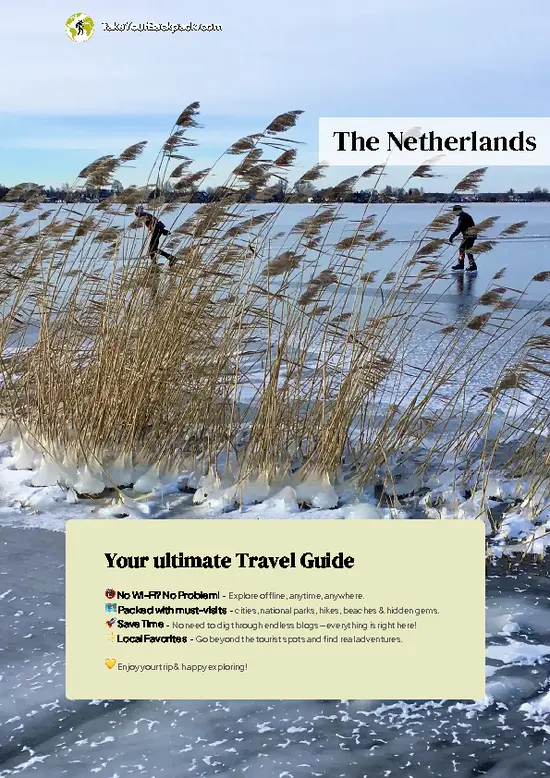
An offline-friendly backpacking guide with optimized travel routes, ranked highlights, transport advice, and the best areas to stay.
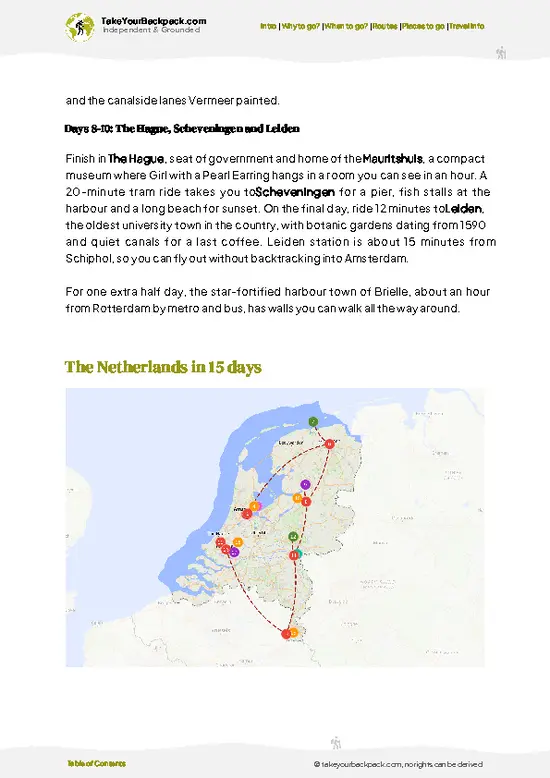
example page 0 from our offline Travel Guide for Netherlands
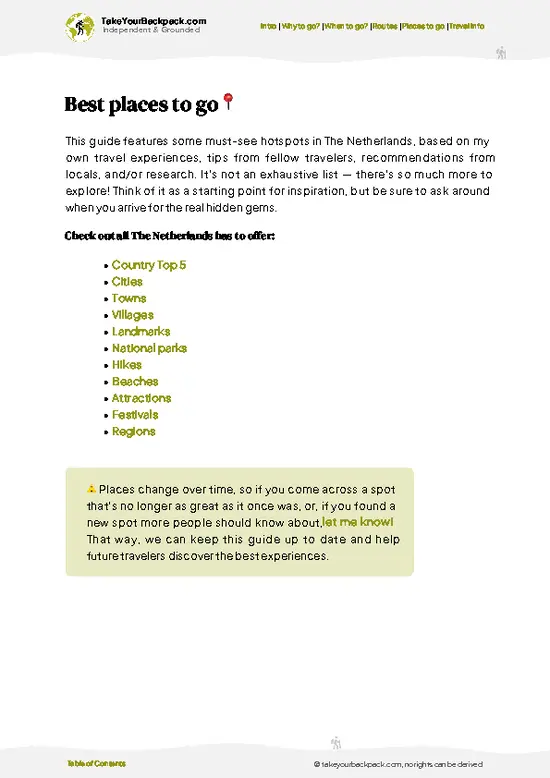
example page 1 from our offline Travel Guide for Netherlands
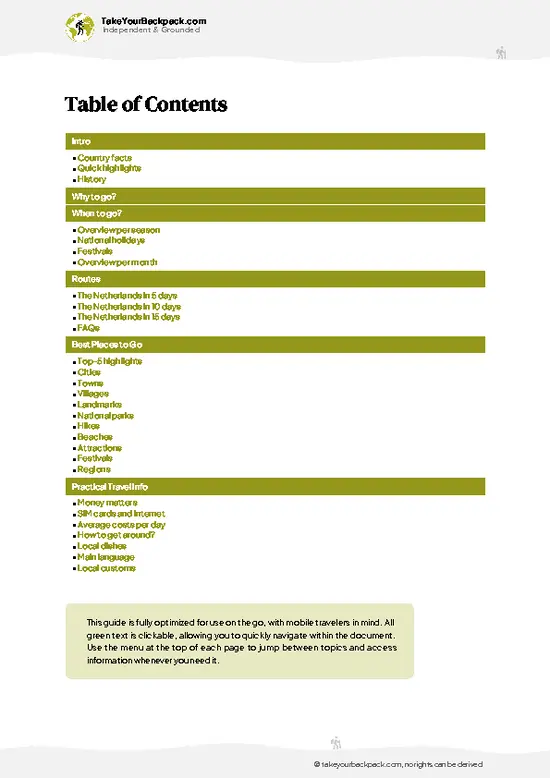
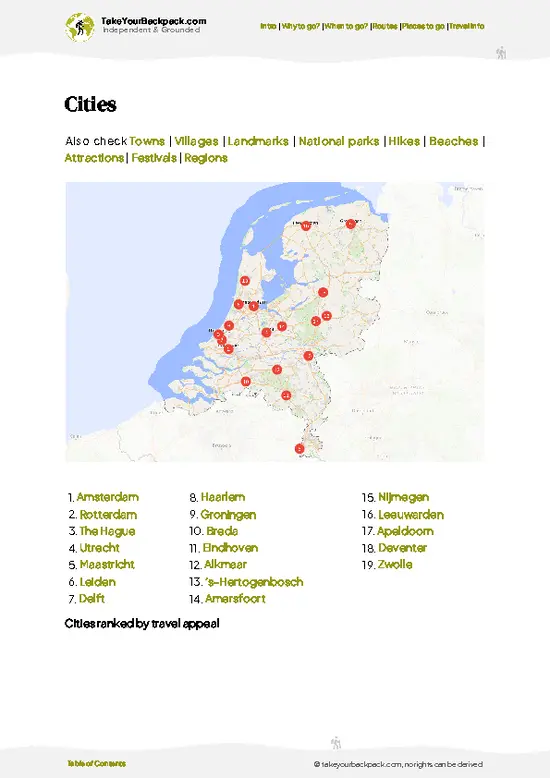
example page 2 from our offline Travel Guide for Netherlands
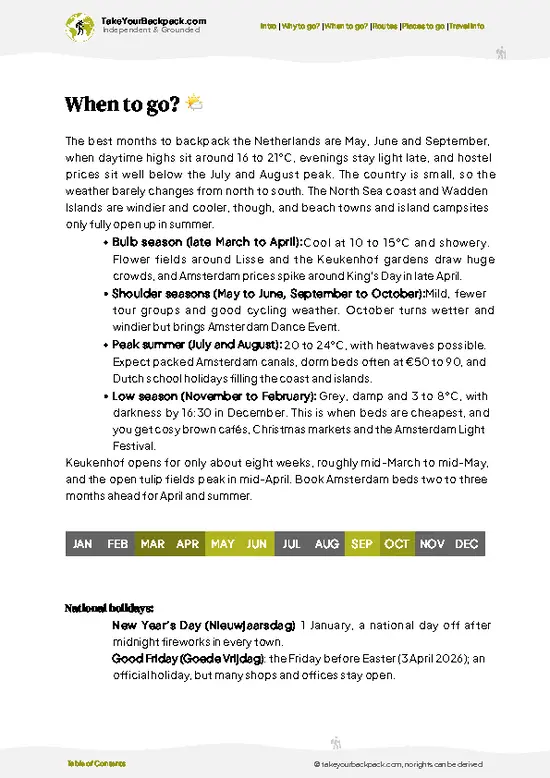
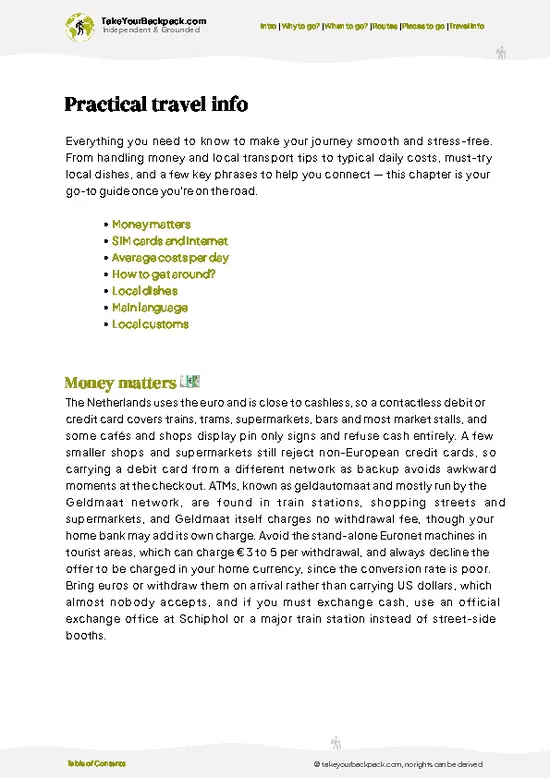
example page 3 from our offline Travel Guide for Netherlands
example page 4 from our offline Travel Guide for Netherlands
example page 5 from our offline Travel Guide for Netherlands
example page 6 from our offline Travel Guide for Netherlands
example page 7 from our offline Travel Guide for Netherlands
The digital guide (373 pages) contains:
✅ 127 highlights, ranked by travel appeal
✅ Optimized 5, 10 & 15-day travel routes
✅ Cities, national parks, landmarks, beaches
✅ How to get around
✅ Offline-friendly for travel without Wi-Fi
👉 Click to see all 30+ guide features

📅 Plan smarter in minutes, not weeks
✅ Month by month travel advice
✅ Festivals & national holidays
✅ Budget expectations

🗺️ Go to the right places, skip the overrated ones
✅ Honest pros & cons of destinations
✅ Top hikes, parks & viewpoints
✅ Lesser-known places most travelers miss
✅ Clear “worth it vs skip it” guidance

🛏️ Travel smoothly without rookie mistakes
✅ Best areas to stay
✅ Transport systems explained simply
✅ Common scams & safety advice
✅ SIM cards, money & practical tips

🌍 Understand the country, not just visit it
✅ Culture & traditions
✅ 52 Essential phrases & customs
✅ Festivals worth planning around
✅ Traveler-friendly historical context
✅ Insights that make places more meaningful

📱 Built for real travel conditions
✅ Fully downloadable PDF
✅ Works completely offline
✅ Optimized for phone use
✅ Useful in remote areas & buses
✅ Everything in one place
Stop searching, start planning
Get instant access to your full guide. 30‑day money-back guarantee.
+ Add another guide for just

By proceeding you agree to our terms.
Sent to your inbox immediately after payment • 100% Secure Checkout
Best Backpacking Travel Advisor 2025 tourism awardBest Backpacking
Travel Advisor
2025
What others say about Take Your Backpack Guides:
⭐⭐⭐⭐⭐
Fantastic, amazing amount of information!
⭐⭐⭐⭐⭐
My goodness this is amazing, it's what I've been looking for hats off too you!
⭐⭐⭐⭐⭐
I think this is absolutely BRILLIANT
⭐⭐⭐⭐
Very complete and informative. It's still missing places, but I gotta to commend you
⭐⭐⭐⭐⭐
This is truly amazing, thank you, can't wait to explore it with my kids!
⭐⭐⭐⭐⭐
Awesome resource, thank you!
⭐⭐⭐⭐⭐
This is amazing! Can't wait to explore the ones I haven't seen
⭐⭐⭐⭐
I love this! Well done, great idea.
⭐⭐⭐⭐⭐
Thanks for taking the time to make this gem!
⭐⭐⭐⭐⭐
This might be the best website I've ever seen.
⭐⭐⭐⭐⭐
Congratulations, and thank you so much for your work; it's incredibly valuable.
⭐⭐⭐⭐
In all seriousness I think you did a great job pointing out the important spots
⭐⭐⭐⭐⭐
10/10 very good
⭐⭐⭐⭐⭐
As someone who's only just starting to visit regularly this is awesome, thank you.
⭐⭐⭐⭐
Thank you very much! I'm going to visit my dad, it's going to be very useful!
⭐⭐⭐⭐⭐
This is really cool! We'll be travelling for the first time and this definitely come in handy.
⭐⭐⭐⭐⭐
You are now our minister of culture, congratulations 👨‍💼
⭐⭐⭐⭐⭐
Just wanted to tell you that this is a pearl! Going to follow your recommendations.
⭐⭐⭐⭐⭐
This is so cool. I'll definitely be using the resource for my travels soon.
⭐⭐⭐⭐⭐
This is very impressive! Good work.
⭐⭐⭐⭐⭐
This is an amazing and informative site. Very well done!

🛏️ Where to stay?Top Places to Consider Staying

Budget accommodation in the Netherlands is easy to find, with hostel dorms in Amsterdam typically running €30 to €70 a night in summer and noticeably less in Rotterdam, Utrecht and smaller cities like Haarlem. In Amsterdam, Centrum puts you within walking distance of the canal ring and the busiest nightlife but is loud, pricey and crowded around De Wallen, while De Pijp and Oud-West offer good bars, cafés and safe, livelier-but-local streets a 10 to 20 minute tram ride out, and Oost and Amsterdam-Noord are quieter and cheaper at the cost of a longer commute. Rotterdam’s Centrum and Witte de Withkwartier give you nightlife and architecture on foot at lower prices, and Utrecht’s compact Binnenstad … read more 👉
Budget accommodation in the Netherlands is easy to find, with hostel dorms in Amsterdam typically running €30 to €70 a night in summer and noticeably less in Rotterdam, Utrecht and smaller cities like Haarlem. In Amsterdam, Centrum puts you within walking distance of the canal ring and the busiest nightlife but is loud, pricey and crowded around De Wallen, while De Pijp and Oud-West offer good bars, cafés and safe, livelier-but-local streets a 10 to 20 minute tram ride out, and Oost and Amsterdam-Noord are quieter and cheaper at the cost of a longer commute. Rotterdam’s Centrum and Witte de Withkwartier give you nightlife and architecture on foot at lower prices, and Utrecht’s compact Binnenstad keeps everything walkable and calm, with Amsterdam about 30 minutes away by train.

If you enjoy meeting fellow travelers, consider choosing hostels with high ratings for atmosphere. On the other hand, if you prefer having your own space, a hotel might be a better option.

The NetherlandsMore Places Across The Netherlands

👋 Meet the founderWho’s Behind Take Your Backpack?

Johan, backpacker and founder of TakeYourBackpackHi, I’m Johan (Netherlands 🇳🇱), the creator of TakeYourBackpack. Over the past 3 decades, I’ve backpacked through 90+ countries across six continents, gaining extensive experience with independent travel, long-term trips, and overland routes.

This site is built on a combination of firsthand travel experience and carefully curated insights from other backpackers. Many guides are based on places I’ve personally visited, while others bring together tips, observations, and practical advice shared by trusted travelers I’ve met along the way.

The goal is to provide realistic, experience-driven guidance — not generic itineraries — so you can explore destinations with better context, clearer expectations, and more confidence.