×

Netherlands🇳🇱 | best beachesYour Guide to the 6 Best beaches in The Netherlands

Beaches in the Netherlands are wide, flat North Sea strands backed by dunes, and the water stays cold and gray-green even in summer. The coast runs about 350 km, and the character shifts with distance from Amsterdam. The Randstad coast (Zandvoort, Scheveningen, Noordwijk) has beach clubs, trains and big crowds because millions live within an hour. The Wadden Islands in the north trade convenience for space: ferries set the pace, and prices rise. Zeeland in the southwest is quieter, with dunes, tidal flats and more car dependence. For backpacking or independent travel, the train network and rentable bikes make the mainland coast easy and cheap, while islands need planning.

By Johan Kruseman 🇳🇱 | Updated October 18, 2026
Explore the best attractions in The Netherlands

Why go?Key Factors That Shape the Experience

The Netherlands is a country defined by its relationship with the sea, and that shapes every beach here. Roughly a quarter of the land lies below sea level, and the coast is held in place by dunes and engineered sand replenishment. That means beaches are wide, clean, carefully managed and almost always reachable by public transport and cycle path, which is rare in Europe. Many sit in front of national park dune reserves, so the setting is wild even when a resort town stands next door.

What the country does not offer is tropical swimming. The North Sea runs about 5 to 7°C in winter and only reaches roughly 17 to 20°C at its summer peak, and wind is a constant. Beaches here suit walking, kitesurfing, surfing in a wetsuit, cycling the dunes and long evenings at a beach pavilion more than lazy … read more 👉
The Netherlands is a country defined by its relationship with the sea, and that shapes every beach here. Roughly a quarter of the land lies below sea level, and the coast is held in place by dunes and engineered sand replenishment. That means beaches are wide, clean, carefully managed and almost always reachable by public transport and cycle path, which is rare in Europe. Many sit in front of national park dune reserves, so the setting is wild even when a resort town stands next door.

What the country does not offer is tropical swimming. The North Sea runs about 5 to 7°C in winter and only reaches roughly 17 to 20°C at its summer peak, and wind is a constant. Beaches here suit walking, kitesurfing, surfing in a wetsuit, cycling the dunes and long evenings at a beach pavilion more than lazy swimming. Sunshine is unreliable, so a coastal day is best treated as flexible rather than guaranteed.

Travelers should also know that the Dutch treat the beach as a year-round social space. Seasonal pavilions are built in spring and dismantled in autumn, and many stay open in winter. Dogs, naturist zones and swimming areas follow local rules, and lifeguard cover is seasonal.
How the List Was Created
The list of best beaches in The Netherlands is created based on beauty, vibe, water quality, activities, and surrounding scenery. If you feel a beach is missing in this list, please let us know.

When to go?Timing Your Visit for the Best Experience

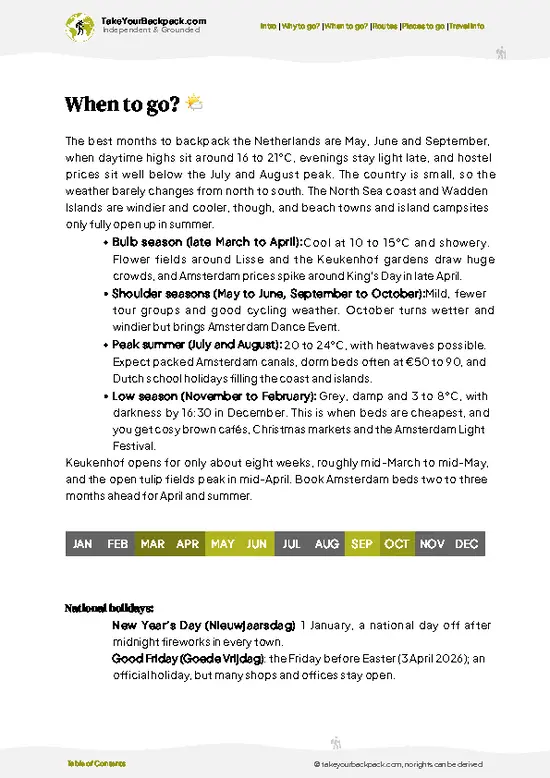
Best months for beach days: The best months are June to August, when air temperatures average roughly 20 to 23°C, daylight lasts until around 22:00 and seasonal beach pavilions are open. The sea only warms to about 17 to 20°C, so even then swimming is brief. July and August bring the most reliable weather, but rain falls in every month, and monthly totals of 60 to 85 mm are normal.
Shoulder seasons: May and September are the smartest choice for independent travelers. Temperatures run around 15 to 19°C, crowds thin out, accommodation drops noticeably from peak rates, and most pavilions remain open. September often gives the warmest sea of the year because the water has stored summer heat, though evenings cool quickly. April and October suit walking, with strong winds and cooler air of about … read more 👉
Best months for beach days: The best months are June to August, when air temperatures average roughly 20 to 23°C, daylight lasts until around 22:00 and seasonal beach pavilions are open. The sea only warms to about 17 to 20°C, so even then swimming is brief. July and August bring the most reliable weather, but rain falls in every month, and monthly totals of 60 to 85 mm are normal.
Shoulder seasons: May and September are the smartest choice for independent travelers. Temperatures run around 15 to 19°C, crowds thin out, accommodation drops noticeably from peak rates, and most pavilions remain open. September often gives the warmest sea of the year because the water has stored summer heat, though evenings cool quickly. April and October suit walking, with strong winds and cooler air of about 10 to 14°C.
Peak periods and winter: Sunny weekends and Dutch school holidays (July to mid-August) fill trains to the Randstad coast and push up prices at hotels and campsites, especially on the Wadden Islands and in Zeeland where beds are limited. Hot days can see roads and parking close to resorts such as Zandvoort. From November to March the sea is 4 to 8°C and many seasonal pavilions close, though winter walks and storm watching draw a loyal crowd, and prices are lowest.

beach hoppingHow to Combine beaches Into One Trip

How many days to allow: A trip linking several beaches in the Netherlands needs 5 to 8 days, because the country is small but transfers, ferries and weather eat into time. The logic is geographic: the Randstad coast sits within 30 to 60 minutes by train from Amsterdam, Haarlem, The Hague or Leiden, then a bus or tram finishes the trip. Zeeland lies further south, around 2 to 3 hours from Amsterdam via Rotterdam and Middelburg, and the Wadden Islands lie north, needing 2.5 to 4 hours including a ferry from Den Helder, Harlingen or Holwerd.
Direction and pacing: A north-to-south or south-to-north line works best, using Amsterdam as a hinge and finishing at a major hub such as Rotterdam or Utrecht. Allow 1 to 2 days for mainland stops and 2 to 3 days for an island, since ferry timetables and tides … read more 👉
How many days to allow: A trip linking several beaches in the Netherlands needs 5 to 8 days, because the country is small but transfers, ferries and weather eat into time. The logic is geographic: the Randstad coast sits within 30 to 60 minutes by train from Amsterdam, Haarlem, The Hague or Leiden, then a bus or tram finishes the trip. Zeeland lies further south, around 2 to 3 hours from Amsterdam via Rotterdam and Middelburg, and the Wadden Islands lie north, needing 2.5 to 4 hours including a ferry from Den Helder, Harlingen or Holwerd.
Direction and pacing: A north-to-south or south-to-north line works best, using Amsterdam as a hinge and finishing at a major hub such as Rotterdam or Utrecht. Allow 1 to 2 days for mainland stops and 2 to 3 days for an island, since ferry timetables and tides limit flexibility. Between regions, expect 1.5 to 4 hours of travel.
Common planning mistakes: The first is cramming three coastlines into a weekend: ferry schedules, bus links and wind-driven weather changes make that exhausting. Leave a buffer day instead. The second is leaving transport to chance. Island ferries, Zeeland buses and bike rentals can be limited on busy days, so reserve what you can in advance. The third is ignoring the forecast. Keep your dates flexible so you can swap coastal days with museum or city days.

The ListTop beaches of The Netherlands

1 Scheveningen

Pier and Kurhaus, harbor herring, city surf, dune sunsets

Walk out along the pier, eat herring by the harbor, catch waves with the surfers, then follow the dunes at sunset.

netherlands-beach-scheveningen
© Google |

2 Zandvoort

Empty mornings, beginner surf, Zuid-Kennemerland dunes, Circuit Zandvoort

Start early on a quiet beach, try a first surf or kitesurf lesson, then hike the dunes and settle at a pavilion for sunset.

netherlands-beach-zandvoort
© Google | Dicker Di

3 Noordwijk

Numbered shore poles, bulb-field bike rides, Space Expo, boulevard sunsets

Walk the sand north to Katwijk, kitesurf or paddleboard when the wind allows, and finish on the boulevard at sunset.

4 Terschelling

Thirty-kilometer shoreline, paal markers, wadlopen, dune sunsets

Cycle between the numbered beach markers, wade across the mudflats at low tide, and swim or paddle in summer.

5 Ameland

Low-tide flats, dune-road cycling, driftwood and shells, star-filled nights

Cycle the dune road to the sand, then walk the wide tidal flats hunting for shells and driftwood until the sun drops.

netherlands-beach-ameland
© Google | Christian Koepper

6 Vlissingen Beach

Westerschelde ships, station-side sand, sunrise and sunset, old town dinner

Drop your pack near the station, walk the boulevard watching ships pass, and end the day with dinner in the old town.

netherlands-beach-vlissingen-beach
© Google |
Loading the map 🌍

Expert viewInsights from Locals and Experts

How many beaches to visit: Visit three or four beaches, no more. The coast offers variety in kind rather than in scenery: a resort strand, a dune-backed nature beach and an island strand cover what the country does. Beyond that, the North Sea looks much the same, and each added stop costs a transfer day. Weather also needs slack, because a gray, windy day can ruin a plan built around one beach per day.
Prioritizing by travel style: For social, budget-minded travelers, resort beaches near Amsterdam and The Hague give cafés, nightlife and trains, and a day trip from a city base saves on lodging. For nature lovers and walkers, dune reserves and tidal flats give space and birdlife, and they suit cycling. For water-sport fans, pick beaches with kitesurf and surf schools, because cold water and steady … read more 👉
How many beaches to visit: Visit three or four beaches, no more. The coast offers variety in kind rather than in scenery: a resort strand, a dune-backed nature beach and an island strand cover what the country does. Beyond that, the North Sea looks much the same, and each added stop costs a transfer day. Weather also needs slack, because a gray, windy day can ruin a plan built around one beach per day.
Prioritizing by travel style: For social, budget-minded travelers, resort beaches near Amsterdam and The Hague give cafés, nightlife and trains, and a day trip from a city base saves on lodging. For nature lovers and walkers, dune reserves and tidal flats give space and birdlife, and they suit cycling. For water-sport fans, pick beaches with kitesurf and surf schools, because cold water and steady wind create the conditions, and wetsuit rental is standard. Islands suit anyone with time and a flexible budget, as ferries and beds make them pricier.
What it costs: Public beaches are free, with no entry fees on most of the coast. Expect around US$50 to 90 a day (roughly €45 to 80) for a backpacker including a hostel bed, trains and meals. Beach days cost less when you pack food, since a pavilion meal runs €15 to 25. Day trip train fares from Amsterdam typically run €6 to 15 each way. Bike rental is about €10 to 20 a day, wetsuit and board rental €25 to 50, and parking at resort beaches can reach €20 or more for a day, so skip the car. Island ferries add roughly €5 to 25 per person each way, and beds fill quickly in July and August, so book ahead.
Safety and etiquette: The main danger is the sea itself: strong currents, rip currents near groynes and piers, and cold water that causes shock. Swim only in marked zones with lifeguards in summer, and heed flag signals. Tides on the Wadden coast are fast, so never walk onto tidal flats without a guide and tide table. Wind makes sunburn easy to miss, so use sunscreen even on gray days.

Dunes are protected. Stay on paths, because walking on dune grass damages the coastal defense and can bring fines. Dogs are restricted on many beaches in summer, and naturist stretches exist, so check signs before settling in. Locals treat cycling etiquette seriously, so keep clear of bike lanes. Take rubbish with you or use the bins provided, since beach cleanliness is a point of pride.

✈️ The backpacker research shortcutThe Netherlands Travel Guide

An offline-friendly backpacking guide with optimized travel routes, ranked highlights, transport advice, and the best areas to stay.
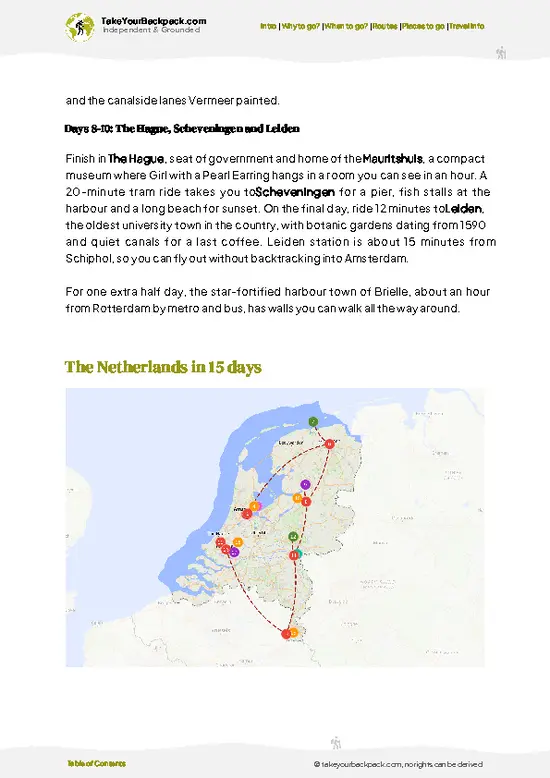
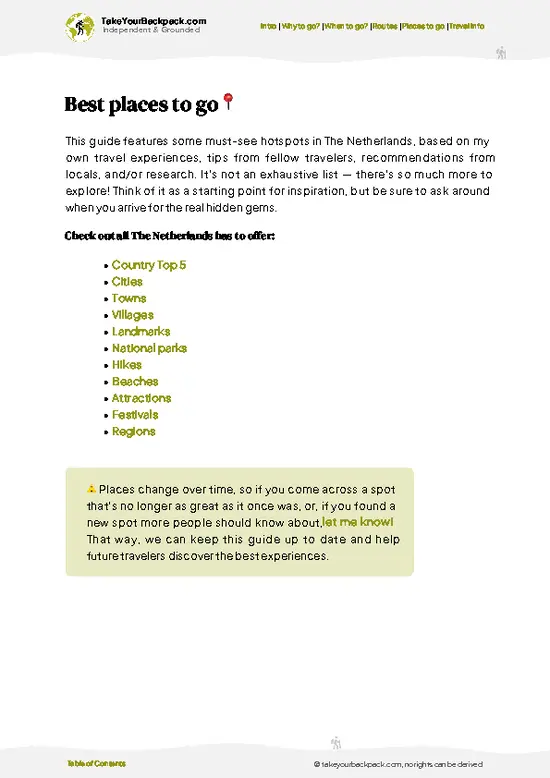
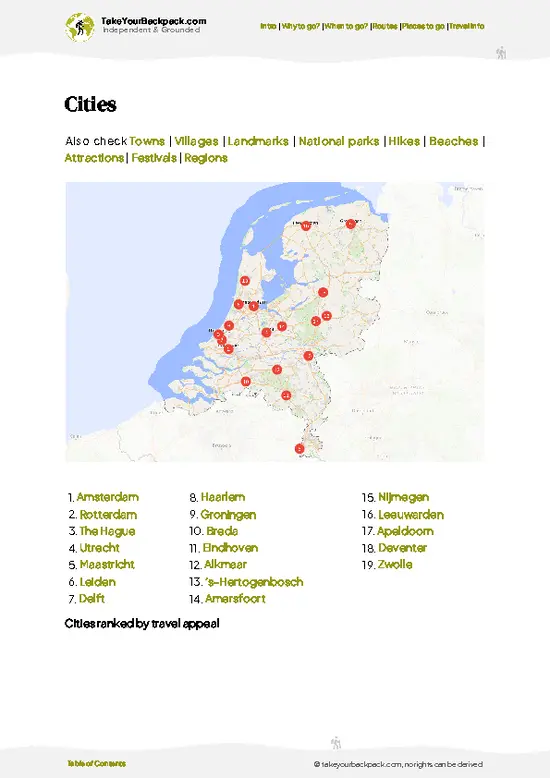
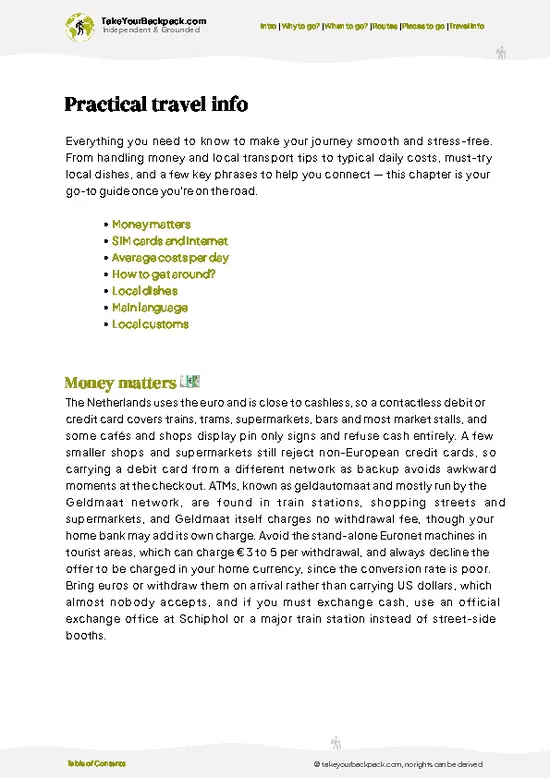
example page 0 from our offline Travel Guide for Netherlands
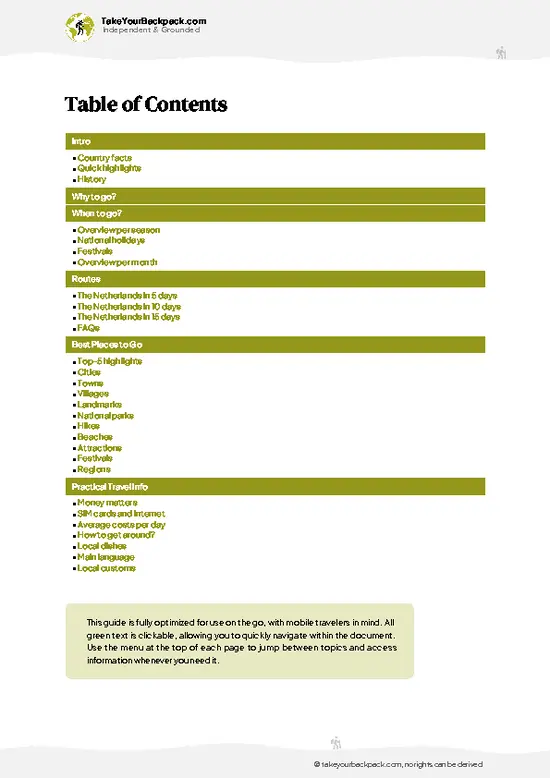
example page 1 from our offline Travel Guide for Netherlands
example page 2 from our offline Travel Guide for Netherlands
example page 3 from our offline Travel Guide for Netherlands
example page 4 from our offline Travel Guide for Netherlands
example page 5 from our offline Travel Guide for Netherlands
example page 6 from our offline Travel Guide for Netherlands
example page 7 from our offline Travel Guide for Netherlands
The digital guide (373 pages) contains:
✅ 127 highlights, ranked by travel appeal
✅ Optimized 5, 10 & 15-day travel routes
✅ Cities, national parks, landmarks, beaches
✅ How to get around
✅ Offline-friendly for travel without Wi-Fi
👉 Click to see all 30+ guide features

📅 Plan smarter in minutes, not weeks
✅ Month by month travel advice
✅ Festivals & national holidays
✅ Budget expectations

🗺️ Go to the right places, skip the overrated ones
✅ Honest pros & cons of destinations
✅ Top hikes, parks & viewpoints
✅ Lesser-known places most travelers miss
✅ Clear “worth it vs skip it” guidance

🛏️ Travel smoothly without rookie mistakes
✅ Best areas to stay
✅ Transport systems explained simply
✅ Common scams & safety advice
✅ SIM cards, money & practical tips

🌍 Understand the country, not just visit it
✅ Culture & traditions
✅ 52 Essential phrases & customs
✅ Festivals worth planning around
✅ Traveler-friendly historical context
✅ Insights that make places more meaningful

📱 Built for real travel conditions
✅ Fully downloadable PDF
✅ Works completely offline
✅ Optimized for phone use
✅ Useful in remote areas & buses
✅ Everything in one place
Stop searching, start planning
Get instant access to your full guide. 30‑day money-back guarantee.
+ Add another guide for just

By proceeding you agree to our terms.
Sent to your inbox immediately after payment • 100% Secure Checkout
Best Backpacking Travel Advisor 2025 tourism awardBest Backpacking
Travel Advisor
2025
What others say about Take Your Backpack Guides:
⭐⭐⭐⭐⭐
Fantastic, amazing amount of information!
⭐⭐⭐⭐⭐
My goodness this is amazing, it's what I've been looking for hats off too you!
⭐⭐⭐⭐⭐
I think this is absolutely BRILLIANT
⭐⭐⭐⭐
Very complete and informative. It's still missing places, but I gotta to commend you
⭐⭐⭐⭐⭐
This is truly amazing, thank you, can't wait to explore it with my kids!
⭐⭐⭐⭐⭐
Awesome resource, thank you!
⭐⭐⭐⭐⭐
This is amazing! Can't wait to explore the ones I haven't seen
⭐⭐⭐⭐
I love this! Well done, great idea.
⭐⭐⭐⭐⭐
Thanks for taking the time to make this gem!
⭐⭐⭐⭐⭐
This might be the best website I've ever seen.
⭐⭐⭐⭐⭐
Congratulations, and thank you so much for your work; it's incredibly valuable.
⭐⭐⭐⭐
In all seriousness I think you did a great job pointing out the important spots
⭐⭐⭐⭐⭐
10/10 very good
⭐⭐⭐⭐⭐
As someone who's only just starting to visit regularly this is awesome, thank you.
⭐⭐⭐⭐
Thank you very much! I'm going to visit my dad, it's going to be very useful!
⭐⭐⭐⭐⭐
This is really cool! We'll be travelling for the first time and this definitely come in handy.
⭐⭐⭐⭐⭐
You are now our minister of culture, congratulations 👨‍💼
⭐⭐⭐⭐⭐
Just wanted to tell you that this is a pearl! Going to follow your recommendations.
⭐⭐⭐⭐⭐
This is so cool. I'll definitely be using the resource for my travels soon.
⭐⭐⭐⭐⭐
This is very impressive! Good work.
⭐⭐⭐⭐⭐
This is an amazing and informative site. Very well done!

🛏️ Where to stay?Where to Stay: The Netherlands Edition

Budget accommodation in the Netherlands is easy to find, with hostel dorms in Amsterdam typically running €30 to €70 a night in summer and noticeably less in Rotterdam, Utrecht and smaller cities like Haarlem. In Amsterdam, Centrum puts you within walking distance of the canal ring and the busiest nightlife but is loud, pricey and crowded around De Wallen, while De Pijp and Oud-West offer good bars, cafés and safe, livelier-but-local streets a 10 to 20 minute tram ride out, and Oost and Amsterdam-Noord are quieter and cheaper at the cost of a longer commute. Rotterdam’s Centrum and Witte de Withkwartier give you nightlife and architecture on foot at lower prices, and Utrecht’s compact Binnenstad … read more 👉
Budget accommodation in the Netherlands is easy to find, with hostel dorms in Amsterdam typically running €30 to €70 a night in summer and noticeably less in Rotterdam, Utrecht and smaller cities like Haarlem. In Amsterdam, Centrum puts you within walking distance of the canal ring and the busiest nightlife but is loud, pricey and crowded around De Wallen, while De Pijp and Oud-West offer good bars, cafés and safe, livelier-but-local streets a 10 to 20 minute tram ride out, and Oost and Amsterdam-Noord are quieter and cheaper at the cost of a longer commute. Rotterdam’s Centrum and Witte de Withkwartier give you nightlife and architecture on foot at lower prices, and Utrecht’s compact Binnenstad keeps everything walkable and calm, with Amsterdam about 30 minutes away by train.

If you enjoy meeting fellow travelers, consider choosing hostels with high ratings for atmosphere. On the other hand, if you prefer having your own space, a hotel might be a better option.

The NetherlandsExplore Beyond This Category

👋 Meet the founderWho’s Behind Take Your Backpack?

Johan, backpacker and founder of TakeYourBackpackHi, I’m Johan (Netherlands 🇳🇱), the creator of TakeYourBackpack. Over the past 3 decades, I’ve backpacked through 90+ countries across six continents, gaining extensive experience with independent travel, long-term trips, and overland routes.

This site is built on a combination of firsthand travel experience and carefully curated insights from other backpackers. Many guides are based on places I’ve personally visited, while others bring together tips, observations, and practical advice shared by trusted travelers I’ve met along the way.

The goal is to provide realistic, experience-driven guidance — not generic itineraries — so you can explore destinations with better context, clearer expectations, and more confidence.