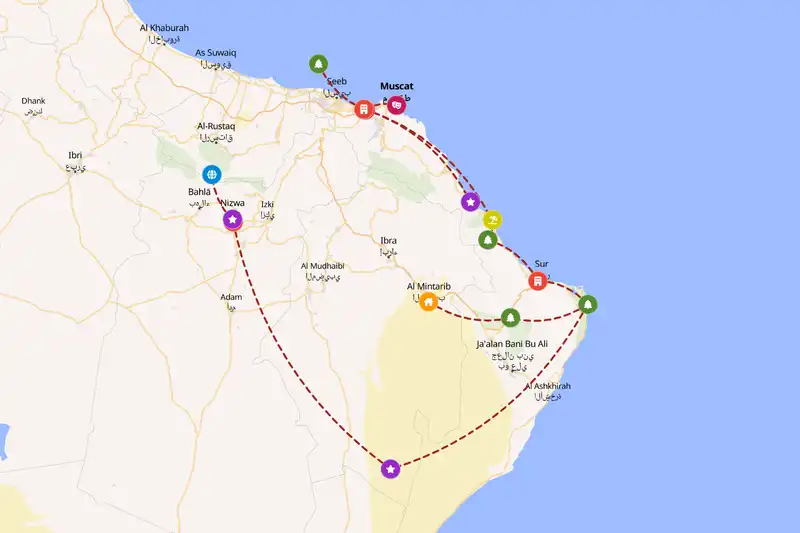
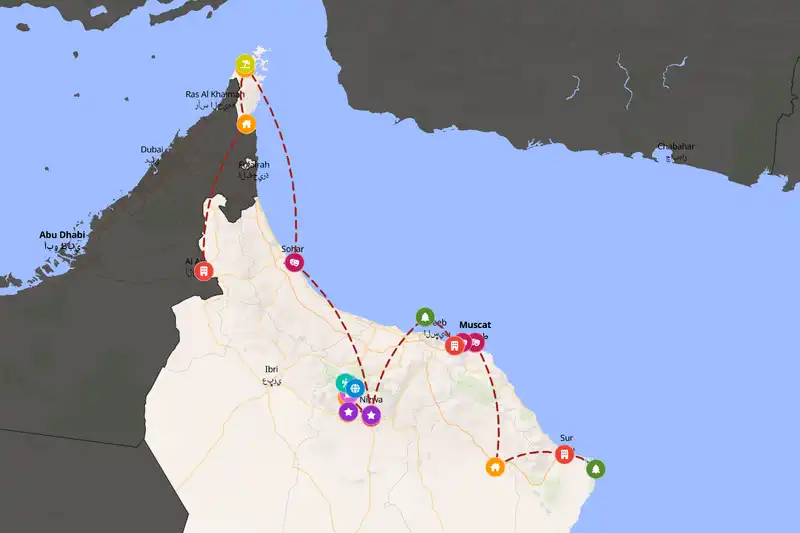
Yes, Oman is one of the easiest Gulf countries to travel on your own: crime is low and road signs appear in both English and Arabic.
Many nationalities get 14 days visa-free, and others apply for an e-visa online before arrival. The harder part is cost. Hostels are rare, so expect OMR 15 to 25 (US$40 to 65) for a basic double in
Muscat or
Nizwa, or camp free on beaches and in wadis, which is widely tolerated. Budget around OMR 17 to 29 (US$45 to 75) a day if you split a rental car, more if you rely on taxis and tours.
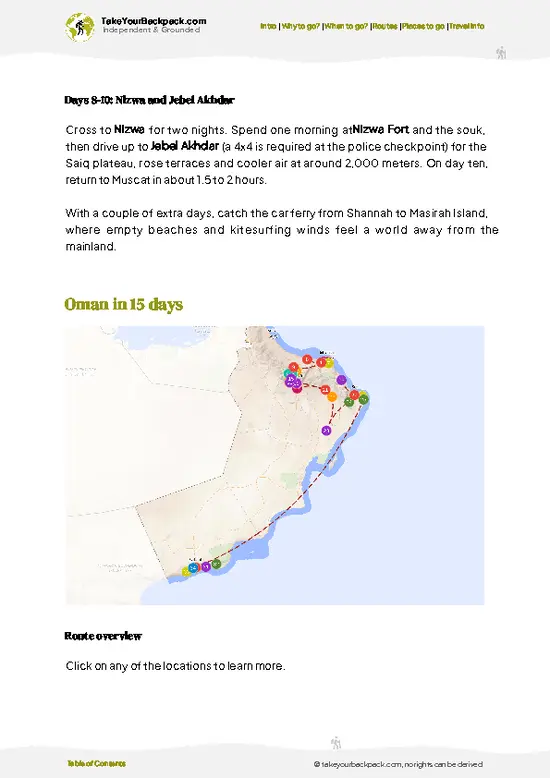
Ten days is the right length for Oman, enough for Muscat, the east coast wadis, a desert night and the Nizwa mountains without rushing.
With five days, stick to
Muscat and
Nizwa (2 to 2.5 hours apart by bus or car) and day-trip to Bahla, Al Hamra and Misfat. Ten days adds Sur, the turtles at Ras Al Jinz, Wadi Shab and Wahiba Sands. Fifteen days lets you fly to
Salalah (about 1.5 hours, roughly OMR 25 to 60 or US$65 to 155 one way) for three nights in Dhofar. Musandam needs another 2 to 3 days on top.
Partly: buses link Oman’s main towns, but most wadis, the desert and the mountain villages are out of reach without a car or driver.
Mwasalat buses run from
Muscat to Nizwa (2 to 2.5 hours), Sur (about 4 hours) and Salalah (around 12 hours overnight, roughly OMR 7 to 8 or US$18 to 21). For
Wadi Shab,
Jebel Shams or
Wahiba Sands you rely on taxis, tours, desert camp pickups from Al Wasil or Bidiyah, or hitching, which is common here. A small rental car costs about OMR 10 to 20 (US$26 to 52) a day and fuel runs around OMR 0.23 a liter, so sharing one usually beats taxis.
The essential places in Oman are the Sultan Qaboos Grand Mosque in Muscat, the forts of Nizwa and Bahla, and a night in Wahiba Sands.
Add
Jebel Shams for the canyon rim walk above Wadi Ghul (3 to 4 hours return) and
Misfat Al Abriyeen, a mud-brick village above terraced date gardens, both within 1.5 hours of Nizwa. On the east coast,
Wadi Shab with its cave waterfall and turtle watching at
Ras Al Jinz fit into two days based in Sur. From June to mid-September,
Salalah and the Dhofar Mountains turn green under the khareef monsoon, a flight of about 1.5 hours from Muscat.
Short on time in Oman, skip the far north and west: Sohar, Al Buraimi and Ibri are pleasant working towns, but none justifies a day of driving compared with the interior.
The
Arabian Oryx Sanctuary needs a permit and a long 4x4 trip into Al Wusta for a slim chance of seeing oryx.
Khasab and Musandam deserve their own 2 to 3 days, since reaching them means a flight or crossing the UAE border twice by road, so save them for a second trip. Outside the khareef,
Salalah is an optional add-on on trips under 10 days, and in Muscat one museum (the National Museum) is plenty.
Yes, our itinerary-planner does exactly that. Set your trip length in days, give your interests and travel style, optionally give start- and end location and/or some mandatory stops you would like to include and the itinerary planner creates your personalized routes for Oman in seconds. Try it out!
Try the itinerary plannerv2.webp)

 Best Backpacking