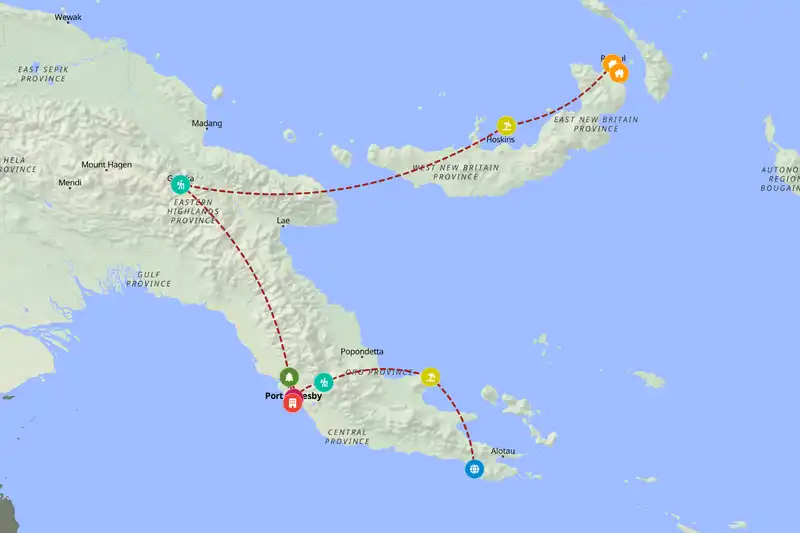
Short answer: no, Papua New Guinea is not an easy classic “just wing it” backpacking country, but it is doable if you’re experienced, flexible, and patient. PNG has limited infrastructure, big distances, and real safety considerations, so you can’t treat it like Southeast Asia.
Independence is possible on a budget if you think in terms of “semi-independent.” That means planning key logistics in advance (flights, first nights, major treks) but keeping your day-to-day loose. You’ll rely heavily on local guesthouses, guides, and shared transport rather than doing everything solo.
The main challenges:
-
Safety & security: Urban crime (especially in Port Moresby, Lae, Mt Hagen) is a serious factor. You need to avoid walking at night, keep valuables hidden, and use trusted taxis or hotel-arranged transport. This is not a place to wander aimlessly with headphones in.
-
Complex local land rights: Most land is customary land. Hiking, visiting villages, waterfalls, or viewpoints usually requires permission and often a local guide or escort. You can’t just roam wherever you want like in many other countries.
-
Sparse infrastructure: Roads are rough, slow, and sometimes unsafe. Public transport exists but is inconsistent and not always foreigner-friendly. Domestic flights are common even for short distances, which hits your budget.
-
Limited backpacker scene: You won’t find a big hostel network or plug-and-play backpacker routes. You’ll meet other travelers, but not in the same density as, say, Indonesia or Thailand.
Who can realistically backpack PNG independently:
- Travelers who have already handled tricky countries (e.g., parts of West Africa, Central Asia, or remote Pacific islands).
- People comfortable with basic conditions, cold showers, and sometimes chaotic logistics.
- Those willing to pay for local help when needed instead of forcing a “pure DIY” approach.
If you’re newer to backpacking, PNG is still possible, but you’ll want to:
- Stick to a few well-trodden areas (Port Moresby + Kokoda or day trips, Highlands around Goroka/Mt Hagen, and maybe one island area like East New Britain or Milne Bay).
- Use guesthouses that can arrange guides and transport.
- Avoid overland travel in risky corridors and use flights instead.
Think of PNG as a place where independence means making your own decisions, not doing everything alone. The more you respect local knowledge and hire local help, the safer and richer your trip will be.
For a backpacker on a budget, the sweet spot is usually
2–3 weeks. Less than 10 days and you’ll spend most of your time and money just getting between places; more than a month and costs can stack up fast unless you’re very good at slow travel.
Rough breakdowns:
-
7–10 days (rushed intro): - Port Moresby (1–2 days): organize logistics, short walks, maybe a day trip.
- One major focus:
- Either a shorter Kokoda section or another trek,
or - One region like the Highlands (Goroka or Mt Hagen)
or - One island area (e.g., Rabaul/Kokopo in East New Britain or Alotau/Milne Bay).
- This is enough to say “I’ve seen PNG,” but you’ll barely scratch the surface.
-
2 weeks (good first trip): - Port Moresby: 1–2 days.
- Highlands: 5–6 days (Goroka and/or Mt Hagen, village stays, markets, day hikes).
- Islands or coastal region: 4–5 days (snorkeling, WWII history, village visits).
- One travel buffer day for delays.
- This lets you see both cultural Highlands and coastal/island life without sprinting.
-
3 weeks (ideal for backpackers): - Port Moresby: 2–3 days total (split at start/end for logistics and flights).
- Highlands: 7–8 days (markets, village stays, side hikes, maybe a small festival if timing works).
- Islands: 7–8 days (Rabaul/Kokopo, or Milne Bay, or Madang area for diving/snorkeling and chill time).
- This timeframe lets you slow down, negotiate better prices, and actually rest between big travel days.
-
4+ weeks (deep dive): - Add a serious trek (Kokoda, Mt Wilhelm, or another multi-day hike).
- Spend longer in one village or island to really get to know people.
- Explore a second island region or more remote areas, accepting higher costs and more complex logistics.
Because domestic flights are expensive, it’s usually better to spend
more time in fewer regions than to hop all over the map. For a first-timer on a budget, 2–3 weeks focused on Port Moresby + Highlands + one island/coastal area is the best balance of cost, effort, and payoff.
You can get around Papua New Guinea without renting a car, but you can’t rely on transport the way you might in more developed backpacker circuits. Think of it as a patchwork of options you combine: domestic flights, PMVs (public motor vehicles), boats, and arranged rides.
How people actually move around without a car:-
Domestic flights: For long distances (Port Moresby to Highlands, islands, or between major towns), flying is the default. Roads are limited, slow, and sometimes unsafe, so even locals fly a lot. This will be your biggest transport cost.
-
PMVs (shared minibuses and trucks): These are the backbone of local overland travel. They’re cheap but can be crowded, slow, and not always comfortable or safe. They’re best for shorter hops between towns or from town to nearby villages, especially in the Highlands.
-
Boats: In coastal and island regions, small boats and ferries are common. You’ll often arrange these through your guesthouse or directly with boat owners. Always factor in safety: life jackets, weather, and daylight.
-
Guesthouse-arranged transport: Many budget guesthouses and mission stays can arrange pickups, day trips, and transfers for a fee. This is often the safest and most reliable way to move between airports, towns, and villages.
-
Taxis and hotel shuttles: In Port Moresby and some larger towns, use trusted taxis or rides arranged by your accommodation. Avoid random lifts from strangers in cities.
What this means for a backpacker:- You can absolutely travel without driving, but you need to
plan key legs in advance, especially flights and any long overland stretches.
- For safety, avoid hitchhiking and be cautious with PMVs after dark or on routes known for crime.
- Build in buffer days for delays; PMVs can break down, roads can be blocked, and flights can shift.
- In remote areas, you’ll often negotiate transport on the spot with boat owners or truck drivers, usually via your host or guide.
If you’re on a tight budget, you’ll use more PMVs and boats and fewer flights, but that means slower travel and more uncertainty. If you have a bit more cash, you’ll fly more and use guesthouse-arranged rides, which is safer and less stressful. Either way, you don’t need your own car, but you do need patience and flexibility.
For a budget traveler, the must-visits in Papua New Guinea are less about ticking cities and more about hitting a mix of
Highlands culture,
island/coastal life, and a manageable slice of
Port Moresby for logistics and context.
1. Highlands (Goroka and/or Mt Hagen)- This is where PNG’s famous “sing-sing” culture, painted faces, and elaborate headdresses really hit you.
-
Why it’s worth it: Markets, village stays, and casual encounters here feel raw and unscripted compared to many cultural shows elsewhere in the world.
-
On a budget: Stay in simple guesthouses or mission accommodations, use PMVs for short hops, and arrange village visits through your host. If your timing lines up with the
Goroka Show or
Mt Hagen Show, it’s worth stretching your budget a bit.
2. An island or coastal region (pick one: East New Britain, Milne Bay, or Madang area)-
East New Britain (Rabaul/Kokopo): WWII history, volcano views, hot springs, and good snorkeling. You can keep costs reasonable with local guesthouses and shared boat trips.
-
Milne Bay (around Alotau or nearby islands): Laid-back coastal villages, clear water, and strong canoe and maritime traditions. Great if you like slow days and village stays.
-
Madang area: Accessible reefs, coastal walks, and a mix of town and village life. Good for divers and snorkelers.
-
Why it’s worth it: You get the sea, reefs, and village life without the heavy resort markup of some Pacific islands.
3. Port Moresby (brief but intentional)- Not a classic “must-see” city, but it’s your main gateway and a good place to understand modern PNG.
-
On a budget: Stay somewhere safe and central or with airport pickup. Use it as a base to:
- Visit the
National Museum & Art Gallery for context on cultures you’ll see later.
- See
Parliament House and the surrounding area.
- Arrange treks or domestic flights.
4. One serious trek or hike (if you’re up for it)-
Kokoda Track: Famous, demanding, and not cheap, but historically and physically intense. Not strictly “budget,” but if you’re going to splurge on one big thing, this is a strong candidate.
-
Mt Wilhelm: PNG’s highest peak, usually cheaper than Kokoda and can be done in a few days with local guides and basic accommodation.
-
Why it’s worth it: Trekking here feels like stepping into a different era: remote villages, no road noise, and real physical challenge.
If you have 2–3 weeks, a strong “must-visit” route for backpackers is:
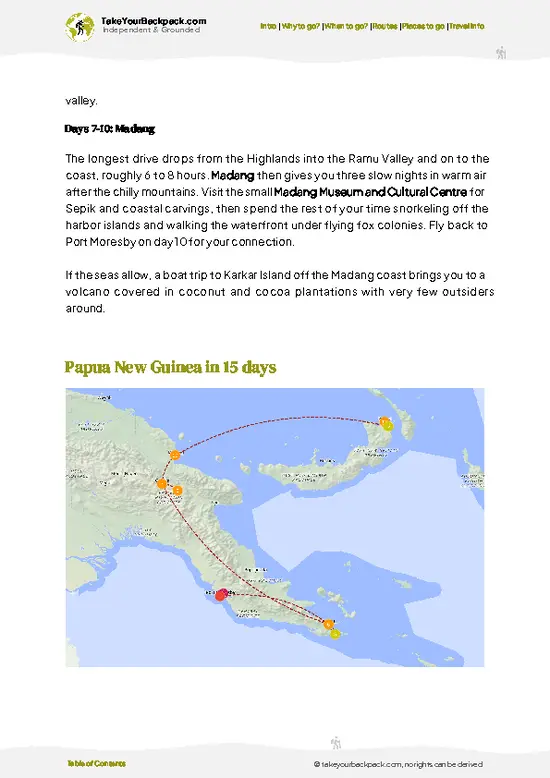
Port Moresby → Highlands (Goroka/Mt Hagen) → one island/coastal region → back to Port Moresby. That gives you culture, mountains, and sea without trying to see the whole country.
If you’re short on time or money, the key is to avoid spreading yourself too thin and to skip experiences that are expensive without adding much to your understanding of PNG.
1. Trying to see too many regions- Don’t try to hit
Port Moresby + Highlands + multiple island groups + remote river areas in one short trip. Every extra region usually means another domestic flight and more logistics.
- Instead, pick
two main areas (for example, Highlands + one island region) and do them properly.
2. Long, complex overland routes just for the sake of “overlanding”- Overland travel between some major centers can be slow, uncomfortable, and occasionally risky.
- If you only have a couple of weeks, skip the idea of epic multi-day bus journeys across the country. Fly the longest legs and use PMVs only where they make sense.
3. Extra time in Port Moresby- Use Port Moresby for
logistics, a museum visit, and maybe a short outing, then move on.
- Don’t burn three or four days here just because it’s the capital; those days are far better spent in the Highlands or on the coast.
4. Multiple big-ticket treks on one trip- Kokoda, Mt Wilhelm, and other serious treks are time- and cash-heavy.
- If you’re short on time, pick
one major trek and skip the rest. Use the remaining days for village stays or easier day hikes instead of stacking big expeditions.
5. Chasing every festival if your dates don’t line up- The big shows (Goroka, Mt Hagen) are incredible, but if your dates don’t match, don’t contort your whole itinerary and budget just to force one in.
- You can still see traditional dress, dances, and ceremonies on a smaller scale through village visits and local events.
6. Remote, ultra-isolated areas on a first short trip- Places that require charter flights, multiple boat changes, or complex permissions are best saved for a longer, more focused return trip.
- On a short visit, skip these and focus on areas with at least some basic infrastructure: Highlands hubs, accessible islands, and coastal towns.
If you’re tight on time, a lean but strong plan is:
minimal time in Port Moresby → one Highlands base → one coastal or island base. Skip everything that requires extra flights or long, risky overland detours just to say you “covered more” of the map.