×

Papua New Guinea🇵🇬 | best beachesExplore the 12 Best beaches in Papua New Guinea

Beaches in Papua New Guinea come wild, warm and almost empty, and they reward anyone willing to push past the Port Moresby airport. Forget resort strips. You get coral-fringed islands, black volcanic sand and palm-lined shores where the nearest neighbor is a village, reached by dinghy, dugout or small plane. The Milne Bay and New Ireland coasts deliver the easiest swimming and snorkeling. Madang and the Bismarck Sea offer reef diving at your doorstep. Costs run high for a backpacker, because flights and boats eat the budget, but village stays keep nights cheap. Independent travel here means planning, patience and negotiating, and the payoff is sand with nobody on it.

By Johan Kruseman 🇳🇱 | Updated October 18, 2026
Explore the best attractions in Papua New Guinea

Why go?What Makes Them Special

Papua New Guinea offers something rare: beaches with almost no development. The country sits inside the Coral Triangle, the planet’s richest marine zone, so even a casual swim over a reef edge puts you among hundreds of coral and fish species. Add 600-plus islands, volcanic coastlines and tropical water that stays warm all year, and the raw ingredients beat most of Southeast Asia.

The flip side is infrastructure. Roads between regions barely exist, so nearly everything moves by domestic flight, boat or PMV minibus along short coastal stretches. There are no beach clubs, sun-lounger rentals or tourist boardwalks. Accommodation is mostly village guesthouses, small lodges and a handful of dive resorts, and many shorelines are owned by local clans under customary land tenure. That means you pay … read more 👉
Papua New Guinea offers something rare: beaches with almost no development. The country sits inside the Coral Triangle, the planet’s richest marine zone, so even a casual swim over a reef edge puts you among hundreds of coral and fish species. Add 600-plus islands, volcanic coastlines and tropical water that stays warm all year, and the raw ingredients beat most of Southeast Asia.

The flip side is infrastructure. Roads between regions barely exist, so nearly everything moves by domestic flight, boat or PMV minibus along short coastal stretches. There are no beach clubs, sun-lounger rentals or tourist boardwalks. Accommodation is mostly village guesthouses, small lodges and a handful of dive resorts, and many shorelines are owned by local clans under customary land tenure. That means you pay a small access or camping fee to the landowners and ask before you swim, fish or walk through.

Before choosing Papua New Guinea for sand and sea, accept a trip that runs on local time. Boats leave when full, flights get rescheduled, and mobile coverage drops out. Costs sit well above neighboring countries. In return, you get remote coastlines, WWII wrecks lying in shallow water and hosts who treat visitors as guests rather than customers. Go for adventure first and tanning second.
Why These Made the Cut
The list of best beaches in Papua New Guinea is created based on beauty, vibe, water quality, activities, and surrounding scenery. If you feel a beach is missing in this list, please let us know.

When to go?Timing Your Visit for the Best Experience

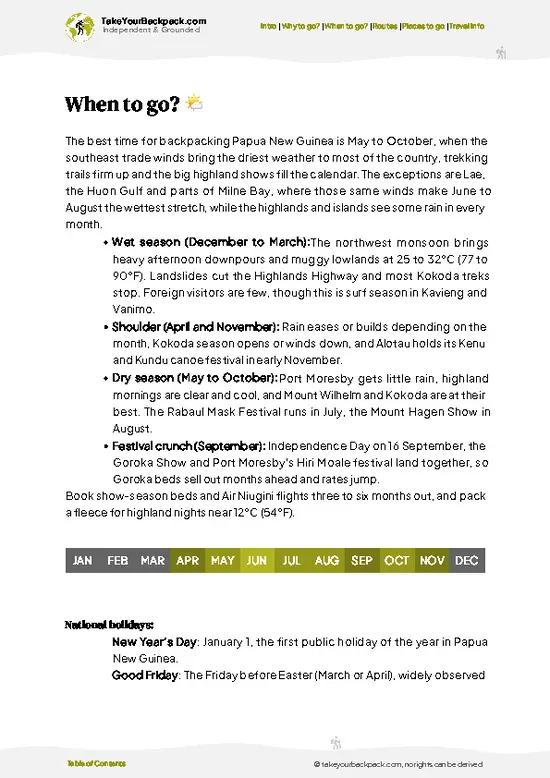
Best months for beach weather: The best months are May to October, when the dry season brings the most sunshine and calmest seas to most of the country. Daytime temperatures hold around 28 to 32°C on the coast, water stays near 28 to 30°C, and humidity is lower than at other times, so boat transfers and island hopping run smoothly.

Regional differences and shoulder seasons: Seasons vary by region. The southeast trade winds from roughly May to October roughen the seas around Milne Bay and the Louisiade chain, so crossings can be bumpy even in the dry months. Madang and the north coast, plus New Ireland, get heavy rain from December to March, with totals easily topping 300 mm a month. Port Moresby is drier, with a distinct dry season from about May to November. Kokopo and Rabaul on New Britain … read more 👉
Best months for beach weather: The best months are May to October, when the dry season brings the most sunshine and calmest seas to most of the country. Daytime temperatures hold around 28 to 32°C on the coast, water stays near 28 to 30°C, and humidity is lower than at other times, so boat transfers and island hopping run smoothly.

Regional differences and shoulder seasons: Seasons vary by region. The southeast trade winds from roughly May to October roughen the seas around Milne Bay and the Louisiade chain, so crossings can be bumpy even in the dry months. Madang and the north coast, plus New Ireland, get heavy rain from December to March, with totals easily topping 300 mm a month. Port Moresby is drier, with a distinct dry season from about May to November. Kokopo and Rabaul on New Britain are typically wetter through the northwest monsoon months.

November and April work as shoulder months, with fewer visitors and lower dive-resort rates, though rain shows up in short afternoon bursts.

Crowds, prices and events: Crowds are never an issue. Prices barely change by season, but dive lodges can book out in July to September, so reserve ahead. Festivals such as the Mask Festival in Rabaul and the Goroka Show pull in visitors, and flights fill quickly around them.

beach hoppingSuggested Travel Strategies

How many days a multi-beach trip needs: A trip linking several beach regions in Papua New Guinea needs 12 to 21 days, because internal flights, weather delays and boat schedules eat time. Pack in fewer days and you spend the holiday in airports.

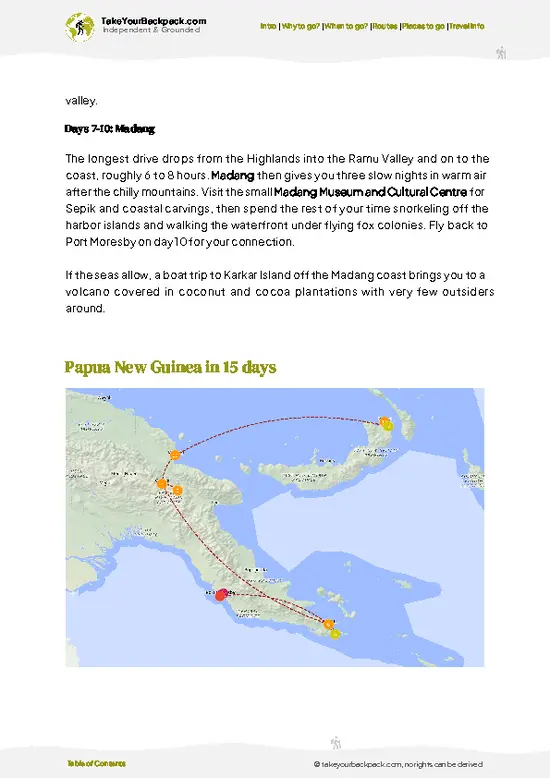
Which regions group well: Cluster by flight corridor. Port Moresby is the hub, and from there you fan out to Alotau and Milne Bay in the southeast, or to Madang, Kavieng and Kokopo via Air Niugini and PNG Air. Pairing Milne Bay with the Port Moresby region keeps flights short, at about 1 to 1.5 hours. A northern loop of Madang then New Ireland or New Britain works, but you usually route back through Port Moresby, so build in the extra leg. Start in the region with the least reliable weather and finish somewhere calm, leaving the final days flexible. … read more 👉
How many days a multi-beach trip needs: A trip linking several beach regions in Papua New Guinea needs 12 to 21 days, because internal flights, weather delays and boat schedules eat time. Pack in fewer days and you spend the holiday in airports.

Which regions group well: Cluster by flight corridor. Port Moresby is the hub, and from there you fan out to Alotau and Milne Bay in the southeast, or to Madang, Kavieng and Kokopo via Air Niugini and PNG Air. Pairing Milne Bay with the Port Moresby region keeps flights short, at about 1 to 1.5 hours. A northern loop of Madang then New Ireland or New Britain works, but you usually route back through Port Moresby, so build in the extra leg. Start in the region with the least reliable weather and finish somewhere calm, leaving the final days flexible.

Time per stop and planning mistakes: Give each region 3 to 5 nights. Local boat transfers often take 1 to 4 hours, and PMV or dinghy rides can stretch to a day in remote areas.

The classic mistakes are booking a tight international connection straight after a domestic flight, trying to cover three or four regions in a week, and skipping buffer days. Instead, add one spare night before any departure abroad, confirm flights 48 hours ahead, and carry cash in small kina notes, since many islands have no ATM.

The ListMust-Visit beaches in Papua New Guinea

1 Tufi Beach

Tufi fjords, sandy inlet coves, reef walls, tapa cloth villages

Paddle mirror-calm green inlets at first light, snorkel coral beside small coves, and watch women beat and paint bark cloth.

2 Kavieng Beach

Harbor wall sunsets, Kavieng market, Japanese wrecks, reef-pass surf

Watch the sun sink behind Nusa and Nago from the seawall, then hire a boat for wreck dives, surf breaks or clearer island water.

3 Loloata Island

Private resort island, house reef, Bootless Bay dives, sheltered kayaking

Reach the island by short boat hop and slip straight onto a reef, then paddle the calm shoreline at flat-water dawn.

4 Kokopo Beach

Volcanic bay sand, Pacific War museum, Tolai market, Tavurvur lookouts

Combine dark-sand sunsets with wartime tunnels, a market selling tabu shell money culture, and drives to the steaming Rabaul volcano.

5 Nusa Island

Albatross Passage, harbor wrecks, house reef, island kayak loop

Dive a current-swept channel and sunken Japanese ships, then paddle around the small island or snorkel straight off the sand.

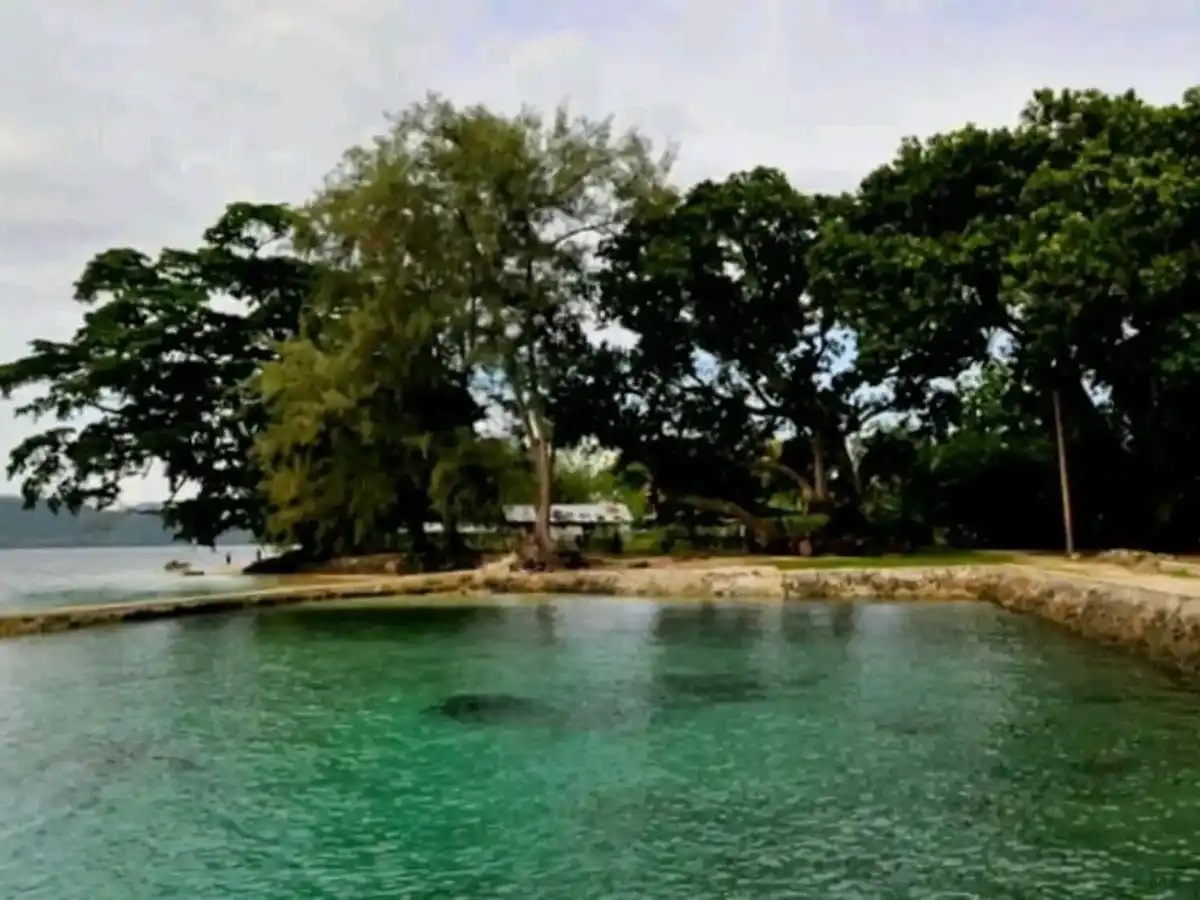
papua-new-guinea-beach-nusa-island
© Google | Gabriel Ngally

6 Samarai Island

Carless island loop, colonial ruins, wharf snorkeling, cemetery lookout

Circle the whole shoreline on foot in about an hour, passing overgrown foundations before climbing to the old graves above the bay.

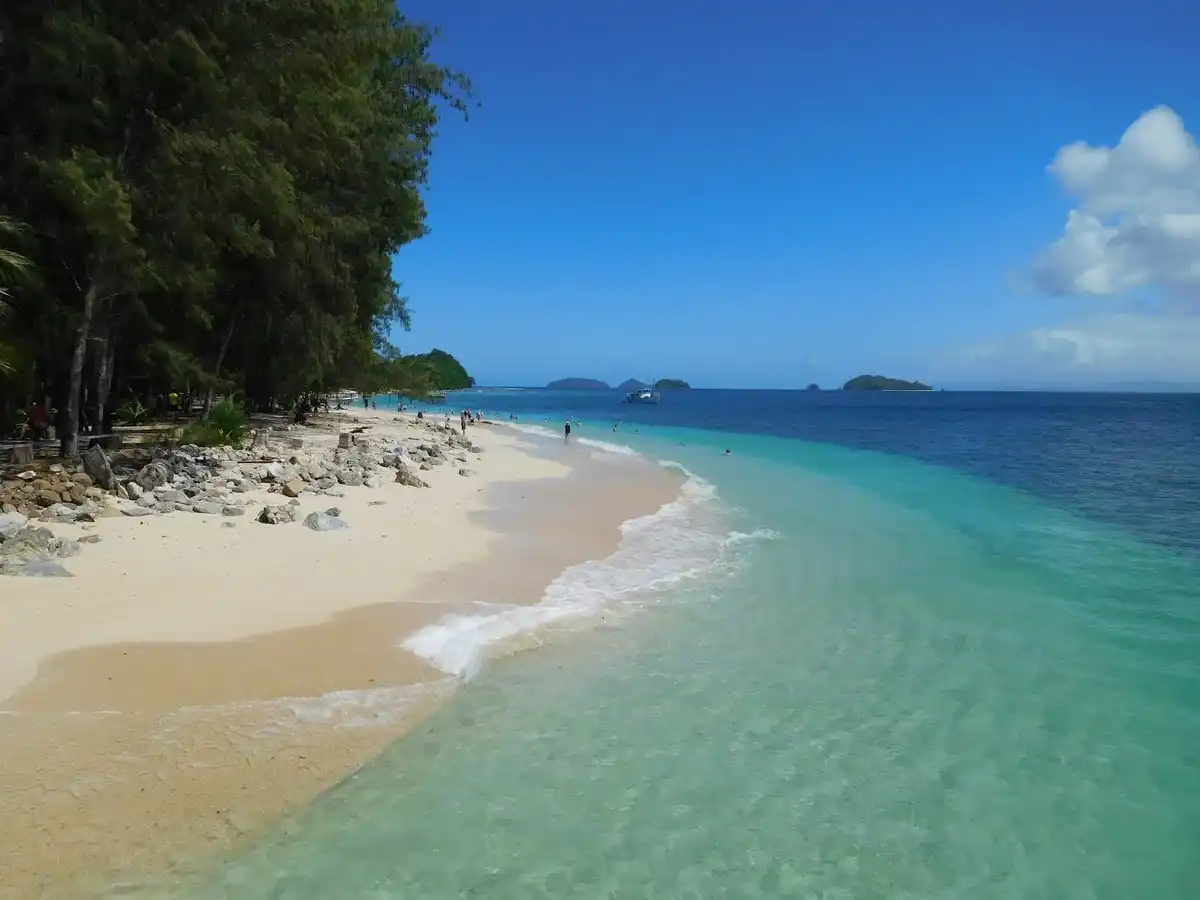
papua-new-guinea-beach-samarai-island
© Google | James Mitau

7 Doini Island

Sailing canoes, roadless island, shore reef, star-filled nights

Drop your pack in a village, snorkel the coral starting near the sand, then paddle out in a local sailing canoe.

papua-new-guinea-beach-doini-island
© Google | Ian Bancroft

8 Salamaua Beach

Isthmus village, Japanese bunkers, Huon Gulf sunrise, offshore wreckage

Cross a thin strip of land with sea on both sides, then climb with a guide to old guns overlooking both bays.

9 Vanimo Beach

Gray-black sand, Pacific swells, morning canoes, headland tidepools

Head for steady surf beside town, ask locals which breaks suit your level, and walk to the headland for tidepools.

10 Wewak Beach

Dark-sand town beach, Cape Wom surrender site, Wewak Point relics, smoked fish market

Pair a sunset stroll on Boram’s dark sand with rusted gun emplacements, the 1945 surrender memorial and market stalls of smoked fish.

11 Aitape Beach

Dark-sand surf shore, 1998 tsunami sites, WWII relics, sago villages

Walk firm black-gray sand at low tide, then ask locals to point out where the 1998 wave struck and where wartime wreckage still sits.

12 Hula Beach

Village waterfront, shallow bay, canoe landings, cooking-fire dusk

Join daily life on the sand as dugouts bring in the catch, then float over nearby coral on a village canoe ride.

Loading the map 🌍

Expert viewTips and Advice from Travelers

How many beaches to visit: Plan on three to four beach stops on a single trip. Each one needs a flight or a long boat ride, and every transfer burns half a day or more. Stay at least three nights at each, because the best moments, a dawn swim over an empty reef or a canoe ride across calm water, come on the second morning, once you stop rushing.

Which kind suits your style: Snorkelers and divers should prioritize reef beaches in Milne Bay, Kimbe and Madang, where the coral starts a few strokes from shore. History fans should look at wartime coasts, where rusting landing craft and wrecks sit in the shallows. Budget travelers do best with village-stay beaches, where you sleep in a simple bungalow, eat fish and taro cooked by your hosts and swim in front of the house. Resort-style comfort exists, … read more 👉
How many beaches to visit: Plan on three to four beach stops on a single trip. Each one needs a flight or a long boat ride, and every transfer burns half a day or more. Stay at least three nights at each, because the best moments, a dawn swim over an empty reef or a canoe ride across calm water, come on the second morning, once you stop rushing.

Which kind suits your style: Snorkelers and divers should prioritize reef beaches in Milne Bay, Kimbe and Madang, where the coral starts a few strokes from shore. History fans should look at wartime coasts, where rusting landing craft and wrecks sit in the shallows. Budget travelers do best with village-stay beaches, where you sleep in a simple bungalow, eat fish and taro cooked by your hosts and swim in front of the house. Resort-style comfort exists, but at dive-lodge prices.

What it costs: Budget US$50 to 90 a day (about K200 to 350) for village stays and local food, rising to US$150 to 300 at dive lodges including meals. Village beds run about K50 to 150 a night. Landowner access or camping fees are usually K10 to 50 per person. A local boat and guide for a day costs roughly K150 to 400 depending on fuel, and domestic flights run about US$100 to 250 a leg. Carry plenty of small kina notes, since ATMs vanish outside the main towns. The reward is a coastline where every payment goes straight to the family hosting you.

Safety and cultural rules: Safety is a real consideration. Petty crime and opportunistic theft are a concern in Port Moresby and Lae, so use arranged airport pickups and avoid walking after dark. Village beaches are generally calm and welcoming, but go with a local contact or guide and never leave valuables unattended.

Respect customary land ownership. Ask before you swim, camp or take photos, and pay the fee. Dress modestly even at the beach, with shorts or a sarong over swimwear when walking through villages, and skip topless sunbathing entirely. Avoid swimming at river mouths, where saltwater crocodiles live, and follow local advice on where it is safe to enter the water. Bring reef-safe sunscreen, a good first-aid kit and malaria prophylaxis, as the whole coast is a risk zone. Evacuation is far away, so travel insurance with medical evacuation cover is not optional.

✈️ The backpacker research shortcutPapua New Guinea Travel Guide

An offline-friendly backpacking guide with optimized travel routes, ranked highlights, transport advice, and the best areas to stay.
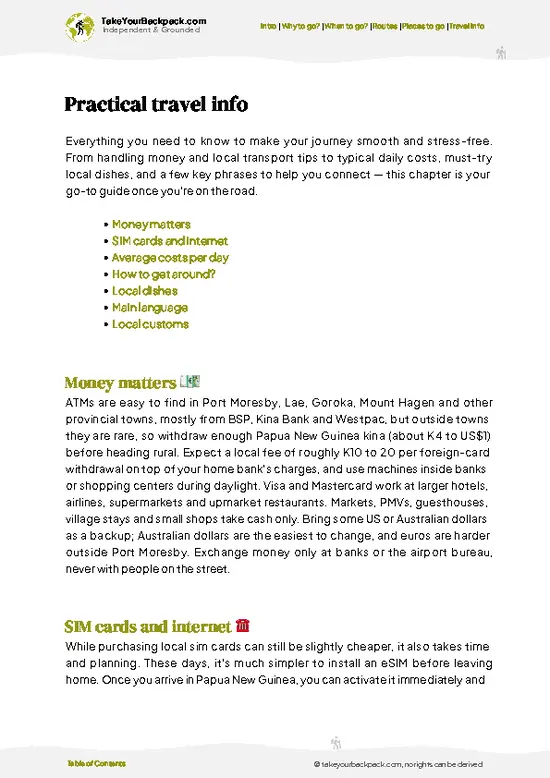
example page 0 from our offline Travel Guide for Papua New Guinea
example page 1 from our offline Travel Guide for Papua New Guinea
example page 2 from our offline Travel Guide for Papua New Guinea
example page 3 from our offline Travel Guide for Papua New Guinea
example page 4 from our offline Travel Guide for Papua New Guinea
example page 5 from our offline Travel Guide for Papua New Guinea
example page 6 from our offline Travel Guide for Papua New Guinea
example page 7 from our offline Travel Guide for Papua New Guinea
The digital guide (251 pages) contains:
✅ 81 highlights, ranked by travel appeal
✅ Optimized 5, 10 & 15-day travel routes
✅ Cities, national parks, landmarks, beaches
✅ How to get around
✅ Offline-friendly for travel without Wi-Fi
👉 Click to see all 30+ guide features

📅 Plan smarter in minutes, not weeks
✅ Month by month travel advice
✅ Festivals & national holidays
✅ Budget expectations

🗺️ Go to the right places, skip the overrated ones
✅ Honest pros & cons of destinations
✅ Top hikes, parks & viewpoints
✅ Lesser-known places most travelers miss
✅ Clear “worth it vs skip it” guidance

🛏️ Travel smoothly without rookie mistakes
✅ Best areas to stay
✅ Transport systems explained simply
✅ Common scams & safety advice
✅ SIM cards, money & practical tips

🌍 Understand the country, not just visit it
✅ Culture & traditions
✅ 52 Essential phrases & customs
✅ Festivals worth planning around
✅ Traveler-friendly historical context
✅ Insights that make places more meaningful

📱 Built for real travel conditions
✅ Fully downloadable PDF
✅ Works completely offline
✅ Optimized for phone use
✅ Useful in remote areas & buses
✅ Everything in one place
Stop searching, start planning
Get instant access to your full guide. 30‑day money-back guarantee.
+ Add another guide for just

By proceeding you agree to our terms.
Sent to your inbox immediately after payment • 100% Secure Checkout
Best Backpacking Travel Advisor 2025 tourism awardBest Backpacking
Travel Advisor
2025
What others say about Take Your Backpack Guides:
⭐⭐⭐⭐⭐
Fantastic, amazing amount of information!
⭐⭐⭐⭐⭐
My goodness this is amazing, it's what I've been looking for hats off too you!
⭐⭐⭐⭐⭐
I think this is absolutely BRILLIANT
⭐⭐⭐⭐
Very complete and informative. It's still missing places, but I gotta to commend you
⭐⭐⭐⭐⭐
This is truly amazing, thank you, can't wait to explore it with my kids!
⭐⭐⭐⭐⭐
Awesome resource, thank you!
⭐⭐⭐⭐⭐
This is amazing! Can't wait to explore the ones I haven't seen
⭐⭐⭐⭐
I love this! Well done, great idea.
⭐⭐⭐⭐⭐
Thanks for taking the time to make this gem!
⭐⭐⭐⭐⭐
This might be the best website I've ever seen.
⭐⭐⭐⭐⭐
Congratulations, and thank you so much for your work; it's incredibly valuable.
⭐⭐⭐⭐
In all seriousness I think you did a great job pointing out the important spots
⭐⭐⭐⭐⭐
10/10 very good
⭐⭐⭐⭐⭐
As someone who's only just starting to visit regularly this is awesome, thank you.
⭐⭐⭐⭐
Thank you very much! I'm going to visit my dad, it's going to be very useful!
⭐⭐⭐⭐⭐
This is really cool! We'll be travelling for the first time and this definitely come in handy.
⭐⭐⭐⭐⭐
You are now our minister of culture, congratulations 👨‍💼
⭐⭐⭐⭐⭐
Just wanted to tell you that this is a pearl! Going to follow your recommendations.
⭐⭐⭐⭐⭐
This is so cool. I'll definitely be using the resource for my travels soon.
⭐⭐⭐⭐⭐
This is very impressive! Good work.
⭐⭐⭐⭐⭐
This is an amazing and informative site. Very well done!

🛏️ Where to stay?Top Areas to Stay

Papua New Guinea has almost no true backpacker hostels, so budget travelers mostly stay in church-run guesthouses, mission lodges and simple family guesthouses, typically K150 to 350 (about US$40 to 90) a night for a private room. In Port Moresby, Boroko has the most cheap guesthouses and is close to shops and PMV routes but feels hectic and unsafe on foot after dark, while Waigani is quieter and near the National Museum and Parliament House. Town and Ela Beach put you on the waterfront with the best restaurants, at noticeably higher prices. Elsewhere, Goroka and Madang have the best spread of affordable lodges, with calmer streets than the capital.

If you enjoy meeting fellow travelers, consider … read more 👉
Papua New Guinea has almost no true backpacker hostels, so budget travelers mostly stay in church-run guesthouses, mission lodges and simple family guesthouses, typically K150 to 350 (about US$40 to 90) a night for a private room. In Port Moresby, Boroko has the most cheap guesthouses and is close to shops and PMV routes but feels hectic and unsafe on foot after dark, while Waigani is quieter and near the National Museum and Parliament House. Town and Ela Beach put you on the waterfront with the best restaurants, at noticeably higher prices. Elsewhere, Goroka and Madang have the best spread of affordable lodges, with calmer streets than the capital.

If you enjoy meeting fellow travelers, consider choosing hostels with high ratings for atmosphere. On the other hand, if you prefer having your own space, a hotel might be a better option.

Papua New GuineaDiscover the Country

👋 Meet the founderWho’s Behind Take Your Backpack?

Johan, backpacker and founder of TakeYourBackpackHi, I’m Johan (Netherlands 🇳🇱), the creator of TakeYourBackpack. Over the past 3 decades, I’ve backpacked through 90+ countries across six continents, gaining extensive experience with independent travel, long-term trips, and overland routes.

This site is built on a combination of firsthand travel experience and carefully curated insights from other backpackers. Many guides are based on places I’ve personally visited, while others bring together tips, observations, and practical advice shared by trusted travelers I’ve met along the way.

The goal is to provide realistic, experience-driven guidance — not generic itineraries — so you can explore destinations with better context, clearer expectations, and more confidence.