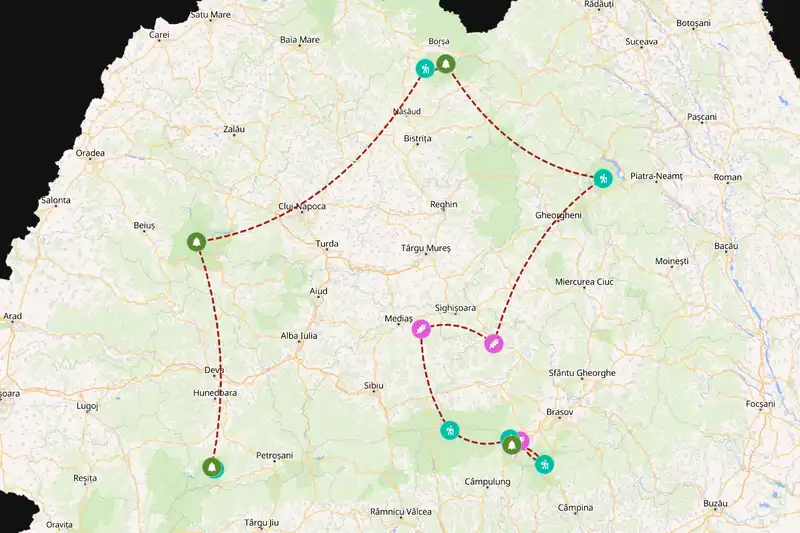
Yes, Romania is easy to backpack independently: trains and buses link every town worth visiting, hostels are plentiful in the main cities, and most people under 40 speak some English.
Dorm beds in
Brasov,
Sibiu,
Cluj-Napoca and
Bucharest cost about 60 to 110 lei (US$13 to 24), and a frugal day runs 150 to 225 lei (US$35 to 50). The Bucharest to Brasov train takes 2.5 to 3 hours for roughly 45 to 70 lei, and tickets can be bought online. The harder part is rural:
Viscri,
Biertan and the outer Bucovina monasteries need a taxi or a lift arranged by your guesthouse from the nearest station.
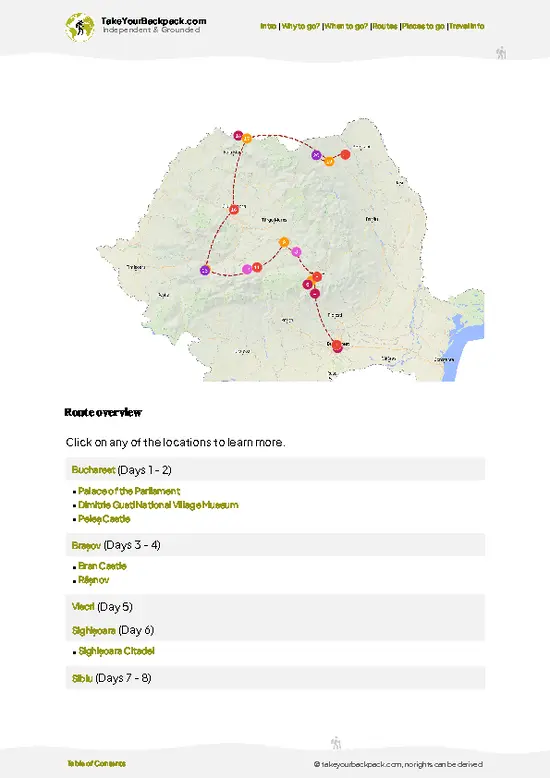
Ten days is the right length for a first trip to Romania: enough to cover Transylvania properly, while two weeks lets you add Maramureș and Bucovina in the north.
With 5 days, stay in
Brasov for Bran and Peleș, then spend a night in
Sighişoara. With 10 days, run
Cluj-Napoca to
Sibiu to Brasov, adding Alba Iulia and a mountain hike. With 14 to 16 days, continue to
Sighetu Marmației (5 to 6 hours by bus from Cluj) and
Gura Humorului for the painted monasteries. The Black Sea coast and the western cities of Timișoara and Oradea each need 2 to 3 extra days.
You can get around Romania without a car: the national rail network and intercity buses connect all the main cities, and only a handful of rural sights require a taxi or tour.
Typical journeys are Bucharest to
Brasov in 2.5 to 3 hours by train, Brasov to
Sighişoara in 2.5 to 3.5 hours,
Cluj-Napoca to
Sibiu in about 3.5 to 4 hours by bus, and Cluj to
Sighetu Marmației in 5 to 6 hours. Trains are slow but cheap, usually 40 to 120 lei (US$9 to 26). The gaps are the
Transfăgărășan Highway (minibus tours from Sibiu, July to October) and the outer Bucovina monasteries, where a taxi for the day costs about 300 to 400 lei.
The must-visits in Romania are the Transylvanian old towns of
Brasov,
Sibiu and
Sighişoara, plus
Peleș Castle and
Bran Castle; with more time, add Maramureș and the
Painted Monasteries of Bucovina.
Brasov needs 2 to 3 nights, since Bran is 45 minutes away by bus and Peleș is about an hour away by train at Sinaia. Sibiu deserves 2 nights for its squares and the open-air ASTRA museum. Sleep inside the walls of Sighişoara for at least one night.
Cluj-Napoca is the best city for nightlife and flights, and
Corvin Castle in Hunedoara is the most dramatic fortress in the country. In the north,
Sighetu Marmației and the Merry Cemetery of Săpânța are worth 2 days.
If you’re short on time in Romania, skip the Black Sea coast, the far western cities and Iași, and keep Bucharest to a single day.
Mamaia and
Constanța are summer resort strips that are 2 to 2.5 hours by train from Bucharest, and they add little unless you specifically want a beach.
Timișoara and
Oradea have attractive centers, but Timișoara is 5 to 6 hours by train from Cluj-Napoca.
Iași sits far out in the northeast. In
Bucharest, one full day covers the Palace of the Parliament and the Village Museum before you head to Brasov, 2.5 to 3 hours away, where the trip properly starts.
Yes, our itinerary-planner does exactly that. Set your trip length in days, give your interests and travel style, optionally give start- and end location and/or some mandatory stops you would like to include and the itinerary planner creates your personalized routes for Romania in seconds. Try it out!
Try the itinerary plannerv2.webp)
 Best Backpacking