×

Romania🇷🇴 | best villagesTop-Rated 6 villages in Romania

Villages in Romania come in three distinct flavors, and the one you pick changes your trip. In Maramureș in the north, wooden gates carved with sun symbols line dirt lanes, hay is stacked on tall poles, and the air smells of woodsmoke and plum brandy. The Transylvanian Saxon villages have fortified churches, ochre facades and cobbled squares, and they are the easiest to reach. The Apuseni and Carpathian highlands mean muddy tracks, cowbells and guesthouses where dinner arrives in clay bowls. Costs stay low everywhere, but buses thin out fast. Independent travelers should expect to rent a car or lean on hitching and local minibuses.

By Johan Kruseman 🇳🇱 | Updated October 18, 2026
Explore the best landmarks in Romania

Why go?Understanding Their Importance

Romania kept its villages alive because collectivization left the land fragmented and a large share of the population never left the countryside. Small plots, horse carts, scythed hay meadows and shepherds walking flocks up to summer pastures are still ordinary work, not performance. The Carpathian arc shaped separate cultures in its valleys, so a wooden church culture, a Saxon fortified-church culture and a transhumant shepherd culture sit within a day’s drive of each other. Medieval Saxon settlers left walled churches and layouts that the 20th century barely altered.

Before choosing Romania, know that infrastructure lags behind the scenery. Rural roads can be potholed or gravel, trains are slow, and village buses often run once or twice a day, sometimes not at weekends. Many places have … read more 👉
Romania kept its villages alive because collectivization left the land fragmented and a large share of the population never left the countryside. Small plots, horse carts, scythed hay meadows and shepherds walking flocks up to summer pastures are still ordinary work, not performance. The Carpathian arc shaped separate cultures in its valleys, so a wooden church culture, a Saxon fortified-church culture and a transhumant shepherd culture sit within a day’s drive of each other. Medieval Saxon settlers left walled churches and layouts that the 20th century barely altered.

Before choosing Romania, know that infrastructure lags behind the scenery. Rural roads can be potholed or gravel, trains are slow, and village buses often run once or twice a day, sometimes not at weekends. Many places have no cash machine, so carry lei in small notes. Expect hospitality that is generous but unpolished: homemade cheese, tuica (fruit brandy) poured before noon, a dog barking at every gate, and a bathroom that may be shared. Winter brings smoke from wood stoves and snow that closes mountain tracks. The reward is a countryside where the soundtrack is still roosters, church bells and the clop of hooves.
Our Approach to Ranking
The list of best villages in Romania is created based on authenticity, scenic beauty, community spirit, traditions, and overall character. If you feel a village is missing in this list, please let us know.

When to go?When to Plan Your Trip

Best months and seasons: The best months for villages in Romania are late May to June and September to early October, when daytime temperatures sit around 18 to 26°C, hay meadows are green or freshly cut, and mountain tracks are dry enough to walk. June is the wettest month in many regions, with afternoon thunderstorms, so pack a shell.
Summer and peak periods: July and August bring 25 to 33°C in Transylvania and cooler nights of 8 to 14°C in the highlands. Guesthouse prices rise roughly 20 to 40 percent, and the busiest weeks are around the Assumption holiday on August 15 and the Easter weekend, when Orthodox villages fill with returning families and rooms book out. Maramureș and Bucovina see their heaviest visitor flow in these weeks.
Autumn, winter and spring: Late September smells of woodsmoke, … read more 👉
Best months and seasons: The best months for villages in Romania are late May to June and September to early October, when daytime temperatures sit around 18 to 26°C, hay meadows are green or freshly cut, and mountain tracks are dry enough to walk. June is the wettest month in many regions, with afternoon thunderstorms, so pack a shell.
Summer and peak periods: July and August bring 25 to 33°C in Transylvania and cooler nights of 8 to 14°C in the highlands. Guesthouse prices rise roughly 20 to 40 percent, and the busiest weeks are around the Assumption holiday on August 15 and the Easter weekend, when Orthodox villages fill with returning families and rooms book out. Maramureș and Bucovina see their heaviest visitor flow in these weeks.
Autumn, winter and spring: Late September smells of woodsmoke, plums and fermenting must, and the forests turn rust and gold. November to March is cold, with temperatures from 0 to minus 15°C in the Carpathians, deep snow, and some guesthouses closed or heated only by tile stoves. Roads to high settlements can close. April is muddy, as thaw turns dirt lanes to clay, though prices are lowest and Orthodox Easter processions are at their most atmospheric.

village hoppingSuggested Travel Strategies

How many days to plan: A trip combining several villages in Romania needs 7 to 14 days, with 10 being comfortable for two or three regions. Give each stop one to two nights, since the pleasure is the evening light, the morning cowbells and a slow walk, not ticking off a checklist.
Which regions group well: Transylvania’s Saxon area around Sibiu, Sighișoara and Brașov clusters tightly, with 1 to 2 hours between bases. Maramureș sits far north, about 6 to 8 hours by road from Cluj-Napoca, so pair it with Bucovina’s painted-monastery villages, another 3 to 5 hours east. A sensible direction is to fly into Cluj-Napoca, go north to Maramureș, east to Bucovina, then south through the Carpathians to Brașov and Sibiu, leaving from Bucharest or Sibiu. Reverse it if flights suit better.
Planning mistakes: … read more 👉
How many days to plan: A trip combining several villages in Romania needs 7 to 14 days, with 10 being comfortable for two or three regions. Give each stop one to two nights, since the pleasure is the evening light, the morning cowbells and a slow walk, not ticking off a checklist.
Which regions group well: Transylvania’s Saxon area around Sibiu, Sighișoara and Brașov clusters tightly, with 1 to 2 hours between bases. Maramureș sits far north, about 6 to 8 hours by road from Cluj-Napoca, so pair it with Bucovina’s painted-monastery villages, another 3 to 5 hours east. A sensible direction is to fly into Cluj-Napoca, go north to Maramureș, east to Bucovina, then south through the Carpathians to Brașov and Sibiu, leaving from Bucharest or Sibiu. Reverse it if flights suit better.
Planning mistakes: The classic error is trusting map distances. Romanian roads average 40 to 50 km/h on rural stretches, with tractors, horse carts and sheep slowing everything, so a 150 km leg can take four hours. Budget travel days as half days. Another mistake is relying on buses between remote villages that run once daily. Rent a car for the north and highlands, or book a driver for a single leg, and use trains only for the Brașov, Sighișoara, Sibiu and Cluj corridor.

The ListTop villages of Romania

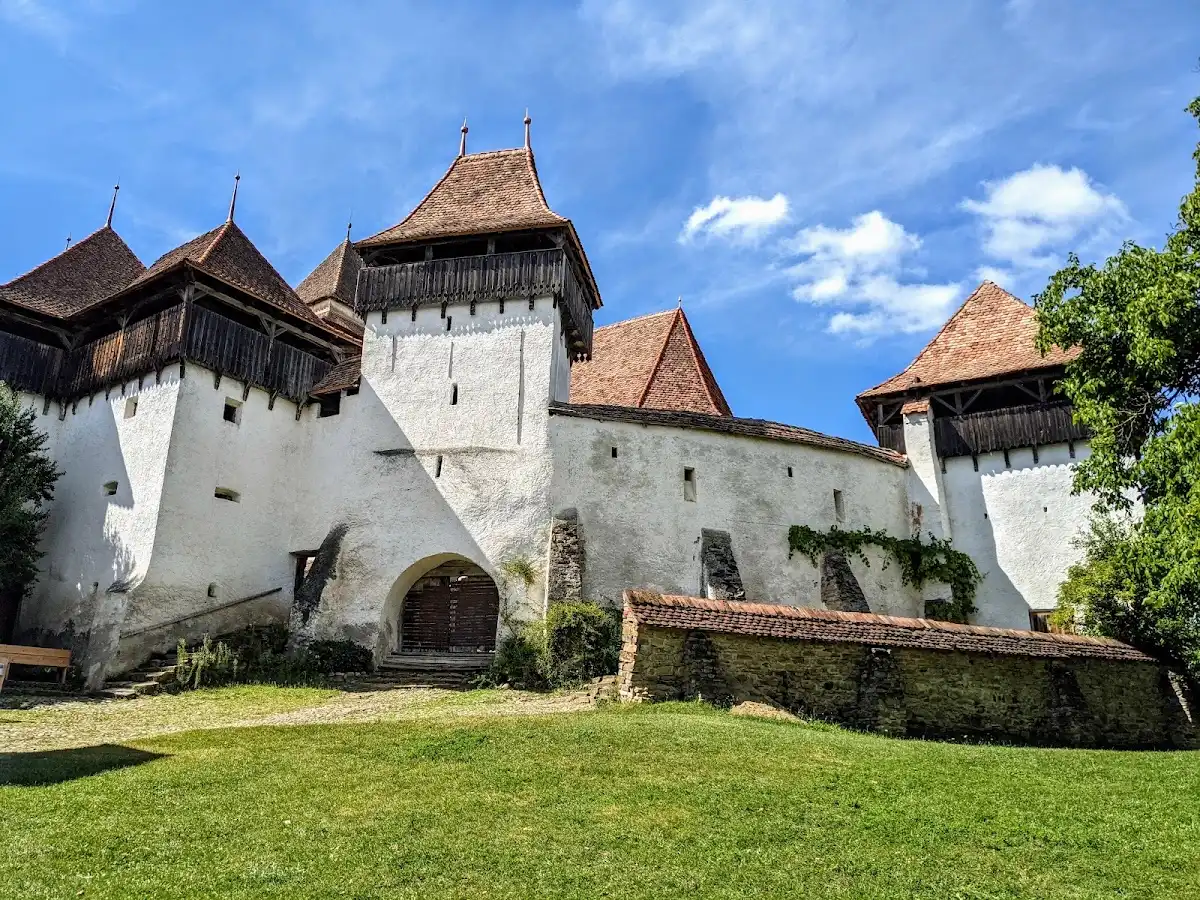
1 Viscri

UNESCO site, whitewashed cottages, sheep pastures

Walk dirt roads lined with blue houses, watch sheep graze beyond the village, and see how conservation shapes everyday routines.

romania-city-viscri
© Google |

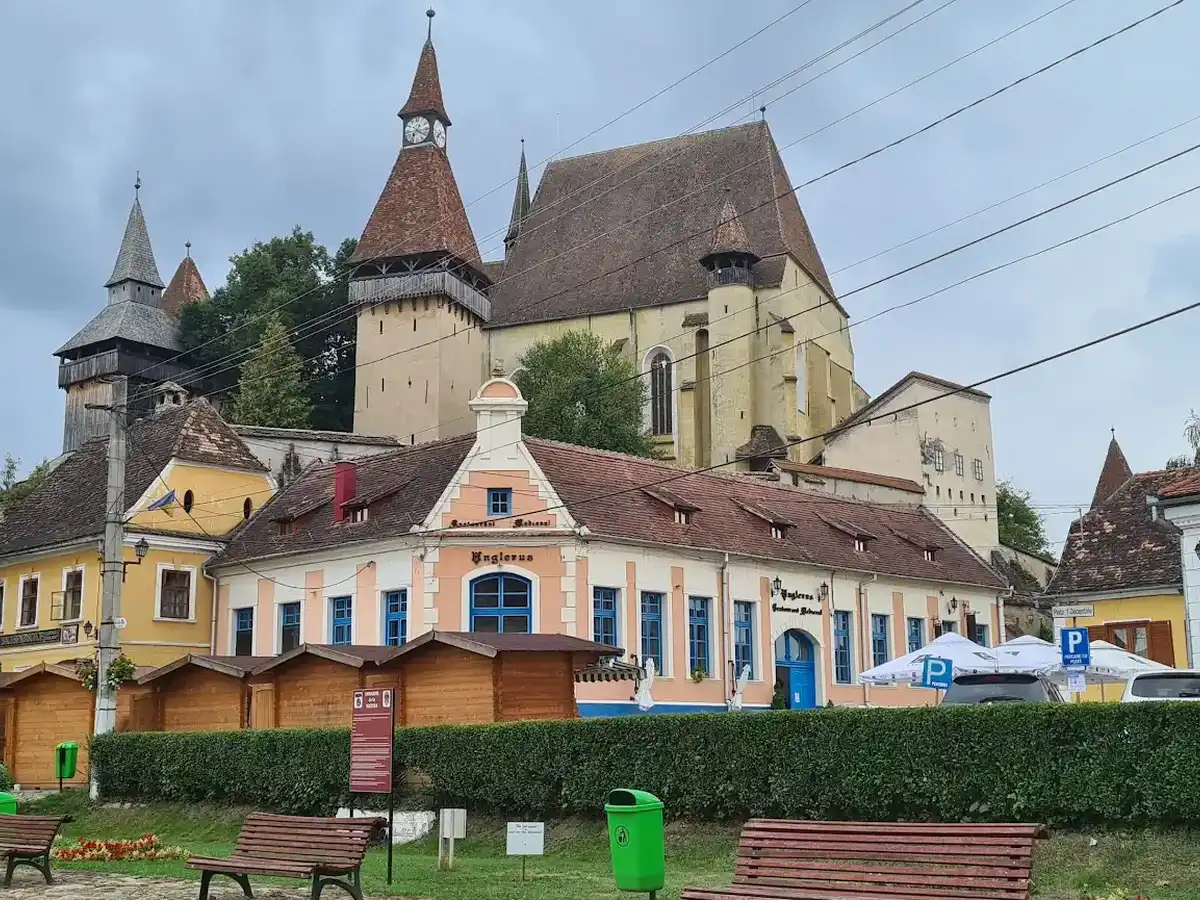
2 Biertan

fortified church, Saxon village, hillside views

Wander among steep lanes and stone walls, then pause to take in the layered rooftops and the imposing church at the village center.

romania-city-biertan
© Google | Ion Taranu

3 Măgura

Karst hills, scattered farms, panoramic ridge

Wake up to sweeping views over limestone peaks, then wander between hayfields and traditional homesteads dotted along winding paths.

romania-city-magura
© Google |

4 Sibiel

icon museum, orchard lanes, shepherd culture

Visit a small museum of painted icons, stroll through apple orchards, and observe the rhythms of a working shepherd village.

romania-city-sibiel
© Google |

5 Cerdac

mountain hamlet, forest edge, rural guesthouses

Experience quiet evenings surrounded by pine woods, with easy access to hiking trails and home-cooked meals in family-run lodges.

6 Sâncraiu

Hungarian traditions, Kalotaszeg crafts, rural homesteads

Experience daily life shaped by Hungarian customs, with hand-painted gates, folk costumes, and a landscape of open fields and scattered farms.

romania-city-sancraiu
© Google |
Loading the map 🌍

Expert viewPro Tips for Exploring the Best

How many villages to visit: I advise four to six villages on a trip of one to two weeks. Fewer than four and you miss the contrast between wooden Maramureș, Saxon Transylvania and the highlands. More than six and you spend your days on rutted roads, arriving at dusk with no time to walk to the hayfield or share a meal. The reward of staying two nights is waking to cowbells and mist rather than packing a bag.
Choosing a kind of village: If you want culture and photography, choose the wooden-church and carved-gate villages of the north, where weekday life continues around you. For easy access and comfort, pick the Saxon villages, which have restored guesthouses, fortified churches with towers you can climb and good wine cellars. For hiking and solitude, choose the Carpathian highland villages, … read more 👉
How many villages to visit: I advise four to six villages on a trip of one to two weeks. Fewer than four and you miss the contrast between wooden Maramureș, Saxon Transylvania and the highlands. More than six and you spend your days on rutted roads, arriving at dusk with no time to walk to the hayfield or share a meal. The reward of staying two nights is waking to cowbells and mist rather than packing a bag.
Choosing a kind of village: If you want culture and photography, choose the wooden-church and carved-gate villages of the north, where weekday life continues around you. For easy access and comfort, pick the Saxon villages, which have restored guesthouses, fortified churches with towers you can climb and good wine cellars. For hiking and solitude, choose the Carpathian highland villages, with trailheads from the doorstep and shepherds’ cheese at the end of the climb. First-timers should start with Saxon, then add one remote region.
What it costs: Budget US$30 to 50 a day (about 140 to 230 lei) on a backpacker level: a guesthouse bed or room for 100 to 200 lei per person, usually with a big breakfast, a home-cooked dinner for 40 to 80 lei, and local minibuses. Fortified church entry costs roughly 10 to 30 lei, and wooden churches often ask a small donation or ticket. A local guide for a half day runs about 150 to 300 lei. Car rental adds roughly US$30 to 50 a day plus fuel. Per village visit, plan US$5 to 15 in fees and snacks, excluding lodging.
Safety and etiquette: Villages are very safe for people, but stray and sheepdogs are the real hazard. Sheepdogs near high pastures can be aggressive, so stop, avoid eye contact and wait for the shepherd to call them off. Carry a stick on trails. Roads are the other risk, with unlit carts, potholes and livestock after dark, so avoid night driving. Dress modestly in churches and monasteries, with covered shoulders and knees, and women may be asked to cover their heads. Ask before photographing people. Accept a hosted drink with a toast, since refusing outright can feel curt. Carry lei in small notes, because card terminals and cash machines are scarce.

✈️ The backpacker research shortcutRomania Travel Guide

An offline-friendly backpacking guide with optimized travel routes, ranked highlights, transport advice, and the best areas to stay.
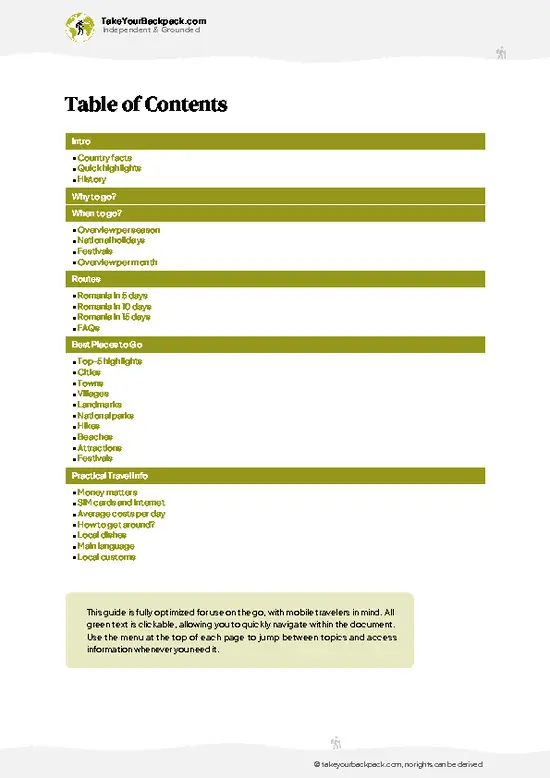
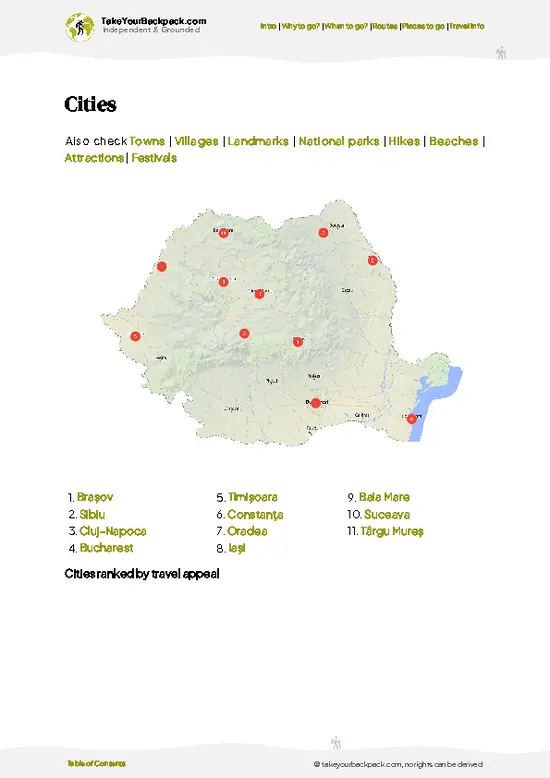
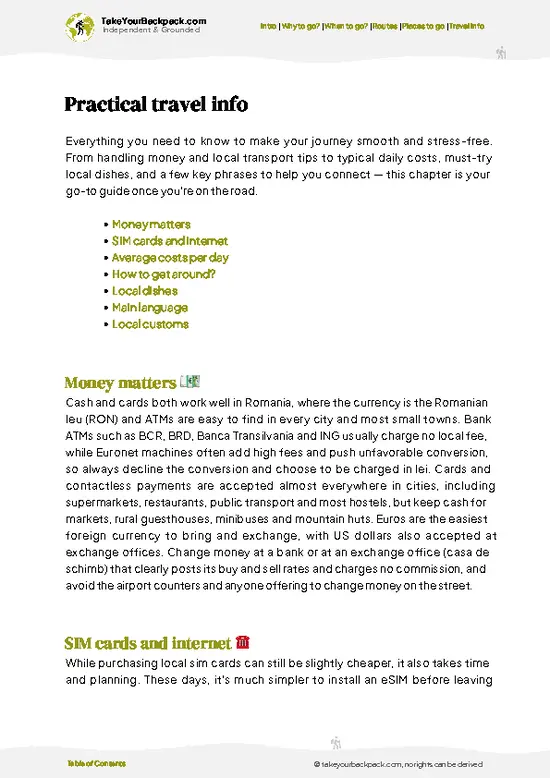
example page 0 from our offline Travel Guide for Romania
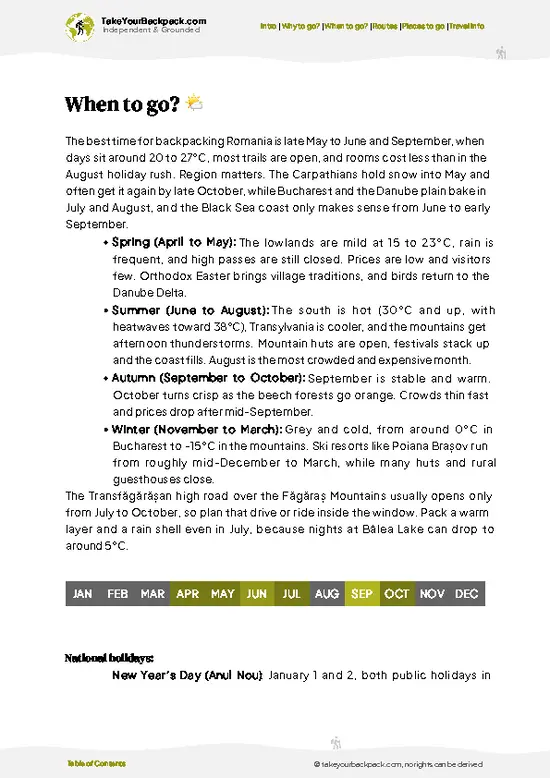
example page 1 from our offline Travel Guide for Romania
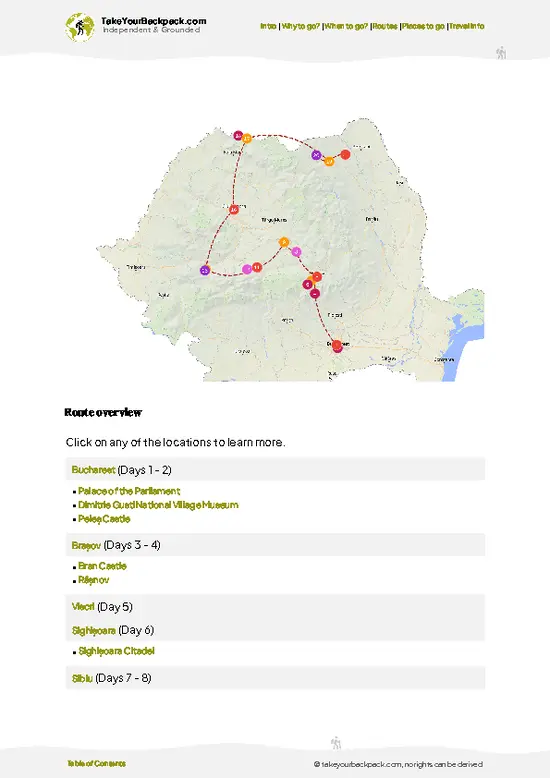
example page 2 from our offline Travel Guide for Romania
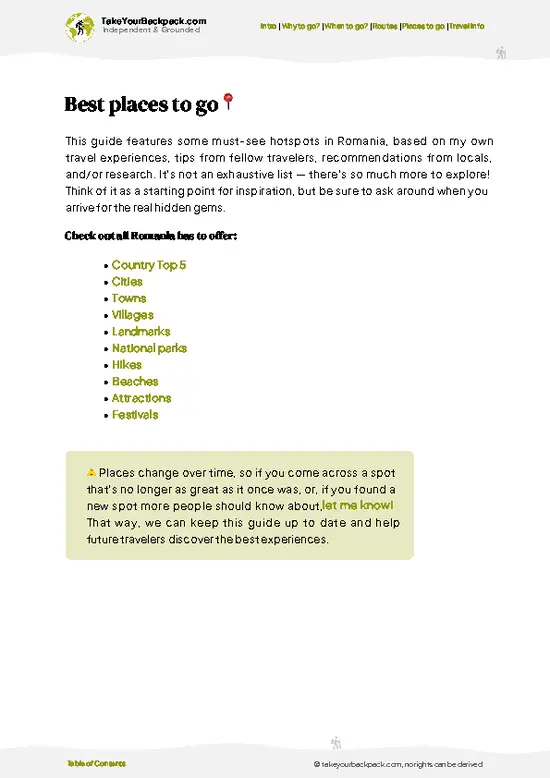
example page 3 from our offline Travel Guide for Romania
example page 4 from our offline Travel Guide for Romania
example page 5 from our offline Travel Guide for Romania
example page 6 from our offline Travel Guide for Romania
example page 7 from our offline Travel Guide for Romania
The digital guide (360 pages) contains:
✅ 94 highlights, ranked by travel appeal
✅ Optimized 5, 10 & 15-day travel routes
✅ Cities, national parks, landmarks, beaches
✅ How to get around
✅ Offline-friendly for travel without Wi-Fi
👉 Click to see all 30+ guide features

📅 Plan smarter in minutes, not weeks
✅ Month by month travel advice
✅ Festivals & national holidays
✅ Budget expectations

🗺️ Go to the right places, skip the overrated ones
✅ Honest pros & cons of destinations
✅ Top hikes, parks & viewpoints
✅ Lesser-known places most travelers miss
✅ Clear “worth it vs skip it” guidance

🛏️ Travel smoothly without rookie mistakes
✅ Best areas to stay
✅ Transport systems explained simply
✅ Common scams & safety advice
✅ SIM cards, money & practical tips

🌍 Understand the country, not just visit it
✅ Culture & traditions
✅ 52 Essential phrases & customs
✅ Festivals worth planning around
✅ Traveler-friendly historical context
✅ Insights that make places more meaningful

📱 Built for real travel conditions
✅ Fully downloadable PDF
✅ Works completely offline
✅ Optimized for phone use
✅ Useful in remote areas & buses
✅ Everything in one place
Stop searching, start planning
Get instant access to your full guide. 30‑day money-back guarantee.
+ Add another guide for just

By proceeding you agree to our terms.
Sent to your inbox immediately after payment • 100% Secure Checkout
Best Backpacking Travel Advisor 2025 tourism awardBest Backpacking
Travel Advisor
2025
What others say about Take Your Backpack Guides:
⭐⭐⭐⭐⭐
Fantastic, amazing amount of information!
⭐⭐⭐⭐⭐
My goodness this is amazing, it's what I've been looking for hats off too you!
⭐⭐⭐⭐⭐
I think this is absolutely BRILLIANT
⭐⭐⭐⭐
Very complete and informative. It's still missing places, but I gotta to commend you
⭐⭐⭐⭐⭐
This is truly amazing, thank you, can't wait to explore it with my kids!
⭐⭐⭐⭐⭐
Awesome resource, thank you!
⭐⭐⭐⭐⭐
This is amazing! Can't wait to explore the ones I haven't seen
⭐⭐⭐⭐
I love this! Well done, great idea.
⭐⭐⭐⭐⭐
Thanks for taking the time to make this gem!
⭐⭐⭐⭐⭐
This might be the best website I've ever seen.
⭐⭐⭐⭐⭐
Congratulations, and thank you so much for your work; it's incredibly valuable.
⭐⭐⭐⭐
In all seriousness I think you did a great job pointing out the important spots
⭐⭐⭐⭐⭐
10/10 very good
⭐⭐⭐⭐⭐
As someone who's only just starting to visit regularly this is awesome, thank you.
⭐⭐⭐⭐
Thank you very much! I'm going to visit my dad, it's going to be very useful!
⭐⭐⭐⭐⭐
This is really cool! We'll be travelling for the first time and this definitely come in handy.
⭐⭐⭐⭐⭐
You are now our minister of culture, congratulations 👨‍💼
⭐⭐⭐⭐⭐
Just wanted to tell you that this is a pearl! Going to follow your recommendations.
⭐⭐⭐⭐⭐
This is so cool. I'll definitely be using the resource for my travels soon.
⭐⭐⭐⭐⭐
This is very impressive! Good work.
⭐⭐⭐⭐⭐
This is an amazing and informative site. Very well done!

🛏️ Where to stay?Where to Stay: Romania Edition

Romania has plenty of hostels and budget guesthouses, with dorm beds typically running 50 to 90 lei (about US$11 to 20) a night and private doubles in family-run guesthouses from roughly 150 lei (US$33). In Bucharest, the Old Town (Lipscani) puts you right on top of the bars and walking distance from most sights, but weekend noise lasts until dawn. The streets around Piața Romană and Piața Victoriei are calmer and still on the metro. In Brașov, the medieval center and the quieter Șchei district sit at the foot of Tâmpa mountain, while central Cluj-Napoca is the pick for student nightlife and Sibiu’s Upper Town is compact, safe and quiet after dark.

If you enjoy meeting fellow travelers, consider … read more 👉
Romania has plenty of hostels and budget guesthouses, with dorm beds typically running 50 to 90 lei (about US$11 to 20) a night and private doubles in family-run guesthouses from roughly 150 lei (US$33). In Bucharest, the Old Town (Lipscani) puts you right on top of the bars and walking distance from most sights, but weekend noise lasts until dawn. The streets around Piața Romană and Piața Victoriei are calmer and still on the metro. In Brașov, the medieval center and the quieter Șchei district sit at the foot of Tâmpa mountain, while central Cluj-Napoca is the pick for student nightlife and Sibiu’s Upper Town is compact, safe and quiet after dark.

If you enjoy meeting fellow travelers, consider choosing hostels with high ratings for atmosphere. On the other hand, if you prefer having your own space, a hotel might be a better option.

RomaniaExplore Beyond This Category

👋 Meet the founderWho’s Behind Take Your Backpack?

Johan, backpacker and founder of TakeYourBackpackHi, I’m Johan (Netherlands 🇳🇱), the creator of TakeYourBackpack. Over the past 3 decades, I’ve backpacked through 90+ countries across six continents, gaining extensive experience with independent travel, long-term trips, and overland routes.

This site is built on a combination of firsthand travel experience and carefully curated insights from other backpackers. Many guides are based on places I’ve personally visited, while others bring together tips, observations, and practical advice shared by trusted travelers I’ve met along the way.

The goal is to provide realistic, experience-driven guidance — not generic itineraries — so you can explore destinations with better context, clearer expectations, and more confidence.