×
Solomon Islands🇸🇧 | 10 days itinerary

The Perfect 10-Day Route for Solomon Islands

By Johan Kruseman 🇳🇱 | Updated April 30, 2026
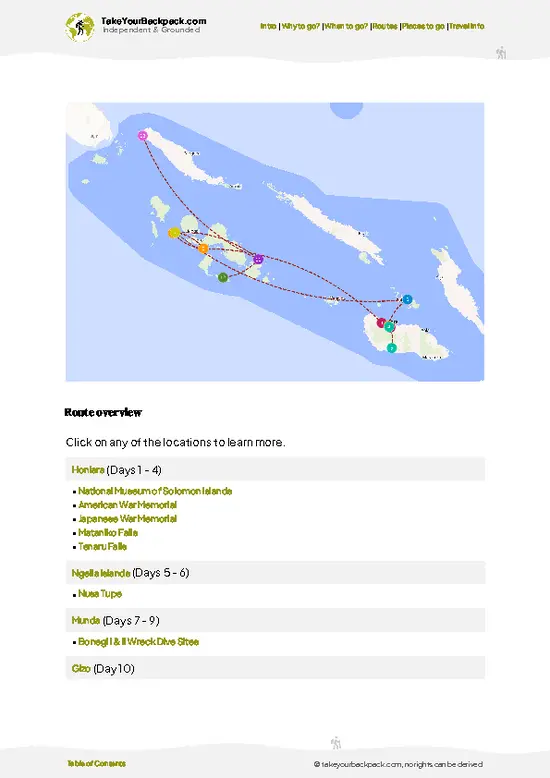
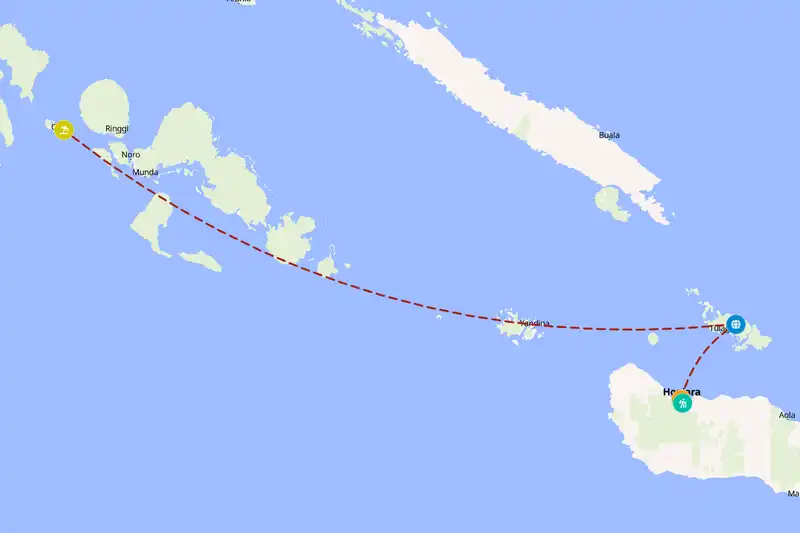
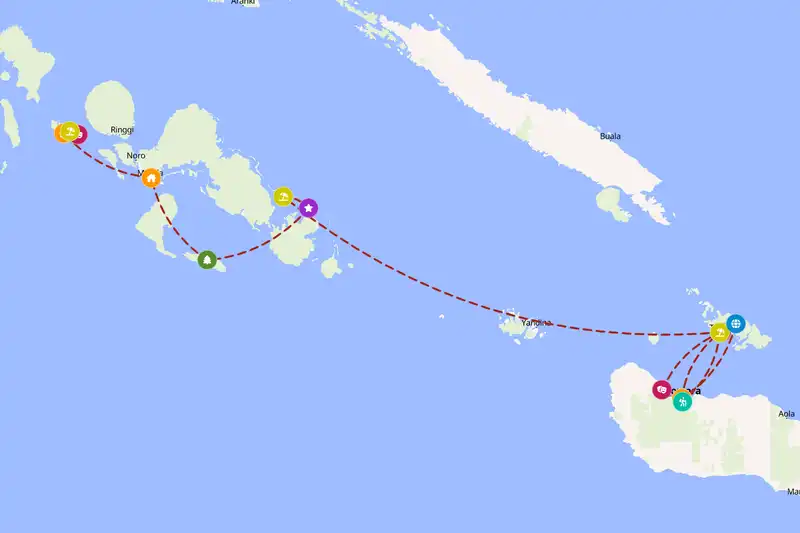
This 10-day route is for travelers who want a balanced mix of WWII history, waterfalls, and serious lagoon time without feeling rushed, comfortable with a couple of domestic flights and boat transfers but still wanting downtime built in. The pace is steady rather than frantic: you’ll use Honiara as a launchpad, then swing out to Munda and Marovo Lagoon for that classic Solomon Islands reef-and-village combo.

Days 1-3: Honiara, War History & Mataniko Falls

Start in Honiara, giving yourself Day 1 to land, change money, and get a feel for the capital’s rough-around-the-edges charm. On Day 2, dive into the WWII story that put Guadalcanal on every historian’s map: visit the National Museum of Solomon Islands for context, then head out to the American War Memorial and Japanese War Memorial to stand on the ridgelines that once decided the Pacific campaign, finishing with a simple dinner back in town. Day 3 is about nature and movement: hike to Mataniko Falls with a local guide, scrambling through … read more 👉
This 10-day route is for travelers who want a balanced mix of WWII history, waterfalls, and serious lagoon time without feeling rushed, comfortable with a couple of domestic flights and boat transfers but still wanting downtime built in. The pace is steady rather than frantic: you’ll use Honiara as a launchpad, then swing out to Munda and Marovo Lagoon for that classic Solomon Islands reef-and-village combo.

Days 1-3: Honiara, War History & Mataniko Falls

Start in Honiara, giving yourself Day 1 to land, change money, and get a feel for the capital’s rough-around-the-edges charm. On Day 2, dive into the WWII story that put Guadalcanal on every historian’s map: visit the National Museum of Solomon Islands for context, then head out to the American War Memorial and Japanese War Memorial to stand on the ridgelines that once decided the Pacific campaign, finishing with a simple dinner back in town. Day 3 is about nature and movement: hike to Mataniko Falls with a local guide, scrambling through jungle and riverbeds to caves and cascades, then return to Honiara for one last night before you trade city dust for outer-island air.

Days 4-6: Munda, Bonegi Wrecks & Marovo Lagoon Gateway

On Day 4, fly west to Munda, a laid-back town that feels like a frontier outpost with a runway; the flight itself is half the fun, skimming over reef and forest. Use the afternoon to walk the waterfront and line up your lagoon plans. Day 5 is your WWII-underwater day: arrange a boat and dive or snorkel the Bonegi I & II Wreck Dive Sites, where coral-encrusted wrecks lie in clear water shallow enough for confident snorkelers but rewarding for divers too; you’re back in Munda by late afternoon for a slow sunset over the bay. On Day 6, keep it flexible: explore more around Munda, visit local markets, or take a short excursion to nearby reefs as you stage for the jump into one of the world’s great lagoons.

Days 7-10: Marovo Lagoon & Tetepare Island Wilderness

On Day 7, travel by boat into Marovo Lagoon, a huge maze of islets, reef walls, and quiet villages that feels like a natural amphitheater of turquoise water and forested ridges; settle into a small lodge or homestay and let the pace drop. Day 8 is about immersion: paddle or boat between islands, snorkel over coral gardens, and visit carvers in local communities, letting the lagoon’s slow rhythm reset your internal clock. On Day 9, take a day trip to Tetepare Island, a conservation success story where there are no permanent villages, just forest, beaches, and rangers watching over turtles and dugongs; hike the trails, swim off wild beaches, and soak up the feeling of being somewhere that still runs on nature’s terms. Day 10 is your exit day: a last sunrise swim in Marovo Lagoon, then boat back toward Munda and fly to Honiara for your onward connection, carrying salt in your hair and a head full of reef colors instead of airport lounges.

For a bonus detour that few make time for, consider a side trip to the tiny community of Nusahope, where evenings are spent on the village jetty swapping stories under a sky full of stars.
Loading the map 🌍
film
0
0
0a
American War Memorial
film
1
1
1a
Japanese War Memorial
film
2
2
2a
Mataniko Falls
Joel Rooskov
film
3
3
3a
Bonegi I & II Wreck Dive Sites
film
4
4
4a
Tetepare Island
Trisha Dwyer

🛏️ Where to stay?10 Days of Adventure

✈️ The backpacker research shortcutSolomon Islands Travel Guide

An offline-friendly backpacking guide with optimized travel routes, ranked highlights, transport advice, and the best areas to stay.
example page 0 from our offline Travel Guide for Solomon Islandsexample page 1 from our offline Travel Guide for Solomon Islandsexample page 2 from our offline Travel Guide for Solomon Islandsexample page 3 from our offline Travel Guide for Solomon Islandsexample page 4 from our offline Travel Guide for Solomon Islandsexample page 5 from our offline Travel Guide for Solomon Islands
The digital guide (169 pages) contains:
45 highlights, ranked by travel appeal
Optimized 5, 10 & 15-day travel routes
Best neighborhoods to stay
How to get around
Offline-friendly for travel without Wi-Fi
👉 See all 30+ guide features

📅 Plan smarter in minutes, not weeks
Month by month travel advice
Festivals & national holidays
Budget expectations

🗺️ Go to the right places, skip the overrated ones
Honest pros & cons of destinations
Top hikes, parks & viewpoints
Lesser-known places most travelers miss
Clear “worth it vs skip it” guidance

🛏️ Travel smoothly without rookie mistakes
Best areas to stay
Transport systems explained simply
Common scams & safety advice
SIM cards, money & practical tips

🌍 Understand the country, not just visit it
Culture & traditions
52 Essential phrases & customs
Festivals worth planning around
Traveler-friendly historical context
Insights that make places more meaningful

📱 Built for real travel conditions
Fully downloadable PDF
Works completely offline
Optimized for phone use
Useful in remote areas & buses
Everything in one place
Save weeks of stressful planning
Get instant access to the full guide directly. 30-day money-back guarantee.


Sent to your inbox immediately after payment • 100% Secure Checkout
Best Backpacking Travel Advisor 2025 tourism awardBest Backpacking
Travel Advisor
2025
What others say about Take Your Backpack Guides:
⭐⭐⭐⭐⭐
Fantastic, amazing amount of information!
⭐⭐⭐⭐⭐
My goodness this is amazing, it's what I've been looking for hats off too you!
⭐⭐⭐⭐⭐
I think this is absolutely BRILLIANT
⭐⭐⭐⭐
Very complete and informative. It's still missing places, but I gotta to commend you
⭐⭐⭐⭐⭐
This is truly amazing, thank you, can't wait to explore it with my kids!
⭐⭐⭐⭐⭐
Awesome resource, thank you!
⭐⭐⭐⭐⭐
This is amazing! Can't wait to explore the ones I haven't seen
⭐⭐⭐⭐
I love this! Well done, great idea.
⭐⭐⭐⭐⭐
Thanks for taking the time to make this gem!
⭐⭐⭐⭐⭐
This might be the best website I've ever seen.
⭐⭐⭐⭐⭐
Congratulations, and thank you so much for your work; it's incredibly valuable.
⭐⭐⭐⭐
In all seriousness I think you did a great job pointing out the important spots
⭐⭐⭐⭐⭐
10/10 very good
⭐⭐⭐⭐⭐
As someone who's only just starting to visit regularly this is awesome, thank you.
⭐⭐⭐⭐
Thank you very much! I'm going to visit my dad, it's going to be very useful!
⭐⭐⭐⭐⭐
This is really cool! We'll be travelling for the first time and this definitely come in handy.
⭐⭐⭐⭐⭐
You are now our minister of culture, congratulations 👨‍💼
⭐⭐⭐⭐⭐
Just wanted to tell you that this is a pearl! Going to follow your recommendations.
⭐⭐⭐⭐⭐
This is so cool. I'll definitely be using the resource for my travels soon.
⭐⭐⭐⭐⭐
This is very impressive! Good work.
⭐⭐⭐⭐⭐
This is an amazing and informative site. Very well done!

🧭 RouteMore Ways to Explore

Travel Solomon Islands your way — from a quick highlights trip to a slow-paced adventure.

🙋 FAQGood to Know

Short version: Solomon Islands is backpackable, but it’s not “Southeast Asia easy.” It’s more like “rewarding if you’re patient and organized.”

Independent travel works best if you’re comfortable with: basic guesthouses, irregular transport, and plans changing last minute. English is widely spoken, people are friendly but not pushy, and crime against travelers is usually low outside a few rough pockets of Honiara at night.

The tricky parts for backpackers:
- Logistics are old-school: no big bus network, few online bookings, and flight schedules that change.
- Cash is king: ATMs are mostly in Honiara and a couple of larger towns; outside that, you’re paying in cash and often negotiating.
- Internet is slow/patchy: you can’t rely on constant data to re-plan on the fly.

How to make it easy on yourself:
- Use Honiara as your logistics hub: book domestic flights, pull cash, buy a local SIM, stock up on snacks and basic meds.
- Travel slower: instead of trying to hit 5–6 islands, pick 2–3 regions and explore properly.
- Rely on word-of-mouth: ask guesthouse owners about boats, hikes, and village stays; they usually know the real schedules and prices better than anything written down.

If you’ve backpacked places like Papua New Guinea, rural Indonesia, or remote Pacific islands, Solomon Islands will feel familiar. If your reference point is only Europe hostels and Thai night buses, it will feel rougher but very doable with the right mindset.
For a backpacker on a budget, the sweet spot is 2–3 weeks. Anything less than 10 days and you’ll spend most of your time in transit instead of actually being in the water or in villages.

Rough breakdowns that work well:
- 7–10 days (minimum that feels worthwhile):
- 2–3 days Honiara (logistics + a WWII site or two + a nearby beach)
- 4–6 days on one main area like Western Province (Gizo/Munda) or Marovo Lagoon
- This is a “taste,” not a deep dive.

- 2 weeks (ideal starter trip):
- 2–3 days Honiara
- 5–6 days Western Province (Gizo/Munda/nearby islands)
- 3–4 days in a second region like Marovo Lagoon or Malaita (for kastom villages and waterfalls)
- Enough time to absorb the slower pace and not panic when a boat is delayed.

- 3 weeks+ (slow-travel/backpacker heaven):
- Same as above, plus another island group like Central Province (Ngella/Tulagi) or Makira.
- Time to do multi-day village stays, freedive/snorkel every day, and chase down local festivals or markets.

Because transport is expensive and irregular, more days usually means better value: you spread the cost of domestic flights and boat rides over more actual “being there” time. If you’re very short on time, it’s better to focus on one region properly than to hop around the whole country.
Yes, you can get around without a car, and most backpackers do. But you’ll be stitching together a patchwork of planes, boats, and shared vehicles.

Main options:
- Domestic flights: The fastest way between provinces (e.g., Honiara–Gizo, Honiara–Munda). Not cheap, but they save days of boat travel. Book as early as you can once in Honiara.
- Boats:
- Scheduled ferries and cargo boats connect Honiara with major islands. They’re cheap, crowded, and slow, but very budget-friendly if you’re time-rich.
- Small outboard boats (banana boats) link villages and islands. These are your “local bus” on water. Always ask about lifejackets, weather, and price beforehand.
- Shared vehicles and pickups:
- On larger islands (Guadalcanal, Malaita, parts of Western Province), you’ll find shared pickups and minibuses running main roads. They leave when full, not by timetable.
- Walking:
- In villages and small islands, you’ll walk a lot. Trails can be muddy and basic, so sandals plus light hikers or trail runners are ideal.

What you give up by not having a car:
- Total freedom on big islands like Guadalcanal; some remote waterfalls or war sites are easier with a hired vehicle.

How to compensate on a budget:
- Base yourself in a village or guesthouse and do day trips by boat or on foot.
- Ask locals to coordinate shared boat rides with other guests or villagers to split costs.
- Be flexible with days: if the boat doesn’t go today, it probably goes tomorrow or when enough people show up.

For most backpackers, renting a car is unnecessary and often more hassle than it’s worth. The local system works fine if you accept island time.
For budget travelers, “must-visit” means places where the experience is big but the infrastructure is still local and characterful.

Top picks:
- Western Province (Gizo, Munda, nearby islands):
- Best all-round base for backpackers: snorkeling, diving, WWII wrecks, laid-back islands, and a range of simple guesthouses.
- Gizo: easy boat access to tiny islands with white sand and coral gardens; good for day trips and cheap-ish stays.
- Munda: excellent reefs and wrecks, plus a more low-key town vibe.

- Marovo Lagoon:
- One of the largest saltwater lagoons on earth, ringed by villages and small eco-lodges.
- Great for budget-friendly village stays, canoe trips, and snorkeling straight off the shore.
- You trade nightlife and convenience for quiet, local life and serious water time.

- Central Province (Ngella/Tulagi area):
- Close to Honiara but feels far more relaxed.
- Good for reef time, WWII history, and village visits without long flights.

- Rural Guadalcanal (outside Honiara):
- Waterfalls, rivers, and village life within a day trip or overnight from the capital.
- Good if you want jungle hikes and cold river swims without flying to another province.

- Cultural visits on Malaita (if you have time and patience for logistics):
- Strong kastom culture, traditional music, and village stays.
- Less polished for tourism, which is exactly why it’s interesting for backpackers who like raw, real experiences.

If you’re on a tight budget and limited time, a combo like: Honiara (for logistics) + Western Province (Gizo/Munda) + either Marovo Lagoon or Central Province gives you reefs, WWII history, and village life without spreading yourself too thin.
If you’re short on time or cash, skip anything that eats days in transit without adding something unique to your trip.

What you can reasonably skip:
- Trying to hit too many provinces:
- Don’t chase a “country completion” checklist. Each extra province usually means another flight or long boat ride. Better to go deep in 1–2 regions than shallow in 5.

- Extended time in Honiara:
- Use Honiara as a logistics hub: 1–2 nights to sort flights, cash, SIM, and maybe a WWII site or nearby beach.
- Skip hanging around the city just to “see more of it.” The real payoff is out in the islands and villages.

- Expensive resort-style stays:
- High-end dive resorts can burn your budget fast. If you’re counting coins, focus on simpler guesthouses and village stays; the same reefs are often accessible by cheaper local boats.

- Very remote islands that require multiple hops:
- If reaching an island needs a domestic flight plus an overnight boat plus a charter, that’s a lot of time and money for one spot.
- Save those for a longer, dedicated trip when you can afford the detours.

- Over-scheduling WWII sites if you’re not a hardcore history buff:
- One or two well-chosen sites around Honiara or Munda give you a strong sense of the history.
- You don’t need to see every single wreck or battlefield unless that’s your main reason for visiting.

For a short backpacking trip, focus on: a couple of days in Honiara for setup, then one main island region (Western Province or Marovo) plus maybe one easy add-on (Central Province or rural Guadalcanal). Everything else can wait for your “round two” visit.

🇸🇧 Solomon IslandsDiscover the Country

Ready to build a truly unique trip? Predefined routes are perfect for first-time visitors, but there is so much more to discover. Whether you are chasing a city trip, pristine national parks, local food scenes, or quiet beaches, pick a category to design your own path.