×
Spain🇪🇸 | 14 days itinerary

14 Days in Spain

By Johan Kruseman 🇳🇱 | Updated May 6, 2026
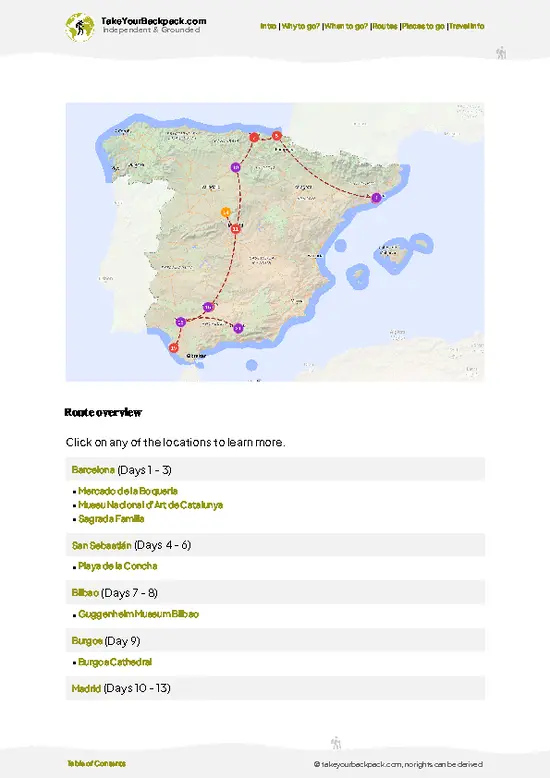
This 14-day itinerary is for travelers who want a balanced first sweep of Spain’s greatest hits, mixing art cities, medieval towns, and a taste of the Mediterranean coast at a moderate pace using high-speed trains and a couple of regional hops. You’ll cover central Spain and the east coast without burning out, with enough two- and three-night stays to actually enjoy late dinners and slow mornings.

Days 1-4: Madrid and royal Spain

Start with four nights in Madrid, using the city as both a cultural heavyweight and a springboard for nearby towns. Dedicate one day to the Prado Museum and another to pairing the Museo Nacional Centro de Arte Reina Sofía with the Museo Nacional Thyssen-Bornemisza, giving yourself long coffee breaks in between instead of trying to sprint through the collections. Slot in a visit to the Palacio Real de Madrid on a lighter museum day, then use one full day for a quick escape to Toledo, where the hilltop old town and layered Jewish-Christian-Muslim history give you … read more 👉
This 14-day itinerary is for travelers who want a balanced first sweep of Spain’s greatest hits, mixing art cities, medieval towns, and a taste of the Mediterranean coast at a moderate pace using high-speed trains and a couple of regional hops. You’ll cover central Spain and the east coast without burning out, with enough two- and three-night stays to actually enjoy late dinners and slow mornings.

Days 1-4: Madrid and royal Spain

Start with four nights in Madrid, using the city as both a cultural heavyweight and a springboard for nearby towns. Dedicate one day to the Prado Museum and another to pairing the Museo Nacional Centro de Arte Reina Sofía with the Museo Nacional Thyssen-Bornemisza, giving yourself long coffee breaks in between instead of trying to sprint through the collections. Slot in a visit to the Palacio Real de Madrid on a lighter museum day, then use one full day for a quick escape to Toledo, where the hilltop old town and layered Jewish-Christian-Muslim history give you a compact contrast to Madrid’s boulevards before you return to the capital for another late-night paseo.

Days 5-7: Castles and aqueducts - Segovia and Cuenca

Leave Madrid for a night in Segovia, where the Roman aqueduct and fairytale Alcázar feel like a live-action history book and everything is walkable from your guesthouse. This move keeps travel short while shifting you into a smaller, more atmospheric town, perfect for an evening of roast lamb and quiet streets. From there, continue to Cuenca for one night, trading Roman stone for dramatic cliffs and hanging houses; spending the night instead of day-tripping means you get the old town almost to yourself once the buses leave, and you still keep the overall pace gentle.

Days 8-11: Valencia - science, sand, and slow evenings

Head east to Valencia for three nights, giving your brain a break from castles and cathedrals. Spend a full day at the Ciudad de las Artes y las Ciencias, where you can pick and choose between the science museum, oceanarium, and just wandering the futuristic architecture without rushing. Use another day to graze your way through the Mercado Central de Valencia and then walk or bike out toward the beach, letting the city’s park-filled riverbed and long evenings reset your pace before the final leg.

Days 12-14: Barcelona - Gaudí and the Mediterranean finale

Finish with three nights in Barcelona, arriving by train so you roll straight into city life. Anchor one day around the Sagrada Familia, giving yourself time to circle the exterior, explore the interior, and then decompress in a nearby café instead of sprinting to the next sight. On another day, head up to Park Güell for Gaudí’s playful architecture and city views, then drop back into town to snack your way through the Mercado de la Boqueria and wander the Gothic Quarter, ending your two-week run with a sunset stroll along the waterfront rather than a last-minute checklist scramble.

My favorite moment on this route is the shift from Madrid’s Prado to a lazy afternoon in Valencia’s parks, when you realize you’re not just sightseeing Spain—you’re actually living in it for a couple of weeks.
Loading the map 🌍
film
0
0
0a
Madrid
Pixabay
film
1
1
1a
Prado Museum
film
2
2
2a
Segovia
Ubaldo Naya
film
3
3
3a
Cuenca
Ramona Gilda
film
4
4
4a
Valencia
film
5
5
5a
Barcelona
Pixabay
film
6
6
6a
Sagrada Familia
Pixabay

🛏️ Where to stay?The Route Breakdown

✈️ The backpacker research shortcutSpain Travel Guide

An offline-friendly backpacking guide with optimized travel routes, ranked highlights, transport advice, and the best areas to stay.
example page 0 from our offline Travel Guide for Spainexample page 1 from our offline Travel Guide for Spainexample page 2 from our offline Travel Guide for Spainexample page 3 from our offline Travel Guide for Spainexample page 4 from our offline Travel Guide for Spainexample page 5 from our offline Travel Guide for Spain
The digital guide (458 pages) contains:
150 highlights, ranked by travel appeal
Optimized 7, 14 & 21-day travel routes
Best neighborhoods to stay
How to get around
Offline-friendly for travel without Wi-Fi
👉 See all 30+ guide features

📅 Plan smarter in minutes, not weeks
Month by month travel advice
Festivals & national holidays
Budget expectations

🗺️ Go to the right places, skip the overrated ones
Honest pros & cons of destinations
Top hikes, parks & viewpoints
Lesser-known places most travelers miss
Clear “worth it vs skip it” guidance

🛏️ Travel smoothly without rookie mistakes
Best areas to stay
Transport systems explained simply
Common scams & safety advice
SIM cards, money & practical tips

🌍 Understand the country, not just visit it
Culture & traditions
52 Essential phrases & customs
Festivals worth planning around
Traveler-friendly historical context
Insights that make places more meaningful

📱 Built for real travel conditions
Fully downloadable PDF
Works completely offline
Optimized for phone use
Useful in remote areas & buses
Everything in one place
Save weeks of stressful planning
Get instant access to the full guide directly. 30-day money-back guarantee.


Sent to your inbox immediately after payment • 100% Secure Checkout
Best Backpacking Travel Advisor 2025 tourism awardBest Backpacking
Travel Advisor
2025
What others say about Take Your Backpack Guides:
⭐⭐⭐⭐⭐
Fantastic, amazing amount of information!
⭐⭐⭐⭐⭐
My goodness this is amazing, it's what I've been looking for hats off too you!
⭐⭐⭐⭐⭐
I think this is absolutely BRILLIANT
⭐⭐⭐⭐
Very complete and informative. It's still missing places, but I gotta to commend you
⭐⭐⭐⭐⭐
This is truly amazing, thank you, can't wait to explore it with my kids!
⭐⭐⭐⭐⭐
Awesome resource, thank you!
⭐⭐⭐⭐⭐
This is amazing! Can't wait to explore the ones I haven't seen
⭐⭐⭐⭐
I love this! Well done, great idea.
⭐⭐⭐⭐⭐
Thanks for taking the time to make this gem!
⭐⭐⭐⭐⭐
This might be the best website I've ever seen.
⭐⭐⭐⭐⭐
Congratulations, and thank you so much for your work; it's incredibly valuable.
⭐⭐⭐⭐
In all seriousness I think you did a great job pointing out the important spots
⭐⭐⭐⭐⭐
10/10 very good
⭐⭐⭐⭐⭐
As someone who's only just starting to visit regularly this is awesome, thank you.
⭐⭐⭐⭐
Thank you very much! I'm going to visit my dad, it's going to be very useful!
⭐⭐⭐⭐⭐
This is really cool! We'll be travelling for the first time and this definitely come in handy.
⭐⭐⭐⭐⭐
You are now our minister of culture, congratulations 👨‍💼
⭐⭐⭐⭐⭐
Just wanted to tell you that this is a pearl! Going to follow your recommendations.
⭐⭐⭐⭐⭐
This is so cool. I'll definitely be using the resource for my travels soon.
⭐⭐⭐⭐⭐
This is very impressive! Good work.
⭐⭐⭐⭐⭐
This is an amazing and informative site. Very well done!

🧭 RouteGot More or Less Time?

Travel Spain your way — from a quick highlights trip to a slow-paced adventure.

🙋 FAQCommon Questions

Spain is one of the easiest countries in Europe to backpack on your own. The big wins for solo, budget travelers are safety, clear infrastructure, and a culture that stays out late, so you rarely feel alone on the street at 10–11 pm. Cities are walkable, hostels are everywhere, and English is common enough in tourist areas that you can get by with basic Spanish plus a translation app. The main thing that surprises people is how regional Spain is: Catalonia, Basque Country, Andalusia, Galicia, and Madrid all feel like different mini-countries with their own languages, food, and schedules. That’s a feature, not a bug, but it means you should expect different meal times, accents, and even bar etiquette as you move around. For budget backpackers, Spain is friendly if you lean into local rhythms: eat the menú del día at lunch instead of dinner, pre-game with supermarket wine and snacks, and use free walking tours to get oriented in each city. You do need to watch for pickpockets in Barcelona, Madrid, and on crowded beaches, but violent crime is rare in typical backpacker zones. Overall, if you’ve never backpacked Europe before, Spain is a very forgiving first country: clear train and bus networks, lots of cheap food options, and a social hostel scene that makes it easy to find people to share tapas or a night bus with.
For a first backpacking trip to Spain, 10–14 days is the sweet spot where you can see a few regions without turning your trip into a train marathon. With 7 days, you should focus hard: either do just one region (for example, only Andalusia: Seville, Córdoba, Granada) or one big city plus day trips (Madrid + Toledo + Segovia, or Barcelona + Girona + Costa Brava). With 10–14 days, you can do a classic loop like: Barcelona (3) → Valencia (2) → Madrid (3) → Seville (3) with a day trip or two. That gives you coast, food, nightlife, and some history without living on transport. With 3 weeks, you can add either the north (Basque Country and maybe Galicia) or more of the south (Cádiz, Ronda, Málaga). Anything over a month and you can slow down, chase cheap weekly rentals, and maybe walk a section of the Camino de Santiago. Budget travelers get more value by staying longer in fewer places: weekly hostel discounts, cheaper apartment rentals, and less money burned on trains. If you only have a short trip, prioritize depth over bragging rights; three cities done well beats six cities you only see from the bus window.
You can absolutely get around Spain without a car, and for backpackers it is usually cheaper and less stressful to rely on public transport. The backbone of the country is its rail network: high-speed AVE trains connect major cities like Madrid, Barcelona, Seville, Málaga, and Valencia in a few hours, and slower regional trains cover smaller cities. Trains are comfortable and easy to navigate, but the fast ones can be pricey if you buy last minute, so budget travelers should book advance tickets when possible or use slower regional options. Buses fill in almost every gap. Companies like ALSA and Avanza run frequent, cheap routes between cities and into smaller towns where trains do not reach. For many budget routes (Madrid–Granada, Seville–Faro, smaller coastal towns), buses are the best value. Inside cities, you can rely on metro systems (Madrid, Barcelona, Valencia, Bilbao), trams, and cheap local buses. Walking is usually the best way to explore old towns, and bike rentals are common in flat cities like Valencia and Seville. Rideshare apps and BlaBlaCar-style carpooling can be a good hack for awkward routes or late-night returns, but you do not need them to make a solid itinerary. The only time a car really helps is if you want to explore remote villages, hike in less-connected mountain areas, or do a deep dive into rural wine regions. For a classic backpacking route hitting major cities and a few coastal spots, public transport is more than enough.
For a budget backpacker, the must-visits in Spain are the places that give you a strong sense of the country’s character without draining your wallet. Madrid is a top pick because it is central, well-connected, and full of cheap or free culture: world-class museums with free hours, lively plazas, and late-night bar streets where you can eat well on tapas and cañas. Barcelona is still worth it for the architecture and the mix of city and sea, but you get more value if you focus on walking neighborhoods (Gràcia, El Born, Barceloneta) and pick just one or two paid Gaudí sites instead of trying to see everything. In the south, Seville and Granada are the heavy hitters. Seville gives you classic Andalusian energy: orange trees, flamenco, and tapas bars that are busy until late. Granada is a budget dream because many bars still give you a free tapa with each drink, and the Alhambra is one of the few sights in Spain that truly deserves its global reputation. If you like smaller, more relaxed cities, Valencia is a smart stop: cheaper than Barcelona, great beaches, a huge park built in a former riverbed, and excellent paella. In the north, San Sebastián is famous for food and beaches, while Bilbao gives you the Guggenheim plus a gritty, real-city feel. If you want something different from the usual route, consider a few days on the Camino de Santiago (for example, starting from Sarria or León): cheap pilgrim hostels, a built-in social scene, and a slower way to see rural Spain without planning every detail.
If you are short on time, skip anything that adds long travel days without giving you a new side of Spain. For most backpackers, that means skipping far-flung islands like the Canaries and sometimes the Balearics (Ibiza, Mallorca, Menorca) on a first, short trip; they are fun but eat days in transit and money on flights and ferries. You can also skip trying to see every Gaudí building or every royal palace; pick one or two big-ticket sights per city and spend the rest of your time walking neighborhoods and eating well. In Barcelona, you can skip La Rambla beyond a quick walk-through; it is crowded, overpriced, and full of pickpockets, while nearby streets in El Raval or the Gothic Quarter feel more real and are better for budget food. In Madrid, you can skip organized pub crawls and just follow the crowds through La Latina or Malasaña for cheaper, more local nights out. If you are tight on days, do not try to hit both the deep south (Andalusia) and the far north (Basque Country, Galicia) in one short trip; choose one region and explore it properly instead of spending full days on trains and buses. Many smaller coastal resort towns that cater mainly to package tourists can also be skipped unless you specifically want a beach week; you will get more culture and better value in cities like Valencia, Cádiz, or Málaga, which combine beaches with real neighborhoods and cheaper local food.

🇪🇸 SpainWhere to Go Next

Ready to build a truly unique trip? Predefined routes are perfect for first-time visitors, but there is so much more to discover. Whether you are chasing a city trip, pristine national parks, local food scenes, or quiet beaches, pick a category to design your own path.