×
Venezuela🇻🇪 | 5 days itinerary

Venezuela in 5 Days

By Johan Kruseman 🇳🇱 | Updated May 7, 2026
This 5-day route is for travelers who want a relaxed but rich taste of Venezuela’s Caribbean side without racing across the whole country, using a simple combo of domestic flight plus short taxi rides and boat transfers. You’ll base yourself mostly on Isla Margarita, mixing easy beach days with one fun waterpark stop and a bit of local town life, so you never feel rushed or stuck in transit instead of in the sea.

Days 1-2: Isla Margarita - Playa El Agua base

Fly into Isla Margarita and head straight up to Playa El Agua, your main base and one of the island’s classic long, palm-lined beaches. Two nights here lets you actually settle in: walk the sand at sunrise before the day-trippers arrive, try a beachside arepa stand, and get a feel for the island’s rhythm instead of just ticking off a quick swim and moving on. The idea is to keep logistics light, so you can spend your energy in the water, not in buses.

Day 3: Isla Margarita - Playa Parguito and Parque El Agua

Shift your focus slightly along … read more 👉
This 5-day route is for travelers who want a relaxed but rich taste of Venezuela’s Caribbean side without racing across the whole country, using a simple combo of domestic flight plus short taxi rides and boat transfers. You’ll base yourself mostly on Isla Margarita, mixing easy beach days with one fun waterpark stop and a bit of local town life, so you never feel rushed or stuck in transit instead of in the sea.

Days 1-2: Isla Margarita - Playa El Agua base

Fly into Isla Margarita and head straight up to Playa El Agua, your main base and one of the island’s classic long, palm-lined beaches. Two nights here lets you actually settle in: walk the sand at sunrise before the day-trippers arrive, try a beachside arepa stand, and get a feel for the island’s rhythm instead of just ticking off a quick swim and moving on. The idea is to keep logistics light, so you can spend your energy in the water, not in buses.

Day 3: Isla Margarita - Playa Parguito and Parque El Agua

Shift your focus slightly along the coast to Playa Parguito, a livelier surf-friendly beach that feels more local and less resorty, then cool off at Parque El Agua Isla de Margarita, the island’s main waterpark. This is your playful day: body-surfing small waves in the morning, then lazy river laps and slides in the afternoon, with taxis or short rides keeping the movements simple and low-stress. You still sleep on Isla Margarita, so you’re not packing and unpacking every night.

Days 4-5: Isla Margarita - Museo Marino and La Asunción

Use your last stretch to add some character beyond the sand by visiting the Museo Marino de Margarita, where you get a quick, engaging crash course on the marine life you’ve been swimming with all week. Then spend time in La Asunción, a quieter town with a more traditional feel, to walk its streets, grab a slow lunch, and pick up a sense of island life away from the beach bars before flying out on Day 5. You leave with a compact but well-rounded snapshot of coastal Venezuela, without ever feeling like you had to sprint to keep up.

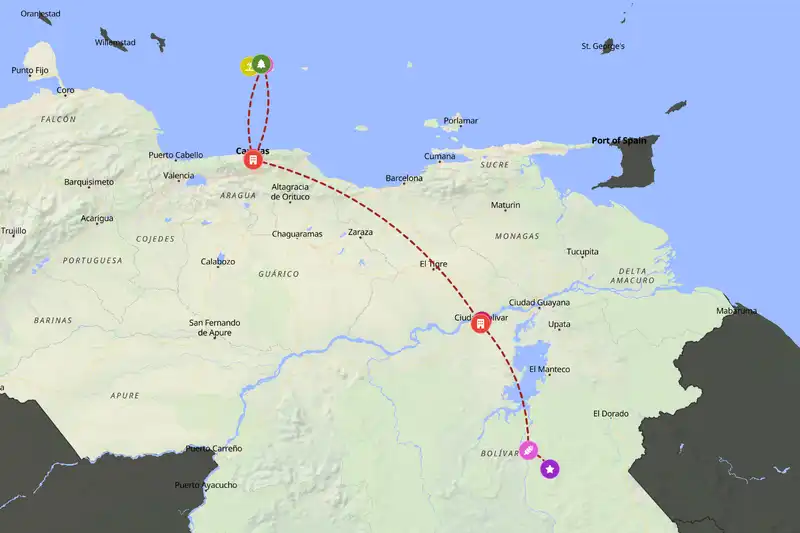
As a final bonus idea once you’ve tasted Isla Margarita, keep an eye on the tiny fishing village of Chuao on the mainland coast, where cacao drying in the sun and boat-only access make it feel like a secret world of its own.
Loading the map 🌍
film
0
0
0a
Playa El Agua
Vlad Malaymen
film
1
1
1a
Playa Parguito
film
2
2
2a
Parque El Agua Isla de Margarita
film
3
3
3a
Museo Marino de Margarita

🛏️ Where to stay?5 Days of Adventure

👉 Click on any of the locations to learn more.
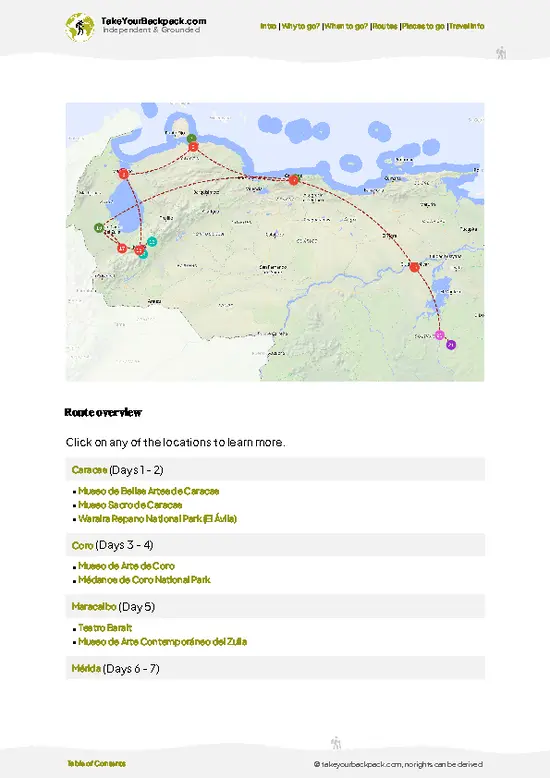
Days 1 - 4Isla Margarita
Days 5 - 7Playa El Agua
Day 8La Asunción

✈️ The backpacker research shortcutVenezuela Travel Guide

An offline-friendly backpacking guide with optimized travel routes, ranked highlights, transport advice, and the best areas to stay.
example page 0 from our offline Travel Guide for Venezuelaexample page 1 from our offline Travel Guide for Venezuelaexample page 2 from our offline Travel Guide for Venezuelaexample page 3 from our offline Travel Guide for Venezuelaexample page 4 from our offline Travel Guide for Venezuelaexample page 5 from our offline Travel Guide for Venezuela
The digital guide (332 pages) contains:
102 highlights, ranked by travel appeal
Optimized 5, 10 & 15-day travel routes
Best neighborhoods to stay
How to get around
Offline-friendly for travel without Wi-Fi
👉 See all 30+ guide features

📅 Plan smarter in minutes, not weeks
Month by month travel advice
Festivals & national holidays
Budget expectations

🗺️ Go to the right places, skip the overrated ones
Honest pros & cons of destinations
Top hikes, parks & viewpoints
Lesser-known places most travelers miss
Clear “worth it vs skip it” guidance

🛏️ Travel smoothly without rookie mistakes
Best areas to stay
Transport systems explained simply
Common scams & safety advice
SIM cards, money & practical tips

🌍 Understand the country, not just visit it
Culture & traditions
52 Essential phrases & customs
Festivals worth planning around
Traveler-friendly historical context
Insights that make places more meaningful

📱 Built for real travel conditions
Fully downloadable PDF
Works completely offline
Optimized for phone use
Useful in remote areas & buses
Everything in one place
Save weeks of stressful planning
Get instant access to the full guide directly. 30-day money-back guarantee.


Sent to your inbox immediately after payment • 100% Secure Checkout
Best Backpacking Travel Advisor 2025 tourism awardBest Backpacking
Travel Advisor
2025
What others say about Take Your Backpack Guides:
⭐⭐⭐⭐⭐
Fantastic, amazing amount of information!
⭐⭐⭐⭐⭐
My goodness this is amazing, it's what I've been looking for hats off too you!
⭐⭐⭐⭐⭐
I think this is absolutely BRILLIANT
⭐⭐⭐⭐
Very complete and informative. It's still missing places, but I gotta to commend you
⭐⭐⭐⭐⭐
This is truly amazing, thank you, can't wait to explore it with my kids!
⭐⭐⭐⭐⭐
Awesome resource, thank you!
⭐⭐⭐⭐⭐
This is amazing! Can't wait to explore the ones I haven't seen
⭐⭐⭐⭐
I love this! Well done, great idea.
⭐⭐⭐⭐⭐
Thanks for taking the time to make this gem!
⭐⭐⭐⭐⭐
This might be the best website I've ever seen.
⭐⭐⭐⭐⭐
Congratulations, and thank you so much for your work; it's incredibly valuable.
⭐⭐⭐⭐
In all seriousness I think you did a great job pointing out the important spots
⭐⭐⭐⭐⭐
10/10 very good
⭐⭐⭐⭐⭐
As someone who's only just starting to visit regularly this is awesome, thank you.
⭐⭐⭐⭐
Thank you very much! I'm going to visit my dad, it's going to be very useful!
⭐⭐⭐⭐⭐
This is really cool! We'll be travelling for the first time and this definitely come in handy.
⭐⭐⭐⭐⭐
You are now our minister of culture, congratulations 👨‍💼
⭐⭐⭐⭐⭐
Just wanted to tell you that this is a pearl! Going to follow your recommendations.
⭐⭐⭐⭐⭐
This is so cool. I'll definitely be using the resource for my travels soon.
⭐⭐⭐⭐⭐
This is very impressive! Good work.
⭐⭐⭐⭐⭐
This is an amazing and informative site. Very well done!

🧭 RouteMore Ways to Explore

Travel Venezuela your way — from a quick highlights trip to a slow-paced adventure.

🙋 FAQGood to Know

Short version: Venezuela is not a classic “show up and wing it” backpacking country right now, but it’s doable if you’re experienced, flexible, and cautious. First-timers to South America are usually better off starting elsewhere, then coming here once they’re used to the region.

The main challenges are safety, cash, and logistics. You need to be very deliberate about where you go, how you move, and when you’re outside after dark. Big cities like Caracas, Maracaibo, and some parts of Valencia have serious crime issues; you stick to safer neighborhoods, move mostly by trusted taxis or rides, and avoid flashing phones or cameras on the street.

Independent backpacking is easiest if you anchor your trip around a few hubs: Mérida (Andes and hiking), Santa Elena de Uairén (Gran Sabana), Ciudad Bolívar or Puerto Ordaz (launch point for Canaima/Angel Falls), and the coastal areas near Choroní or Morrocoy. In those places you can find guesthouses, local guides, and other travelers, and you can arrange tours on the ground.

You can technically do everything independently, but for certain areas it’s smarter to use local agencies or guides: Angel Falls/Canaima, remote tepui treks, and some jungle routes. These aren’t “tour bus” experiences; they’re logistics-heavy trips where a good local operator means safer boats, better food, and fewer headaches.

Spanish helps a lot. Outside tourist zones, English is rare, and you’ll be negotiating prices, transport, and directions constantly. If your Spanish is basic, write down key phrases and keep offline translation handy.

You also need a strong offline setup: maps downloaded, accommodation pre-pinned, and key addresses written down. Power cuts and weak signal are normal in some regions, so don’t rely on always being online.

If you’re used to backpacking in places like Colombia, Peru, or Mexico and you’re comfortable with rough edges, Venezuela can be incredibly rewarding. If you’re brand new to travel or anxious about safety, it’s not the easiest first destination to tackle solo.
If you only have 1 week, you should focus hard and not try to see the whole country. One realistic 7-day plan is: fly into Caracas, connect to Canaima for Angel Falls, spend 3–4 days on the lagoon and river trip, then 2–3 days on the coast (Choroní or a quick Morrocoy hop) before flying out. Another 1-week option is to skip Angel Falls and do Mérida plus the Andes and hot springs, with maybe a quick side trip to the Llanos for wildlife.

With 2 weeks, you can do a solid “highlight reel” without sprinting. A strong 14-day structure: 4–5 days in Canaima/Angel Falls, 4–5 days in Mérida (hiking, páramo, cable car, nearby villages), and 3–4 days on the Caribbean coast (Choroní, Morrocoy, or a simple beach base). That gives you jungle, mountains, and sea without spending your whole trip on buses.

With 3 weeks, you can add the Gran Sabana or a longer trek. For example: 5 days Canaima/Angel Falls, 5–6 days Gran Sabana from Santa Elena de Uairén (waterfalls, viewpoints, maybe a short tepui hike), 5–6 days Mérida and the Andes, and 4–5 days of coast recovery at the end. This is where Venezuela really starts to feel like a full journey instead of a quick hit.

A month or more lets you slow down, chase cheap local deals, and wait out weather. You can add a serious trek like Roraima (usually 5–7 days), a Llanos wildlife trip, or extra time in smaller Andean or coastal towns. Longer stays also help you adapt to local rhythms, find trusted contacts, and reduce risk by not rushing transfers.

Because internal flights and long-distance buses can be unpredictable, always build in buffer days between big moves. In Venezuela, “how much time you need” is as much about margin for delays as it is about sightseeing.
You can get around Venezuela without a car, but you need patience, flexibility, and a bit of strategy. Think of it as a patchwork of transport types rather than one smooth system.

For long distances, the main options are domestic flights and intercity buses. Flights are the fastest way to jump between Caracas, Canaima, Puerto Ordaz, and sometimes Mérida or Maracaibo. They can be irregular, so you plan your route around the flights you can actually get, not the other way around.

Intercity buses connect most major cities and many regional towns. They’re cheap but can be slow, and schedules may change. Night buses are common, but for safety and comfort it’s usually better to travel by day when you can, especially on routes with fewer tourists.

For medium distances and local moves, you’ll use shared taxis, minibuses, and moto-taxis. In cities and towns, colectivos (shared vans) and buses are the budget backbone, but they can be crowded and not always clearly marked. When arriving somewhere new, it’s often worth paying a bit more for a registered taxi or a ride arranged by your guesthouse, at least for the first hop.

To reach national parks and remote areas, you usually combine public transport with organized transfers. For example, to get to Canaima and Angel Falls, you fly into Canaima and then your tour operator handles boats and local logistics. For the Gran Sabana, you reach Santa Elena de Uairén by bus or shared taxi, then join a local tour or hire a driver for day trips and treks.

On the Caribbean coast, you’ll often use boats to hop between beaches and islands. These are usually arranged from the nearest town or port (like Choroní or Chichiriviche) and priced per boat or per person depending on the route.

Renting a car is possible but not necessary for most backpackers and adds its own risks: fuel queues, police checkpoints, navigation stress, and security. If you’re on a budget and willing to accept some discomfort, you can absolutely cross the country using public and semi-public transport, as long as you keep your days flexible and avoid moving around late at night.
For a backpacker on a budget, the must-visit list is about variety: jungle, mountains, and coast, with at least one big “only in Venezuela” experience.

Canaima National Park and Angel Falls are the headliners. The lagoon with its curtain of waterfalls, the boat ride up the river, and the view of Angel Falls dropping off the tepui are worth building your trip around. It’s not the cheapest part of the country, but if you’re coming all this way, this is the one big splurge that actually feels justified.

The Gran Sabana, accessed from Santa Elena de Uairén, is another standout. You get wide open savanna, tabletop mountains on the horizon, and a ridiculous number of waterfalls you can swim in. It’s a dream for wild camping, short hikes, and multi-day treks if you have the time and budget. Roraima, the iconic tepui, is a serious but manageable multi-day trek for fit backpackers.

Mérida and the Andes are the best base for budget travelers who like mountains and cool air. The city has a student vibe, cheaper food, and plenty of guesthouses. From there you can ride one of the world’s highest cable cars (when operating), hike in the páramo, visit small villages like Mucuchíes or Jají, and soak in hot springs. It’s also a good place to arrange Llanos wildlife trips if you want an affordable mini-safari.

For the coast, Choroní and nearby Puerto Colombia are classic backpacker stops: colonial streets, jungle-backed beaches, and boat trips to quieter coves. Morrocoy National Park, with its cays and sandbars, is another strong choice if you like clear water and day trips by boat. Both can be done on a budget if you share boats and stay in simple posadas.

If you have extra time, the Llanos (for wildlife and cowboy culture) and some of the less-developed coastal stretches are great add-ons. But if you’re short on days or money, prioritize: Angel Falls/Canaima, either Gran Sabana or Mérida, and at least a few days on the Caribbean.
If you’re short on time, skip anything that eats days in transit without giving you a totally different experience from what you already have on your route.

You can skip Caracas as a sightseeing destination. Use it as a transit hub if you must, but don’t burn precious days trying to “do” the city. The safety trade-offs and stress usually aren’t worth it for a quick visit, especially when you could be in the mountains or on the coast instead.

You can also skip trying to hit too many big cities: Maracaibo, Valencia, Barquisimeto, and similar urban centers are important locally but not essential for a short backpacking trip. They add bus hours, not variety. If you want a city feel, Mérida gives you enough urban life plus easy access to nature.

If your budget is tight, you might skip doing both the Gran Sabana and a long Llanos trip. They’re different ecosystems, but both are about wide landscapes and nature. Pick one: Gran Sabana if you’re more into waterfalls and tepuis, Llanos if you’re obsessed with wildlife and don’t mind basic conditions.

On the coast, avoid trying to sample every beach town. Pick one main base (Choroní or Morrocoy, for example) and explore from there. Jumping between multiple coastal towns can eat days in short, awkward transfers that don’t add much beyond another version of sand and palm trees.

If you’re extremely tight on time (under 10 days), skip long, demanding treks like Roraima. They’re incredible but lock you into one area for nearly a week. In that scenario, it’s smarter to do shorter hikes around Mérida or the Gran Sabana and keep your route flexible.

In general, skip anything that requires multiple full days of buses just to say you “covered” more of the map. Venezuela rewards depth over breadth: a few well-chosen regions will give you a far better trip than a rushed loop through every famous name.

🇻🇪 VenezuelaDiscover the Country

Ready to build a truly unique trip? Predefined routes are perfect for first-time visitors, but there is so much more to discover. Whether you are chasing a city trip, pristine national parks, local food scenes, or quiet beaches, pick a category to design your own path.