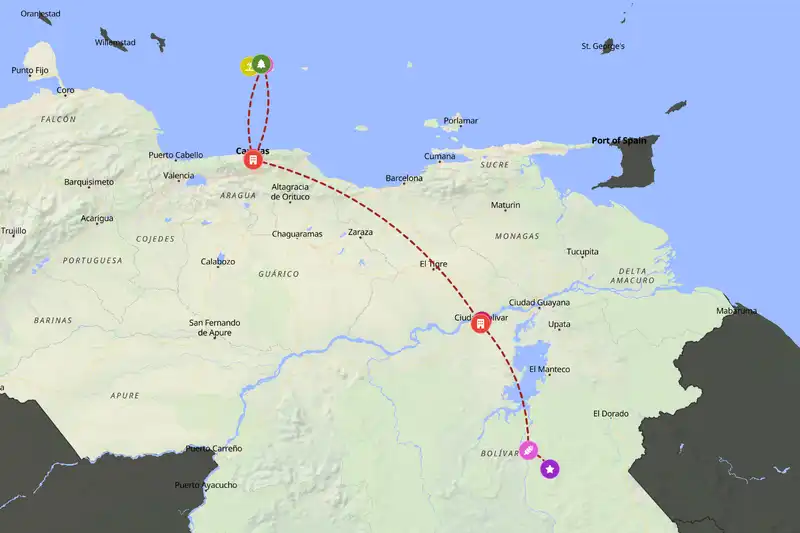
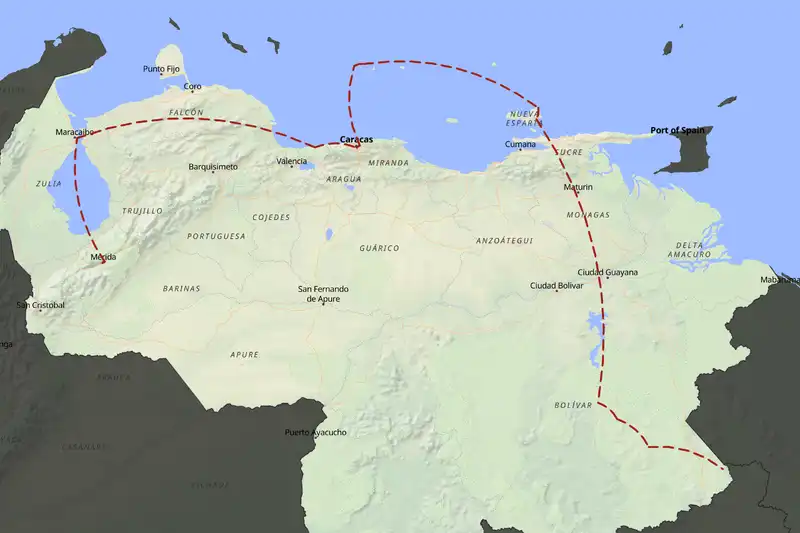
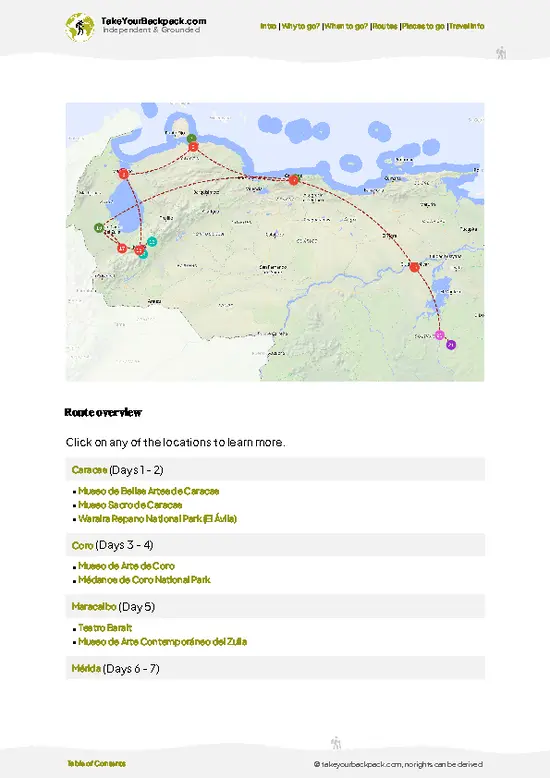
This fifteen-day loop through Venezuela suits travelers who want the widest spread the country offers: colonial streets and sand dunes in the northwest, Andean trails and lightning storms in the west, then the tepuis of the far south. The pace is steady, with one or two calm days between the hard ones. The western half runs overland on long-distance buses and por puestos (shared taxis that leave when full), with a jeep for the mountain stretch. The southern half switches to domestic flights, a small prop plane into Canaima and a curiara (motorized dugout canoe) up to Angel Falls.
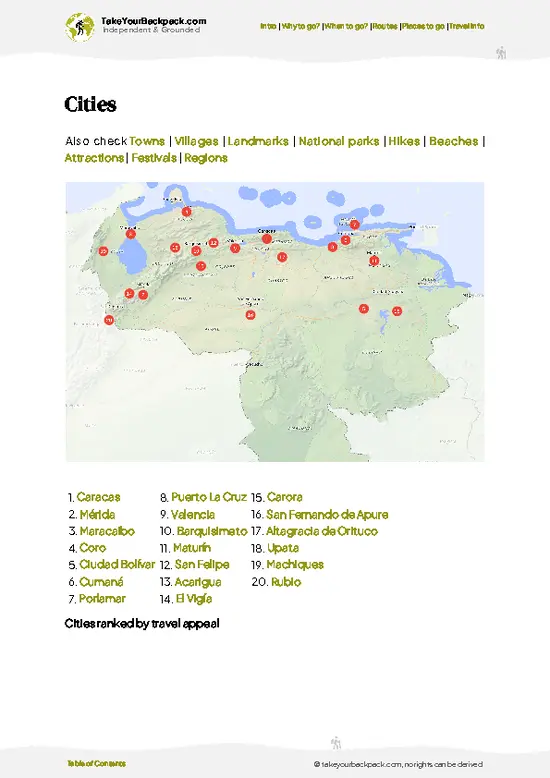
Days 1-2: Caracas
Give
Caracas two nights to absorb the jet lag and the altitude-free heat before the long road west. On day one, walk the leafy Los Caobos park to the
Museo de Bellas Artes de Caracas, where the sculpture garden and the Venezuelan landscape rooms make a good primer on the country you are about to cross. In the afternoon, the small
Museo Sacro de Caracas beside the cathedral on Plaza Bolívar holds colonial religious art in a restored seminary building, and the old center around it is at its liveliest before dusk.
Day two belongs to
El Ávila National Park. Start early from the Sabas Nieves trailhead in Altamira, where caraqueños jog up before work, and climb about an hour to the ranger station for the view south over the city. Fitter hikers can push on toward the higher ridges. Be back down by mid-afternoon, when the cloud usually rolls in.
Days 3-4: Coro
The bus to
Coro takes 7 to 8 hours, so leave early and treat day three as a travel day. The payoff is a colonial town of mud-and-cane houses painted ochre and turquoise, a UNESCO World Heritage Site since 1993, where you can wander Calle Zamora and the Paseo Talavera with almost no traffic. The
Museo de Arte de Coro sits in one of those old mansions and is a quick, cool hour.
Keep day four loose for the
Médanos de Coro National Park, whose dunes start right at the edge of town. Go in the last two hours of daylight, when the sand cools enough to walk barefoot and the wind sculpts fresh ridges every few minutes. Bring water and leave valuables at your posada.
Day 5: Maracaibo
A shorter 4-hour ride brings you to
Maracaibo, and it splits the otherwise brutal run to the Andes in two. Arriving over the 8.7-kilometer General Rafael Urdaneta Bridge, you see the lake for the first time, oil platforms and all. The city is hot and proud: stop at the restored
Teatro Baralt facing Plaza Baralt, then spend the afternoon inside the large, air-conditioned
Museo de Arte Contemporáneo del Zulia. In the evening, the candy-colored houses of El Saladillo along Calle Carabobo are the place to hear gaita, the local drum-and-cuatro music.
Days 6-9: Mérida and the Sierra Nevada
Day six is the second long bus day, 7 to 9 hours climbing from lakeside heat into the mountains, and
Mérida rewards it with cool nights, cheap posadas and a student crowd. Rest, eat a pisca andina breakfast soup, and book your Catatumbo tour in town for day ten.
On day seven, take a por puesto up the Trans-Andean road, about 1.5 to 2 hours, to the
Laguna de Mucubají Trail. The lake sits at roughly 3,550 meters among frailejón plants, and the walk up to Laguna Negra is short but thin on air, a sensible warm-up for what comes next.
Day eight starts with the
Teleférico de Mérida, the Mukumbarí cable car that climbs to Pico Espejo at 4,765 meters. Ride down one station to Loma Redonda and pick up the
Los Nevados Trail, a mostly downhill walk of 4 to 5 hours to the village of Los Nevados, where you sleep in a simple posada with a wood stove. On day nine a jeep takes you back to Mérida along a rough track, 3 to 4 hours of hairpins and valley views.
Days 10-11: Catatumbo lightning
The two-day tour from Mérida drops to the southwest shore of Lake Maracaibo and continues by boat to stilt villages inside
Catatumbo National Park. You spend the night in a hammock over the water while near-silent lightning flickers across the sky for hours, most nights of the year. On day eleven, ask the operator to drop you at
El Vigía on the way back, and catch a flight to
Caracas. Sleep near the airport side of the coast to keep the next morning simple.
Days 12-15: Ciudad Bolívar and Canaima
Fly south to
Ciudad Bolívar and spend the afternoon on the Paseo Orinoco, where the river runs wide and brown past the yellow colonial facades of the old town. This is where Canaima flights and packages are arranged.
On day thirteen a small plane flies you over the savanna to
Canaima in about an hour. Swim in the tea-colored lagoon and walk behind the curtain of Salto El Sapo, which leaves you soaked and laughing. Day fourteen is the curiara trip up the Carrao and Churún rivers, 4 to 5 hours depending on water levels (June to November is most reliable), to a hammock camp facing
Angel Falls. The water drops 979 meters from the top of Auyán-tepui, and at dawn you often have it almost to yourself. Day fifteen brings you back down the river and onto your flight out.
If the Andes leave you wanting more, take a jeep above Mucuchíes to Gavidia, a small páramo village of stone houses and potato terraces where farm families rent out simple rooms.
v2.webp)
 Best Backpacking