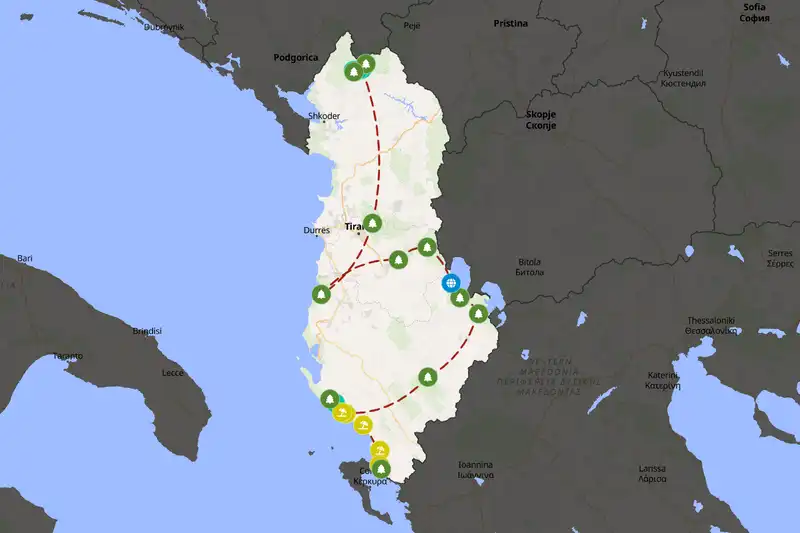
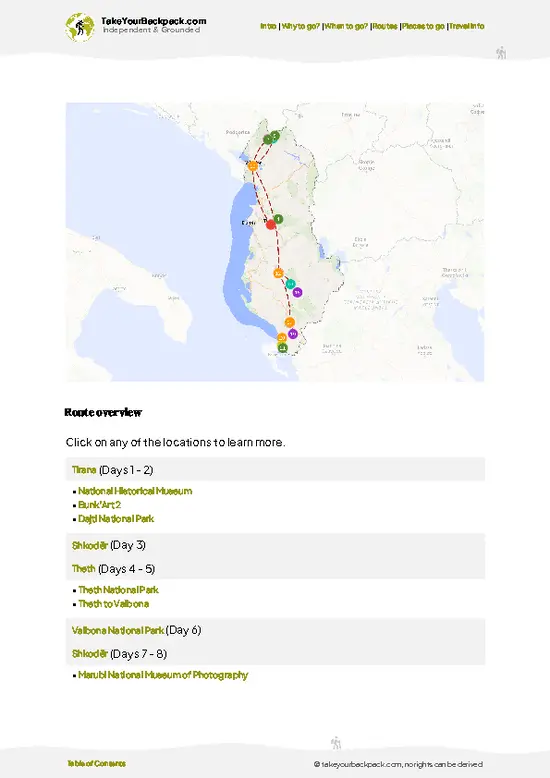
This fifteen-day route is for travelers who want the full sweep of Albania, from limestone peaks in the north to the Ionian shore in the south, with time to hike, read museum captions properly and sit through a long lunch. The pace is steady: one demanding hiking day, a few half-day transfers and several unhurried mornings. You’ll use intercity buses, local minibuses (furgons), a mountain shuttle, the lake ferry from Fierza to Koman, an organized day tour or taxi for the Osum canyon, and one taxi detour to the Blue Eye.
Days 1-3: Tirana
Give
Tirana two nights to work out how the country fits together. Start at the
National Historical Museum, whose huge socialist-era mosaic over the entrance faces Skanderbeg Square, then walk a few minutes to
Bunk’Art 2, a former Interior Ministry bunker that tells the story of the Sigurimi secret police in cold, cramped rooms. It is heavy going, and it makes everything you see later in the mountains easier to read.
On your second day, take the cable car up …
read more 👉This fifteen-day route is for travelers who want the full sweep of Albania, from limestone peaks in the north to the Ionian shore in the south, with time to hike, read museum captions properly and sit through a long lunch. The pace is steady: one demanding hiking day, a few half-day transfers and several unhurried mornings. You’ll use intercity buses, local minibuses (furgons), a mountain shuttle, the lake ferry from Fierza to Koman, an organized day tour or taxi for the Osum canyon, and one taxi detour to the Blue Eye.
Days 1-3: Tirana
Give Tirana two nights to work out how the country fits together. Start at the National Historical Museum, whose huge socialist-era mosaic over the entrance faces Skanderbeg Square, then walk a few minutes to Bunk’Art 2, a former Interior Ministry bunker that tells the story of the Sigurimi secret police in cold, cramped rooms. It is heavy going, and it makes everything you see later in the mountains easier to read.
On your second day, take the cable car up into Dajti National Park. The ride takes about 15 minutes and lifts you to a ridge above 1,000 meters, where the whole city spreads out below and the air turns noticeably cooler. It is also a gentle test for your legs before the north.Days 3-4: Shkodër
The bus to Shkodër takes around 2 hours. Treat this first night as a staging post: buy snacks and cash for the mountains, confirm your Theth shuttle and your luggage plan, and walk the pedestrian street in the evening, where half the town seems to be out on a bicycle.Days 4-7: Theth and the hike to Valbona
The minibus to Theth climbs for roughly 2.5 to 3 hours into a valley walled by grey peaks. Two nights here matter. Use the full day in Theth National Park to walk between scattered stone guesthouses, the small church that appears on every postcard and the old lock-in tower where men once sheltered during blood feuds, and to rest your legs before the big day.
Day 6 is the classic Theth to Valbona crossing: about 17 kilometers, 6 to 8 hours, topping out at the Valbona Pass at roughly 1,800 meters. Start early, carry plenty of water and send your big bag ahead by transfer. You’ll drop into Valbona National Park, a wider, greener valley with river gravel and guesthouse gardens, and spend one night there with dinner from the family kitchen.Days 7-9: Back to Shkodër by lake ferry
An early shuttle takes you to Fierza for the ferry, which threads for about 2.5 to 3 hours through a narrow gorge flooded by the Drin dams, with cliffs dropping straight into green water. A connecting minibus brings you to Shkodër by early afternoon. Two nights here means the next day stays easy: the Marubi National Museum of Photography holds images from a family studio that documented northern Albania from the 19th century onward, and those portraits of highland clans hit differently after you have just walked their valleys.Days 9-11: Berat and the Osum canyon
Shkodër to b>Berat is the longest transfer of the trip, around 4.5 to 5 hours with a change in Tirana, so leave early and plan nothing else. In the late afternoon, climb to Berat Castle, which people still live inside, and step into the Onufri Iconography Museum in the castle’s church to see the 16th-century painter’s famous red.
On your full day, head into Skrapar for the Osum canyon, a gorge roughly 13 kilometers long with cliffs rising straight from the river. Spring brings enough water for rafting; in summer you walk the riverbed instead. Most tours pair it with the Bogova waterfalls, a 20 to 30 minute walk from the village to a cold pool under a curtain of moss.Days 11-13: Gjirokastër
The bus south to Gjirokastër takes about 4 hours, sometimes with a change. This time, go inside the houses: the Skenduli House shows how a wealthy Ottoman-era family lived across several floors, with separate rooms for winter and summer and painted ceilings. Spend an evening in the old bazaar eating qifqi, fried rice balls with mint that are hard to find outside this town. Make the Gjirokastër Castle a short morning visit for the view across the Drino valley.Days 13-15: Sarandë, Ksamil and Butrint
On the way to the coast, stop at the Blue Eye Spring, where water wells up from a depth nobody has fully measured. A taxi from the main road keeps this simple. Base yourself in Sarandë and combine the south in one long day: catch the early bus to Butrint National Park before the heat, walk the Greek theater and the Venetian tower, and finish at the hilltop Butrint Archaeological Museum. Then hop back to Ksamil Beach for an afternoon swim out to the small islands. Your last morning leaves time for the ferry to Corfu or the 5-hour bus back to Tirana.
If a friend were following this route, I’d tell them to walk to the Grunas Waterfall from Theth at breakfast time on their rest day, before the day-trippers arrive, and to bring a towel for the cold plunge.


 Best Backpacking