×

Algeria🇩🇿 | best townsWhere to Find the 8 Best towns in Algeria

Towns in Algeria come in layers: Ottoman and French quarters, Berber hill villages, and oasis settlements where the pavement gives way to sand. Along the Mediterranean coast, you get salt air, grilled sardines, the clatter of trams and white-and-blue facades climbing hillsides, with the most services and the most buses. The High Plateaux are cooler, drier and quieter, with wool-scented markets and wide dusty light. In the Sahara, towns are mud-brick and palm-shaded, silent at midday, loud with tea glasses and drums after dark. Costs stay low everywhere, but transport thins out sharply once you leave the north. Crowds are rare, so independent travel or backpacking here means being a curiosity, often welcomed with coffee and questions. Expect slow bureaucracy, few signs in English, and cash-only economies. Coastal and northern towns suit first-timers, while desert towns suit those who accept long hauls and planning ahead.

By Johan Kruseman 🇳🇱 | Updated October 23, 2026
Explore the best landmarks in Algeria

Why go?What Makes Them Special

Algeria is the largest country in Africa, and that scale shapes everything about its towns. Four distinct layers of history sit side by side: Roman and Numidian ruins, medieval Berber and Arab settlement, Ottoman rule, and 132 years of French colonial planning. The result is towns where a casbah of whitewashed stairways meets a boulevard of arcaded Haussmann-style buildings, often within a ten-minute walk. Few countries compress that much into a single townscape.

Geography splits the country into three very different zones. A narrow, green, densely populated north holds most towns and nearly all of the infrastructure. Behind it the Atlas ranges and High Plateaux bring cold winters and thin air. South of that lies the Sahara, over four-fifths of the territory, where towns exist because of … read more 👉
Algeria is the largest country in Africa, and that scale shapes everything about its towns. Four distinct layers of history sit side by side: Roman and Numidian ruins, medieval Berber and Arab settlement, Ottoman rule, and 132 years of French colonial planning. The result is towns where a casbah of whitewashed stairways meets a boulevard of arcaded Haussmann-style buildings, often within a ten-minute walk. Few countries compress that much into a single townscape.

Geography splits the country into three very different zones. A narrow, green, densely populated north holds most towns and nearly all of the infrastructure. Behind it the Atlas ranges and High Plateaux bring cold winters and thin air. South of that lies the Sahara, over four-fifths of the territory, where towns exist because of oases, wells and old caravan routes. Distances between them are huge, and a single hop can mean 8 to 12 hours on a road or a domestic flight.

Before choosing Algeria for its towns, know that tourism infrastructure is minimal. Hotels are limited, English is rare (Arabic, Berber languages and French dominate), and card payments are unreliable, so carry cash in dinars. A visa is required for most nationalities and should be arranged well before departure, often with a hotel booking or invitation letter. Desert travel can require a registered guide or permits, and some border and Saharan zones are restricted. Check your government’s current advice before booking.

The upside is authenticity. Markets smell of cumin, mint and fresh bread, cafes fill with men over small strong espressos, and nothing is staged for visitors. It is rough around the edges, and that is exactly what makes it honest.
Evaluating the Top Choices
The list of best towns in Algeria is created based on charm, local culture, atmosphere, hidden gems, and visitor appeal. If you feel a town is missing in this list, please let us know.

When to go?When to Plan Your Trip

Best months: The best months for Algeria’s towns are March to May and October to November, when northern and plateau temperatures sit at roughly 15 to 27°C and the Sahara is warm rather than punishing. Spring brings green hillsides, wildflowers and clear light over the Mediterranean, while autumn keeps the sea warm and the evenings mild.

Winter: From December to February, the north and High Plateaux turn wet and cold. Coastal towns average 8 to 16°C with regular rain, while plateau towns often drop to freezing at night, and snow can close Atlas passes. This is the one season when the Sahara is at its best: days of 20 to 25°C, cold nights near 5°C or lower, and crisp, hard blue skies. Pack layers, because mud-brick rooms hold the chill and few have heating.

Summer: June to August is hot almost … read more 👉
Best months: The best months for Algeria’s towns are March to May and October to November, when northern and plateau temperatures sit at roughly 15 to 27°C and the Sahara is warm rather than punishing. Spring brings green hillsides, wildflowers and clear light over the Mediterranean, while autumn keeps the sea warm and the evenings mild.

Winter: From December to February, the north and High Plateaux turn wet and cold. Coastal towns average 8 to 16°C with regular rain, while plateau towns often drop to freezing at night, and snow can close Atlas passes. This is the one season when the Sahara is at its best: days of 20 to 25°C, cold nights near 5°C or lower, and crisp, hard blue skies. Pack layers, because mud-brick rooms hold the chill and few have heating.

Summer: June to August is hot almost everywhere. Coastal towns reach 30 to 35°C with sticky humidity, and the sea is busy with Algerian families, so beach-town rooms get pricier and fill up, sometimes doubling in price in July and August. On the plateaux, expect dry heat of 32 to 38°C. In the Sahara, daytime temperatures commonly pass 40°C and can hit 45 to 50°C, so streets empty from noon until late afternoon. Avoid desert towns in this period.

Shoulder periods and holidays: Ramadan shifts by about 11 days earlier each year. Daytime cafes and many restaurants close, then streets erupt after sunset with food stalls, sweets and crowds. Hours shorten, and transport may run less frequently around Eid. Friday is the weekly rest day, and shops often shut for much of it. Travelers who do not fast can still find food, though it is quieter and more discreet. Choose spring or autumn for the easiest balance of comfort, price and open doors.

town hoppingPlanning Your Route Efficiently

How many days: A trip linking several towns in Algeria needs 10 to 21 days, and the lower end only works if you stay within one region. Distances are large, roads are slower than maps suggest, and even short hops eat half a day.

Which regions pair well: The northern coast and nearby Tell Atlas cluster neatly: Algiers, Constantine, Annaba, Oran and Tlemcen are linked by trains, long-distance buses and shared taxis. Moving east to west or west to east along that corridor is easy. The High Plateaux fit as a middle step between coast and desert, with Batna and Sétif as typical hubs. The Sahara is best treated as its own leg, because Ghardaïa, Timimoun and Djanet are separated from the coast by 8 to 14 hours on the road, or a flight of 1.5 to 2.5 hours from Algiers.

A sensible direction is coast … read more 👉
How many days: A trip linking several towns in Algeria needs 10 to 21 days, and the lower end only works if you stay within one region. Distances are large, roads are slower than maps suggest, and even short hops eat half a day.

Which regions pair well: The northern coast and nearby Tell Atlas cluster neatly: Algiers, Constantine, Annaba, Oran and Tlemcen are linked by trains, long-distance buses and shared taxis. Moving east to west or west to east along that corridor is easy. The High Plateaux fit as a middle step between coast and desert, with Batna and Sétif as typical hubs. The Sahara is best treated as its own leg, because Ghardaïa, Timimoun and Djanet are separated from the coast by 8 to 14 hours on the road, or a flight of 1.5 to 2.5 hours from Algiers.

A sensible direction is coast first, then south. Start where the airport and hotels are easiest, adjust to local rhythms, then head into the heat and silence of the desert towns once you have your cash, permits and Arabic phrases in order. Finish with a flight back north, so a delayed bus does not cost you your departure.

Time per stop and transfers: Allow 1 to 2 nights in coastal and plateau towns, and 2 to 4 nights in desert towns, where arrival days are tiring and guided excursions take a full day. Typical coastal transfers run 3 to 6 hours by bus or train, and cross-country hauls from Algiers to Oran or Constantine can take 5 to 8 hours.

Common planning mistakes: The biggest mistake is trying to cover too much by road. Seven towns in ten days means seven days of sitting in vehicles. Pick two or three regions, and use domestic flights for desert hops. Another is arriving late: buses and shared taxis tend to leave when full, mostly in the morning, so plan departures early and avoid Fridays. Finally, book desert guides and permits before you arrive, since last-minute arrangements are slow and options narrow quickly.

The ListMust-Visit towns in Algeria

1 Djanet

Tassili gateway, Zelouaz quarter, palm paths, Sebiba dances

Arrange a licensed guide, then use the oasis as a base, with palm-grove walks and Tuareg silver stalls between rock art treks.

2 Timimoun

Red adobe ksar, salt flat sunsets, Gourara foggaras, arcaded square

Trace shared water through palm gardens, wander arched adobe passages, and catch the salt flat turn pink below town at dusk.

3 Aïn Sefra

Dune at the door, Mekter ridge, Eberhardt grave, narrow-gauge station

Climb the sand mountain at the edge of town before breakfast, then wander mud-brick lanes and a quiet cemetery tied to a Sahara writer.

4 El Kala

Fishing port, Lake Tonga, cork oak park, rocky coves

Watch the dawn fish auction at the harbor, then follow lakeshore tracks for herons and swim in cold, clear coves nearby.

algeria-city-el-kala
© Google |

5 In Salah

Foggara channels, red ksar, Tidikelt palms, edge dunes

Follow underground water channels into palm gardens, then get lost in ocher mud-brick lanes before heading out to the sand at day's end.

6 Illizi

Permit office, ochre basin, Tuareg silver, edge-of-town viewpoint

Sort permits and guides in a dry, quiet outpost, stock up at the market, and watch the plateau wall cool at dusk.

7 Ksar Chellala

High steppe, wheat and sheep, Tiaret Province, road stopover

Break a long road journey with a walk along the main street and market, then watch the wind-scoured plateau town settle at dusk.

algeria-city-ksar-chellala
© Google |

8 Tissemsilt

Atlas cedars, Ouarsenis plateau, market street, wheat-ridge views

Ride out to the cedar forest at Theniet El Had for resinous trails, then drink coffee on café terraces back in town.

Loading the map 🌍

Expert viewWhat You Should Know

How many towns to visit: I would advise four to six towns on a trip of two to three weeks. Algeria’s distances and its slow, cash-heavy logistics punish quick itineraries, and each town needs a full afternoon just to be walked properly: narrow stairways, cafe terraces, bakeries pulling out flatbread, the call to prayer bouncing off whitewashed walls. Fewer stops let you actually talk to people, and conversation is where Algeria pays back. Visitors who rush end up with a camera roll and no stories.

Choosing between kinds of towns: For first-timers and anyone short on time, prioritize coastal and northern towns: they have the most hotels, the best public transport and the easiest food, from grilled fish to semolina pastries dripping with honey. If you want history, pick towns with Roman or … read more 👉
How many towns to visit: I would advise four to six towns on a trip of two to three weeks. Algeria’s distances and its slow, cash-heavy logistics punish quick itineraries, and each town needs a full afternoon just to be walked properly: narrow stairways, cafe terraces, bakeries pulling out flatbread, the call to prayer bouncing off whitewashed walls. Fewer stops let you actually talk to people, and conversation is where Algeria pays back. Visitors who rush end up with a camera roll and no stories.

Choosing between kinds of towns: For first-timers and anyone short on time, prioritize coastal and northern towns: they have the most hotels, the best public transport and the easiest food, from grilled fish to semolina pastries dripping with honey. If you want history, pick towns with Roman or Ottoman layers, where you can walk through ruins and old quarters in a single morning. For atmosphere and silence, choose a Saharan oasis town: palm shade, thick-walled clay houses, dates and mint tea at dusk. Desert towns cost more and demand more planning, so choose one or two at most and avoid mixing them with a rushed coastal circuit.

Budget: Budget travelers can manage US$25 to 45 a day (roughly 3,400 to 6,000 DZD) in northern towns: a basic hotel room at about US$15 to 30, meals at US$3 to 8, and local buses or shared taxis at US$1 to 8 per hop. Saharan towns run higher, around US$50 to 90 a day, because guides, 4x4 transport and permits add up. A guided desert day typically costs US$40 to 100 depending on group size. Museum and ruin entry fees are small, often under US$2 to 4. Carry plenty of cash in dinars, since ATMs are patchy and foreign cards often fail. Exchange rates differ between official banks and informal street rates, so check the current gap before changing money.

Safety and cultural considerations: Most northern towns feel calm and everyday life is friendly, with strangers offering directions or coffee. Still, check your government’s current travel advice, especially for the Sahara, border zones and some mountain areas, where restrictions and escort requirements can apply. Use registered guides in the south, and register your plans with your accommodation.

Dress modestly: shoulders and knees covered, and a light scarf for women is useful in conservative towns. Ask before photographing people, and avoid photographing police, military sites and government buildings, which can lead to long and tiring questioning. Avoid public displays of affection, and alcohol is available only in limited places. Friday midday is prayer time and many shops shut, so plan your errands around it.

Petty theft occurs in crowded markets and stations, so keep valuables in a front pocket. Learning a few phrases in French or Arabic (bonjour, shukran) changes how people treat you, and that small effort often turns a stiff transaction into an invitation to tea. French is widely understood, especially in the north, and gets you much further than English.

✈️ The backpacker research shortcutAlgeria Travel Guide

An offline-friendly backpacking guide with optimized travel routes, ranked highlights, transport advice, and the best areas to stay.
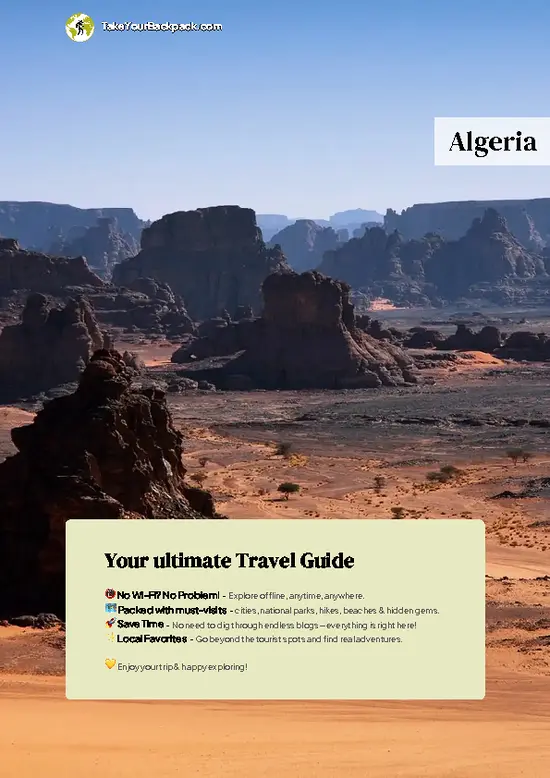
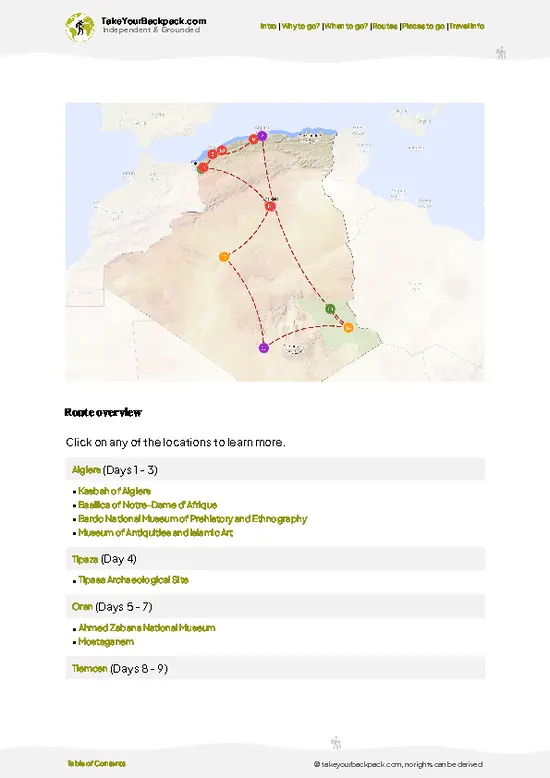
example page 0 from our offline Travel Guide for Algeria
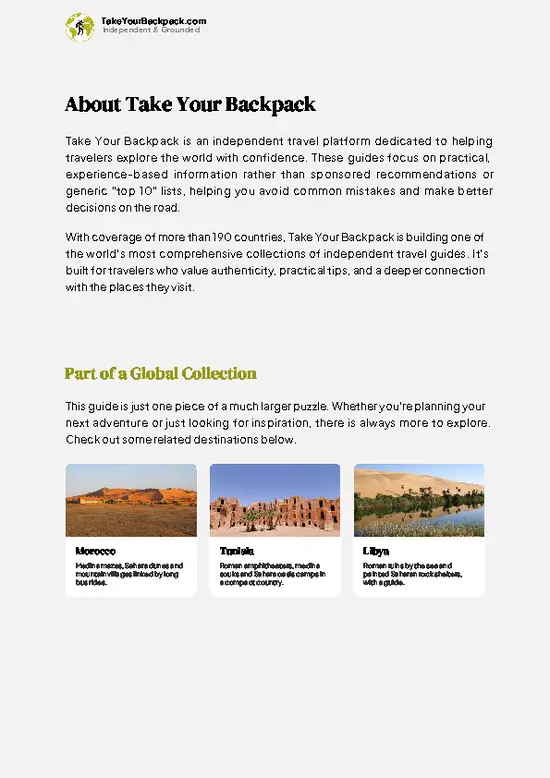
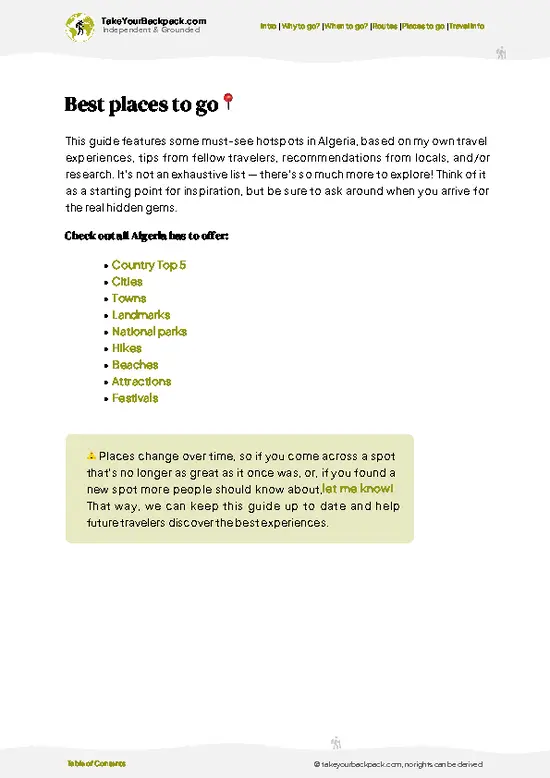
example page 1 from our offline Travel Guide for Algeria
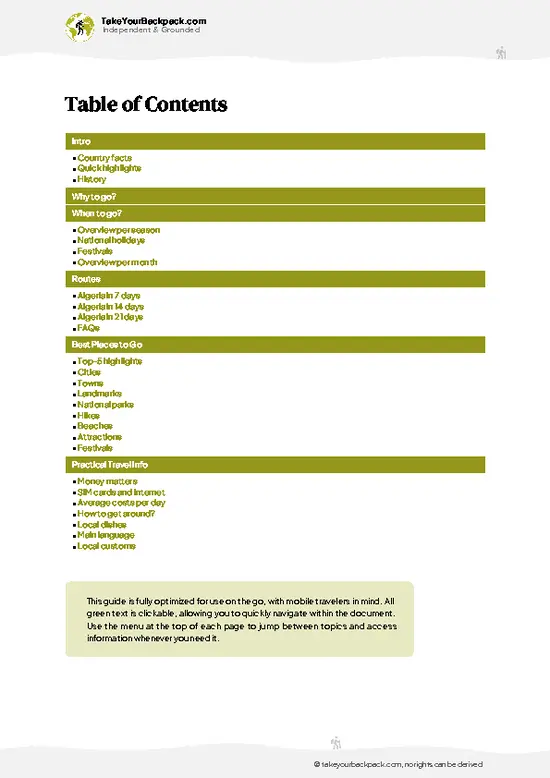
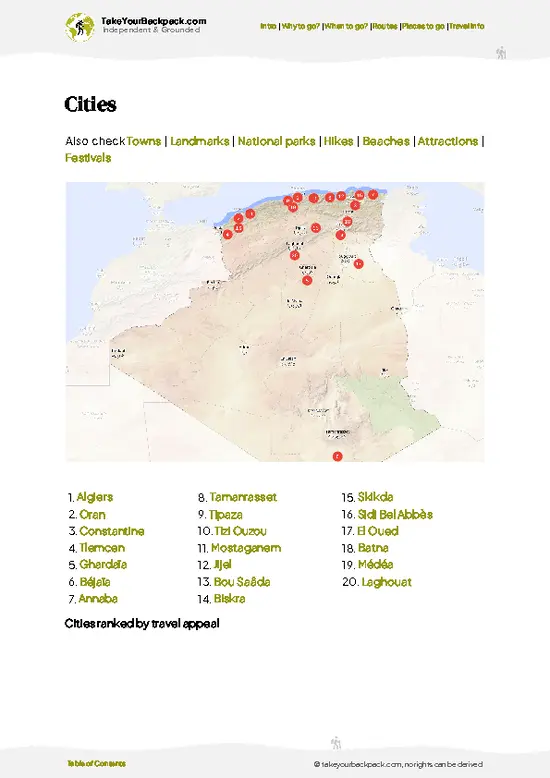
example page 2 from our offline Travel Guide for Algeria
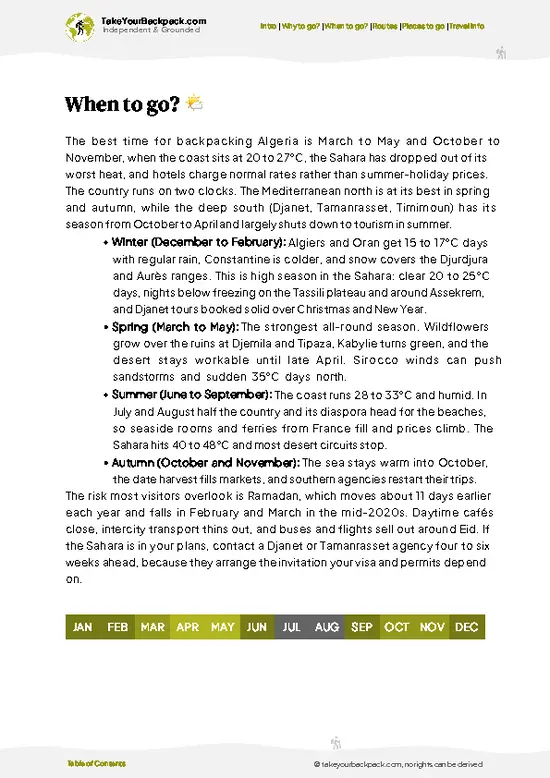
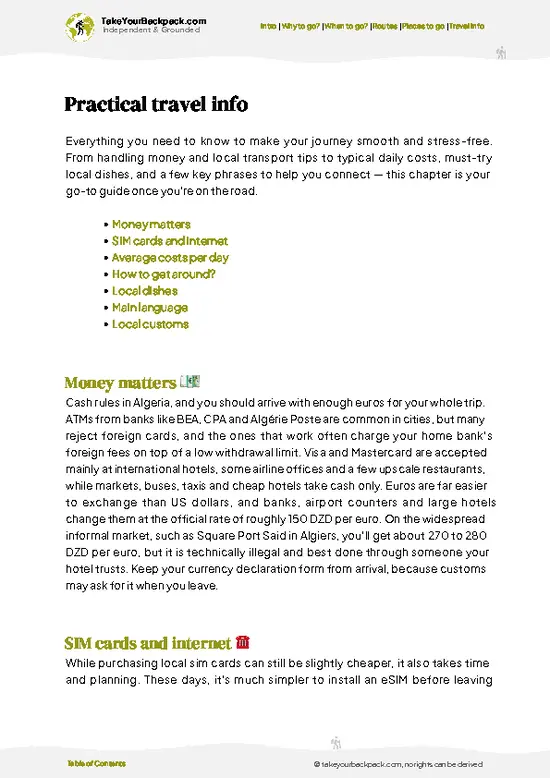
example page 3 from our offline Travel Guide for Algeria
example page 4 from our offline Travel Guide for Algeria
example page 5 from our offline Travel Guide for Algeria
example page 6 from our offline Travel Guide for Algeria
example page 7 from our offline Travel Guide for Algeria
The digital guide (314 pages) contains:
✅ 79 highlights, ranked by travel appeal
✅ Optimized 7, 14 & 21-day travel routes
✅ Cities, national parks, landmarks, beaches
✅ How to get around
✅ Offline-friendly for travel without Wi-Fi
👉 Click to see all 30+ guide features

📅 Plan smarter in minutes, not weeks
✅ Month by month travel advice
✅ Festivals & national holidays
✅ Budget expectations

🗺️ Go to the right places, skip the overrated ones
✅ Honest pros & cons of destinations
✅ Top hikes, parks & viewpoints
✅ Lesser-known places most travelers miss
✅ Clear “worth it vs skip it” guidance

🛏️ Travel smoothly without rookie mistakes
✅ Best areas to stay
✅ Transport systems explained simply
✅ Common scams & safety advice
✅ SIM cards, money & practical tips

🌍 Understand the country, not just visit it
✅ Culture & traditions
✅ 52 Essential phrases & customs
✅ Festivals worth planning around
✅ Traveler-friendly historical context
✅ Insights that make places more meaningful

📱 Built for real travel conditions
✅ Fully downloadable PDF
✅ Works completely offline
✅ Optimized for phone use
✅ Useful in remote areas & buses
✅ Everything in one place
Stop searching, start planning
Get instant access to your full guide. 30‑day money-back guarantee.
+ Add another guide for just

By proceeding you agree to our terms.
Sent to your inbox immediately after payment • 100% Secure Checkout
Best Backpacking Travel Advisor 2025 tourism awardBest Backpacking
Travel Advisor
2025
What others say about Take Your Backpack Guides:
⭐⭐⭐⭐⭐
Fantastic, amazing amount of information!
⭐⭐⭐⭐⭐
My goodness this is amazing, it's what I've been looking for hats off too you!
⭐⭐⭐⭐⭐
I think this is absolutely BRILLIANT
⭐⭐⭐⭐
Very complete and informative. It's still missing places, but I gotta to commend you
⭐⭐⭐⭐⭐
This is truly amazing, thank you, can't wait to explore it with my kids!
⭐⭐⭐⭐⭐
Awesome resource, thank you!
⭐⭐⭐⭐⭐
This is amazing! Can't wait to explore the ones I haven't seen
⭐⭐⭐⭐
I love this! Well done, great idea.
⭐⭐⭐⭐⭐
Thanks for taking the time to make this gem!
⭐⭐⭐⭐⭐
This might be the best website I've ever seen.
⭐⭐⭐⭐⭐
Congratulations, and thank you so much for your work; it's incredibly valuable.
⭐⭐⭐⭐
In all seriousness I think you did a great job pointing out the important spots
⭐⭐⭐⭐⭐
10/10 very good
⭐⭐⭐⭐⭐
As someone who's only just starting to visit regularly this is awesome, thank you.
⭐⭐⭐⭐
Thank you very much! I'm going to visit my dad, it's going to be very useful!
⭐⭐⭐⭐⭐
This is really cool! We'll be travelling for the first time and this definitely come in handy.
⭐⭐⭐⭐⭐
You are now our minister of culture, congratulations 👨‍💼
⭐⭐⭐⭐⭐
Just wanted to tell you that this is a pearl! Going to follow your recommendations.
⭐⭐⭐⭐⭐
This is so cool. I'll definitely be using the resource for my travels soon.
⭐⭐⭐⭐⭐
This is very impressive! Good work.
⭐⭐⭐⭐⭐
This is an amazing and informative site. Very well done!

🛏️ Where to stay?Top Areas to Stay

Backpacker-style hostels are rare in Algeria, so budget travelers mostly stay in state-run youth hostels (auberges de jeunesse), simple family hotels and private rooms or apartments, with doubles typically running about 3,000 to 6,000 DZD (US$22 to 45). In Algiers, the streets around Grande Poste and Didouche Mourad put you within walking distance of the Casbah and the best cafés, though they are noisy and quiet down early at night, while Hydra is calm and safe but pricier and a taxi ride from the sights. In Oran, the city center near Place du 1er Novembre and the Front de Mer gives you the liveliest evenings in the country, and in Constantine the old center near the bridges is the most practical … read more 👉
Backpacker-style hostels are rare in Algeria, so budget travelers mostly stay in state-run youth hostels (auberges de jeunesse), simple family hotels and private rooms or apartments, with doubles typically running about 3,000 to 6,000 DZD (US$22 to 45). In Algiers, the streets around Grande Poste and Didouche Mourad put you within walking distance of the Casbah and the best cafés, though they are noisy and quiet down early at night, while Hydra is calm and safe but pricier and a taxi ride from the sights. In Oran, the city center near Place du 1er Novembre and the Front de Mer gives you the liveliest evenings in the country, and in Constantine the old center near the bridges is the most practical base, just very hilly and short on budget choices.

If you enjoy meeting fellow travelers, consider choosing hostels with high ratings for atmosphere. On the other hand, if you prefer having your own space, a hotel might be a better option.

AlgeriaDiscover the Country

👋 Meet the founderWho’s Behind Take Your Backpack?

Johan, backpacker and founder of TakeYourBackpackHi, I’m Johan (Netherlands 🇳🇱), the creator of TakeYourBackpack. Over the past 3 decades, I’ve backpacked through 90+ countries across six continents, gaining extensive experience with independent travel, long-term trips, and overland routes.

This site is built on a combination of firsthand travel experience and carefully curated insights from other backpackers. Many guides are based on places I’ve personally visited, while others bring together tips, observations, and practical advice shared by trusted travelers I’ve met along the way.

The goal is to provide realistic, experience-driven guidance — not generic itineraries — so you can explore destinations with better context, clearer expectations, and more confidence.