×
Australia🇦🇺 | 14 days itinerary

Australia in 14 Days

By Johan Kruseman 🇳🇱 | Updated May 3, 2026
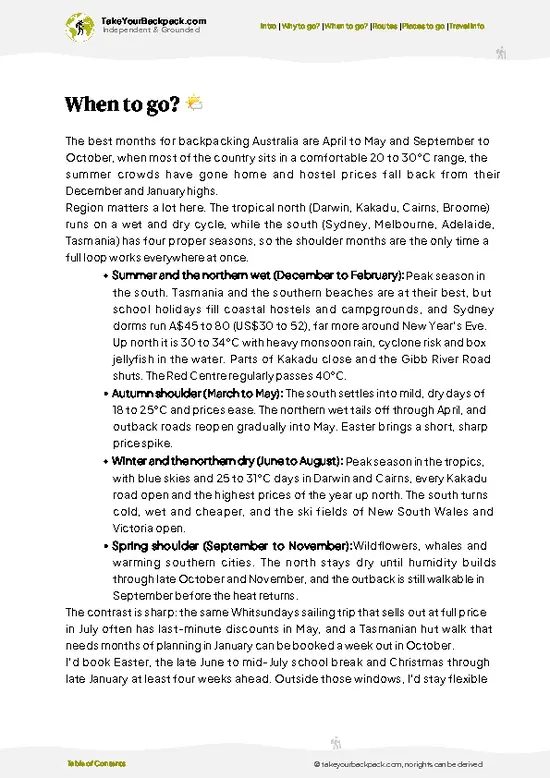
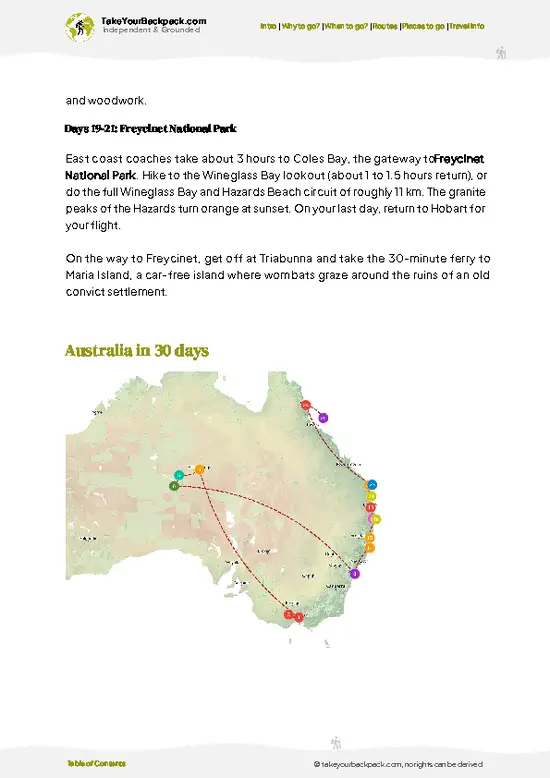
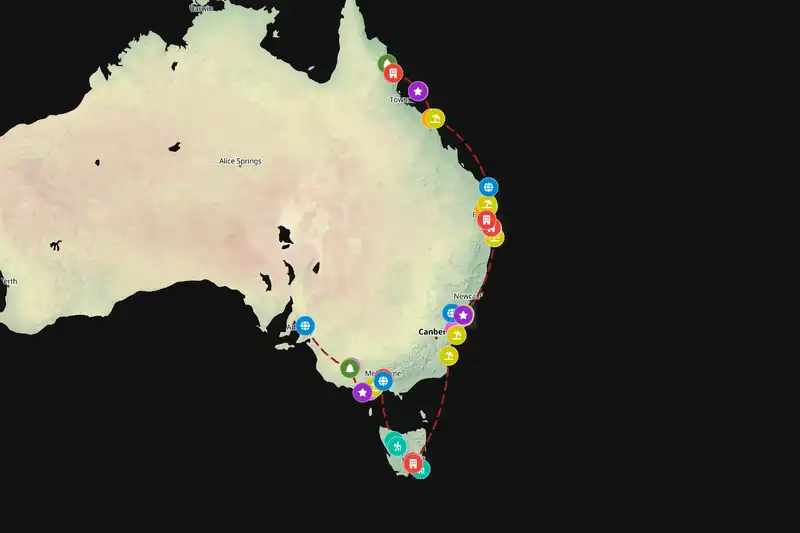
This 14-day itinerary is for first-time visitors who want a deep dive into Australia’s east coast icons without racing across the whole continent, using mostly flights plus easy local buses and ferries; the pace is relaxed but you’ll still feel like you’ve packed a lot in, with time to actually swim, hike, and linger over coffee instead of just ticking boxes.

Days 1-4: Sydney icons and coastal living

Start in Sydney so you can lock in the big-ticket city experiences before heading north. Base yourself in the harbour area to walk between the Sydney Opera House, the Sydney Harbour Bridge, and the Art Gallery of New South Wales, mixing world-class culture with ferry rides and sunset views. Dedicate a full day to the coast: ride the ferry to Manly Beach or bus out to Bondi Beach, then walk the clifftop path via Bronte Beach and Coogee Beach for a sampler of Sydney’s beach culture without changing hotels every night. This phase gives you a soft landing, great food, and a feel for Australian city … read more 👉
This 14-day itinerary is for first-time visitors who want a deep dive into Australia’s east coast icons without racing across the whole continent, using mostly flights plus easy local buses and ferries; the pace is relaxed but you’ll still feel like you’ve packed a lot in, with time to actually swim, hike, and linger over coffee instead of just ticking boxes.

Days 1-4: Sydney icons and coastal living

Start in Sydney so you can lock in the big-ticket city experiences before heading north. Base yourself in the harbour area to walk between the Sydney Opera House, the Sydney Harbour Bridge, and the Art Gallery of New South Wales, mixing world-class culture with ferry rides and sunset views. Dedicate a full day to the coast: ride the ferry to Manly Beach or bus out to Bondi Beach, then walk the clifftop path via Bronte Beach and Coogee Beach for a sampler of Sydney’s beach culture without changing hotels every night. This phase gives you a soft landing, great food, and a feel for Australian city life before you chase the tropics.

Days 5-9: Cairns, reef days and rainforest nights

Fly to Cairns and slow the pace down while you ramp the nature up. Use Cairns as your base for two essential experiences: a full-day trip out to the Great Barrier Reef Marine tourism experiences to snorkel or dive above coral gardens, and a day exploring the ancient Daintree National Parks within the broader Wet Tropics of Queensland, where you can walk boardwalks under dripping canopy and spot cassowaries if you’re lucky. Add a day trip north to Four Mile Beach at Port Douglas or south to Palm Cove to get that classic palm-fringed sand without repacking your bag. This stretch is about warm water, early mornings on boats, and evenings eating seafood in shorts and flip-flops.

Days 10-14: Noosa and K’gari coast escape

Fly or bus down to the Sunshine Coast and base yourself in Noosa for a gentler, small-town finish. Spend lazy mornings swimming at Noosa Main Beach and walking the coastal track in Noosa National Park, then take a day trip to K’gari (Fraser Island) via Hervey Bay to drive along wild sand highways and swim in freshwater lakes framed by forest. If you want one more change of scene, add a side trip to Coolum or Mooloolaba for a different flavour of beach town, but keep your base in Noosa so you’re not constantly packing. These last days are about easing off the gas, catching sunrises over the Pacific, and letting the trip sink in before you head home.

My favourite moment on this route is that first post-flight plunge into the warm water off the Great Barrier Reef, when the jet lag disappears the second you spot your first sea turtle.
Loading the map 🌍
film
0
0
0a
Sydney
Pixabay
film
1
1
1a
Sydney Opera House
Pixabay
film
2
2
2a
Sydney Harbour Bridge
Pixabay
film
3
3
3a
Art Gallery of New South Wales
film
4
4
4a
Bondi Beach
Paul O'leary
film
5
5
5a
Coogee Beach
film
6
6
6a
Cairns
film
7
7
7a
Daintree
Toni Ann Mills
film
8
8
8a
Wet Tropics of Queensland
Sean Kelleher
film
9
9
9a
Palm Cove
Hagen Dufner
film
10
10
10a
Noosa Main Beach
Gustav
film
11
11
11a
Hervey Bay
film
12
12
12a
Coolum
Rick Podger

✈️ The backpacker research shortcutAustralia Travel Guide

An offline-friendly backpacking guide with optimized travel routes, ranked highlights, transport advice, and the best areas to stay.
example page 0 from our offline Travel Guide for Australiaexample page 1 from our offline Travel Guide for Australiaexample page 2 from our offline Travel Guide for Australiaexample page 3 from our offline Travel Guide for Australiaexample page 4 from our offline Travel Guide for Australiaexample page 5 from our offline Travel Guide for Australia
The digital guide (478 pages) contains:
151 highlights, ranked by travel appeal
Optimized 14, 21 & 30-day travel routes
Best neighborhoods to stay
How to get around
Offline-friendly for travel without Wi-Fi
👉 See all 30+ guide features

📅 Plan smarter in minutes, not weeks
Month by month travel advice
Festivals & national holidays
Budget expectations

🗺️ Go to the right places, skip the overrated ones
Honest pros & cons of destinations
Top hikes, parks & viewpoints
Lesser-known places most travelers miss
Clear “worth it vs skip it” guidance

🛏️ Travel smoothly without rookie mistakes
Best areas to stay
Transport systems explained simply
Common scams & safety advice
SIM cards, money & practical tips

🌍 Understand the country, not just visit it
Culture & traditions
Local customs
Festivals worth planning around
Traveler-friendly historical context
Insights that make places more meaningful

📱 Built for real travel conditions
Fully downloadable PDF
Works completely offline
Optimized for phone use
Useful in remote areas & buses
Everything in one place
Save weeks of stressful planning
Get instant access to the full guide directly. 30-day money-back guarantee.


Sent to your inbox immediately after payment • 100% Secure Checkout
Best Backpacking Travel Advisor 2025 tourism awardBest Backpacking
Travel Advisor
2025
What others say about Take Your Backpack Guides:
⭐⭐⭐⭐⭐
Fantastic, amazing amount of information!
⭐⭐⭐⭐⭐
My goodness this is amazing, it's what I've been looking for hats off too you!
⭐⭐⭐⭐⭐
I think this is absolutely BRILLIANT
⭐⭐⭐⭐
Very complete and informative. It's still missing places, but I gotta to commend you
⭐⭐⭐⭐⭐
This is truly amazing, thank you, can't wait to explore it with my kids!
⭐⭐⭐⭐⭐
Awesome resource, thank you!
⭐⭐⭐⭐⭐
This is amazing! Can't wait to explore the ones I haven't seen
⭐⭐⭐⭐
I love this! Well done, great idea.
⭐⭐⭐⭐⭐
Thanks for taking the time to make this gem!
⭐⭐⭐⭐⭐
This might be the best website I've ever seen.
⭐⭐⭐⭐⭐
Congratulations, and thank you so much for your work; it's incredibly valuable.
⭐⭐⭐⭐
In all seriousness I think you did a great job pointing out the important spots
⭐⭐⭐⭐⭐
10/10 very good
⭐⭐⭐⭐⭐
As someone who's only just starting to visit regularly this is awesome, thank you.
⭐⭐⭐⭐
Thank you very much! I'm going to visit my dad, it's going to be very useful!
⭐⭐⭐⭐⭐
This is really cool! We'll be travelling for the first time and this definitely come in handy.
⭐⭐⭐⭐⭐
You are now our minister of culture, congratulations 👨‍💼
⭐⭐⭐⭐⭐
Just wanted to tell you that this is a pearl! Going to follow your recommendations.
⭐⭐⭐⭐⭐
This is so cool. I'll definitely be using the resource for my travels soon.
⭐⭐⭐⭐⭐
This is very impressive! Good work.
⭐⭐⭐⭐⭐
This is an amazing and informative site. Very well done!

🧭 RouteChoose Your Itinerary

Travel Australia your way — from a quick highlights trip to a slow-paced adventure.

🙋 FAQFrequently Asked Questions

Short answer: yes, Australia is one of the easiest countries on earth to backpack independently, especially for English speakers and first-timers. The backpacker infrastructure is mature: hostels everywhere, clear signage, and a big culture of solo travelers and working holiday makers, so you rarely feel alone unless you want to.

The east coast (Melbourne–Sydney–Brisbane–Cairns) is the most plug-and-play: tons of hostels, tour desks, and bus passes designed for backpackers. You can book most things a few days ahead, even in high season, as long as you’re flexible on exact dates and room types.

Safety-wise, it’s straightforward: violent crime against travelers is rare, tap water is drinkable, food hygiene is high, and emergency services are reliable. The real risks are nature-based: heat, dehydration, long distances, strong surf, and wildlife you shouldn’t poke. If you respect warning signs and don’t treat the outback like a city park, you’re fine.

Costs are the main challenge. Australia is not cheap, but it’s manageable if you: cook in hostel kitchens, use supermarket deals, travel overland instead of flying every leg, and pick a few big-ticket activities instead of doing everything. Working holiday visas are a game changer for long trips; casual work in hospitality, farms, or construction can refill your budget fast if you’re eligible.

Culturally, Aussies are relaxed and direct. People will help if you ask, but they won’t hover. Backpacker bars, hostel common rooms, and group tours (sailing in the Whitsundays, Fraser Island/ K’gari 4x4 trips, Great Ocean Road day tours) are easy places to meet others if you’re solo.

The only time independent travel gets tricky is in very remote areas (deep outback, Cape York, some parts of Western Australia and the Northern Territory) where distances are huge, public transport is thin, and conditions can be harsh. Those are still doable, but you either join a tour, rent a vehicle with others, or plan very carefully around fuel, water, and weather. For most backpackers sticking to the main loop, independent travel is simple and rewarding.
For a tight budget trip that still feels worthwhile, 2 weeks is the bare minimum, 3–4 weeks is the sweet spot, and 6–8 weeks lets you breathe and chase good weather. The country is massive; trying to “do Australia” in 10 days just burns money on flights and leaves you frustrated.

If you have:
10–14 days: Pick one region and go deep.
- East Coast city + nearby nature: Sydney + Blue Mountains + a bit of the coast; or Melbourne + Great Ocean Road + Grampians.
- Tropical north: Cairns/Port Douglas for reef + rainforest, maybe add the Atherton Tablelands.
- Red Centre: Alice Springs + Uluru–Kata Tjuta + Kings Canyon (join a budget tour to keep logistics simple).
Trying to combine Uluru, Sydney, and the Great Barrier Reef in 2 weeks is technically possible but expensive and rushed.

3–4 weeks: Ideal for a first backpacking trip.
- Classic east coast route: Melbourne → Sydney → Byron Bay → Brisbane → Noosa/Fraser Island (K’gari) → Airlie Beach/Whitsundays → Cairns. You won’t see everything, but you can hit a strong mix of cities, beaches, and rainforest.
- Or: East coast + Red Centre: focus on Sydney–Cairns plus a 4–5 day side trip to Uluru. This costs more (domestic flights + tours) but gives you both reef and desert.

6–8 weeks: You can slow down, chase cheap deals, and avoid constant flying.
- Full east coast with side trips inland (Blue Mountains, Atherton Tablelands, maybe a farm stay or regional town).
- Add Tasmania (1–2 weeks) for hiking and cooler weather, or a Perth + Southwest WA loop if you’re okay with a long flight and some car shares.

3+ months: This is where working holiday style travel shines. You can:
- Work a few weeks in a city or regional town, then travel with the money you saved.
- Do longer overland routes (e.g., Darwin to Perth, or Adelaide to Darwin via the Red Centre) using rideshares, relocation vehicles, or cheap campervan splits with other backpackers.

For budget travelers, more time usually means lower daily costs: you can wait for off-peak fares, buy groceries in bulk, and avoid last-minute flights. The key is to choose a realistic chunk of the country and accept that you’ll come back another time rather than sprinting across the map.
You can absolutely get around Australia without a car, especially along the east coast and between major cities. The trick is to combine a few transport types instead of relying on just one.

1. Intercity buses (great for backpackers)
- Companies run long-distance routes along the east coast and between big cities. They’re safe, relatively comfortable, and cheaper than most flights if you book in advance.
- Hop-on hop-off style passes used to be the classic backpacker move; now it’s often cheaper to book individual legs during sales. Compare both.
- Overnight buses save you a hostel night but can wreck your sleep; use them sparingly on longer routes.

2. Trains (limited but pleasant)
- City suburban trains (Sydney, Melbourne, Brisbane, Perth) are excellent for day trips and commuting.
- Long-distance trains exist (like Sydney–Melbourne, Sydney–Brisbane, and the famous Ghan/Indian Pacific), but they’re usually slower and more expensive than buses or budget flights, so not ideal for tight budgets unless you snag a deal or really love trains.

3. Budget flights (for big jumps)
- For huge distances (e.g., Sydney ↔ Cairns, Melbourne ↔ Perth, east coast ↔ Uluru), flying is often the most time-efficient option.
- Low-cost carriers can be cheap if you travel light and book early, but baggage fees add up fast. Stick to one small checked bag or just a carry-on if you can.

4. Tours and day trips
- In remote or spread-out areas (Uluru, Kakadu, K’gari/Fraser Island, Whitsundays, Great Ocean Road), budget tours are often cheaper and safer than trying to DIY without a car.
- Look for backpacker-focused operators that include camping or hostel-style accommodation and meals; they can be surprisingly good value.

5. Rideshares and relocation deals
- Rideshare boards (hostel noticeboards, apps, Facebook groups) are common on popular routes like Sydney–Byron–Brisbane or Darwin–Alice Springs. You usually chip in for fuel and maybe share driving if you’re licensed.
- Campervan relocation deals let you move a vehicle from A to B for very little money, sometimes with fuel included, but dates and routes are fixed and you need to be comfortable driving long distances.

6. City transport
- Major cities have good public transport (trains, trams, buses, ferries). Grab the local transport card (Opal in Sydney, Myki in Melbourne, etc.) and load credit; it’s cheaper than buying single tickets.
- Walking and cycling are solid options in inner-city areas; many hostels have cheap bike rentals.

Where no-car travel gets hard is in very remote regions and national parks without tour options. If you want deep outback exploration on a tight budget, your best bet is to team up with others to rent a car or join a longer overland tour rather than trying to patch together public transport that barely exists.
For budget backpackers, “must-visit” means high impact for your time and money. These are the places that consistently deliver strong experiences without requiring a luxury budget.

1. Sydney + Blue Mountains (New South Wales)
- Why it’s worth it: Iconic skyline, coastal walks, and easy access to real wilderness. You can see the Opera House and Harbour Bridge for free, swim at Bondi or Manly, and hike in the Blue Mountains on a day trip using public transport.
- Budget tips: Use the Opal card, walk the Bondi–Coogee coastal path, and stay in central or beachside hostels with kitchens.

2. Melbourne + Great Ocean Road (Victoria)
- Why it’s worth it: Street art, coffee culture, live music, and a very walkable city, plus one of the best coastal drives anywhere.
- Budget tips: Free city trams in the CBD, cheap eats in Chinatown and markets, and backpacker day tours along the Great Ocean Road that undercut car rental costs if you’re solo.

3. East Coast Beaches: Byron Bay, Noosa, and the backpacker corridor (NSW/QLD)
- Why it’s worth it: Surf towns, hostel social life, and easy bus connections. Byron Bay and Noosa are pricier but deliver that classic Aussie beach vibe with good hiking and free ocean.
- Budget tips: Cook your own meals, skip paid yoga/surf camps and just rent a board, use coastal walking tracks instead of paid tours where possible.

4. K’gari (Fraser Island) and the Whitsundays (Queensland)
- Why it’s worth it: These are the two big-ticket east coast adventures that usually live up to the hype. K’gari gives you 4x4 sand driving, freshwater lakes, and camping; the Whitsundays give you sailing, beaches, and reef.
- Budget tips: Choose backpacker-focused tours with shared accommodation (camping or dorm-style cabins). Don’t try to DIY K’gari without experience; the tour is often cheaper than renting a 4x4 once you factor in insurance and risk.

5. Cairns + Great Barrier Reef + Daintree Rainforest (Far North Queensland)
- Why it’s worth it: Access to the reef and the world’s oldest rainforest from one backpacker hub. Cairns is built for budget travelers: lots of hostels, cheap food, and tour competition.
- Budget tips: Pick one solid reef trip instead of multiple; choose a day boat with a good reputation rather than the absolute cheapest. Use public buses or budget tours to reach nearby waterfalls and the Daintree.

6. Uluru–Kata Tjuta + Kings Canyon (Red Centre, Northern Territory)
- Why it’s worth it: This is the spiritual and visual heart of the country. Sunrise and sunset over Uluru, walking around the base, and hiking Kings Canyon are powerful experiences that feel very different from the coast.
- Budget tips: Join a multi-day camping tour from Alice Springs or Yulara; it’s usually cheaper and safer than renting a car solo. Accept that this will be one of your pricier segments and cut costs elsewhere.

7. Tasmania (if you have time and like hiking)
- Why it’s worth it: Cooler climate, rugged mountains, and some of the best multi-day hikes in the country. Great for those who prefer trails and quiet over party hostels.
- Budget tips: Base in Hobart or Launceston, use buses and occasional tours, and focus on a few key areas (e.g., Cradle Mountain, Freycinet) rather than trying to loop the whole island without a car.

If you’re short on time or money, prioritize: one big city (Sydney or Melbourne), one stretch of east coast (Byron to Cairns is the classic), and one “wow” nature area (Uluru or the reef). That mix gives you a strong first taste without blowing your budget on constant flights.
On a tight schedule or budget, you skip things that are expensive to reach, repetitive, or similar to places you’ll see elsewhere on your route. You’re not saying they’re bad; you’re just playing smart with time and money.

1. Trying to cross the whole country in one trip
- Skip the urge to do Sydney, Melbourne, Cairns, Uluru, Perth, Darwin, and Tasmania in 2–3 weeks. You’ll burn cash on flights and see most places through bus windows and hostel check-ins. Pick one or two regions and do them well.

2. Multiple reef trips in different towns
- The Great Barrier Reef is incredible, but you don’t need to snorkel it from three different ports.
- If you’re short on time, pick Cairns/Port Douglas or the Whitsundays for your main reef experience and skip extra reef tours elsewhere. Use the saved money for a different type of activity (hiking, cultural tour, or outback trip).

3. Extra-big cities that feel similar
- If you’re already doing Sydney and Melbourne, you can skip long stays in Brisbane or Adelaide on a first trip unless you have a specific reason (friends, events, cheap flights). They’re pleasant, but for a rushed backpacker they can feel like more of the same: good food, nice riverfronts, but less distinctive than your limited time deserves.

4. Deep outback road trips without time or crew
- Iconic drives like Darwin–Broome, Perth–Exmouth, or the full Gibb River Road are amazing but require time, a vehicle, and some experience.
- If you only have 2–3 weeks and no travel buddies to share costs, skip these for now and focus on accessible outback experiences like Uluru–Kata Tjuta and Kings Canyon via a budget tour.

5. Overpriced wildlife parks when you’ll see animals elsewhere
- You don’t need to pay for every wildlife park on the map. Kangaroos, wallabies, and heaps of birdlife show up for free in national parks and even around some hostels.
- If you want guaranteed koalas or crocs, choose one reputable sanctuary or tour and skip the rest.

6. Too many party towns in a row
- Backpacker hubs like Byron Bay, Airlie Beach, and Cairns are fun, but if you try to go hard in all of them, you’ll torch your budget and your energy.
- If you’re short on time, pick one or two places to lean into the nightlife and keep the rest more chill: beach walks, free hikes, hostel dinners.

7. Long detours to places similar to what you’ve already seen
- If you’ve already done the Great Ocean Road, you can skip another long coastal detour just to see more cliffs and beaches unless they’re truly on your way.
- If you’ve spent serious time in Tasmania hiking, you can skip some shorter mainland hikes that offer similar scenery but cost you extra flights or bus rides.

The core idea: don’t chase every famous name. For a short, budget trip, prioritize a mix of one major city, one coast/reef section, and one outback or rainforest area. Skip extra versions of the same thing and you’ll save money, reduce travel fatigue, and actually enjoy the places you do see.

🇦🇺 AustraliaExplore Australia

Ready to build a truly unique trip? Predefined routes are perfect for first-time visitors, but there is so much more to discover. Whether you are chasing a city trip, pristine national parks, local food scenes, or quiet beaches, pick a category to design your own path.