×

Austria🇦🇹 | best villagesExplore the 8 Best villages in Austria

Villages in Austria follow the terrain. In the Tyrol and Vorarlberg valleys, farmhouses cluster under steep slopes, and prices climb wherever a ski lift sits close by. Salzkammergut lake settlements and the Wachau wine valley are easier to reach and busier in summer. Carinthia, Styria and Burgenland are quieter and cheaper, but buses thin out there. Because the rail network is dense and the bus network feeds the valleys, backpacking or independent travel works well, as long as you match the village type to your season, budget and tolerance for crowds.

By Johan Kruseman 🇳🇱 | Updated October 19, 2026
Explore the best landmarks in Austria

Why go?Understanding Their Importance

Austria suits villages because mountain geography kept settlements small and separate. Alpine valleys offered limited farmland, so communities grew around a church, an inn and a few farms rather than merging into towns. Centuries of Catholic tradition and Habsburg-era administration left parish churches, onion-domed spires and market squares at the center of nearly every settlement, and building rules in many regions still keep timber chalets and local roof styles in place.

The second reason is infrastructure. Tourism took hold in the 19th century, and the country invested early in rail lines, postbus routes and marked hiking paths. Even remote valleys usually have a scheduled bus connection and a guesthouse, which is rare in the Alps outside Switzerland.

Before choosing Austria for villages, … read more 👉
Austria suits villages because mountain geography kept settlements small and separate. Alpine valleys offered limited farmland, so communities grew around a church, an inn and a few farms rather than merging into towns. Centuries of Catholic tradition and Habsburg-era administration left parish churches, onion-domed spires and market squares at the center of nearly every settlement, and building rules in many regions still keep timber chalets and local roof styles in place.

The second reason is infrastructure. Tourism took hold in the 19th century, and the country invested early in rail lines, postbus routes and marked hiking paths. Even remote valleys usually have a scheduled bus connection and a guesthouse, which is rare in the Alps outside Switzerland.

Before choosing Austria for villages, know that this success has a cost. Popular alpine and lake villages are expensive and crowded in peak season, and many are shaped around skiing or day-trippers. Shops and restaurants close on Sundays and often one weekday, so plan food around that. Guest cards, issued by many lodgings, often include free local buses and lifts, which changes the real cost of a stay. Quieter eastern and southern regions give a more local feel, but require more planning for transport.
Behind the Scenes of Selection
The list of best villages in Austria is created based on authenticity, scenic beauty, community spirit, traditions, and overall character. If you feel a village is missing in this list, please let us know.

When to go?Seasonal Guide to Visiting

Best months: The best months for Austrian villages are June and September, when daytime highs reach about 18 to 25°C in the valleys, trails are open and the summer crowds are thinner than in July and August. At lower altitudes, including the Wachau, Burgenland and the Styrian wine country, May and early October also work well, with harvest color and mild days of 15 to 20°C.
Shoulder seasons and peak periods: July and August bring the warmest weather and the heaviest rain, often in short afternoon thunderstorms. They also bring the highest prices at lake and alpine villages, where rooms can cost 20 to 40 percent more than in June or September. High mountain paths and cable cars in Tyrol and Salzburg usually open by June and close by mid or late October.

April and November are the weak points. … read more 👉
Best months: The best months for Austrian villages are June and September, when daytime highs reach about 18 to 25°C in the valleys, trails are open and the summer crowds are thinner than in July and August. At lower altitudes, including the Wachau, Burgenland and the Styrian wine country, May and early October also work well, with harvest color and mild days of 15 to 20°C.
Shoulder seasons and peak periods: July and August bring the warmest weather and the heaviest rain, often in short afternoon thunderstorms. They also bring the highest prices at lake and alpine villages, where rooms can cost 20 to 40 percent more than in June or September. High mountain paths and cable cars in Tyrol and Salzburg usually open by June and close by mid or late October.

April and November are the weak points. Many mountain guesthouses, lifts and lakeside businesses close for the gap between seasons, and village life goes quiet. Rain and mud are common, and temperatures hover around 5 to 12°C.
Winter: From December to March, snow turns Tyrol, Vorarlberg and Salzburgerland into ski territory. Prices peak around Christmas, New Year and the February school holidays. Villages away from lifts, including in Carinthia and Lower Austria, stay cheaper, though Advent markets in December draw domestic visitors almost everywhere.

village hoppingOptimizing Your Multi-Stop Itinerary

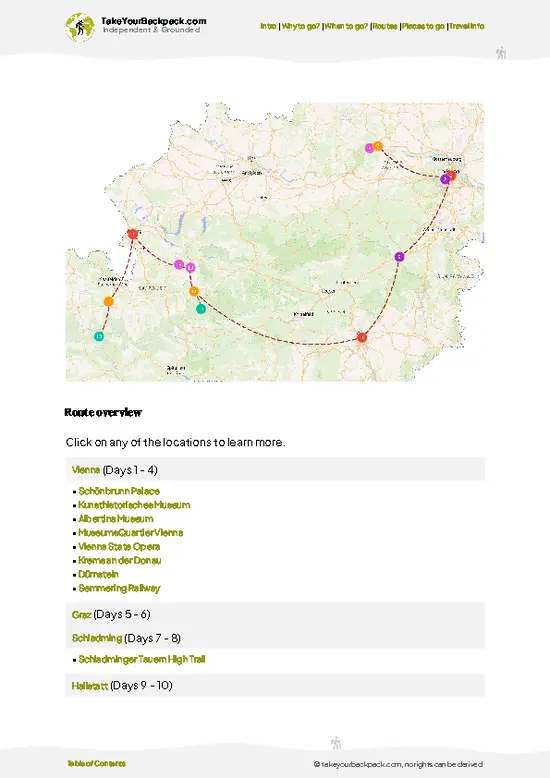
How many days to allow: A trip combining several villages in Austria needs 7 to 12 days, which allows three to five stops without turning the trip into a transit exercise. Plan on 1 to 3 nights per stop: one night suits a quick visit, but two or three let you hike or walk in the surroundings after you arrive.
Grouping regions and direction: Regions that sit along the same rail corridor combine best. Salzburg, the Salzkammergut and the Dachstein area form one cluster. Innsbruck, the Tyrolean valleys and Vorarlberg form another along the Arlberg line. The Danube cluster, around Krems and Melk, links easily with Vienna. Travelers entering through Vienna often go west (Danube, Salzkammergut, Tyrol) and fly or train out of Innsbruck, Salzburg or Munich, which avoids backtracking. Southern Carinthia … read more 👉
How many days to allow: A trip combining several villages in Austria needs 7 to 12 days, which allows three to five stops without turning the trip into a transit exercise. Plan on 1 to 3 nights per stop: one night suits a quick visit, but two or three let you hike or walk in the surroundings after you arrive.
Grouping regions and direction: Regions that sit along the same rail corridor combine best. Salzburg, the Salzkammergut and the Dachstein area form one cluster. Innsbruck, the Tyrolean valleys and Vorarlberg form another along the Arlberg line. The Danube cluster, around Krems and Melk, links easily with Vienna. Travelers entering through Vienna often go west (Danube, Salzkammergut, Tyrol) and fly or train out of Innsbruck, Salzburg or Munich, which avoids backtracking. Southern Carinthia and Styria fit better as a separate loop from Graz or Klagenfurt.

Connections between regions generally take 2 to 4 hours by train, such as Vienna to Salzburg at about 2.5 hours or Salzburg to Innsbruck at about 2 hours. Final bus links into a valley add 30 to 90 minutes.
Planning mistakes: The most common error is packing in too many regions, which leaves more time on trains than in villages. Choose two regions at most for a week. Another is ignoring last bus times, which in many valleys leave in the early evening and run thinly on Sundays. Check timetables on the ÖBB app before booking lodging, and arrive before mid-afternoon.

The ListThe Best villages of Austria

1 Hallstatt

Lakeside houses, salt mine tunnels, mountain backdrop, boat landings

Arrive by ferry or foot to a compact lakeshore village where ancient salt mining shaped the landscape and daily life.

austria-city-hallstatt
© Google | Gal1leo

2 Dürnstein

Danube riverbanks, blue church tower, terraced vineyards, castle ruins

Wander through narrow lanes beneath steep vineyards, then climb to a ruined fortress for views over the river and valley.

austria-city-durnstein
© Google | Christian M

3 St. Gilgen

Wolfgangsee views, Mozart family history, lakeside squares

Absorb lakeside scenery, trace musical heritage, and relax in open squares framed by traditional facades and mountain backdrops.

austria-city-st-gilgen
© Google | Ursula Kraemer

4 Gosau

Alpine meadows, Dachstein massif, wooden farmhouses, glacier views

Follow quiet trails past grazing cattle and traditional homes, with the dramatic Dachstein peaks and glaciers always in sight.

5 St. Anton am Arlberg

ski slopes, après-ski bars, mountain passes

Ski challenging runs, join lively evenings, and cross high passes that connect Tyrol with the western Alps.

6 Rattenberg

glassblowing studios, medieval lanes, compact townscape

Watch artisans shape glass, explore narrow streets, and experience Austria’s smallest town nestled beneath a rocky hill.

austria-city-rattenberg
© Google |

7 Traunkirchen

Peninsula church, Traunsee lake, lakeside promenade, monastery grounds

Stroll along the water’s edge, visit a lakeside church perched on a rocky outcrop, and explore quiet monastery gardens.

8 Lunz am See

Mountain lake, forested hills, wooden piers, summer swimming

Swim in clear waters, rent a rowboat, or hike forested slopes surrounding a tranquil lake popular with locals in summer.

austria-city-lunz-am-see
© Google | Felix Popernitsch
Loading the map 🌍

Expert viewInsights from Locals and Experts

How many villages to visit: I advise three to five villages on a trip of one to two weeks. Austrian villages are compact, so the value comes from walking, eating and spending an evening there, not from ticking off names. Beyond five, transfers eat the time that makes a village worth visiting. Staying two nights in each place also lets you use the first evening to arrive and the full day for a hike or a swim.
Choosing a kind of village: Match the type to your travel style. Hikers should favor high alpine villages in Tyrol, Salzburgerland and Vorarlberg, where trailheads and huts sit close. Culture and food seekers do better in the Wachau, Burgenland and southern Styria, where wine taverns and harvest-season Heurigen set the pace. Budget travelers should lean toward Carinthia, eastern Styria … read more 👉
How many villages to visit: I advise three to five villages on a trip of one to two weeks. Austrian villages are compact, so the value comes from walking, eating and spending an evening there, not from ticking off names. Beyond five, transfers eat the time that makes a village worth visiting. Staying two nights in each place also lets you use the first evening to arrive and the full day for a hike or a swim.
Choosing a kind of village: Match the type to your travel style. Hikers should favor high alpine villages in Tyrol, Salzburgerland and Vorarlberg, where trailheads and huts sit close. Culture and food seekers do better in the Wachau, Burgenland and southern Styria, where wine taverns and harvest-season Heurigen set the pace. Budget travelers should lean toward Carinthia, eastern Styria and Lower Austria, where prices are noticeably lower than around ski resorts. Lake villages suit swimming and easy cycling but fill quickly in July and August.
What it costs: Plan on €70 to 110 a day as a backpacker staying in hostels, simple guesthouses or private rooms, eating one restaurant meal and self-catering the rest. Resort villages in high season can push that to €120 to 160. Dorm beds run about €30 to 55 in most places, and double rooms in family guesthouses €70 to 130. Bus rides within a valley cost roughly €2 to 8, and many lodgings issue a guest card that covers local transport and sometimes lifts, so ask at check-in. Cable cars charge about €20 to 50 return, and village museums or churches usually cost €0 to 8. Hiking itself is free.
Safety and etiquette: Crime is very low, so the real risks are mountain weather and terrain. Afternoon storms form fast in summer, so start hikes early and carry a rain layer even on short walks. Mark your route with the local tourist office, and note that the European emergency number 112 works across the country, though signal drops in deep valleys. Alpine huts require reservations in July and August.

For etiquette, greet people with “Grüß Gott” in the west and south, or “Servus” and “Hallo” in the east. Quiet hours apply on Sundays and after about 10 pm, and many shops close on Sundays, so buy food on Saturday. On farm land, keep to marked paths and close gates, because cattle graze on many pastures and mother cows can be aggressive. Tipping 5 to 10 percent by rounding up is normal, and cash is still preferred at huts and small guesthouses.

✈️ The backpacker research shortcutAustria Travel Guide

An offline-friendly backpacking guide with optimized travel routes, ranked highlights, transport advice, and the best areas to stay.
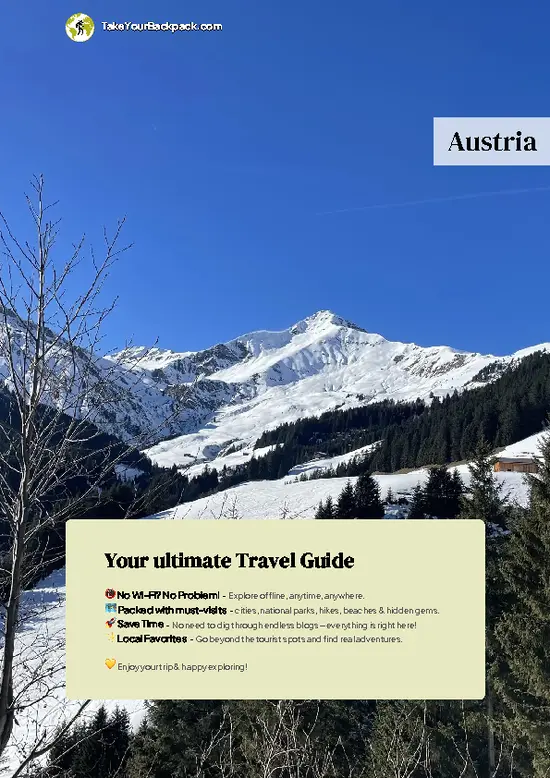
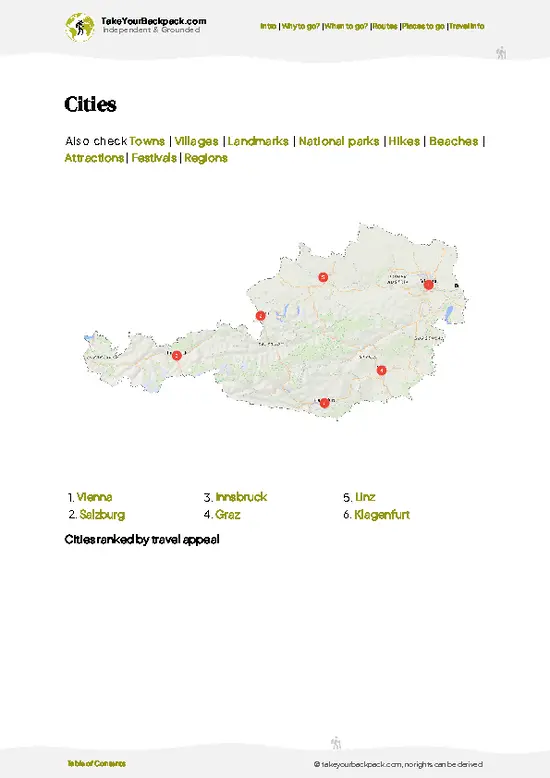
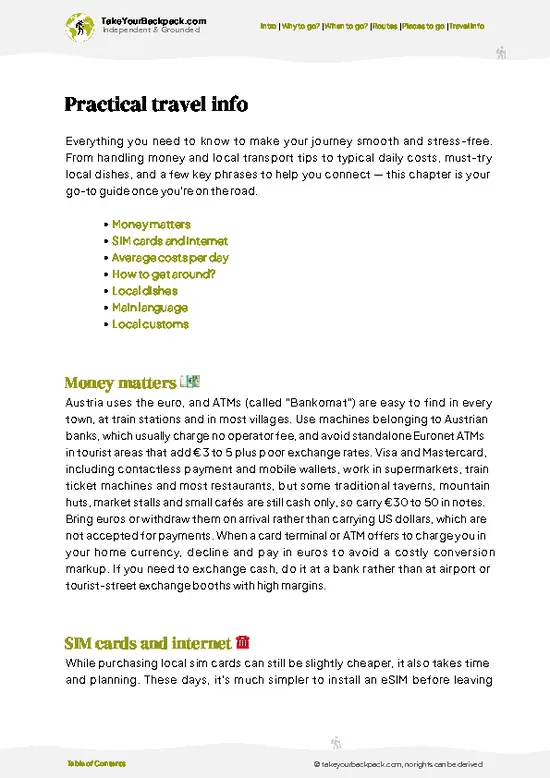
example page 0 from our offline Travel Guide for Austria
example page 1 from our offline Travel Guide for Austria
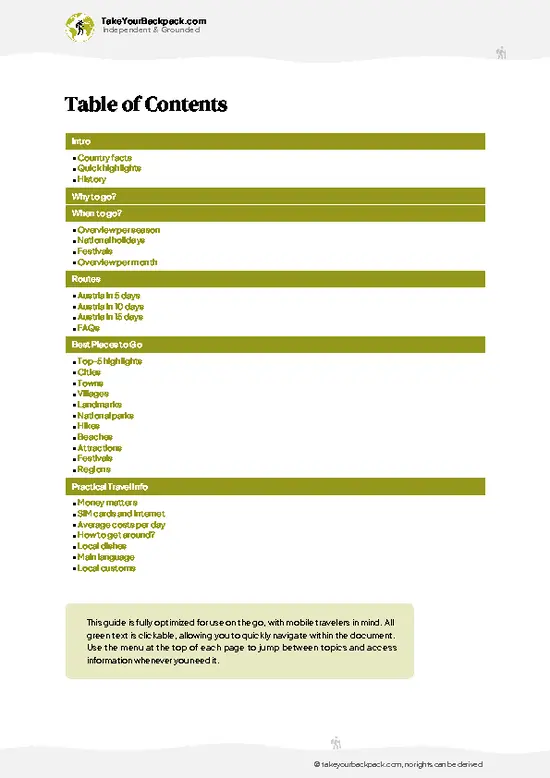
example page 2 from our offline Travel Guide for Austria
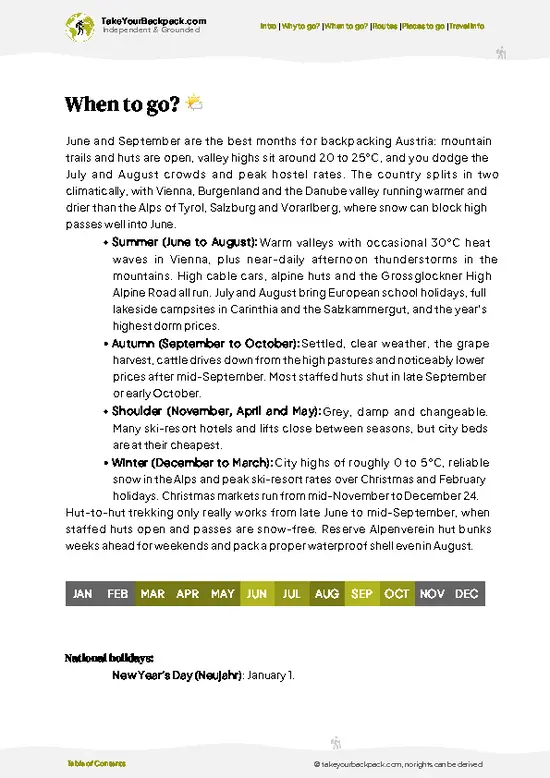
example page 3 from our offline Travel Guide for Austria
example page 4 from our offline Travel Guide for Austria
example page 5 from our offline Travel Guide for Austria
example page 6 from our offline Travel Guide for Austria
example page 7 from our offline Travel Guide for Austria
The digital guide (354 pages) contains:
✅ 90 highlights, ranked by travel appeal
✅ Optimized 5, 10 & 15-day travel routes
✅ Cities, national parks, landmarks, beaches
✅ How to get around
✅ Offline-friendly for travel without Wi-Fi
👉 Click to see all 30+ guide features

📅 Plan smarter in minutes, not weeks
✅ Month by month travel advice
✅ Festivals & national holidays
✅ Budget expectations

🗺️ Go to the right places, skip the overrated ones
✅ Honest pros & cons of destinations
✅ Top hikes, parks & viewpoints
✅ Lesser-known places most travelers miss
✅ Clear “worth it vs skip it” guidance

🛏️ Travel smoothly without rookie mistakes
✅ Best areas to stay
✅ Transport systems explained simply
✅ Common scams & safety advice
✅ SIM cards, money & practical tips

🌍 Understand the country, not just visit it
✅ Culture & traditions
✅ 52 Essential phrases & customs
✅ Festivals worth planning around
✅ Traveler-friendly historical context
✅ Insights that make places more meaningful

📱 Built for real travel conditions
✅ Fully downloadable PDF
✅ Works completely offline
✅ Optimized for phone use
✅ Useful in remote areas & buses
✅ Everything in one place
Stop searching, start planning
Get instant access to your full guide. 30‑day money-back guarantee.
+ Add another guide for just

By proceeding you agree to our terms.
Sent to your inbox immediately after payment • 100% Secure Checkout
Best Backpacking Travel Advisor 2025 tourism awardBest Backpacking
Travel Advisor
2025
What others say about Take Your Backpack Guides:
⭐⭐⭐⭐⭐
Fantastic, amazing amount of information!
⭐⭐⭐⭐⭐
My goodness this is amazing, it's what I've been looking for hats off too you!
⭐⭐⭐⭐⭐
I think this is absolutely BRILLIANT
⭐⭐⭐⭐
Very complete and informative. It's still missing places, but I gotta to commend you
⭐⭐⭐⭐⭐
This is truly amazing, thank you, can't wait to explore it with my kids!
⭐⭐⭐⭐⭐
Awesome resource, thank you!
⭐⭐⭐⭐⭐
This is amazing! Can't wait to explore the ones I haven't seen
⭐⭐⭐⭐
I love this! Well done, great idea.
⭐⭐⭐⭐⭐
Thanks for taking the time to make this gem!
⭐⭐⭐⭐⭐
This might be the best website I've ever seen.
⭐⭐⭐⭐⭐
Congratulations, and thank you so much for your work; it's incredibly valuable.
⭐⭐⭐⭐
In all seriousness I think you did a great job pointing out the important spots
⭐⭐⭐⭐⭐
10/10 very good
⭐⭐⭐⭐⭐
As someone who's only just starting to visit regularly this is awesome, thank you.
⭐⭐⭐⭐
Thank you very much! I'm going to visit my dad, it's going to be very useful!
⭐⭐⭐⭐⭐
This is really cool! We'll be travelling for the first time and this definitely come in handy.
⭐⭐⭐⭐⭐
You are now our minister of culture, congratulations 👨‍💼
⭐⭐⭐⭐⭐
Just wanted to tell you that this is a pearl! Going to follow your recommendations.
⭐⭐⭐⭐⭐
This is so cool. I'll definitely be using the resource for my travels soon.
⭐⭐⭐⭐⭐
This is very impressive! Good work.
⭐⭐⭐⭐⭐
This is an amazing and informative site. Very well done!

🛏️ Where to stay?Where to Stay in Austria

Hostels are plentiful in Austria, with dorm beds typically running €25 to €45 a night and the widest choice in Vienna, Salzburg, Innsbruck and Graz, plus youth hostels and budget guesthouses in smaller towns and alpine resorts. In Vienna, Neubau and Mariahilf near Westbahnhof put you in walking distance of the MuseumsQuartier and plenty of bars, while Favoriten around the Hauptbahnhof is cheaper and has excellent transport links but little character after dark; Leopoldstadt sits between the two, close to the Prater and the center but quieter at night. In Salzburg, beds near the station in Elisabeth-Vorstadt cost noticeably less than anything in the Altstadt (a 15 to 20 minute walk away), and … read more 👉
Hostels are plentiful in Austria, with dorm beds typically running €25 to €45 a night and the widest choice in Vienna, Salzburg, Innsbruck and Graz, plus youth hostels and budget guesthouses in smaller towns and alpine resorts. In Vienna, Neubau and Mariahilf near Westbahnhof put you in walking distance of the MuseumsQuartier and plenty of bars, while Favoriten around the Hauptbahnhof is cheaper and has excellent transport links but little character after dark; Leopoldstadt sits between the two, close to the Prater and the center but quieter at night. In Salzburg, beds near the station in Elisabeth-Vorstadt cost noticeably less than anything in the Altstadt (a 15 to 20 minute walk away), and in Innsbruck the area around the main station keeps you close to the old town and the Nordkette cable car.

If you enjoy meeting fellow travelers, consider choosing hostels with high ratings for atmosphere. On the other hand, if you prefer having your own space, a hotel might be a better option.

AustriaMore of Austria

👋 Meet the founderWho’s Behind Take Your Backpack?

Johan, backpacker and founder of TakeYourBackpackHi, I’m Johan (Netherlands 🇳🇱), the creator of TakeYourBackpack. Over the past 3 decades, I’ve backpacked through 90+ countries across six continents, gaining extensive experience with independent travel, long-term trips, and overland routes.

This site is built on a combination of firsthand travel experience and carefully curated insights from other backpackers. Many guides are based on places I’ve personally visited, while others bring together tips, observations, and practical advice shared by trusted travelers I’ve met along the way.

The goal is to provide realistic, experience-driven guidance — not generic itineraries — so you can explore destinations with better context, clearer expectations, and more confidence.