×
Belarus🇧🇾 | 15 days itinerary

A Complete 15-Day Plan for Belarus

By Johan Kruseman 🇳🇱 | Updated May 5, 2026
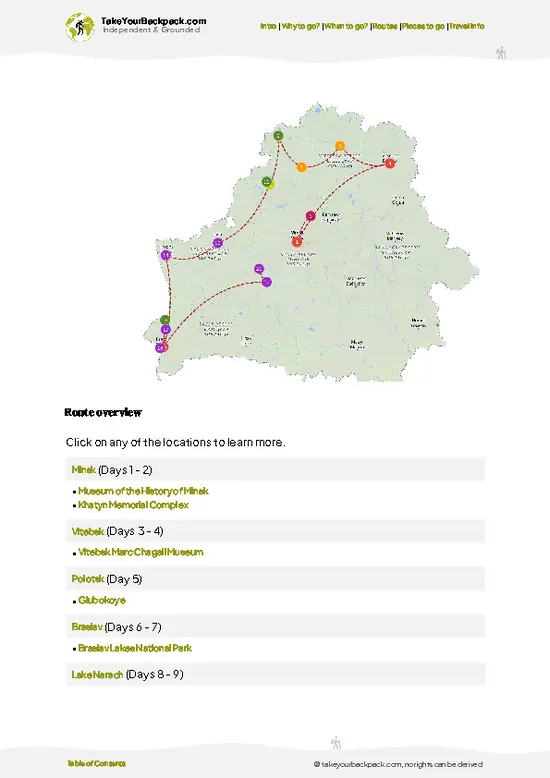
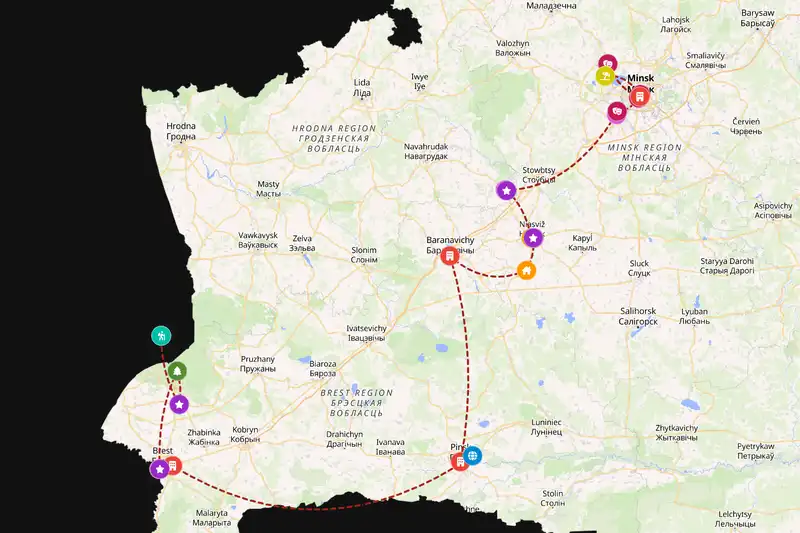
This 15-day route is for travelers who want to really sink into Belarus: big cities, medieval towns, deep forests, and lake country, moving at a measured pace that still covers serious ground. You’ll mostly use trains and intercity buses between hubs like Minsk, Brest, Grodno, and Vitebsk, with shorter local rides to castles, national parks, and villages so you never stack long travel days back-to-back.

Days 1-3: Minsk, memory, and folk life foundations

Start with three nights in Minsk to get your bearings and adjust to the rhythm of the country. Spend your first full day walking the city core and booking an evening at the National Academic Bolshoi Opera and Ballet Theatre of Belarus, where the combination of serious talent and accessible pricing makes it one of the best-value cultural nights out in Eastern Europe. On day two, take a half-day trip to the Khatyn Memorial Complex to understand the scale of wartime loss in Belarus, then return to Minsk for a slow evening rather than cramming … read more 👉
This 15-day route is for travelers who want to really sink into Belarus: big cities, medieval towns, deep forests, and lake country, moving at a measured pace that still covers serious ground. You’ll mostly use trains and intercity buses between hubs like Minsk, Brest, Grodno, and Vitebsk, with shorter local rides to castles, national parks, and villages so you never stack long travel days back-to-back.

Days 1-3: Minsk, memory, and folk life foundations

Start with three nights in Minsk to get your bearings and adjust to the rhythm of the country. Spend your first full day walking the city core and booking an evening at the National Academic Bolshoi Opera and Ballet Theatre of Belarus, where the combination of serious talent and accessible pricing makes it one of the best-value cultural nights out in Eastern Europe. On day two, take a half-day trip to the Khatyn Memorial Complex to understand the scale of wartime loss in Belarus, then return to Minsk for a slow evening rather than cramming more heavy history. Use day three to explore the Belarusian State Museum of Folk Architecture and Rural Lifestyle near Strochitsy, where relocated wooden churches and farmhouses give you a tactile sense of rural traditions before you head deeper into the countryside later in the trip.

Days 4-6: Castles, noble estates, and village ruins in the southwest

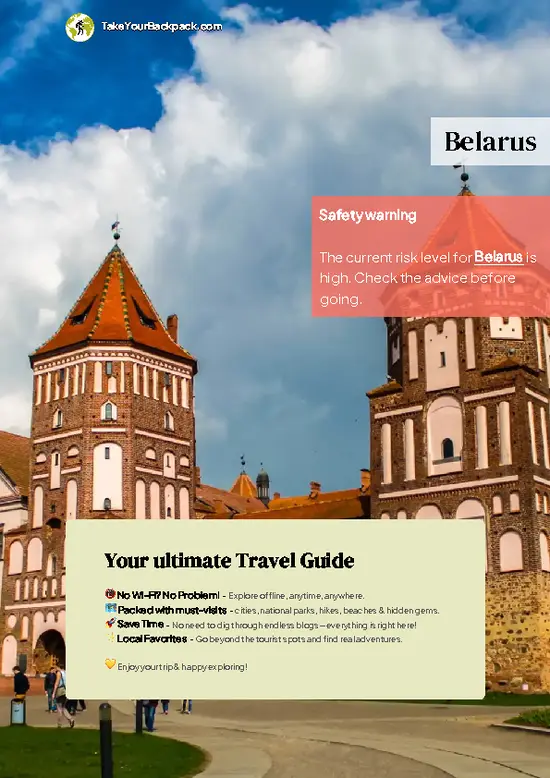
Travel by bus from Minsk to the town of Nesvizh and settle in for two nights so you can explore without suitcase fatigue. Dedicate a full day to the Nesvizh Palace and Nesvizh Castle, wandering the park, lakeside paths, and town streets once the day-trippers leave. On the next day, make a side trip to the village of Mir to visit the Mir Castle Complex, whose chunky towers and moat feel straight out of a storybook, then continue southwest to the village of Ruzhany for a night amid the atmospheric ruins of the old palace complex; it’s more raw and less polished than Nesvizh, which is exactly the point. From Ruzhany, move on to Brest without rushing, breaking up the journey so it feels like a gentle progression rather than a forced march.

Days 7-9: Brest, fortress history, and primeval forest

Base yourself in Brest for three nights to balance heavy history with wild nature. Spend one full day at the Brest Hero-Fortress Memorial Complex and Brest Hero-Fortress, where monumental sculptures, surviving ramparts, and small museums tell the story of the city’s brutal World War II siege; give yourself time to wander the grounds instead of just ticking off the main monuments. On another day, take a trip into Belovezhskaya Pushcha National Park and walk part of the Belovezhskaya Pushcha Forest Trail, where ancient oaks, bison habitat, and quiet paths show you why this forest is such a big deal in European conservation. Use your third evening in Brest to decompress on its pedestrian streets, people-watch, and enjoy the feeling of a border city that looks both east and west.

Days 10-12: Grodno’s layered past and castle country

Ride a daytime train or bus to Grodno and give yourself two nights to explore a city that packs a lot of history into a walkable center. Spend your first full day wandering the old town and focusing on the Kalozha Church, whose riverside perch and ancient walls make it one of the most characterful churches in the country. From Grodno, take a side trip to Lida to visit Lida Castle, a more rugged, less manicured fortress that gives you a different flavor of medieval defense than Mir or Nesvizh; it’s optional, but for castle fans it rounds out the set nicely. Return to Grodno for your second night so you’re not constantly changing beds, then prepare for a longer but manageable travel day toward the lakes and northern towns.

Days 13-15: Vitebsk, Chagall, and lake-town calm

Head northeast to Vitebsk, a city with strong artistic associations and a more relaxed tempo than Minsk, and stay two nights so you can explore without rushing. Visit the Vitebsk Marc Chagall Museum to connect the city’s streets with the dreamlike paintings you’ve seen in galleries elsewhere, then wander the riverfront and central squares to feel how the city has rebuilt itself around that legacy. On your final full day, take a trip to the town of Braslaw and the surrounding Braslav Lakes National Park, where you can walk sections of the Braslav Lakes Trail, climb viewpoints, and watch the light change over the water; it’s a calm, nature-heavy finale after the fortresses and big cities. Return to Vitebsk for your last night, then depart the next morning with a mental map of Belarus that stretches from primeval forest to castle towns to lake country.

When you come back for round two, consider tracking down the tiny hamlet of Zaslavl’s old ramparts, where grass, wind, and a handful of locals share more space than visitors ever will.
Loading the map 🌍
film
0
0
0a
Minsk
Liavontsi Ananka
film
1
1
1a
National Academic Bolshoi Opera and Ballet Theatre of Belarus
film
2
2
2a
Belarusian State Museum of Folk Architecture and Rural Lifestyle
film
3
3
3a
Nesvizh
film
4
4
4a
Nesvizh Palace
film
5
5
5a
Nesvizh Castle
Andrzej Burlikowski
film
6
6
6a
Mir
film
7
7
7a
Mir Castle Complex
Мирский замок
film
8
8
8a
Brest
Krystyna Cislik
film
9
9
9a
Brest Hero-Fortress Memorial Complex
film
10
10
10a
Brest Hero-Fortress
Paul Casco
film
11
11
11a
Kalozha Church
Павел Тищенко
film
12
12
12a
Lida Castle
Анатолий Галкин
film
13
13
13a
Vitebsk
Alex Fil

✈️ The backpacker research shortcutBelarus Travel Guide

An offline-friendly backpacking guide with optimized travel routes, ranked highlights, transport advice, and the best areas to stay.
example page 0 from our offline Travel Guide for Belarusexample page 1 from our offline Travel Guide for Belarusexample page 2 from our offline Travel Guide for Belarusexample page 3 from our offline Travel Guide for Belarusexample page 4 from our offline Travel Guide for Belarusexample page 5 from our offline Travel Guide for Belarus
The digital guide (273 pages) contains:
76 highlights, ranked by travel appeal
Optimized 5, 10 & 15-day travel routes
Best neighborhoods to stay
How to get around
Offline-friendly for travel without Wi-Fi
👉 See all 30+ guide features

📅 Plan smarter in minutes, not weeks
Month by month travel advice
Festivals & national holidays
Budget expectations

🗺️ Go to the right places, skip the overrated ones
Honest pros & cons of destinations
Top hikes, parks & viewpoints
Lesser-known places most travelers miss
Clear “worth it vs skip it” guidance

🛏️ Travel smoothly without rookie mistakes
Best areas to stay
Transport systems explained simply
Common scams & safety advice
SIM cards, money & practical tips

🌍 Understand the country, not just visit it
Culture & traditions
52 Essential phrases & customs
Festivals worth planning around
Traveler-friendly historical context
Insights that make places more meaningful

📱 Built for real travel conditions
Fully downloadable PDF
Works completely offline
Optimized for phone use
Useful in remote areas & buses
Everything in one place
Save weeks of stressful planning
Get instant access to the full guide directly. 30-day money-back guarantee.


Sent to your inbox immediately after payment • 100% Secure Checkout
Best Backpacking Travel Advisor 2025 tourism awardBest Backpacking
Travel Advisor
2025
What others say about Take Your Backpack Guides:
⭐⭐⭐⭐⭐
Fantastic, amazing amount of information!
⭐⭐⭐⭐⭐
My goodness this is amazing, it's what I've been looking for hats off too you!
⭐⭐⭐⭐⭐
I think this is absolutely BRILLIANT
⭐⭐⭐⭐
Very complete and informative. It's still missing places, but I gotta to commend you
⭐⭐⭐⭐⭐
This is truly amazing, thank you, can't wait to explore it with my kids!
⭐⭐⭐⭐⭐
Awesome resource, thank you!
⭐⭐⭐⭐⭐
This is amazing! Can't wait to explore the ones I haven't seen
⭐⭐⭐⭐
I love this! Well done, great idea.
⭐⭐⭐⭐⭐
Thanks for taking the time to make this gem!
⭐⭐⭐⭐⭐
This might be the best website I've ever seen.
⭐⭐⭐⭐⭐
Congratulations, and thank you so much for your work; it's incredibly valuable.
⭐⭐⭐⭐
In all seriousness I think you did a great job pointing out the important spots
⭐⭐⭐⭐⭐
10/10 very good
⭐⭐⭐⭐⭐
As someone who's only just starting to visit regularly this is awesome, thank you.
⭐⭐⭐⭐
Thank you very much! I'm going to visit my dad, it's going to be very useful!
⭐⭐⭐⭐⭐
This is really cool! We'll be travelling for the first time and this definitely come in handy.
⭐⭐⭐⭐⭐
You are now our minister of culture, congratulations 👨‍💼
⭐⭐⭐⭐⭐
Just wanted to tell you that this is a pearl! Going to follow your recommendations.
⭐⭐⭐⭐⭐
This is so cool. I'll definitely be using the resource for my travels soon.
⭐⭐⭐⭐⭐
This is very impressive! Good work.
⭐⭐⭐⭐⭐
This is an amazing and informative site. Very well done!

🧭 RouteMore Ways to Explore

Travel Belarus your way — from a quick highlights trip to a slow-paced adventure.

🙋 FAQGood to Know

Short version: yes, but it rewards a bit of prep. Belarus is safe, people are generally kind to strangers, and prices are friendly for backpackers, but English is limited and bureaucracy can be quirky. If you’ve handled places like rural Ukraine, Georgia, or the Balkans, Belarus will feel familiar. If this is your first “Cyrillic country,” you just need to be more deliberate. Book your first couple of nights in advance, screenshot your bookings, and keep your passport and migration/registration slips organized. Learn the Cyrillic alphabet before you go; it makes train stations, menus, and street signs suddenly readable, which is a huge confidence boost. Big cities like Minsk, Brest, Hrodna (Grodno), and Vitebsk are straightforward: hostels, apartments, and guesthouses are easy to find on major booking platforms, and public transport is cheap and reliable. Rural areas and national parks are more old-school: fewer English speakers, more reliance on gestures, translation apps, and patience. Independent backpacking is easiest if you stick to the main rail lines and a few well-known nature spots, and treat remote villages as day trips or short overnights rather than trying to freestyle deep countryside itineraries. Visas and entry rules have changed several times over the years, so you need to sort your entry route, visa requirements, and any registration rules before you go; once you’re in, day-to-day travel is simple. Overall, Belarus is very doable solo if you’re comfortable with a bit of language barrier, slower logistics, and planning your route around trains and marshrutkas instead of spontaneous hitchhiking.
If you’re moving fast and focusing on cities, you can get a solid feel for Belarus in 5–7 days: Minsk plus one or two side trips. That works if you’re on a longer Eastern Europe loop and just want a taste. For a balanced backpacking trip that includes both Soviet-era city life and nature, 10–12 days is the sweet spot. That gives you time for Minsk, Brest and the Brest Fortress, Mir and Niasvizh castles, and at least one national park like Belavezhskaya Pushcha or Braslaw Lakes without sprinting. If you’re slow-travel inclined, 2 weeks lets you add Vitebsk or Hrodna, spend a night or two in a small town, and actually relax instead of just collecting train tickets. Under 4 days is only worth it if you’re entering visa-free via Minsk or on a quick side hop: you’d basically do Minsk plus one easy day trip (Mir/Niasvizh or a nearby forest) and that’s it. Over 2 weeks is mainly for people who really enjoy quiet countryside, birdwatching, cycling, or digging into World War II history; the country is flat and calm, so there’s not a huge list of “headline” sights, but it’s great if you like slow, cheap, low-drama travel.
You can absolutely get around Belarus without a car, and for backpackers it’s usually the better choice. The backbone of the country is its rail network: trains between Minsk, Brest, Hrodna, Vitebsk, Mahilyow, and Homyel are cheap, reasonably frequent, and comfortable. There are fast trains on the main corridors and slower elektrichka commuter trains that stop in smaller towns; both are budget-friendly, and buying tickets at the station is straightforward if you know your destination in Cyrillic or have it written down. For places not on the main rail lines, marshrutkas (shared minibuses) and regional buses fill the gaps. They’re slightly more chaotic but very backpacker-friendly: low cost, lots of departures on popular routes, and you just pay the driver or buy a ticket at a kiosk. This is how you’ll reach many smaller towns and some national park gateways. Inside cities, you can rely on metro (in Minsk), trams, trolleybuses, and regular buses; tickets are cheap and usually sold at kiosks or from the driver. Walking is safe and often the best way to get a feel for a place once you’re in the center. Where it gets trickier without a car is deep nature: certain trailheads, remote villages, or specific forest areas might require a taxi from the nearest town or pre-arranged transport with a guesthouse. If you’re okay with using taxis for the last 10–20 km of a journey, you won’t miss much. For a classic backpacking route—Minsk, Brest, castles, one or two national parks—you don’t need a car at all; you just need to plan around train and bus timetables instead of winging it hour by hour.
For a first-time, budget-conscious backpacking trip, there are a few places that really justify the time and ticket money. Minsk is the anchor: not because it’s pretty in a postcard way, but because it shows you the scale of Soviet-era planning, wide avenues, and big public spaces. Walk Independence Avenue, check out Victory Square, and spend time in the smaller neighborhoods and bars where the city actually feels lived-in. It’s also your best base for cheap hostels and onward transport. Brest is next on the list, mainly for Brest Fortress. The fortress complex is one of the most powerful World War II sites in the region: huge, heavy, and emotionally intense, and it gives real context to the country’s history. The town itself is relaxed and easy to wander on foot. Mir and Niasvizh (Nesvizh) castles are the classic day trip combo from Minsk or a one-night stopover. They’re some of the most atmospheric historical sites in Belarus, with lakes, parks, and enough detail to keep history nerds happy without feeling like a theme park. For nature, Belavezhskaya Pushcha National Park is the standout: ancient forest, European bison, and a sense of old Europe that’s hard to find elsewhere. It’s not hardcore trekking, but it’s a great place to cycle or walk for a day or two. If you like lakes and low-key camping vibes, Braslaw Lakes region is worth the detour in warmer months: think swimming, canoeing, and quiet evenings rather than dramatic mountains. For an extra city with character, Hrodna (Grodno) is a strong pick: compact old center, churches and synagogues, and a more Central European feel that contrasts nicely with Minsk. If you have 10–14 days, a route that links Minsk, Brest, Mir/Niasvizh, Belavezhskaya Pushcha, and either Braslaw Lakes or Hrodna gives you a very complete picture without blowing your budget.
If you’re short on time, skip anything that’s just a weaker version of something you’re already seeing. You don’t need multiple mid-sized Soviet-style cities; Minsk plus maybe one more (Brest or Hrodna) is enough. Cities like Mahilyow or Homyel are interesting if you’re slow traveling, but they’re not essential if you only have a week. You can also skip long detours to small towns that don’t have a specific draw for you; many have similar low-rise blocks, a central square, and a church or two. If you’re already visiting Belavezhskaya Pushcha or Braslaw Lakes, you can pass on extra minor forests or lakes that require complicated bus connections; the landscapes are pleasant but not dramatically different. Unless you’re a hardcore museum person, you don’t need to hit every big museum in Minsk; choose one or two that match your interests (history, war, art) and spend the rest of your time walking neighborhoods and parks. If your schedule is really tight—say 4–5 days—skip Braslaw Lakes and any far-north or far-east detours and focus on a triangle of Minsk, Mir/Niasvizh, and Brest with the fortress. That gives you city life, castles, and major history without wasting hours on transfers. Finally, don’t burn a day on shopping malls or generic modern attractions; Belarus’s strengths for backpackers are its history, quiet nature, and the feel of everyday life, not its retail scene or big-ticket entertainment complexes.

🇧🇾 BelarusDiscover the Country

Ready to build a truly unique trip? Predefined routes are perfect for first-time visitors, but there is so much more to discover. Whether you are chasing a city trip, pristine national parks, local food scenes, or quiet beaches, pick a category to design your own path.