
×

Costa Rica🇨🇷 | best townsWhere to Find the 10 Best towns in Costa Rica

Costa Rica’s towns rarely look like postcards. Expect tin roofs ticking in afternoon heat, a soccer field at the center, the smell of gallo pinto and diesel, and a church facing a park. The Pacific coast brings surf shacks, dust and sunsets, with higher prices. The Caribbean side is humid and cheaper, with Afro-Caribbean cooking, reggae and rain that arrives without warning. The highlands are cool, misty and coffee-scented. For backpacking or independent travel, access matters: public buses are frequent and cheap, but dirt roads and river crossings slow the remote spots, and crowds thicken where the tour vans stop.

By Johan Kruseman 🇳🇱 | Updated October 23, 2026
Explore the best villages in Costa Rica

Why go?Why Travelers Love These Spots

Costa Rica suits town-hopping because it is small, about 51,000 square kilometers, yet packs cloud forest, volcano slopes, two coastlines and dry tropical plains into a few hours of driving. The result is towns that feel different within one day: damp and cool at 1,500 meters, then sticky and salt-crusted by the sea. Since the army was abolished in 1948, spending has gone into schools, clinics and roads, which is why even small places have electricity, drinkable tap water in most areas and reliable buses that run to the village plaza.

The flip side is that this is not a bargain country. Towns near beaches and national parks price in dollars, and costs run higher than in neighboring Nicaragua or Panama. Many towns are built around a single activity, such as surfing, canopy tours or volcano … read more 👉
Costa Rica suits town-hopping because it is small, about 51,000 square kilometers, yet packs cloud forest, volcano slopes, two coastlines and dry tropical plains into a few hours of driving. The result is towns that feel different within one day: damp and cool at 1,500 meters, then sticky and salt-crusted by the sea. Since the army was abolished in 1948, spending has gone into schools, clinics and roads, which is why even small places have electricity, drinkable tap water in most areas and reliable buses that run to the village plaza.

The flip side is that this is not a bargain country. Towns near beaches and national parks price in dollars, and costs run higher than in neighboring Nicaragua or Panama. Many towns are built around a single activity, such as surfing, canopy tours or volcano viewing, so the real texture of life sits one street back, in sodas (small family restaurants) serving a casado for about US$5 to 8.

Before choosing Costa Rica, know that distances are deceiving. A 100 kilometer trip can take four hours on winding, potholed roads, and bridges flood in heavy rain. English is common in tourist hubs, but a few Spanish phrases open doors everywhere else.
How the List Was Created
The list of best towns in Costa Rica is created based on charm, local culture, atmosphere, hidden gems, and visitor appeal. If you feel a town is missing in this list, please let us know.

When to go?When to Plan Your Trip

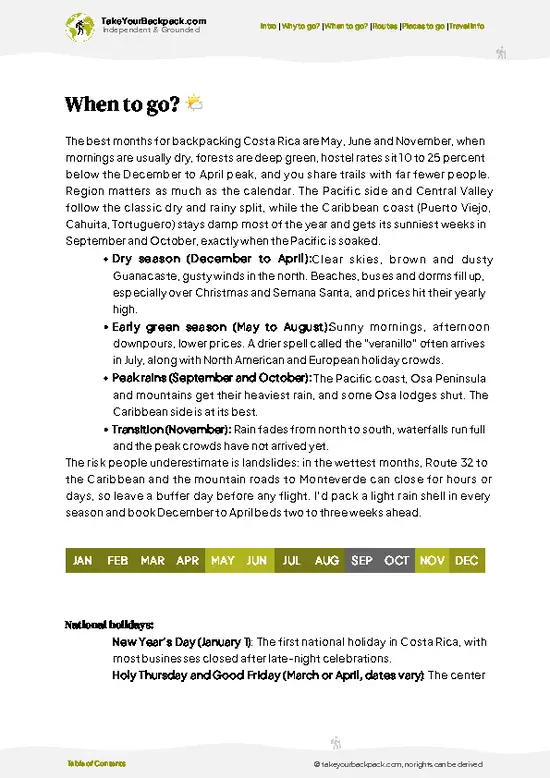
Best months for towns: The best months are December to April, when the Pacific side is dry, skies are clear blue and roads are firm. Daytime highs run 30 to 35°C (86 to 95°F) on the northern Pacific coast, with dust in the air and almost no rain. The highlands stay cooler, around 18 to 25°C (64 to 77°F), with a morning chill.
Green season and shoulder months: From May to November afternoon downpours drum on tin roofs, often starting at 2 or 3 p.m. Mornings are usually bright, so plan outings early. September and October are the wettest on the Pacific and in the highlands, with 300 to 500 mm of rain a month in some areas, and unpaved roads turn to mud. May, June and November are good compromises: green hills, fewer visitors and rates often 20 to 40 percent lower than in peak season.
Caribbean … read more 👉
Best months for towns: The best months are December to April, when the Pacific side is dry, skies are clear blue and roads are firm. Daytime highs run 30 to 35°C (86 to 95°F) on the northern Pacific coast, with dust in the air and almost no rain. The highlands stay cooler, around 18 to 25°C (64 to 77°F), with a morning chill.
Green season and shoulder months: From May to November afternoon downpours drum on tin roofs, often starting at 2 or 3 p.m. Mornings are usually bright, so plan outings early. September and October are the wettest on the Pacific and in the highlands, with 300 to 500 mm of rain a month in some areas, and unpaved roads turn to mud. May, June and November are good compromises: green hills, fewer visitors and rates often 20 to 40 percent lower than in peak season.
Caribbean side runs differently: The Caribbean coast has no true dry season. February to April and September to October tend to be its drier windows, while December and July bring heavier rain. That makes it a smart pick when the Pacific is soggy.
Peak periods: Christmas through New Year’s and Semana Santa (Holy Week) fill buses and beds, and prices jump. Book ahead then, especially on the coast.

town hoppingOptimizing Your Multi-Stop Itinerary

How long you need: A trip linking several towns in Costa Rica works best in 10 to 14 days, with 2 to 4 nights per stop. Fewer than 2 nights leaves you living out of a bus seat; the country’s roads punish rushed plans.
Regions that pair well: Group by geography. The Central Valley and highlands sit near San José, the main transport hub, and link easily with the northern lowlands and volcano area. The northern Pacific (Guanacaste and the Nicoya Peninsula) and the central and southern Pacific are each better as their own cluster. The Caribbean is a separate leg, reached by a 3 to 4 hour bus from San José.
Direction and transfers: Start in San José or Liberia and travel in a loop, ending near the other airport to avoid backtracking. Typical transfers run 3 to 5 hours between neighboring regions, … read more 👉
How long you need: A trip linking several towns in Costa Rica works best in 10 to 14 days, with 2 to 4 nights per stop. Fewer than 2 nights leaves you living out of a bus seat; the country’s roads punish rushed plans.
Regions that pair well: Group by geography. The Central Valley and highlands sit near San José, the main transport hub, and link easily with the northern lowlands and volcano area. The northern Pacific (Guanacaste and the Nicoya Peninsula) and the central and southern Pacific are each better as their own cluster. The Caribbean is a separate leg, reached by a 3 to 4 hour bus from San José.
Direction and transfers: Start in San José or Liberia and travel in a loop, ending near the other airport to avoid backtracking. Typical transfers run 3 to 5 hours between neighboring regions, and up to 6 to 8 hours between the far north and the deep south. Shuttles cost roughly US$40 to 65 per transfer and save time; public buses cost a fraction but often route through San José.
Common planning mistakes: The biggest error is trusting map distances. Allow double the time Google suggests in the rainy season. Another is packing in too many stops, then spending every afternoon in transit. Choose two or three regions, and leave a buffer day before any flight. Travel in the morning, since afternoon storms bring landslides, flooded fords and early dark by about 5:30 p.m.

The ListMust-Visit towns in Costa Rica

1 La Fortuna

Arenal views, 70-meter falls, thermal pools

Descend hundreds of steps to a waterfall pool, cross old lava flows beneath the volcano, and soak in river-fed hot springs by night.

2 Monteverde

Cloud forest, night walks, Quaker cheese

Trace mossy trails and hanging bridges at opening time, join a guided night walk, then sample ice cream at the old dairy.

3 Manuel Antonio

Park wildlife, hillside road, cove beaches

Enter the park at opening for capuchins and sloths, then swim at a calm cove and watch sunset from a restaurant built in a cargo plane.

4 Tamarindo

Beginner waves, turtle nesting, estuary paddling

Book a surf lesson on a long beach, kayak the mangrove estuary, and cross to Playa Grande for guided nesting-season turtle watching.

5 Puerto Viejo

Bike rentals, Salsa Brava, Caribbean coves

Pedal sandy roads to a calm cove, watch a heavy reef wave break from shore, and visit a sloth rescue center.

costa-rica-city-puerto-viejo
© Google | Vanesa Vallez

6 Uvita

Whale-tail sandbar, Costanera strip, waterfall pool

Walk the sandbar at low tide, time a humpback boat tour with the migration, then cool off in a forest waterfall pool.

7 Nosara

Gentle surf, yoga studios, tide pools

Learn to surf on a wide beach, explore rocky pools at low tide, and join morning yoga before howler monkeys settle down.

8 Dominical

Beach break, Barú river mouth, Friday market

Paddle out at dawn when the wind is down, then watch the Pacific turn orange from a beach bar after a Friday market breakfast.

9 Puerto Jiménez

Osa gateway, Golfo Dulce pier, scarlet macaws

Arrange Corcovado guides here, then spend spare hours among macaws in almond trees, on a calm gulf beach, and at the waterfront at dusk.

10 Cahuita

Caribbean park trail, black sand, coconut rice

Walk a flat coastal trail past sloths and monkeys, then finish days on a dark beach and over coconut-cooked rice and beans.

11 Liberia

White adobe streets, grackle dusk, Guanacaste museum

Stroll the old adobe street, visit a 19th-century chapel and a former barracks museum, then catch the grackles screeching over the evening park.

12 Quepos

Fishing port, marina walk, park gateway

Sleep in town for cheaper dinners, stroll the marina at dusk, and catch an early bus up to the national park.

13 Bijagua

Río Celeste access, night frogs, hanging bridges

Book the first trail slot at the blue river, then spend evenings on guided flashlight walks and days among hanging bridges.

14 Turrialba

Reventazón rapids, CATIE gardens, fresh cheese

Raft Class II to III water in the morning, tour a research campus of coffee and cacao, and buy soft cheese in town.

15 Santa Cruz

Guanacaste plaza, Black Christ, colonial bell tower

Sit under plaza shade trees, visit the church of the Black Christ, and eat cheap market lunches among locals rather than tour groups.

costa-rica-city-santa-cruz
© Google |

16 Atenas

Coffee slopes, Friday feria, shaded plaza

Settle into a mild-climate town where mornings go to park-side bakeries, Friday mornings to the market, and late afternoons to viewpoints over coffee farmland.

costa-rica-city-atenas
© Google |

17 San Isidro de El General

Chirripó gateway, cool valley air, fruit stand breakfasts, mountain ridges

Stock up on market fruit and cheese, then ride to San Gerardo de Rivas to register for the Chirripó climb the next morning.

18 Nicoya

Colonial church, Chorotega roots, market tortillas

Step into a 1600s adobe church, trace the 1824 annexation story on the plaza, and buy corn snacks at the municipal market.

19 Sarchí

Oxcart workshops, giant wheel, cedar furniture

Watch artisans paint wheels in a water-powered factory, photograph the giant oxcart, and browse roadside rocking chairs and leather work.

20 Zarcero

Topiary garden, palmito cheese, mountain chill

Wander clipped cypress arches and animals in the church park, then taste salty local cheese and fudge from shops around the plaza.

21 San Ramón

Saturday feria, poets and presidents, coffee mills

Taste fresh roasts on hillside mill visits, browse a Saturday market, and catch a concert at the restored municipal theater.

22 Grecia

Red metal church, yuca at the feria, coffee hills

Admire a steel church shipped from Belgium, graze the weekend market, and hike to waterfalls and valley lookouts among cane and coffee fields.

23 Guápiles

Route 32 market town, pejibaye, rainforest tram

Eat casados at main-street sodas, browse weekend produce stalls, and ride a rainforest tram and zip line on the Braulio Carrillo edge.

24 Parrita

Palm plantations, mangrove estuary, dark-sand shore

Cycle flat roads between oil palms, paddle the river estuary for herons and crocodiles, and walk an empty driftwood beach.

25 Ciudad Quesada

San Carlos farm hub, modern cathedral, cheese market

Browse a working market town where locals fill the cathedral plaza, stalls sell fresh cheese and tamales, and sunset views stretch over cane fields.

Think you know Costa Rica?

Prove you’re a true local — uncover 15 lesser-known towns in Costa Rica that locals tend to keep to themselves.
Loading the map 🌍

Expert viewWhat You Should Know

How many towns to visit: I advise three to five towns on a trip of two weeks. Each needs at least two nights to feel like more than a bus stop, and Costa Rica’s winding roads eat the rest. More than that and you will see the inside of a shuttle van far more than the street life.
Which kind to prioritize: Match the town to your style. If you want surf and nightlife, pick a Pacific beach town and accept higher prices and a younger, international crowd. If you want local life and cooking, choose a highland or Caribbean town, where the sodas, the Saturday feria (farmers market) and the evening plaza are the main attractions. For nature access, choose a town at the edge of a park or reserve, but note that you pay for proximity. A town that exists purely for tour operators is worth one night, not … read more 👉
How many towns to visit: I advise three to five towns on a trip of two weeks. Each needs at least two nights to feel like more than a bus stop, and Costa Rica’s winding roads eat the rest. More than that and you will see the inside of a shuttle van far more than the street life.
Which kind to prioritize: Match the town to your style. If you want surf and nightlife, pick a Pacific beach town and accept higher prices and a younger, international crowd. If you want local life and cooking, choose a highland or Caribbean town, where the sodas, the Saturday feria (farmers market) and the evening plaza are the main attractions. For nature access, choose a town at the edge of a park or reserve, but note that you pay for proximity. A town that exists purely for tour operators is worth one night, not three.
What it costs: Budget US$45 to 80 a day as a backpacker: dorm beds US$12 to 25, a casado at a soda US$5 to 8, local buses US$1 to 10 per ride. Cooking in hostel kitchens cuts costs; supermarkets are decent but imported goods are pricey. Add US$15 to 30 for national park entry (foreign visitors usually pay US$15 to 20), US$40 to 90 for a guided night or bird walk, and US$40 to 65 for a shuttle. Surf lessons run about US$40 to 70 and board rental US$10 to 20 a day. Many places accept US dollars but give change in colones, so carry small bills and colones for buses and sodas.
Safety and local etiquette: Costa Rica is relatively safe, but petty theft is the main risk. Never leave belongings in a parked car or on the sand, even briefly, and keep your phone out of sight on crowded buses. Beach towns see the most bag snatching after dark. Rip currents kill more visitors than crime, so swim only where lifeguards or locals are in the water, and ask about conditions at your hostel.
Cultural considerations: Ticos value politeness. Greet people with a “buenas” on entering a shop or soda, and do not jump straight to the question. Dress in shirts away from the beach. The phrase “pura vida” works as hello, thanks and no worries, but use it sincerely. Tap water is safe in most towns, though on remote coasts ask first. Skip any tour that promises guaranteed wildlife sightings. Hire a licensed guide for animal spotting, since a good one finds sloths and owls that you will walk past.

✈️ The backpacker research shortcutCosta Rica Travel Guide

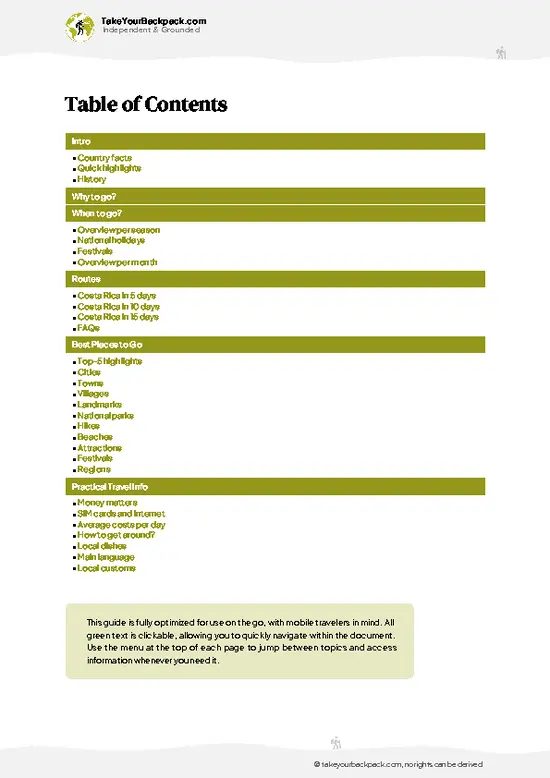
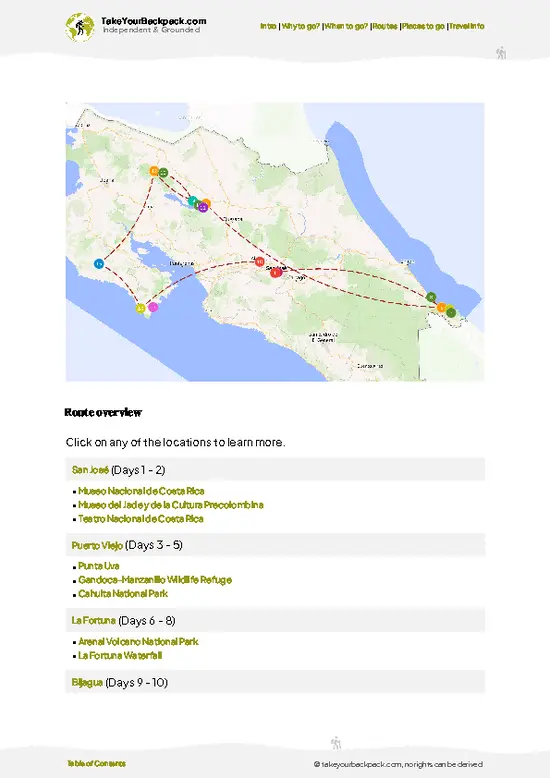
An offline-friendly backpacking guide with optimized travel routes, ranked highlights, transport advice, and the best areas to stay.
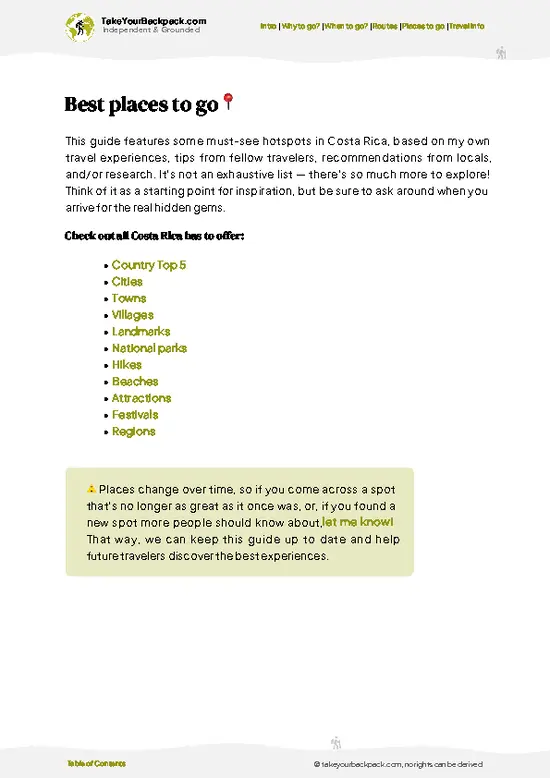
example page 0 from our offline Travel Guide for Costa Rica
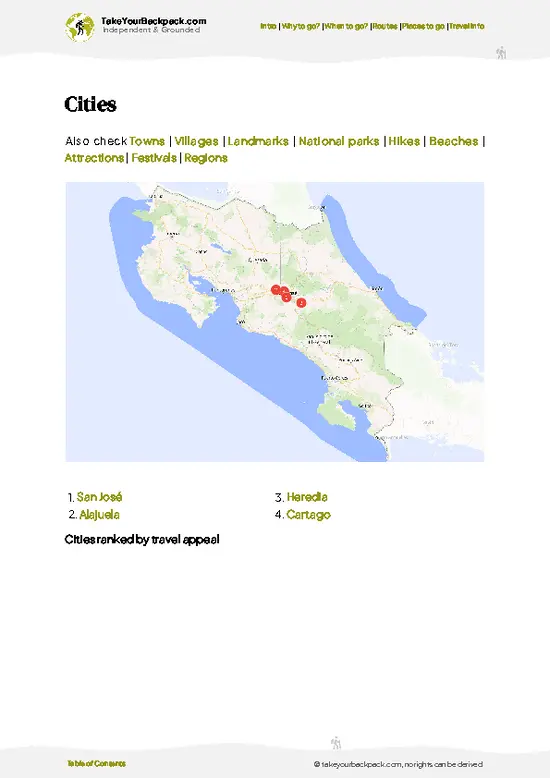
example page 1 from our offline Travel Guide for Costa Rica
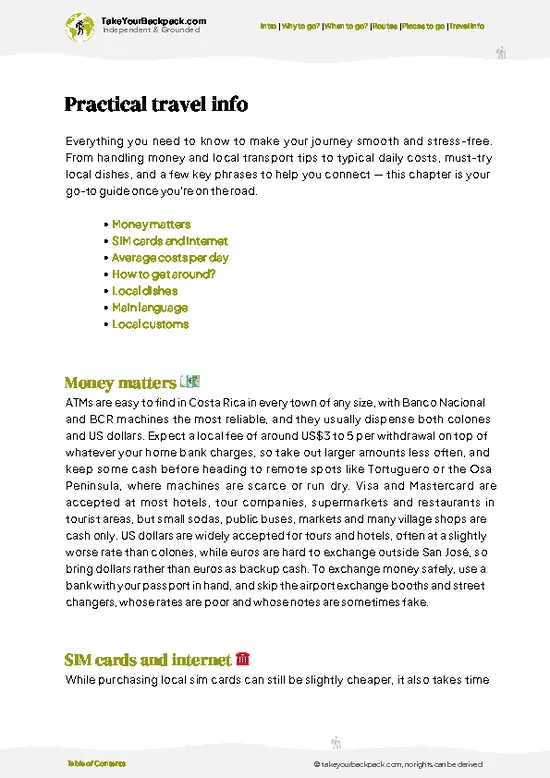
example page 2 from our offline Travel Guide for Costa Rica
example page 3 from our offline Travel Guide for Costa Rica
example page 4 from our offline Travel Guide for Costa Rica
example page 5 from our offline Travel Guide for Costa Rica
example page 6 from our offline Travel Guide for Costa Rica
example page 7 from our offline Travel Guide for Costa Rica
The digital guide (287 pages) contains:
✅ 90 highlights, ranked by travel appeal
✅ Optimized 5, 10 & 15-day travel routes
✅ Cities, national parks, landmarks, beaches
✅ How to get around
✅ Offline-friendly for travel without Wi-Fi
👉 Click to see all 30+ guide features

📅 Plan smarter in minutes, not weeks
✅ Month by month travel advice
✅ Festivals & national holidays
✅ Budget expectations

🗺️ Go to the right places, skip the overrated ones
✅ Honest pros & cons of destinations
✅ Top hikes, parks & viewpoints
✅ Lesser-known places most travelers miss
✅ Clear “worth it vs skip it” guidance

🛏️ Travel smoothly without rookie mistakes
✅ Best areas to stay
✅ Transport systems explained simply
✅ Common scams & safety advice
✅ SIM cards, money & practical tips

🌍 Understand the country, not just visit it
✅ Culture & traditions
✅ 52 Essential phrases & customs
✅ Festivals worth planning around
✅ Traveler-friendly historical context
✅ Insights that make places more meaningful

📱 Built for real travel conditions
✅ Fully downloadable PDF
✅ Works completely offline
✅ Optimized for phone use
✅ Useful in remote areas & buses
✅ Everything in one place
Stop searching, start planning
Get instant access to your full guide. 30‑day money-back guarantee.
+ Add another guide for just

By proceeding you agree to our terms.
Sent to your inbox immediately after payment • 100% Secure Checkout
Best Backpacking Travel Advisor 2025 tourism awardBest Backpacking
Travel Advisor
2025
What others say about Take Your Backpack Guides:
⭐⭐⭐⭐⭐
Fantastic, amazing amount of information!
⭐⭐⭐⭐⭐
My goodness this is amazing, it's what I've been looking for hats off too you!
⭐⭐⭐⭐⭐
I think this is absolutely BRILLIANT
⭐⭐⭐⭐
Very complete and informative. It's still missing places, but I gotta to commend you
⭐⭐⭐⭐⭐
This is truly amazing, thank you, can't wait to explore it with my kids!
⭐⭐⭐⭐⭐
Awesome resource, thank you!
⭐⭐⭐⭐⭐
This is amazing! Can't wait to explore the ones I haven't seen
⭐⭐⭐⭐
I love this! Well done, great idea.
⭐⭐⭐⭐⭐
Thanks for taking the time to make this gem!
⭐⭐⭐⭐⭐
This might be the best website I've ever seen.
⭐⭐⭐⭐⭐
Congratulations, and thank you so much for your work; it's incredibly valuable.
⭐⭐⭐⭐
In all seriousness I think you did a great job pointing out the important spots
⭐⭐⭐⭐⭐
10/10 very good
⭐⭐⭐⭐⭐
As someone who's only just starting to visit regularly this is awesome, thank you.
⭐⭐⭐⭐
Thank you very much! I'm going to visit my dad, it's going to be very useful!
⭐⭐⭐⭐⭐
This is really cool! We'll be travelling for the first time and this definitely come in handy.
⭐⭐⭐⭐⭐
You are now our minister of culture, congratulations 👨‍💼
⭐⭐⭐⭐⭐
Just wanted to tell you that this is a pearl! Going to follow your recommendations.
⭐⭐⭐⭐⭐
This is so cool. I'll definitely be using the resource for my travels soon.
⭐⭐⭐⭐⭐
This is very impressive! Good work.
⭐⭐⭐⭐⭐
This is an amazing and informative site. Very well done!

🛏️ Where to stay?Top Areas to Stay

Costa Rica has a dense hostel network, with dorm beds typically running ₡8,000 to 16,000 (about US$15 to 30) a night and private doubles in small guesthouses from roughly US$35 to 60. In the capital, San José, Barrio Escalante is the pick for its restaurants, craft beer bars and safer streets, while Barrio Amón puts you within walking distance of the museums but gets sketchy after dark. Outside the city, La Fortuna sits right by Arenal Volcano and goes quiet by 10 pm, Santa Elena in Monteverde is cool, calm and close to the cloud forest reserves, Puerto Viejo de Talamanca on the Caribbean side has the liveliest reggae and bar scene with more petty theft, and the surf towns of Tamarindo and Santa … read more 👉
Costa Rica has a dense hostel network, with dorm beds typically running ₡8,000 to 16,000 (about US$15 to 30) a night and private doubles in small guesthouses from roughly US$35 to 60. In the capital, San José, Barrio Escalante is the pick for its restaurants, craft beer bars and safer streets, while Barrio Amón puts you within walking distance of the museums but gets sketchy after dark. Outside the city, La Fortuna sits right by Arenal Volcano and goes quiet by 10 pm, Santa Elena in Monteverde is cool, calm and close to the cloud forest reserves, Puerto Viejo de Talamanca on the Caribbean side has the liveliest reggae and bar scene with more petty theft, and the surf towns of Tamarindo and Santa Teresa trade higher prices for beach access and late nights.

If you enjoy meeting fellow travelers, consider choosing hostels with high ratings for atmosphere. On the other hand, if you prefer having your own space, a hotel might be a better option.

Costa RicaDiscover the Country

👋 Meet the founderWho’s Behind Take Your Backpack?

Johan, backpacker and founder of TakeYourBackpackHi, I’m Johan (Netherlands 🇳🇱), the creator of TakeYourBackpack. Over the past 3 decades, I’ve backpacked through 90+ countries across six continents, gaining extensive experience with independent travel, long-term trips, and overland routes.

This site is built on a combination of firsthand travel experience and carefully curated insights from other backpackers. Many guides are based on places I’ve personally visited, while others bring together tips, observations, and practical advice shared by trusted travelers I’ve met along the way.

The goal is to provide realistic, experience-driven guidance — not generic itineraries — so you can explore destinations with better context, clearer expectations, and more confidence.