×

Djibouti🇩🇯 | best townsThe 8 Top towns in Djibouti

In Djibouti, towns pulse with unique character, shaped by their geography and culture. From the bustling streets of Djibouti City to the tranquil shores of Tadjourah, each location offers distinct experiences for backpackers and independent travelers. Seasonal variations influence accessibility and vibe, while local customs enrich your journey. Choosing the right town can enhance your cultural immersion, affect your budget, and dictate your overall safety and ease of travel, making it essential to understand these nuances.

By Johan Kruseman 🇳🇱 | Updated September 4, 2026
Explore the best villages in Djibouti

Why go?Understanding Their Importance

Djibouti’s towns offer a unique blend of cultural richness and geographic diversity that sets them apart from other countries. The pace of life is unhurried, allowing travelers to soak in the local atmosphere, from bustling markets to quiet cafes. The culinary scene reflects a mix of influences, with spicy dishes that tell stories of trade routes and migration.

Geographically, Djibouti’s towns are clustered, which can affect itinerary planning. While this proximity allows for deeper exploration, it also means that travel time between towns can be limited. The climatic conditions can be harsh, with high temperatures that may deter some travelers, but those who venture out are rewarded with stunning landscapes and vibrant local culture.

Understanding these constraints is crucial. Accessibility … read more 👉
Djibouti’s towns offer a unique blend of cultural richness and geographic diversity that sets them apart from other countries. The pace of life is unhurried, allowing travelers to soak in the local atmosphere, from bustling markets to quiet cafes. The culinary scene reflects a mix of influences, with spicy dishes that tell stories of trade routes and migration.

Geographically, Djibouti’s towns are clustered, which can affect itinerary planning. While this proximity allows for deeper exploration, it also means that travel time between towns can be limited. The climatic conditions can be harsh, with high temperatures that may deter some travelers, but those who venture out are rewarded with stunning landscapes and vibrant local culture.

Understanding these constraints is crucial. Accessibility varies, and while some towns are easily reached, others require more effort to explore. This trade-off between convenience and immersive experiences is a defining characteristic of travel in Djibouti.
Evaluating the Top Choices
The list of best towns in Djibouti is created based on charm, local culture, atmosphere, hidden gems, and visitor appeal. If you feel a town is missing in this list, please let us know.

When to go?Best Time to Visit Djibouti for towns

Djibouti’s climate is largely arid, with two main seasons: the hot season and the cooler months. The hot season, from May to September, brings intense heat, often exceeding 100°F. This period can make outdoor activities uncomfortable, especially in towns where shade is scarce.

The cooler months, from October to April, offer more pleasant temperatures, making it the ideal time for visits. During this period, local life thrives, with markets bustling and outdoor gatherings common.

Shoulder seasons, particularly late April and early October, can provide a balance. Expect fewer crowds and lower prices, but be prepared for lingering heat or the occasional rain.

Travelers should consider the impact of the weather on local events and daily life. The rhythm of towns shifts with the seasons, … read more 👉
Djibouti’s climate is largely arid, with two main seasons: the hot season and the cooler months. The hot season, from May to September, brings intense heat, often exceeding 100°F. This period can make outdoor activities uncomfortable, especially in towns where shade is scarce.

The cooler months, from October to April, offer more pleasant temperatures, making it the ideal time for visits. During this period, local life thrives, with markets bustling and outdoor gatherings common.

Shoulder seasons, particularly late April and early October, can provide a balance. Expect fewer crowds and lower prices, but be prepared for lingering heat or the occasional rain.

Travelers should consider the impact of the weather on local events and daily life. The rhythm of towns shifts with the seasons, influencing everything from market days to social gatherings.

town hoppingHow to Combine towns Into One Trip

Routing Logic

Travelers should cluster towns by region to minimize travel fatigue. Start in Djibouti City, the bustling capital, then head to the coastal charm of Tadjoura. This route allows for a smooth transition from urban energy to laid-back seaside vibes.

Time Management

Allocate at least half a day in each town. This pacing allows for exploration without feeling rushed. Spend a morning in Djibouti City, then an afternoon soaking in Tadjoura’s atmosphere.

Common Mistakes

Many travelers underestimate distances and overestimate time. Avoid cramming too many stops into a single day.

Trade-offs

Consider the balance between speed and depth. Quick visits may miss the local character, while slower travel can reveal hidden treasures. Prioritize comfort and flexibility to enhance the experience.

The ListThe Best towns of Djibouti

1 Tadjoura

whitewashed houses, port town, Saho culture, mountain backdrop

Wander Tadjoura’s narrow lanes, discover Saho influences, and enjoy the contrast between the port’s activity and the surrounding mountains.

2 Obock

Gulf of Tadjoura, colonial lighthouse, ferry terminal, quiet seafront

Arrive in Obock for ferry access, a tranquil seafront, and reminders of the town’s colonial past along the Gulf of Tadjoura.

djibouti-city-obock v1
© Google |

3 Dikhil

oasis town, palm groves, weekly market, Afar culture

Rest in Dikhil to experience palm-shaded streets, a lively weekly market, and the intersection of Afar and Issa traditions.

4 As Eyla

remote plateau, Afar villages, arid landscapes, livestock routes

Experience the stark plateau of As Eyla, where daily life revolves around herding, sparse settlements, and the rhythms of the Afar community.

5 Yoboki

salt flats, nomadic camps, sparse services, desert crossroads

Pause in Yoboki for access to salt flats and nomadic encampments, with minimal infrastructure but strategic location for desert routes.

6 Holhol

railway stop, colonial relics, military presence, dry riverbed

Travel through Holhol to observe remnants of colonial infrastructure, a functioning train station, and a landscape shaped by seasonal rivers.

7 Damerjog

coastal wetlands, port development, fishing villages, mangrove stands

Explore Damerjog’s evolving coastline, where mangroves, fishing communities, and new port projects meet the Gulf of Aden.

8 Goubetto

rail junction, small market, commuter hub, semi-arid plains

Use Goubetto as a practical stop for rail connections, local supplies, and a look at daily life on Djibouti’s semi-arid plains.

Loading the map 🌍

Expert viewInsights from Locals and Experts

Travel Rhythm

In Djibouti, the towns are your gateways to understanding the country’s unique blend of cultures and landscapes. Aim to visit three to five towns to capture the essence of this region. Each town offers a different slice of life, from bustling markets to serene coastal views. The rhythm of travel here is slow; embrace it. Allocate at least a week to soak in the local vibe without feeling rushed.

Local Charm

Each town has its own character. Some are lively with street vendors and music, while others are quieter, inviting you to engage with locals over a cup of coffee. Expect to see a mix of Somali, Afar, and French influences, which shape everything from the food to the architecture. However, be prepared for varying levels of infrastructure. Some towns may lack reliable public … read more 👉
Travel Rhythm

In Djibouti, the towns are your gateways to understanding the country’s unique blend of cultures and landscapes. Aim to visit three to five towns to capture the essence of this region. Each town offers a different slice of life, from bustling markets to serene coastal views. The rhythm of travel here is slow; embrace it. Allocate at least a week to soak in the local vibe without feeling rushed.

Local Charm

Each town has its own character. Some are lively with street vendors and music, while others are quieter, inviting you to engage with locals over a cup of coffee. Expect to see a mix of Somali, Afar, and French influences, which shape everything from the food to the architecture. However, be prepared for varying levels of infrastructure. Some towns may lack reliable public transport, making a rental car or local guide essential for getting around.

Logistical Considerations

Traveling between towns can be a challenge. Roads may be rough, and distances can feel longer than they appear on a map. Factor in travel time when planning your itinerary. Budget for both time and money; while some towns are more affordable, others may surprise you with higher costs for basic services.

Safety & Cultural Considerations

Safety is generally good, but always stay aware of your surroundings. Dress modestly and respect local customs, especially in more traditional areas. Engaging with locals can enhance your experience, but approach with humility and openness.

Trade-offs

The trade-off here is between depth and breadth. Visiting more towns might mean skimming the surface of each, while focusing on fewer locations allows for deeper connections and understanding. Choose wisely based on your interests and energy levels. The reward is in the stories you’ll gather and the friendships you’ll forge along the way.

✈️ The backpacker research shortcutDjibouti Travel Guide

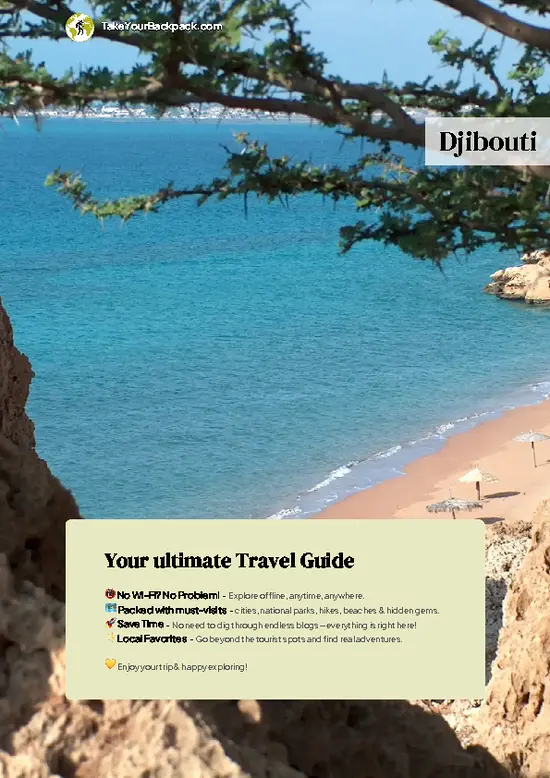
An offline-friendly backpacking guide with optimized travel routes, ranked highlights, transport advice, and the best areas to stay.
example page 0 from our offline Travel Guide for Djibouti
example page 1 from our offline Travel Guide for Djibouti
example page 2 from our offline Travel Guide for Djibouti
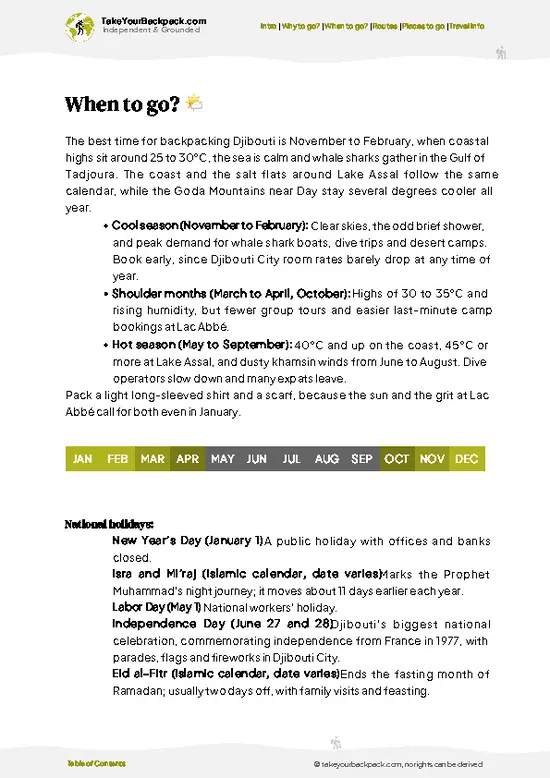
example page 3 from our offline Travel Guide for Djibouti
example page 4 from our offline Travel Guide for Djibouti
example page 5 from our offline Travel Guide for Djibouti
example page 6 from our offline Travel Guide for Djibouti
example page 7 from our offline Travel Guide for Djibouti
The digital guide (200 pages) contains:
47 highlights, ranked by travel appeal
Optimized 2, 3 & 5-day travel routes
Cities, national parks, landmarks, beaches
How to get around
Offline-friendly for travel without Wi-Fi
👉 Click to see all 30+ guide features

📅 Plan smarter in minutes, not weeks
Month by month travel advice
Festivals & national holidays
Budget expectations

🗺️ Go to the right places, skip the overrated ones
Honest pros & cons of destinations
Top hikes, parks & viewpoints
Lesser-known places most travelers miss
Clear “worth it vs skip it” guidance

🛏️ Travel smoothly without rookie mistakes
Best areas to stay
Transport systems explained simply
Common scams & safety advice
SIM cards, money & practical tips

🌍 Understand the country, not just visit it
Culture & traditions
52 Essential phrases & customs
Festivals worth planning around
Traveler-friendly historical context
Insights that make places more meaningful

📱 Built for real travel conditions
Fully downloadable PDF
Works completely offline
Optimized for phone use
Useful in remote areas & buses
Everything in one place
Save weeks of stressful planning
Get instant access to your full guide. 30‑day money-back guarantee.
+ Add another guide for just US$7.80

By proceeding you agree to our terms.
Sent to your inbox immediately after payment • 100% Secure Checkout
Best Backpacking Travel Advisor 2025 tourism awardBest Backpacking
Travel Advisor
2025
What others say about Take Your Backpack Guides:
⭐⭐⭐⭐⭐
Fantastic, amazing amount of information!
⭐⭐⭐⭐⭐
My goodness this is amazing, it's what I've been looking for hats off too you!
⭐⭐⭐⭐⭐
I think this is absolutely BRILLIANT
⭐⭐⭐⭐
Very complete and informative. It's still missing places, but I gotta to commend you
⭐⭐⭐⭐⭐
This is truly amazing, thank you, can't wait to explore it with my kids!
⭐⭐⭐⭐⭐
Awesome resource, thank you!
⭐⭐⭐⭐⭐
This is amazing! Can't wait to explore the ones I haven't seen
⭐⭐⭐⭐
I love this! Well done, great idea.
⭐⭐⭐⭐⭐
Thanks for taking the time to make this gem!
⭐⭐⭐⭐⭐
This might be the best website I've ever seen.
⭐⭐⭐⭐⭐
Congratulations, and thank you so much for your work; it's incredibly valuable.
⭐⭐⭐⭐
In all seriousness I think you did a great job pointing out the important spots
⭐⭐⭐⭐⭐
10/10 very good
⭐⭐⭐⭐⭐
As someone who's only just starting to visit regularly this is awesome, thank you.
⭐⭐⭐⭐
Thank you very much! I'm going to visit my dad, it's going to be very useful!
⭐⭐⭐⭐⭐
This is really cool! We'll be travelling for the first time and this definitely come in handy.
⭐⭐⭐⭐⭐
You are now our minister of culture, congratulations 👨‍💼
⭐⭐⭐⭐⭐
Just wanted to tell you that this is a pearl! Going to follow your recommendations.
⭐⭐⭐⭐⭐
This is so cool. I'll definitely be using the resource for my travels soon.
⭐⭐⭐⭐⭐
This is very impressive! Good work.
⭐⭐⭐⭐⭐
This is an amazing and informative site. Very well done!

🛏️ Where to stay?Best Stay Options in Djibouti

Yes—there are hostels and budget accommodation in Djibouti, concentrated mainly in Djibouti City (Ville Nouvelle), the Balbala suburb, and the zones near the port/airport; options are limited overall and mostly basic, so plan for simple facilities and sporadic availability.
City center gives the best mix of safety, restaurants, transport links and proximity to sights but costs a bit more; Balbala is the cheapest and most local option yet has fewer tourist services and can be noisier or less secure after dark; airport/port areas are convenient for arrivals/departures but quiet at night with limited nightlife and public transport.

If you enjoy meeting fellow travelers, consider choosing hostelsread more 👉
Yes—there are hostels and budget accommodation in Djibouti, concentrated mainly in Djibouti City (Ville Nouvelle), the Balbala suburb, and the zones near the port/airport; options are limited overall and mostly basic, so plan for simple facilities and sporadic availability.
City center gives the best mix of safety, restaurants, transport links and proximity to sights but costs a bit more; Balbala is the cheapest and most local option yet has fewer tourist services and can be noisier or less secure after dark; airport/port areas are convenient for arrivals/departures but quiet at night with limited nightlife and public transport.

If you enjoy meeting fellow travelers, consider choosing hostels with high ratings for atmosphere. On the other hand, if you prefer having your own space, a hotel might be a better option.

DjiboutiWhere to Go Next

👋 Meet the founderWho’s Behind Take Your Backpack?

Johan, backpacker and founder of TakeYourBackpackHi, I’m Johan (Netherlands 🇳🇱), the creator of TakeYourBackpack. Over the past decade, I’ve backpacked through 80+ countries across six continents, gaining extensive experience with independent travel, long-term trips, and overland routes.

This site is built on a combination of firsthand travel experience and carefully curated insights from other backpackers. Many guides are based on places I’ve personally visited, while others bring together tips, observations, and practical advice shared by trusted travelers I’ve met along the way.

The goal is to provide realistic, experience-driven guidance — not generic itineraries — so you can explore destinations with better context, clearer expectations, and more confidence.

Get full Djibouti guide •
Instant download • 47 highlights • Full Offline guide