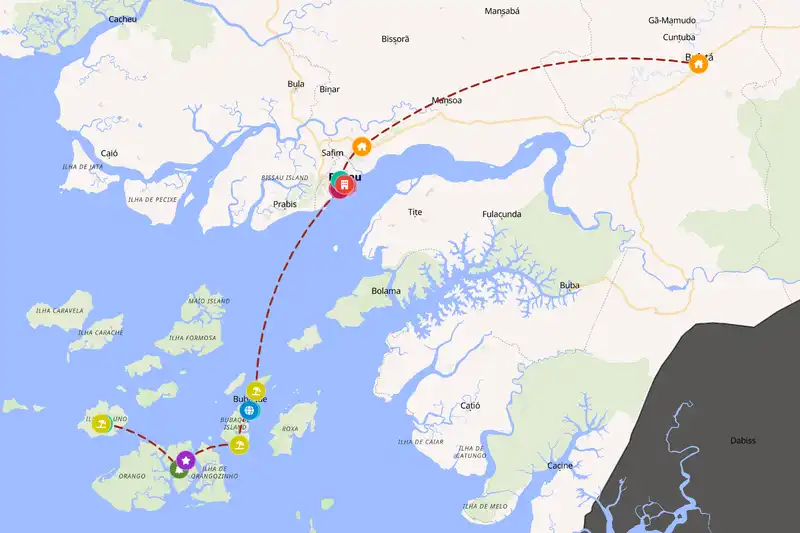
Yes, Guinea-Bissau is doable independently, but it is rough around the edges: few hostels, little signage and timetables that bend to tides and passenger numbers. People are relaxed and helpful, which makes up for a lot.
Plan on guesthouse rooms in
Bissau at roughly XOF 15,000 to 30,000 (US$25 to 50) a night, with simpler options in towns like
Cacheu and
Bafatá. Shared sept-place taxis link the main towns, and boats run from Bissau to
Bubaque in 2 to 6 hours depending on the vessel. Carry plenty of cash in CFA francs, since ATMs outside the capital are rare, and learn a few phrases of Kriol or Portuguese, as English is little spoken.
A week is the right amount of time for Guinea-Bissau if you want both the mainland and the islands; five days covers the highlights at a brisk pace.
Two days is enough for
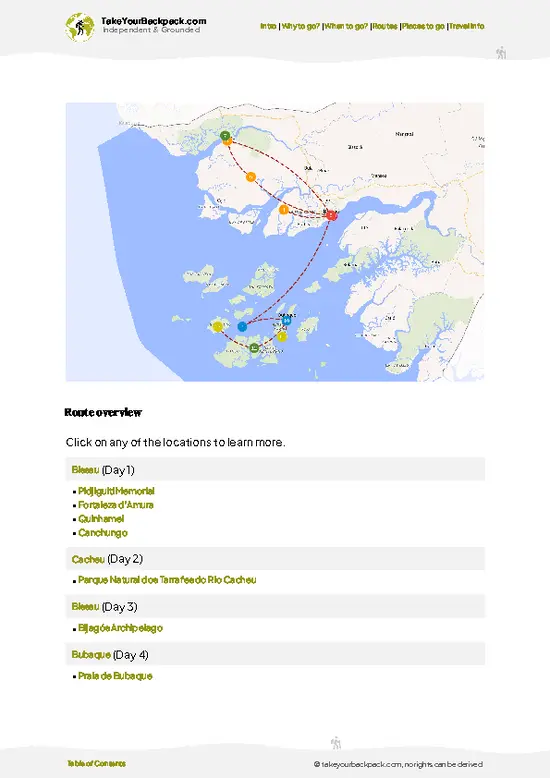
Bissau itself. Add 2 days for a northern loop to
Cacheu, 2 to 3 hours from the capital by road, and at least 2 to 3 days for the
Bijagós Archipelago, because ferries to
Bubaque do not run daily and onward boats to
Orango depend on tides. With 10 days you can head east to
Bafatá and
Gabú (3 to 4 hours from Bissau) or south to the forests of
Cantanhez National Park.
You can get around Guinea-Bissau without a car, using shared taxis, minibuses and boats, though departures leave only when full.
In
Bissau, toca-toca minibuses cost around XOF 100 to 150 per ride and city taxis XOF 500 to 1,000. Sept-place taxis run from the main garage to
Cacheu (2 to 3 hours, about XOF 2,500 to 4,000) and to
Gabú (3 to 4 hours, about XOF 4,000 to 5,500). For the islands, the ferry to
Bubaque takes 4 to 6 hours and speedboats about 2 hours. Reaching
Orango or
João Vieira requires a chartered boat, best split within a group.
The must-visits in Guinea-Bissau are the
Bijagós Archipelago, the old port quarter of
Bissau and the river town of
Cacheu.
In the islands,
Bubaque is the easy base with long beaches, while
Orango National Park is the reason to stretch your budget: saltwater hippos and Bijagó villages, reached by chartered pirogue in about 2 hours. In Bissau, see the Pidjiguiti memorial and the
Mercado de Bandim in a day or two. Cacheu, 2 to 3 hours north, pairs a slave-trade fort with mangrove boat trips. With more time,
João Vieira and Poilão Marine National Park is a major sea turtle nesting site.
If you are short on time in Guinea-Bissau, skip the far east and the deep south, and spend your days between Bissau, Cacheu and the Bijagós.
Gabú and
Madina do Boé sit 3 to 6 hours or more from the capital on slow roads, and the attractions there, mostly market life and savanna, need extra days to justify the trip.
Varela Beach is lovely but sits far up by the Senegal border, so a Bubaque beach is a better use of limited time. In Bissau itself, the Presidential Palace and
Estádio Lino Correia can be seen in passing or left out.
Yes, our itinerary-planner does exactly that. Set your trip length in days, give your interests and travel style, optionally give start- and end location and/or some mandatory stops you would like to include and the itinerary planner creates your personalized routes for Guinea-Bissau in seconds. Try it out!
Try the itinerary plannerv2.webp)

 Best Backpacking