×
Guinea-Bissau🇬🇼 | 5 days itinerary

Your 5-Day Guinea-Bissau Itinerary

By Johan Kruseman 🇳🇱 | Updated May 2, 2026
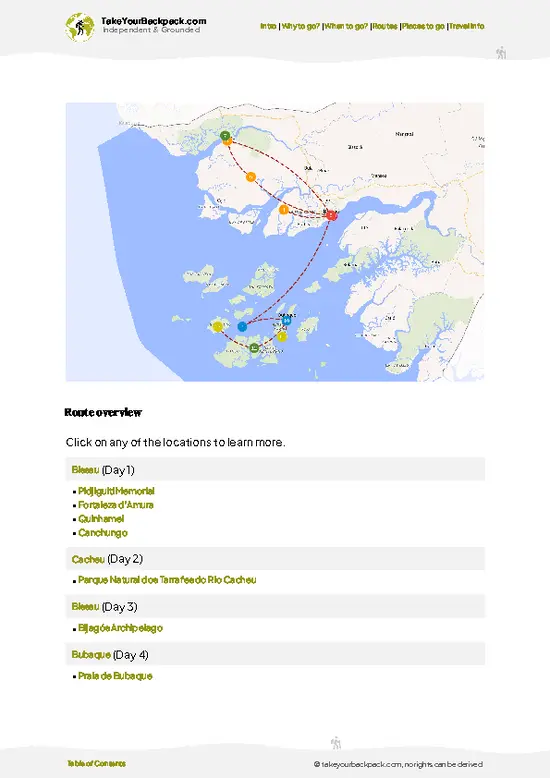
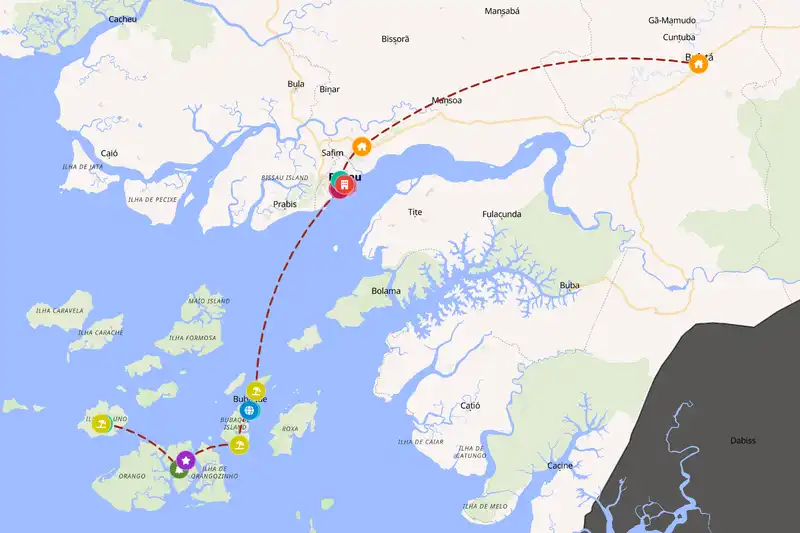
This 5-day route is for travelers who want to feel like they’ve actually “done” Guinea-Bissau in a compact window: capital markets and history, a taste of the interior, and serious time in the Bijagós, moving by taxi, shared bush cars, and scheduled boats at a measured, exploratory pace with no back-to-back marathon travel days.

Days 1-2: Bissau’s history, markets, and cultural corners

Settle into Bissau for two nights so you can explore without constantly packing and unpacking. Start with Mercado de Bandim, where the crush of stalls, smells of smoked fish, and bursts of color from fabric sellers give you a fast education in how the city feeds and dresses itself, then contrast that with the more manageable Mercado de Caracol, which lets you slow down and actually talk to people instead of just squeezing through crowds. Walk or taxi over to the Porto Pidjiguiti Monument and Waterfront to connect with the country’s independence story while watching working boats slide in and out of the harbor, … read more 👉
This 5-day route is for travelers who want to feel like they’ve actually “done” Guinea-Bissau in a compact window: capital markets and history, a taste of the interior, and serious time in the Bijagós, moving by taxi, shared bush cars, and scheduled boats at a measured, exploratory pace with no back-to-back marathon travel days.

Days 1-2: Bissau’s history, markets, and cultural corners

Settle into Bissau for two nights so you can explore without constantly packing and unpacking. Start with Mercado de Bandim, where the crush of stalls, smells of smoked fish, and bursts of color from fabric sellers give you a fast education in how the city feeds and dresses itself, then contrast that with the more manageable Mercado de Caracol, which lets you slow down and actually talk to people instead of just squeezing through crowds. Walk or taxi over to the Porto Pidjiguiti Monument and Waterfront to connect with the country’s independence story while watching working boats slide in and out of the harbor, then continue to Fortaleza d’Amura, where the fort’s walls and military presence remind you that the past and present are tightly woven here. In the late afternoon, duck into Igreja da Nossa Senhora da Candelária for a quieter, architectural pause, and if you have the energy, swing by the Centro Cultural Franco-Bissau-Guineense to catch an exhibition or performance that puts local art and music front and center, giving your first two days a strong cultural backbone rather than just a checklist of monuments.

Day 3: Bolama’s faded grandeur and coastal calm

On day three, head out by boat to Bolama, keeping the travel focused on a single, meaningful move instead of trying to crisscross the whole country. Bolama’s slow streets and colonial-era buildings, including the Cabo de Santa Maria area, tell the story of a former capital that never quite kept up with time, and wandering here feels like stepping through a history book that’s been left out in the sun. Give yourself the day to walk, talk to locals, and sit in the shade watching goats and kids share the same dusty squares, then overnight on Bolama so you can enjoy the cooler evening air and the sense of being somewhere that most travelers skip entirely.

Days 4-5: Deep into the Bijagós - Bubaque and Orango

On day four, continue by boat into the Bijagós Archipelago, heading for Bubaque as your base and giving yourself two days to really lean into island life. Spend your first afternoon on the Bubaque Island Coastal Walk, following sandy tracks between small villages and viewpoints before dropping down to Praia de Bubaque for a swim and a slow sunset, then sleep on Bubaque so you’re not rushing anywhere. On day five, push deeper into the wild side with a trip to Orango National Park, where the Orango Island Trails take you through savanna, mangroves, and village landscapes that show off why this park is such a big deal for both wildlife and traditional life in the islands, and cap it with time on Praia de Orango to let the experience sink in. As boat schedules pull you back toward Bubaque and eventually Bissau, you’ll feel like you’ve stitched together capital, colonial history, and raw island nature into one coherent story rather than a frantic sprint between dots on a map.

When you’re ready to go even further off script, keep the remote forest hamlet of Ponta Anchaca in mind as a future side quest into the country’s quieter corners.
Loading the map 🌍
film
0
0
0a
Fortaleza d’Amura
film
1
1
1a
Igreja da Nossa Senhora da Candelária
film
2
2
2a
Centro Cultural Franco-Bissau-Guineense
film
3
3
3a
Bolama
film
4
4
4a
Cabo de Santa Maria
film
5
5
5a
Bubaque Island Coastal Walk

✈️ The backpacker research shortcutGuinea-Bissau Travel Guide

An offline-friendly backpacking guide with optimized travel routes, ranked highlights, transport advice, and the best areas to stay.
example page 0 from our offline Travel Guide for Guinea-Bissauexample page 1 from our offline Travel Guide for Guinea-Bissauexample page 2 from our offline Travel Guide for Guinea-Bissauexample page 3 from our offline Travel Guide for Guinea-Bissauexample page 4 from our offline Travel Guide for Guinea-Bissauexample page 5 from our offline Travel Guide for Guinea-Bissau
The digital guide (200 pages) contains:
53 highlights, ranked by travel appeal
Optimized 2, 3 & 5-day travel routes
Best neighborhoods to stay
How to get around
Offline-friendly for travel without Wi-Fi
👉 See all 30+ guide features

📅 Plan smarter in minutes, not weeks
Month by month travel advice
Festivals & national holidays
Budget expectations

🗺️ Go to the right places, skip the overrated ones
Honest pros & cons of destinations
Top hikes, parks & viewpoints
Lesser-known places most travelers miss
Clear “worth it vs skip it” guidance

🛏️ Travel smoothly without rookie mistakes
Best areas to stay
Transport systems explained simply
Common scams & safety advice
SIM cards, money & practical tips

🌍 Understand the country, not just visit it
Culture & traditions
52 Essential phrases & customs
Festivals worth planning around
Traveler-friendly historical context
Insights that make places more meaningful

📱 Built for real travel conditions
Fully downloadable PDF
Works completely offline
Optimized for phone use
Useful in remote areas & buses
Everything in one place
Save weeks of stressful planning
Get instant access to the full guide directly. 30-day money-back guarantee.


Sent to your inbox immediately after payment • 100% Secure Checkout
Best Backpacking Travel Advisor 2025 tourism awardBest Backpacking
Travel Advisor
2025
What others say about Take Your Backpack Guides:
⭐⭐⭐⭐⭐
Fantastic, amazing amount of information!
⭐⭐⭐⭐⭐
My goodness this is amazing, it's what I've been looking for hats off too you!
⭐⭐⭐⭐⭐
I think this is absolutely BRILLIANT
⭐⭐⭐⭐
Very complete and informative. It's still missing places, but I gotta to commend you
⭐⭐⭐⭐⭐
This is truly amazing, thank you, can't wait to explore it with my kids!
⭐⭐⭐⭐⭐
Awesome resource, thank you!
⭐⭐⭐⭐⭐
This is amazing! Can't wait to explore the ones I haven't seen
⭐⭐⭐⭐
I love this! Well done, great idea.
⭐⭐⭐⭐⭐
Thanks for taking the time to make this gem!
⭐⭐⭐⭐⭐
This might be the best website I've ever seen.
⭐⭐⭐⭐⭐
Congratulations, and thank you so much for your work; it's incredibly valuable.
⭐⭐⭐⭐
In all seriousness I think you did a great job pointing out the important spots
⭐⭐⭐⭐⭐
10/10 very good
⭐⭐⭐⭐⭐
As someone who's only just starting to visit regularly this is awesome, thank you.
⭐⭐⭐⭐
Thank you very much! I'm going to visit my dad, it's going to be very useful!
⭐⭐⭐⭐⭐
This is really cool! We'll be travelling for the first time and this definitely come in handy.
⭐⭐⭐⭐⭐
You are now our minister of culture, congratulations 👨‍💼
⭐⭐⭐⭐⭐
Just wanted to tell you that this is a pearl! Going to follow your recommendations.
⭐⭐⭐⭐⭐
This is so cool. I'll definitely be using the resource for my travels soon.
⭐⭐⭐⭐⭐
This is very impressive! Good work.
⭐⭐⭐⭐⭐
This is an amazing and informative site. Very well done!

🧭 RouteAlternative Routes

Travel Guinea-Bissau your way — from a quick highlights trip to a slow-paced adventure.

🙋 FAQBackpacking FAQ

Short version: Guinea-Bissau is doable to backpack independently if you already have some West Africa miles on your boots; it’s not ideal as a first-ever backpacking country. Infrastructure is thin, information is scarce, and things move on “Africa time,” but that’s exactly why it feels like an adventure instead of a package tour.

The easy parts: people are generally friendly, costs are low, and there’s very little mass tourism pressure. You can usually find a room, a plate of rice and fish, and a minibus heading somewhere if you’re patient. Portuguese or basic Crioulo helps a lot, but you can scrape by with French plus gestures in many spots.

The hard parts: inconsistent electricity and water, limited ATMs (and some don’t accept foreign cards), almost no online booking, and very little English. Road conditions can be rough, especially in rainy season, and schedules are more “when full” than fixed. You need to be comfortable with uncertainty and last‑minute changes.

For a budget backpacker who’s traveled in places like Senegal, Gambia, or Guinea, Guinea-Bissau feels like the quieter cousin: fewer hustlers, more logistical puzzles. For a total beginner, it can feel overwhelming unless you slow down, keep your route simple, and accept that you’re trading convenience for authenticity and low costs.

Bottom line: independent backpacking is absolutely possible, but it rewards patience, flexibility, and a sense of humor more than tight itineraries and checklists.
For a proper backpacking taste of Guinea-Bissau, 10–14 days is a sweet spot; 7 days is the bare minimum; 3+ weeks is for slow travelers who like to linger.

If you only have about a week, focus on: 1–2 days in Bissau to get your bearings and sort logistics, then 4–5 days in the Bijagós Islands (Bubaque as a base) with maybe a quick stop in Quinhamel or another nearby coastal area on the way back.

With 10–14 days, you can:
- Spend 2–3 days in Bissau: markets, old colonial quarter, port, and visa/boat logistics.
- Do 5–7 days in the Bijagós: Bubaque plus day trips or overnights to nearby islands.
- Add 2–3 days inland: a town like Bafatá or Gabú for a very different, more Sahel‑flavored side of the country.

With 3 weeks or more, you can slow everything down: wait out boat delays, explore lesser‑visited islands, and spend time in small inland villages without feeling rushed. This is where Guinea-Bissau really shines for long‑term backpackers who like to sit in one place and let the trip come to them.

If you’re combining Guinea-Bissau with Senegal or Guinea, you can comfortably give it 7–10 days as a side mission, but anything under a week will feel like you only saw Bissau and one island.
You can get around Guinea-Bissau without renting a car, but you can’t get around without patience. Public transport exists, but it’s basic, slow, and often crowded.

Between cities and towns, you’ll mostly use:
- Shared taxis and minibuses (aluguers): they leave when full, not on a strict schedule. They’re cheap and social but can be cramped and hot.
- Bush taxis and pickups: especially on rougher routes; expect dust, goats, and sacks of everything.

For the Bijagós Islands, you’ll rely on:
- Public ferries: cheap, irregular, and subject to weather and mechanical issues.
- Local boats/pangas: more flexible but more expensive; you’ll often negotiate directly with boat owners or through your guesthouse.

Inside Bissau, you can move around by:
- Taxis: inexpensive, usually shared; agree on a price before you get in.
- Walking: central areas are walkable, but watch traffic and potholes.

Not having a car means you’ll miss some very remote villages and you’ll be tied to boat and minibus rhythms, but for a budget backpacker that’s usually fine. The key is to travel early in the day, avoid tight connections, and assume that any long hop (especially involving a boat) might eat an entire day.
For a budget backpacker, these are the places that actually earn the effort and cost:

1. Bissau (the capital)
Not because it’s pretty in a postcard way, but because it’s the country’s nerve center. You’ll sort boats, permits, cash, and onward travel here. The old colonial quarter has crumbling buildings, street bars, and a lived‑in, slightly chaotic charm. Markets are great for people‑watching and cheap food. One or two full days is usually enough.

2. Bijagós Islands – especially Bubaque
This is the main reason most travelers come. Bubaque is the easiest base: you’ve got simple guesthouses, a few bars, and access to other islands by local boat. Think sandy beaches, palm trees, and a slow rhythm where the biggest decision is whether to swim, walk, or nap. It’s not polished resort territory; it’s more like a laid‑back, slightly rough‑around‑the-edges island village.

3. Nearby Bijagós islands (as day trips or short overnights)
Depending on season and budget, you can hop to smaller islands for quieter beaches, mangroves, and wildlife. Some islands have sacred sites and strong traditional culture, so you move respectfully and usually with a local guide. Even one or two side trips from Bubaque will make the archipelago feel much bigger and wilder.

4. An inland town like Bafatá or Gabú
If you have time, heading inland gives you a completely different feel from the coast and islands: drier landscapes, different ethnic groups, and fewer travelers. It’s not about big sights; it’s about markets, tea stalls, and long conversations. For backpackers who like to see how people actually live away from the capital, 2–3 days in one inland town is worth it.

If you’re short on time or money, prioritize: Bissau (logistics and culture hit) + Bubaque (island base) + one extra island or an inland town if transport lines up.
If you’re tight on time or cash, you can skip anything that adds a lot of transport hassle without giving you a clearly different experience from what you already have.

You can usually skip:
- Trying to see too many Bijagós islands: bouncing between lots of small islands sounds romantic, but each hop costs time and money. Better to pick Bubaque plus one other island than to chase a long list.
- Deep inland detours to very small villages: unless you have a specific reason (research, contacts, volunteering), the extra days in bush taxis often don’t add much beyond what you’d already feel in a mid‑sized inland town like Bafatá or Gabú.
- Chasing wildlife “bucket list” experiences on a tight schedule: some islands are known for hippos, turtles, or birdlife, but sightings are seasonal and access can be expensive or logistically heavy. If you’re not visiting in the right season or you’re on a strict budget, don’t burn days and cash on a low‑odds mission.
- Long, rushed overland border runs just to say you crossed: if you’re only in the region for a short time, it’s usually better to go deeper in Guinea-Bissau than to spend two full days in transport just to tick another country off.

In practice, a time‑crunched backpacker can focus on Bissau and the more accessible parts of the Bijagós and skip ultra‑remote islands, far‑flung villages, and any plan that depends on perfectly timed boats or bush taxis. The less you try to cram in, the more Guinea-Bissau actually opens up for you.

🇬🇼 Guinea-BissauMore of Guinea-Bissau

Ready to build a truly unique trip? Predefined routes are perfect for first-time visitors, but there is so much more to discover. Whether you are chasing a city trip, pristine national parks, local food scenes, or quiet beaches, pick a category to design your own path.