×

Hungary🇭🇺 | best villagesYour Guide to the 2 Best villages in Hungary

Hungarian villages come in three moods. In the Great Plain, the Puszta, you get flat horizons, white-washed farmhouses, the creak of well-sweeps and the smell of paprika drying on porches. Northern Hungary and the Balaton uplands offer wine cellars cut into volcanic hillsides, cool stone and the tang of new must in autumn. In the west, Őrség and Zala bring timber belfries, damp forest and quiet roads. Costs stay low, with rooms often US$25 to 50, but bus links thin out after mid-afternoon, so independent travelers on a backpacking budget should plan around timetables. Crowds gather only on summer weekends near Lake Balaton and in Hollókő.

By Johan Kruseman 🇳🇱 | Updated October 19, 2026
Explore the best landmarks in Hungary

Why go?Key Factors That Shape the Experience

Hungary suits village travel because of its layered history. Ottoman occupation, Habsburg rule and the 20th century carved distinct pockets of identity: Palóc communities in the north keep embroidered textiles and wooden-gabled houses, Swabian settlements in the south keep their German-influenced baking and church fairs, and the Great Plain keeps its horse and cattle herding traditions. Wine is the second thread. Volcanic hills, loess soil and cellar rows mean village life often centers on a press house, with the smell of damp stone and oak and a glass poured straight from the barrel.

Before committing, know the limits. The country is mostly flat or gently rolling, so expect soft light across fields rather than alpine drama. Public transport radiates from Budapest, and cross-country links … read more 👉
Hungary suits village travel because of its layered history. Ottoman occupation, Habsburg rule and the 20th century carved distinct pockets of identity: Palóc communities in the north keep embroidered textiles and wooden-gabled houses, Swabian settlements in the south keep their German-influenced baking and church fairs, and the Great Plain keeps its horse and cattle herding traditions. Wine is the second thread. Volcanic hills, loess soil and cellar rows mean village life often centers on a press house, with the smell of damp stone and oak and a glass poured straight from the barrel.

Before committing, know the limits. The country is mostly flat or gently rolling, so expect soft light across fields rather than alpine drama. Public transport radiates from Budapest, and cross-country links between villages are slow, often requiring a change in a county town. Many rural places run on seasonal rhythms, so guesthouses, cellars and museums can shut from November to March. Language is another factor: Hungarian is unrelated to its neighbors, and English fades quickly outside tourist spots, though a few phrases and a translation app go a long way. Village food is heavy, lard and sour cream and paprika, and delicious after a day outdoors.
Our Approach to Ranking
The list of best villages in Hungary is created based on authenticity, scenic beauty, community spirit, traditions, and overall character. If you feel a village is missing in this list, please let us know.

When to go?Optimal Periods for Travel

Best months: The best months for Hungarian villages are May to June and September to early October, when daytime highs sit around 18 to 26°C, fields are green or gold and cellars and guesthouses are open. In spring, orchards bloom and the air smells of lilac and cut grass. In September, grape harvest brings the sweet fermenting smell of must to wine villages in the north and around Lake Balaton.
Summer: July and August often reach 30 to 35°C, with the Great Plain baking under hard white light and thunderstorms common in late afternoon. Lake Balaton villages fill on weekends, and accommodation can cost 30 to 60 percent more than in shoulder months. Hollókő and other popular northern spots get day-trip crowds on festival weekends. Weekday visits stay calm.
Winter: From November to March, temperatures … read more 👉
Best months: The best months for Hungarian villages are May to June and September to early October, when daytime highs sit around 18 to 26°C, fields are green or gold and cellars and guesthouses are open. In spring, orchards bloom and the air smells of lilac and cut grass. In September, grape harvest brings the sweet fermenting smell of must to wine villages in the north and around Lake Balaton.
Summer: July and August often reach 30 to 35°C, with the Great Plain baking under hard white light and thunderstorms common in late afternoon. Lake Balaton villages fill on weekends, and accommodation can cost 30 to 60 percent more than in shoulder months. Hollókő and other popular northern spots get day-trip crowds on festival weekends. Weekday visits stay calm.
Winter: From November to March, temperatures hover around -5 to 5°C, fog settles over the plain and many rural guesthouses, museums and wine cellars close or open only by appointment. December brings Christmas markets and woodsmoke, and prices drop, but bus services reduce and the days end by 4:30 pm. Hillside lanes in the north and west can turn icy, and snow in Őrség can slow local roads. For flexibility, aim for late April or mid-October, when it is cool, quiet and cheaper.

village hoppingTips for Visiting Multiple Destinations

How many days: A trip combining several Hungarian villages needs 5 to 8 days, with enough slack for slow buses. The country is small, but rural transport is not quick, so two regions per trip is the sensible limit.
Grouping regions: The northern hills (Mátra, Bükk, Tokaj) pair well with each other, with Eger as a hub. The west, Őrség and the Zala hills, links through Szombathely or Zalaegerszeg. Lake Balaton and its uplands connect with the west by train via Keszthely. The Great Plain works best as a separate leg from Kecskemét or Debrecen. Traveling from Budapest outward and returning on a different line avoids backtracking. Budapest to Eger takes about 2 to 2.5 hours by train or bus. Budapest to Szombathely takes about 2.5 to 3 hours. Cross-regional hops often take 3 to 5 hours with a change. … read more 👉
How many days: A trip combining several Hungarian villages needs 5 to 8 days, with enough slack for slow buses. The country is small, but rural transport is not quick, so two regions per trip is the sensible limit.
Grouping regions: The northern hills (Mátra, Bükk, Tokaj) pair well with each other, with Eger as a hub. The west, Őrség and the Zala hills, links through Szombathely or Zalaegerszeg. Lake Balaton and its uplands connect with the west by train via Keszthely. The Great Plain works best as a separate leg from Kecskemét or Debrecen. Traveling from Budapest outward and returning on a different line avoids backtracking. Budapest to Eger takes about 2 to 2.5 hours by train or bus. Budapest to Szombathely takes about 2.5 to 3 hours. Cross-regional hops often take 3 to 5 hours with a change.
Time per stop: Allow half a day to one night per village. Smaller hamlets are done in 2 to 3 hours, but the evening light and quiet are worth a night, especially in cellar and forest areas. Aim for no more than one village per day.
Common mistakes: The classic error is stacking villages on the same afternoon using timetables that stop around 4 to 6 pm. Another is relying on Sunday buses, which are minimal. Instead, check MÁV and Volánbusz schedules in advance, base yourself in a county town and make short out-and-back trips, or rent a car for the Őrség and the Zala hills where bus links are weakest.

The ListHighly Recommended villages of Hungary

1 Hollókő

folk architecture, UNESCO village, spring festivals

Walk cobbled lanes lined with whitewashed houses, observe living traditions, and experience seasonal celebrations that shape the village’s rhythm.

hungary-city-holloko
© Google | Ferenc Táskai

2 Bükkszentkereszt

pine forests, mountain air, herbal traditions

Hike through dense woods, breathe crisp upland air, and discover local herbal remedies rooted in the surrounding hills and village customs.

hungary-city-bukkszentkereszt
© Google | Tamas Varga
Loading the map 🌍

Expert viewWhat You Should Know

How many villages: I advise four to six villages on a trip of about a week. Fewer leaves you short of variety, but more turns the trip into a timetable puzzle. Hungarian village life rewards lingering, the slow lunch, the second glass at the cellar, the late-afternoon walk when chimney smoke drifts over the roofs, and rushed days miss that.
Which kind to prioritize: For culture and folk tradition, choose northern Palóc villages with their carved timber houses and embroidery. For wine and food, go to Tokaj, Eger and the Balaton uplands, where the cellar is the social room. For quiet and walking, Őrség, with its forest, ponds and pumpkin-seed oil, is the best fit. For horses and open skies, pick the Great Plain, but accept long flat distances. Mix two kinds rather than five.
Budget: A backpacker … read more 👉
How many villages: I advise four to six villages on a trip of about a week. Fewer leaves you short of variety, but more turns the trip into a timetable puzzle. Hungarian village life rewards lingering, the slow lunch, the second glass at the cellar, the late-afternoon walk when chimney smoke drifts over the roofs, and rushed days miss that.
Which kind to prioritize: For culture and folk tradition, choose northern Palóc villages with their carved timber houses and embroidery. For wine and food, go to Tokaj, Eger and the Balaton uplands, where the cellar is the social room. For quiet and walking, Őrség, with its forest, ponds and pumpkin-seed oil, is the best fit. For horses and open skies, pick the Great Plain, but accept long flat distances. Mix two kinds rather than five.
Budget: A backpacker can manage on US$35 to 60 a day (about 12,500 to 22,000 forints). Guesthouse rooms or private rooms run US$25 to 50, dorm beds in larger towns about US$15 to 25, a village lunch of soup and a main US$7 to 12, and a wine tasting US$5 to 15. Entry to small village museums or folk houses is usually US$2 to 5. Local buses cost roughly US$2 to 8 per leg, and a rental car costs US$30 to 55 a day plus fuel. Guided cellar tours or horse shows cost US$10 to 30. Carry forints in cash, because small cellars, buffets and village shops often do not take cards.
Safety and etiquette: Rural Hungary is very safe, with petty theft rare. The real hazards are practical: icy lanes in winter, ticks in forest and meadow from spring to autumn, and strong homemade pálinka that is poured generously. Never drive after drinking, as Hungary has a zero alcohol limit for drivers. Greet people with a nod and “Jó napot” when entering shops and guesthouses. Dress modestly in churches, and ask before photographing people or private yards. Many places close Sunday afternoons, and quiet hours in the evening are taken seriously. Villages are lived-in communities, not open-air museums, so keep voices low and stay on public paths.
What makes it worth the journey: Crowds are small outside summer weekends and costs are far below Western Europe. What you get in return is woodsmoke in cold air, cellar walls beaded with damp, warm bread, and church bells across empty fields.

✈️ The backpacker research shortcutHungary Travel Guide

An offline-friendly backpacking guide with optimized travel routes, ranked highlights, transport advice, and the best areas to stay.
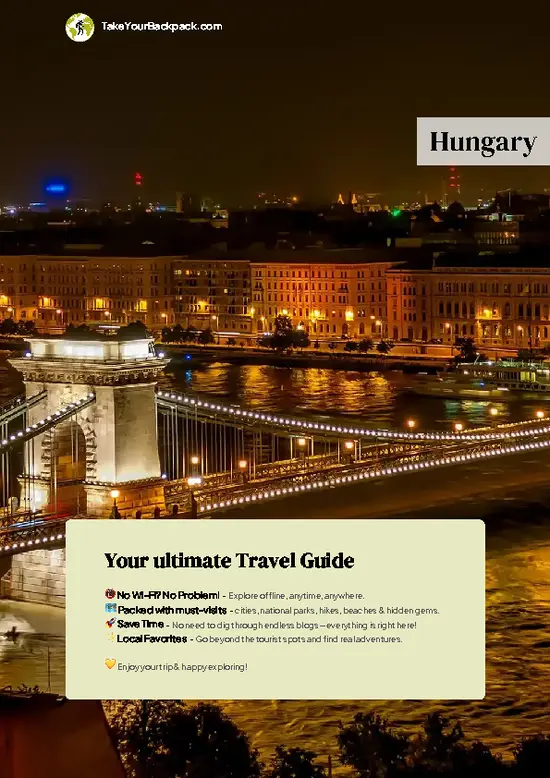
example page 0 from our offline Travel Guide for Hungary
example page 1 from our offline Travel Guide for Hungary
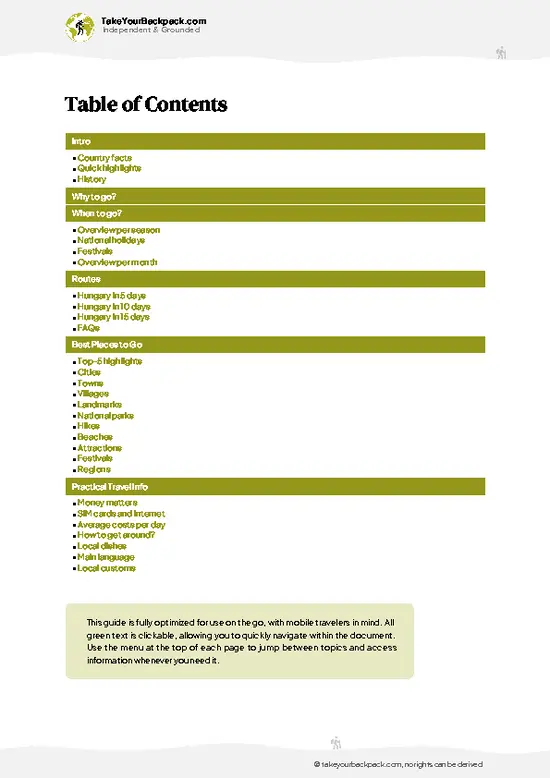
example page 2 from our offline Travel Guide for Hungary
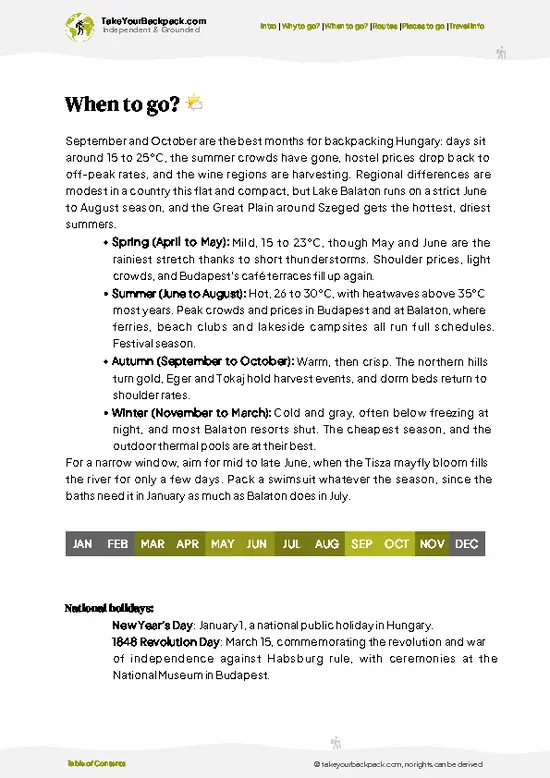
example page 3 from our offline Travel Guide for Hungary
example page 4 from our offline Travel Guide for Hungary
example page 5 from our offline Travel Guide for Hungary
example page 6 from our offline Travel Guide for Hungary
example page 7 from our offline Travel Guide for Hungary
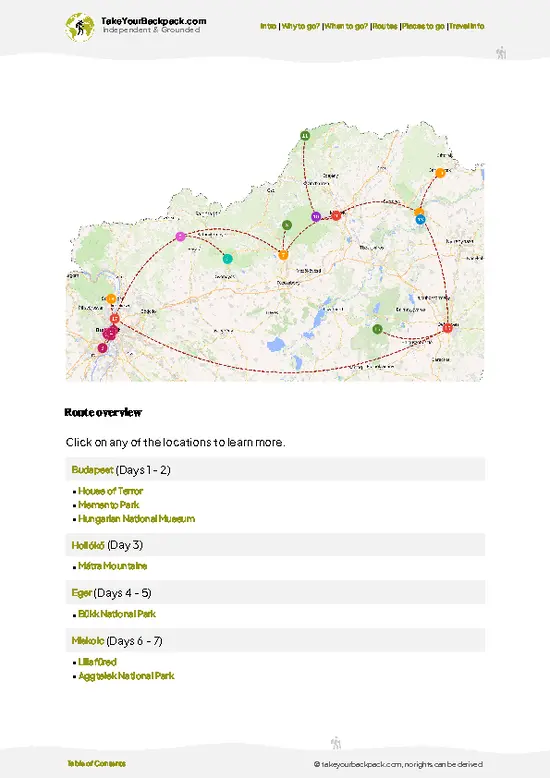
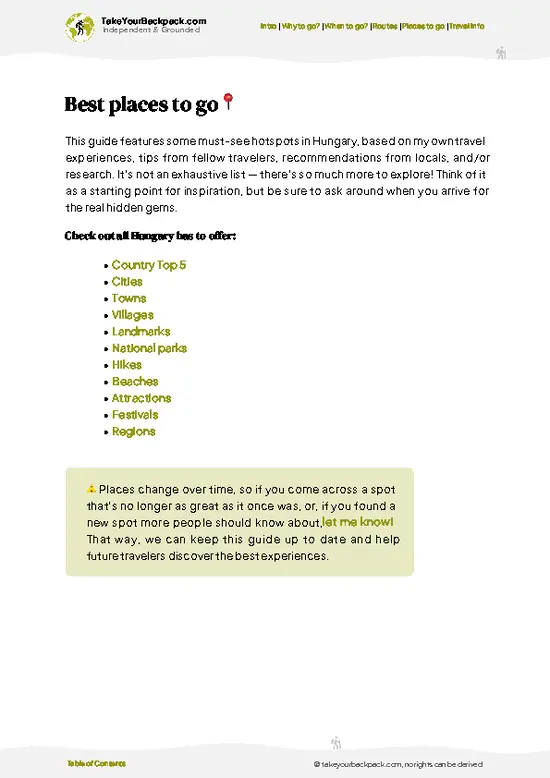
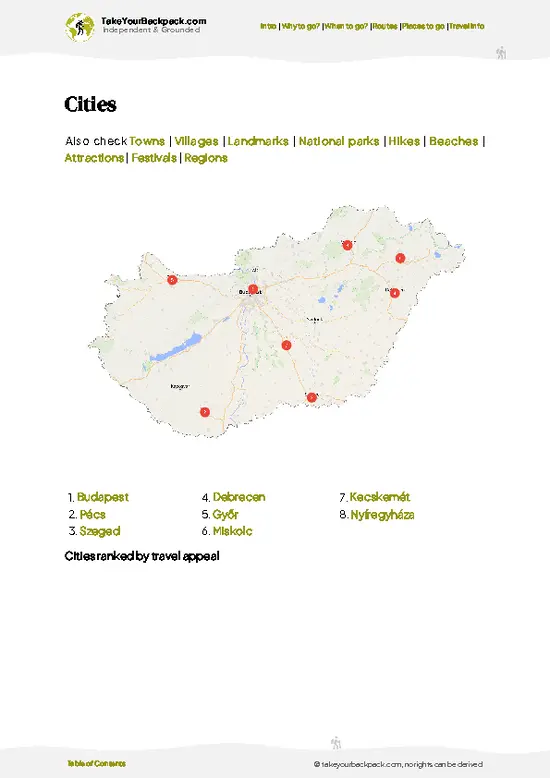
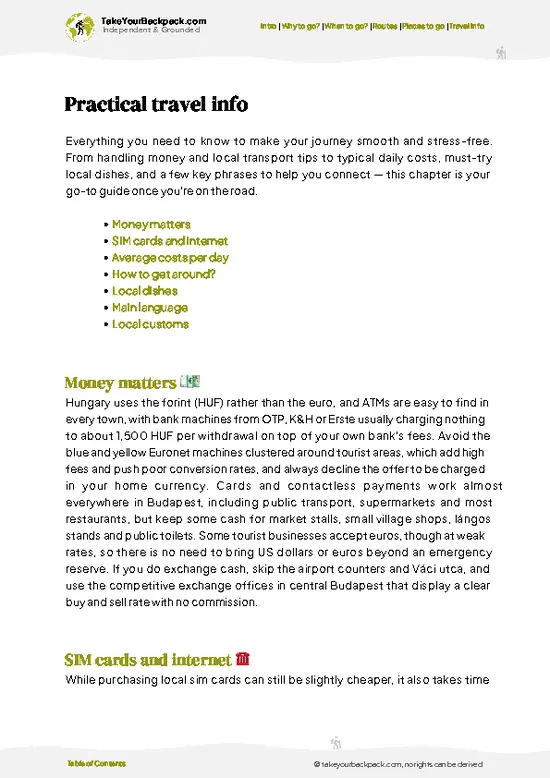
The digital guide (334 pages) contains:
✅ 86 highlights, ranked by travel appeal
✅ Optimized 5, 10 & 15-day travel routes
✅ Cities, national parks, landmarks, beaches
✅ How to get around
✅ Offline-friendly for travel without Wi-Fi
👉 Click to see all 30+ guide features

📅 Plan smarter in minutes, not weeks
✅ Month by month travel advice
✅ Festivals & national holidays
✅ Budget expectations

🗺️ Go to the right places, skip the overrated ones
✅ Honest pros & cons of destinations
✅ Top hikes, parks & viewpoints
✅ Lesser-known places most travelers miss
✅ Clear “worth it vs skip it” guidance

🛏️ Travel smoothly without rookie mistakes
✅ Best areas to stay
✅ Transport systems explained simply
✅ Common scams & safety advice
✅ SIM cards, money & practical tips

🌍 Understand the country, not just visit it
✅ Culture & traditions
✅ 52 Essential phrases & customs
✅ Festivals worth planning around
✅ Traveler-friendly historical context
✅ Insights that make places more meaningful

📱 Built for real travel conditions
✅ Fully downloadable PDF
✅ Works completely offline
✅ Optimized for phone use
✅ Useful in remote areas & buses
✅ Everything in one place
Stop searching, start planning
Get instant access to your full guide. 30‑day money-back guarantee.
+ Add another guide for just

By proceeding you agree to our terms.
Sent to your inbox immediately after payment • 100% Secure Checkout
Best Backpacking Travel Advisor 2025 tourism awardBest Backpacking
Travel Advisor
2025
What others say about Take Your Backpack Guides:
⭐⭐⭐⭐⭐
Fantastic, amazing amount of information!
⭐⭐⭐⭐⭐
My goodness this is amazing, it's what I've been looking for hats off too you!
⭐⭐⭐⭐⭐
I think this is absolutely BRILLIANT
⭐⭐⭐⭐
Very complete and informative. It's still missing places, but I gotta to commend you
⭐⭐⭐⭐⭐
This is truly amazing, thank you, can't wait to explore it with my kids!
⭐⭐⭐⭐⭐
Awesome resource, thank you!
⭐⭐⭐⭐⭐
This is amazing! Can't wait to explore the ones I haven't seen
⭐⭐⭐⭐
I love this! Well done, great idea.
⭐⭐⭐⭐⭐
Thanks for taking the time to make this gem!
⭐⭐⭐⭐⭐
This might be the best website I've ever seen.
⭐⭐⭐⭐⭐
Congratulations, and thank you so much for your work; it's incredibly valuable.
⭐⭐⭐⭐
In all seriousness I think you did a great job pointing out the important spots
⭐⭐⭐⭐⭐
10/10 very good
⭐⭐⭐⭐⭐
As someone who's only just starting to visit regularly this is awesome, thank you.
⭐⭐⭐⭐
Thank you very much! I'm going to visit my dad, it's going to be very useful!
⭐⭐⭐⭐⭐
This is really cool! We'll be travelling for the first time and this definitely come in handy.
⭐⭐⭐⭐⭐
You are now our minister of culture, congratulations 👨‍💼
⭐⭐⭐⭐⭐
Just wanted to tell you that this is a pearl! Going to follow your recommendations.
⭐⭐⭐⭐⭐
This is so cool. I'll definitely be using the resource for my travels soon.
⭐⭐⭐⭐⭐
This is very impressive! Good work.
⭐⭐⭐⭐⭐
This is an amazing and informative site. Very well done!

🛏️ Where to stay?Best Places to Stay in Hungary

Hungary has plenty of hostels and budget guesthouses, with dorm beds in Budapest typically running about 5,000 to 10,000 HUF (US$14 to 28) a night and private rooms starting around 15,000 HUF (US$42). The densest cluster sits in Erzsébetváros (District VII, the old Jewish Quarter), which puts you steps from the ruin bars and a short walk from most sights, though weekend noise can run past 3 am; Terézváros (District VI) along Andrássy út is nearly as central and a bit calmer. Belváros (District V) gets you closest to the river and Parliament at higher prices, while the inner Palace District of Józsefváros (District VIII) is cheaper and quieter, with streets that feel rougher the farther you go … read more 👉
Hungary has plenty of hostels and budget guesthouses, with dorm beds in Budapest typically running about 5,000 to 10,000 HUF (US$14 to 28) a night and private rooms starting around 15,000 HUF (US$42). The densest cluster sits in Erzsébetváros (District VII, the old Jewish Quarter), which puts you steps from the ruin bars and a short walk from most sights, though weekend noise can run past 3 am; Terézváros (District VI) along Andrássy út is nearly as central and a bit calmer. Belváros (District V) gets you closest to the river and Parliament at higher prices, while the inner Palace District of Józsefváros (District VIII) is cheaper and quieter, with streets that feel rougher the farther you go from the Museum Boulevard ring.

If you enjoy meeting fellow travelers, consider choosing hostels with high ratings for atmosphere. On the other hand, if you prefer having your own space, a hotel might be a better option.

HungaryExplore Hungary

👋 Meet the founderWho’s Behind Take Your Backpack?

Johan, backpacker and founder of TakeYourBackpackHi, I’m Johan (Netherlands 🇳🇱), the creator of TakeYourBackpack. Over the past 3 decades, I’ve backpacked through 90+ countries across six continents, gaining extensive experience with independent travel, long-term trips, and overland routes.

This site is built on a combination of firsthand travel experience and carefully curated insights from other backpackers. Many guides are based on places I’ve personally visited, while others bring together tips, observations, and practical advice shared by trusted travelers I’ve met along the way.

The goal is to provide realistic, experience-driven guidance — not generic itineraries — so you can explore destinations with better context, clearer expectations, and more confidence.