×

Iceland🇮🇸 | best townsDiscover the 6 Best towns Across Iceland

Iceland’s towns are small, wind-scrubbed outposts where fishing harbors smell of diesel and brine, and corrugated-iron houses glow red, blue and yellow against black mountains. Most hold only a few hundred to a few thousand people. The Reykjavik area has the most hostels, buses and crowds. The Westfjords and East Fjords are quieter, slower to reach and pricier per meal because everything arrives by truck. The North offers geothermal pools and whale-watching harbors, while the South Coast gets tour buses by noon. For backpacking or independent travel, the choice comes down to how much you want convenience against silence.

By Johan Kruseman 🇳🇱 | Updated October 18, 2026
Explore the best villages in Iceland

Why go?Understanding Their Importance

Iceland has almost no historic city centers. People settled on the coast because the interior is lava desert and glacier, so towns grew around harbors, not trade crossroads. That gives you wooden and corrugated-metal buildings, fish-drying heritage, and a church and a swimming pool at the center of nearly every settlement. Those geothermal pools are the real social hub: you rinse naked first, then sit in 38 to 42°C water while locals talk about weather and fishing quotas.

The climate shapes everything. Wind can rattle a hostel window all night, and rain often arrives sideways. Summer brings near-constant daylight, while midwinter gives only four to five hours of gray-blue light. Roads between towns can close in snow, and in the Westfjords and East Fjords mountain passes decide your schedule. … read more 👉
Iceland has almost no historic city centers. People settled on the coast because the interior is lava desert and glacier, so towns grew around harbors, not trade crossroads. That gives you wooden and corrugated-metal buildings, fish-drying heritage, and a church and a swimming pool at the center of nearly every settlement. Those geothermal pools are the real social hub: you rinse naked first, then sit in 38 to 42°C water while locals talk about weather and fishing quotas.

The climate shapes everything. Wind can rattle a hostel window all night, and rain often arrives sideways. Summer brings near-constant daylight, while midwinter gives only four to five hours of gray-blue light. Roads between towns can close in snow, and in the Westfjords and East Fjords mountain passes decide your schedule.

Know before you choose Iceland for towns: this is a nature-first country, so towns are bases, not sights in themselves. Distances are long, public transport is thin outside the southwest, and prices are among the highest in Europe. Groceries are the main saving, since tap water is excellent and supermarkets are well stocked. Many towns have little nightlife beyond one bar and a bakery, which suits travelers who want quiet.
Behind the Scenes of Selection
The list of best towns in Iceland is created based on charm, local culture, atmosphere, hidden gems, and visitor appeal. If you feel a town is missing in this list, please let us know.

When to go?Optimal Periods for Travel

Best months: June to August is the best window for towns in Iceland, because roads and mountain passes are open, daylight lasts up to 21 hours and most guesthouses, cafés and whale-watching boats operate. Daytime temperatures sit around 10 to 15°C in the south and can reach the high teens in the north and east. Rain is frequent in the south and west, with the wettest coastal areas seeing roughly 1,500 mm or more a year in places like Vik.

Shoulder seasons: May and September are my pick for value. Temperatures run about 3 to 10°C, crowds thin out, and accommodation can be 20 to 40 percent cheaper than in July. Some small museums and seasonal restaurants in the Westfjords and East Fjords still open late or close early. September brings the first northern lights chances and dark, crisp evenings. … read more 👉
Best months: June to August is the best window for towns in Iceland, because roads and mountain passes are open, daylight lasts up to 21 hours and most guesthouses, cafés and whale-watching boats operate. Daytime temperatures sit around 10 to 15°C in the south and can reach the high teens in the north and east. Rain is frequent in the south and west, with the wettest coastal areas seeing roughly 1,500 mm or more a year in places like Vik.

Shoulder seasons: May and September are my pick for value. Temperatures run about 3 to 10°C, crowds thin out, and accommodation can be 20 to 40 percent cheaper than in July. Some small museums and seasonal restaurants in the Westfjords and East Fjords still open late or close early. September brings the first northern lights chances and dark, crisp evenings.

Winter: October to April means short days, ice on roads and wind that cuts through cheap jackets. Temperatures hover around -3 to 4°C on the coast, colder inland. Reykjavik and the South Coast stay accessible, but northern and eastern roads can close with little warning. Prices are lowest from November to March, apart from the Christmas and New Year peak. Pools feel best in the cold, with steam rising into the dark.

town hoppingHow to Combine towns Into One Trip

Trip length: Combining several towns in Iceland takes 7 to 14 days, and 10 days is enough for the Ring Road with a few detours. Most travelers fly into Keflavik and use Reykjavik as the hub for buses and car rental.

Direction and clusters: The southwest, South Coast, East Fjords and North form a natural loop. Going counterclockwise puts the easiest roads and busiest sights first, then moves into quieter country. The Westfjords work best as a separate block of 4 to 6 days, reached by a 5 to 6 hour drive from Reykjavik or by ferry across Breidafjordur. Allow 1 to 2 nights per town, and 3 if you want pools, harbor walks and a day hike. Typical drives between regions run 2 to 5 hours, with Reykjavik to Vik taking about 2.5 hours and Vik to the East Fjords about 4 to 5 hours.

Planning mistakes: … read more 👉
Trip length: Combining several towns in Iceland takes 7 to 14 days, and 10 days is enough for the Ring Road with a few detours. Most travelers fly into Keflavik and use Reykjavik as the hub for buses and car rental.

Direction and clusters: The southwest, South Coast, East Fjords and North form a natural loop. Going counterclockwise puts the easiest roads and busiest sights first, then moves into quieter country. The Westfjords work best as a separate block of 4 to 6 days, reached by a 5 to 6 hour drive from Reykjavik or by ferry across Breidafjordur. Allow 1 to 2 nights per town, and 3 if you want pools, harbor walks and a day hike. Typical drives between regions run 2 to 5 hours, with Reykjavik to Vik taking about 2.5 hours and Vik to the East Fjords about 4 to 5 hours.

Planning mistakes: The biggest error is trying to cover the whole Ring Road in 5 days, which leaves you staring at wet windshields. Another is ignoring daylight in winter, when 200 kilometers can take a full day. Fuel stations can be 100 kilometers or more apart in the east and north, so fill up whenever you pass one. Book hostels and campsites ahead in July and August, and carry food, since a small-town shop may close by 6 pm or on Sundays.

The ListThe Best towns of Iceland

1 Akureyri

harbor views, botanical gardens, northern art scene

Stroll through a compact center where mountain backdrops meet galleries, a lively harbor, and green spaces shaped by Arctic light.

2 Húsavík

whale watching, geothermal baths, colorful harbor

Board a boat for close encounters with marine life, then unwind in mineral-rich pools overlooking the bay and snow-capped mountains.

iceland-city-husavik
© Google | Anders Berggren

3 Ísafjörður

fjord setting, wooden warehouses, hiking base

Begin adventures into remote valleys from a town where steep slopes, historic buildings, and outdoor routes define daily life.

iceland-city-isafjordur
© Google |

4 Egilsstaðir

transport hub, forest walks, lake access

Use this practical base to reach eastern fjords, hike wooded trails, or explore the shores of Lagarfljót with minimal detours.

iceland-city-egilsstadir
© Google |

5 Selfoss

riverbank walks, geothermal pools, crossroads town

Pause in a practical hub where travelers cross paths, soak in local pools, and access the southern countryside with ease.

6 Grindavík

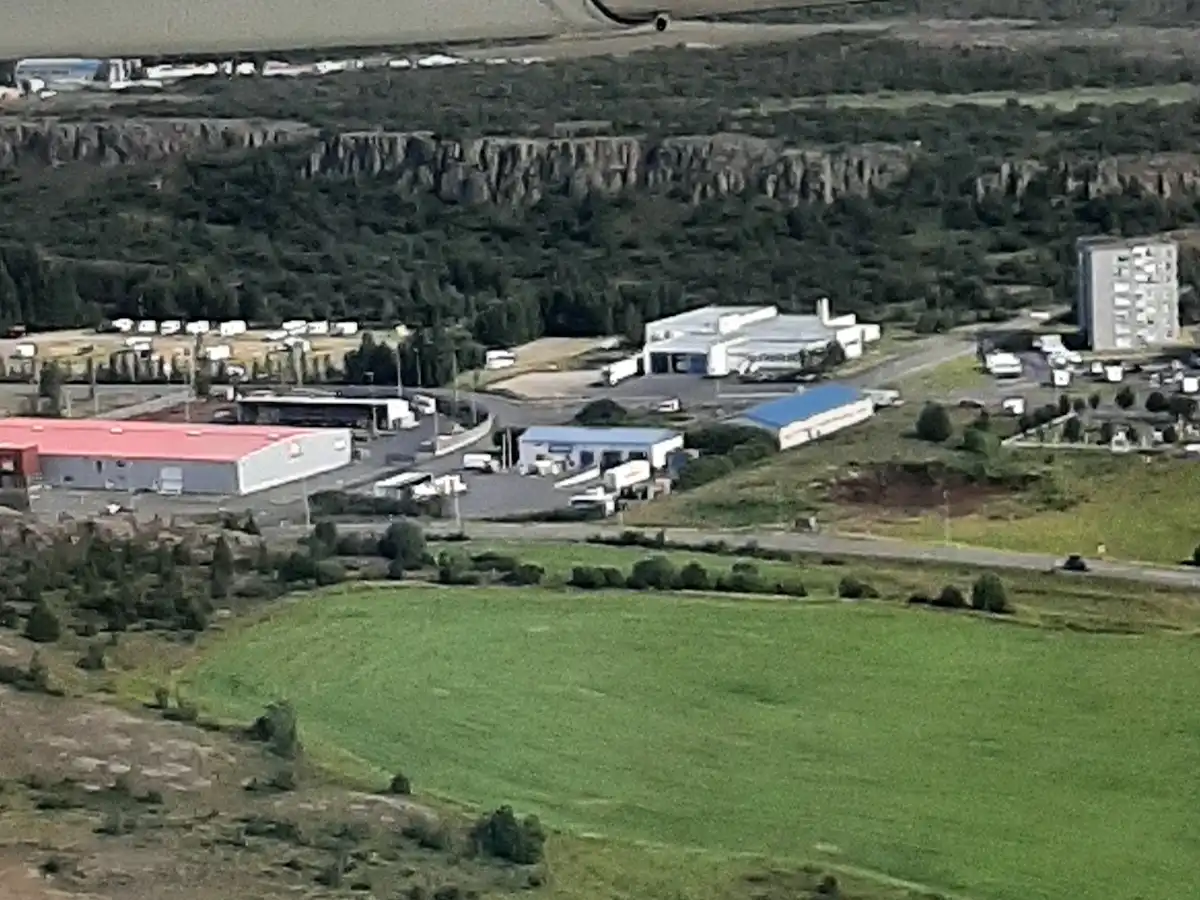
lava fields, fishing harbor, Blue Lagoon access

Experience a working port surrounded by volcanic terrain, with easy entry to geothermal bathing and the stark landscapes of the Reykjanes Peninsula.

iceland-city-grindavik
© Google |
Loading the map 🌍

Expert viewInsights from Locals and Experts

How many towns: I advise visiting four to six towns on a trip of one to two weeks. Iceland’s distances are long, and the pace of a place only shows when you stay at least a night. Fewer than four feels like a rush, while more than six means more driving than looking. Mix one larger base with smaller fishing settlements for contrast.

Choosing the kind: If you want easy access, pick towns near Reykjavik and the South Coast, where buses run and hostels are plentiful. If you want quiet and cheaper rooms outside peak season, choose the Westfjords or East Fjords, but expect long drives and thin services. Travelers who like pools, cafés and whale-watching suit the North, where harbor towns are compact and walkable. Choose by pace first and by photos second.

What it costs: Iceland is expensive. … read more 👉
How many towns: I advise visiting four to six towns on a trip of one to two weeks. Iceland’s distances are long, and the pace of a place only shows when you stay at least a night. Fewer than four feels like a rush, while more than six means more driving than looking. Mix one larger base with smaller fishing settlements for contrast.

Choosing the kind: If you want easy access, pick towns near Reykjavik and the South Coast, where buses run and hostels are plentiful. If you want quiet and cheaper rooms outside peak season, choose the Westfjords or East Fjords, but expect long drives and thin services. Travelers who like pools, cafés and whale-watching suit the North, where harbor towns are compact and walkable. Choose by pace first and by photos second.

What it costs: Iceland is expensive. A tight backpacker budget runs about US$90 to 140 a day: dorm beds US$40 to 70, self-catered groceries US$15 to 25, and a pool entry US$7 to 12. Eating out lifts that fast, with a simple café meal around US$18 to 30 and a pint US$10 to 14. Whale-watching costs roughly US$90 to 130, local guided walks US$60 to 120, and a rental car US$50 to 150 a day depending on season and gear. Fuel is a major line item. Camping runs US$15 to 25 per person, but only in designated sites, and it is limited outside summer. The most useful saving is a supermarket shop at Bonus or Kronan, plus a refillable bottle, because tap water is clean and often tastes faintly mineral.

Safety and culture: Iceland is very safe from crime, but weather is the real hazard. Check road.is for conditions and safetravel.is for alerts, and file a travel plan for remote drives. Wind can rip a car door off its hinges, so hold it with both hands. In winter, ice on small-town streets is slick, and a pair of microspikes helps.

Culturally, Icelanders are reserved but fair and direct. Quiet hours in guesthouses are taken seriously. Shower naked with soap before entering any pool, which is a firm rule and one locals will politely enforce. Tipping is not expected. Do not drive off marked roads, and do not camp in town fields or on farmland without permission. Respect fences and sheep, which wander onto rural roads and in autumn are gathered in loud communal round-ups. In small towns, shops may close early on weekends, so buy food ahead.

The reward is real: the sound of gulls over the harbor, wool-scented hostel common rooms, steaming pools under a green sky, and a bakery’s warm bread at the end of a wet day.

✈️ The backpacker research shortcutIceland Travel Guide

An offline-friendly backpacking guide with optimized travel routes, ranked highlights, transport advice, and the best areas to stay.
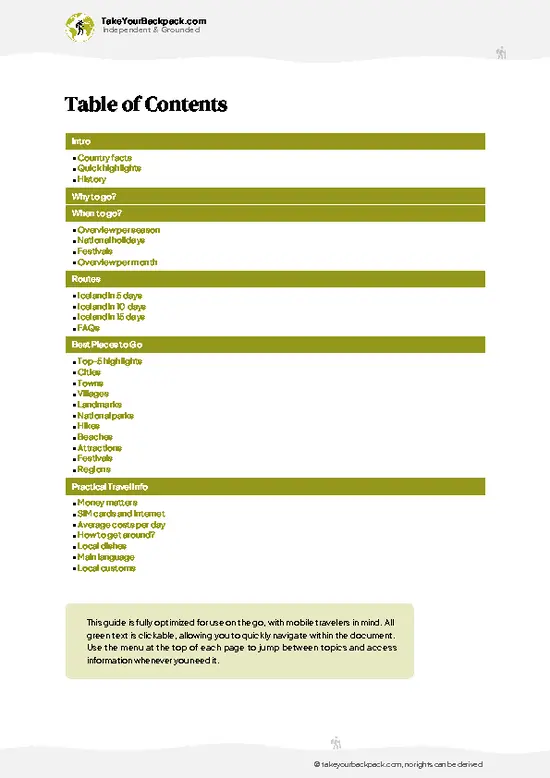
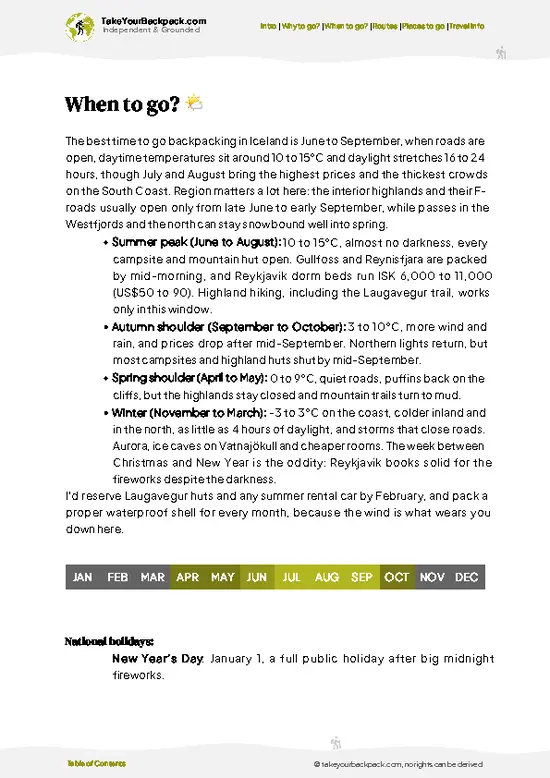
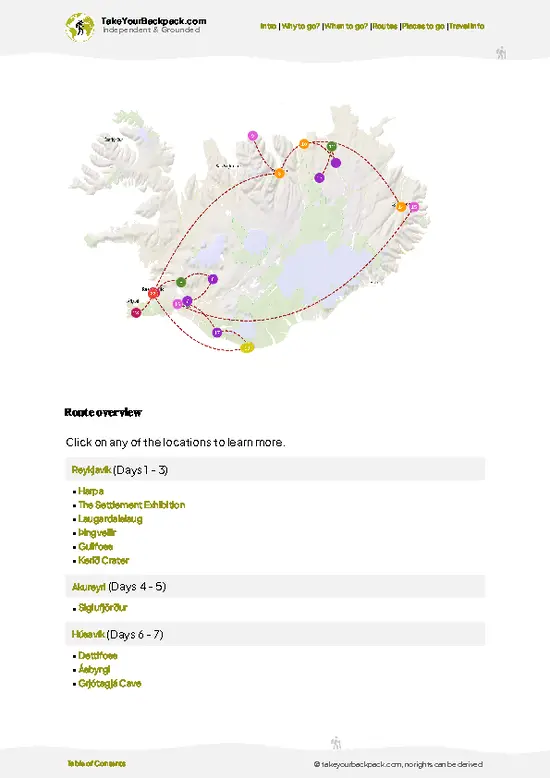
example page 0 from our offline Travel Guide for Iceland
example page 1 from our offline Travel Guide for Iceland
example page 2 from our offline Travel Guide for Iceland
example page 3 from our offline Travel Guide for Iceland
example page 4 from our offline Travel Guide for Iceland
example page 5 from our offline Travel Guide for Iceland
example page 6 from our offline Travel Guide for Iceland
example page 7 from our offline Travel Guide for Iceland
The digital guide (230 pages) contains:
✅ 61 highlights, ranked by travel appeal
✅ Optimized 5, 10 & 15-day travel routes
✅ Cities, national parks, landmarks, beaches
✅ How to get around
✅ Offline-friendly for travel without Wi-Fi
👉 Click to see all 30+ guide features

📅 Plan smarter in minutes, not weeks
✅ Month by month travel advice
✅ Festivals & national holidays
✅ Budget expectations

🗺️ Go to the right places, skip the overrated ones
✅ Honest pros & cons of destinations
✅ Top hikes, parks & viewpoints
✅ Lesser-known places most travelers miss
✅ Clear “worth it vs skip it” guidance

🛏️ Travel smoothly without rookie mistakes
✅ Best areas to stay
✅ Transport systems explained simply
✅ Common scams & safety advice
✅ SIM cards, money & practical tips

🌍 Understand the country, not just visit it
✅ Culture & traditions
✅ 52 Essential phrases & customs
✅ Festivals worth planning around
✅ Traveler-friendly historical context
✅ Insights that make places more meaningful

📱 Built for real travel conditions
✅ Fully downloadable PDF
✅ Works completely offline
✅ Optimized for phone use
✅ Useful in remote areas & buses
✅ Everything in one place
Stop searching, start planning
Get instant access to your full guide. 30‑day money-back guarantee.
+ Add another guide for just

By proceeding you agree to our terms.
Sent to your inbox immediately after payment • 100% Secure Checkout
Best Backpacking Travel Advisor 2025 tourism awardBest Backpacking
Travel Advisor
2025
What others say about Take Your Backpack Guides:
⭐⭐⭐⭐⭐
Fantastic, amazing amount of information!
⭐⭐⭐⭐⭐
My goodness this is amazing, it's what I've been looking for hats off too you!
⭐⭐⭐⭐⭐
I think this is absolutely BRILLIANT
⭐⭐⭐⭐
Very complete and informative. It's still missing places, but I gotta to commend you
⭐⭐⭐⭐⭐
This is truly amazing, thank you, can't wait to explore it with my kids!
⭐⭐⭐⭐⭐
Awesome resource, thank you!
⭐⭐⭐⭐⭐
This is amazing! Can't wait to explore the ones I haven't seen
⭐⭐⭐⭐
I love this! Well done, great idea.
⭐⭐⭐⭐⭐
Thanks for taking the time to make this gem!
⭐⭐⭐⭐⭐
This might be the best website I've ever seen.
⭐⭐⭐⭐⭐
Congratulations, and thank you so much for your work; it's incredibly valuable.
⭐⭐⭐⭐
In all seriousness I think you did a great job pointing out the important spots
⭐⭐⭐⭐⭐
10/10 very good
⭐⭐⭐⭐⭐
As someone who's only just starting to visit regularly this is awesome, thank you.
⭐⭐⭐⭐
Thank you very much! I'm going to visit my dad, it's going to be very useful!
⭐⭐⭐⭐⭐
This is really cool! We'll be travelling for the first time and this definitely come in handy.
⭐⭐⭐⭐⭐
You are now our minister of culture, congratulations 👨‍💼
⭐⭐⭐⭐⭐
Just wanted to tell you that this is a pearl! Going to follow your recommendations.
⭐⭐⭐⭐⭐
This is so cool. I'll definitely be using the resource for my travels soon.
⭐⭐⭐⭐⭐
This is very impressive! Good work.
⭐⭐⭐⭐⭐
This is an amazing and informative site. Very well done!

🛏️ Where to stay?Best Stay Options in Iceland

Iceland has plenty of hostels and guesthouses, with dorm beds typically running ISK 6,000 to 11,000 (about US$45 to 80) a night in summer, and most of them are in Reykjavík. Miðborg (the 101 downtown area around Laugavegur) puts you within walking distance of Hallgrímskirkja, the harbor and the bus terminals, but weekend bar noise lasts until 4 or 5 a.m. Quieter Vesturbær and Laugardalur, home to the city campsite and the biggest public pool, are 15 to 30 minutes on foot from the center and very safe, while up north Akureyri has a small cluster of budget beds near its compact downtown.

If you enjoy meeting fellow travelers, consider choosing hostels with high ratings for atmosphere. On the other … read more 👉
Iceland has plenty of hostels and guesthouses, with dorm beds typically running ISK 6,000 to 11,000 (about US$45 to 80) a night in summer, and most of them are in Reykjavík. Miðborg (the 101 downtown area around Laugavegur) puts you within walking distance of Hallgrímskirkja, the harbor and the bus terminals, but weekend bar noise lasts until 4 or 5 a.m. Quieter Vesturbær and Laugardalur, home to the city campsite and the biggest public pool, are 15 to 30 minutes on foot from the center and very safe, while up north Akureyri has a small cluster of budget beds near its compact downtown.

If you enjoy meeting fellow travelers, consider choosing hostels with high ratings for atmosphere. On the other hand, if you prefer having your own space, a hotel might be a better option.

IcelandWhere to Go Next

👋 Meet the founderWho’s Behind Take Your Backpack?

Johan, backpacker and founder of TakeYourBackpackHi, I’m Johan (Netherlands 🇳🇱), the creator of TakeYourBackpack. Over the past 3 decades, I’ve backpacked through 90+ countries across six continents, gaining extensive experience with independent travel, long-term trips, and overland routes.

This site is built on a combination of firsthand travel experience and carefully curated insights from other backpackers. Many guides are based on places I’ve personally visited, while others bring together tips, observations, and practical advice shared by trusted travelers I’ve met along the way.

The goal is to provide realistic, experience-driven guidance — not generic itineraries — so you can explore destinations with better context, clearer expectations, and more confidence.