×

Iraq🇮🇶 | best townsEssential 9 towns to Explore in Iraq

Towns in Iraq split into three camps, and the right one depends on what you want. The Kurdistan Region in the north is the easy pick: visa on arrival, relaxed checkpoints, cool mountain air, and prices of roughly US$30 to 50 a day. The central and southern Arab towns carry the deepest history (Mesopotamian sites, Shia pilgrimage centers, marsh settlements), but they demand patience with permits, checkpoints and fixers. The western desert towns are not worth planning around: access is limited and there is little to see. Independent travel works best in the north, with one or two southern stops added for substance. Expect few other foreigners anywhere, and that is the appeal.

By Johan Kruseman 🇳🇱 | Updated October 19, 2026
Explore the best landmarks in Iraq

Why go?Understanding Their Importance

Iraq suits towns because history sits at street level. Mesopotamia produced the first cities, and many modern towns grow directly around ancient mounds, shrines, caravanserais and old river crossings. Two rivers, the Tigris and Euphrates, decide where people live, so settlements cluster along water and in the northern foothills, while the desert west is nearly empty. That geography also gives you a clear split between cool, green Kurdish highlands and flat, hot, date-palm plains.

Before choosing Iraq for towns, accept that tourism infrastructure is thin. Few signs are in English, there are no hostel networks, and public transport is mostly shared taxis and minibuses that leave when full. Sites often lack opening hours, ticket booths or labels, so a local guide adds real value. Security varies … read more 👉
Iraq suits towns because history sits at street level. Mesopotamia produced the first cities, and many modern towns grow directly around ancient mounds, shrines, caravanserais and old river crossings. Two rivers, the Tigris and Euphrates, decide where people live, so settlements cluster along water and in the northern foothills, while the desert west is nearly empty. That geography also gives you a clear split between cool, green Kurdish highlands and flat, hot, date-palm plains.

Before choosing Iraq for towns, accept that tourism infrastructure is thin. Few signs are in English, there are no hostel networks, and public transport is mostly shared taxis and minibuses that leave when full. Sites often lack opening hours, ticket booths or labels, so a local guide adds real value. Security varies by province, and checkpoints are routine, particularly outside Kurdistan, where you should carry your passport and copies at all times. Government travel advisories matter more here than almost anywhere else, so check them before you book.

In return you get unusually warm hospitality, tea offered without agenda, and the chance to see places with no tour-bus layer at all. Skip Iraq if you want polish. Choose it if you want substance.
Behind the Scenes of Selection
The list of best towns in Iraq is created based on charm, local culture, atmosphere, hidden gems, and visitor appeal. If you feel a town is missing in this list, please let us know.

When to go?Best Time to Visit Iraq for towns

Best months: The best months for Iraq’s towns are March to April and October to November, when daytime temperatures sit around 18 to 30°C instead of the 45 to 50°C that grips the south in summer. These are the only windows when walking around a town for hours is pleasant everywhere in the country.
Seasons by region: In the Kurdistan Region, spring is the strongest season. Hills turn green, and rainfall, which totals roughly 400 to 700 mm a year in the mountains, tapers off by May. Summer there is hot in the lowland towns (35 to 42°C) but tolerable in higher ones. Winter brings cold nights and snow in the mountains, and some roads slow down. In the south (Basra, the marsh area and Najaf), skip June to September entirely. Heat makes midday sightseeing pointless, and humidity near the Gulf makes … read more 👉
Best months: The best months for Iraq’s towns are March to April and October to November, when daytime temperatures sit around 18 to 30°C instead of the 45 to 50°C that grips the south in summer. These are the only windows when walking around a town for hours is pleasant everywhere in the country.
Seasons by region: In the Kurdistan Region, spring is the strongest season. Hills turn green, and rainfall, which totals roughly 400 to 700 mm a year in the mountains, tapers off by May. Summer there is hot in the lowland towns (35 to 42°C) but tolerable in higher ones. Winter brings cold nights and snow in the mountains, and some roads slow down. In the south (Basra, the marsh area and Najaf), skip June to September entirely. Heat makes midday sightseeing pointless, and humidity near the Gulf makes it worse. Winter days of 15 to 22°C are pleasant, though January can bring rain and mud.
Crowds and prices: Foreign crowds are never a problem. Pilgrimage periods are the exception: during Arbaeen, usually in late summer or early autumn depending on the lunar calendar, millions converge on Karbala and Najaf, and hotels fill and prices climb sharply. Avoid those towns then. Ramadan shifts opening hours, with daytime restaurants shut outside Kurdistan.

town hoppingSuggested Travel Strategies

How long to allow: A trip linking several Iraqi towns needs 10 to 16 days, because transit and checkpoint delays eat more time than distances suggest. Fewer than 10 turns it into a blur of vehicles.
Grouping and direction: Cluster by region. The Kurdish north (Erbil, Sulaymaniyah, Duhok hubs) fits together, with 2 to 3 hours between major cities by shared taxi. The central-south belt (Baghdad, Najaf, Karbala, Nasiriyah, Basra) forms a second cluster, with 1.5 to 4 hours between most links. Moving between north and south is the long leg, around 5 to 8 hours by road from Erbil to Baghdad, or a short domestic flight. Start in the north to settle in with the easy logistics, then fly or drive south, and finish at Baghdad or Basra airport.
Time per stop: Give a town 1 to 2 nights. One night is enough … read more 👉
How long to allow: A trip linking several Iraqi towns needs 10 to 16 days, because transit and checkpoint delays eat more time than distances suggest. Fewer than 10 turns it into a blur of vehicles.
Grouping and direction: Cluster by region. The Kurdish north (Erbil, Sulaymaniyah, Duhok hubs) fits together, with 2 to 3 hours between major cities by shared taxi. The central-south belt (Baghdad, Najaf, Karbala, Nasiriyah, Basra) forms a second cluster, with 1.5 to 4 hours between most links. Moving between north and south is the long leg, around 5 to 8 hours by road from Erbil to Baghdad, or a short domestic flight. Start in the north to settle in with the easy logistics, then fly or drive south, and finish at Baghdad or Basra airport.
Time per stop: Give a town 1 to 2 nights. One night is enough for a compact place, while a base for nearby ruins or marshes deserves two. Anything more than three nights on a single stop is rarely worth it.
Planning mistakes: The classic error is cramming the north-south crossing into a single day alongside sightseeing. Break it up, or fly. Another is relying on late-afternoon transport: shared taxis thin out by evening and driving after dark is best avoided, so move in the morning. Finally, do not skip checkpoint time in your estimates. Add an hour or two to any southern or inter-province drive.

The ListTop towns of Iraq

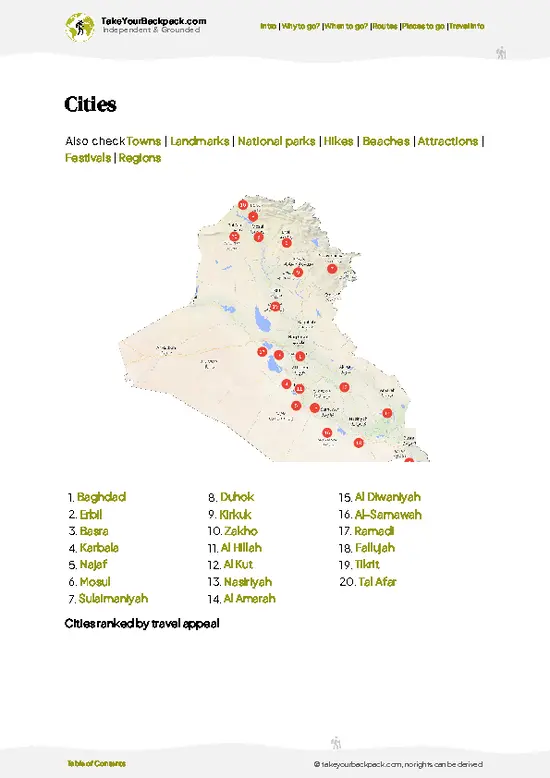
1 Amedi

mountain plateau, ancient gate, Kurdish enclave

Ascend to a plateau town encircled by mountains, where Kurdish culture thrives behind stone walls and a dramatic ancient gateway.

2 Al-Qurnah

marshland edge, confluence point, Adam’s Tree

Stand at the legendary meeting of the Tigris and Euphrates, where marshes begin and local lore marks the birthplace of ancient stories.

3 Al-Kifl

prophet’s tomb, Jewish heritage, compact center

Step into a small town where a historic shrine draws visitors and traces of Jewish history remain visible in the old quarter.

4 Sinjar

mountain ridge, Yazidi shrines, remote villages

Ascend rugged slopes to discover Yazidi religious sites and isolated communities shaped by the dramatic Sinjar Mountains and their unique traditions.

5 Haditha

Reservoir lake, limestone cliffs, riverside villages

Relax by the water’s edge, where the reservoir draws locals for fishing and the surrounding cliffs frame quiet settlements.

6 Alqosh

hilltop monastery, Assyrian village, stone houses

Climb to a village perched above the plains, where ancient monasteries and stone homes reveal the area’s deep Assyrian roots.

7 Rawa

Euphrates banks, mudbrick houses, palm groves

Trace the slow curve of the Euphrates past quiet mudbrick neighborhoods and date palms, where river life sets the town’s gentle rhythm.

8 Al-Baghdadi

river island, military presence, bridge crossings

Reach a town set on an island in the Euphrates, where bridges and checkpoints reflect its strategic importance and riverine setting.

9 Al-Uzayr

shrine town, riverside lanes, pilgrimage site

Visit a riverside settlement known for its religious significance, where pilgrims gather at a revered shrine along quiet, winding streets.

Loading the map 🌍

Expert viewPro Tips for Exploring the Best

How many towns to visit: I advise four to six towns on one trip. Fewer leaves you with a single flavor of the country, and more means you spend most days in a shared taxi watching checkpoints go by. Four to six gives one or two nights each and room to absorb the pace.
Choosing by travel style: First-timers and anyone on a tight schedule should lead with Kurdistan: easier entry, English spoken more often, and simple self-guided walking. History-focused travelers should add two or three towns in the central and southern belt, which hold the Mesopotamian and Islamic heritage that makes Iraq distinct. Anyone drawn by wetlands or pilgrimage culture should pick a town for that specific purpose and skip filler stops. Western desert towns are not worth the time or permit hassle.
What it costs: Budget … read more 👉
How many towns to visit: I advise four to six towns on one trip. Fewer leaves you with a single flavor of the country, and more means you spend most days in a shared taxi watching checkpoints go by. Four to six gives one or two nights each and room to absorb the pace.
Choosing by travel style: First-timers and anyone on a tight schedule should lead with Kurdistan: easier entry, English spoken more often, and simple self-guided walking. History-focused travelers should add two or three towns in the central and southern belt, which hold the Mesopotamian and Islamic heritage that makes Iraq distinct. Anyone drawn by wetlands or pilgrimage culture should pick a town for that specific purpose and skip filler stops. Western desert towns are not worth the time or permit hassle.
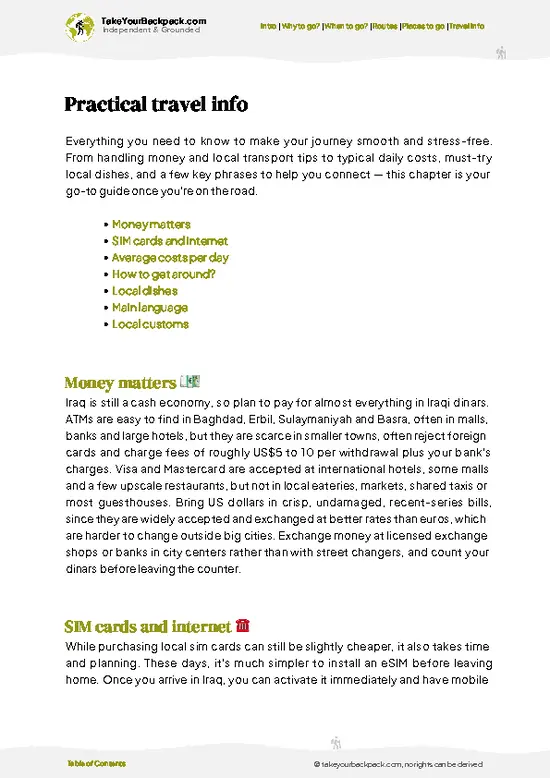
What it costs: Budget US$30 to 50 a day in Kurdistan and US$40 to 70 a day in the south, where fewer hotel options push prices up. Basic guesthouses and hotels run US$15 to 40 a night, meals in local restaurants US$3 to 8, and shared taxis between towns US$5 to 20. Site entry is usually free or under US$5 per visit, but a licensed guide or driver for ruins or marshes costs US$50 to 120 a day. Pay for one when sites lack signage or road access is complicated; skip one in walkable town centers. Cash matters, so carry US dollars in clean, recent notes, and exchange to Iraqi dinars locally, as cards are widely refused outside upscale hotels.
Costs and delays that catch travelers out: Booking a driver without agreeing the full price and route first leads to mid-trip renegotiation. Settle the total before you leave. Arriving in a town with no hotel booked wastes hours, since some guesthouses are unlisted or not licensed for foreigners; confirm ahead. Southern provinces may require permits or registration with local security, so ask your hotel on arrival and allow a half day. Tourist-priced taxis from airports and bus stations can double the fair fare, so agree the price or use a hotel pickup.
Safety and cultural considerations: Check current government advisories before each leg, because conditions differ sharply by province. Carry your passport and several photocopies, and be patient with checkpoints: friendly cooperation speeds everything up. Dress modestly, with long sleeves and trousers, and women should carry a headscarf for shrines and mosques, where entry for non-Muslims varies by site. Ask before photographing people, and never photograph checkpoints or military sites. Alcohol is easy to find in Kurdistan but rare and sensitive elsewhere. Avoid political talk with strangers until you read the room, and accept tea invitations, which are a normal part of hospitality.

✈️ The backpacker research shortcutIraq Travel Guide

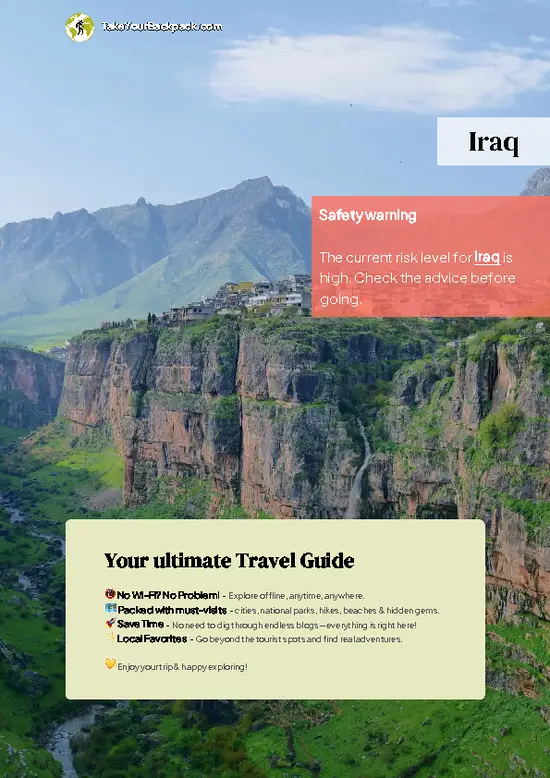
An offline-friendly backpacking guide with optimized travel routes, ranked highlights, transport advice, and the best areas to stay.
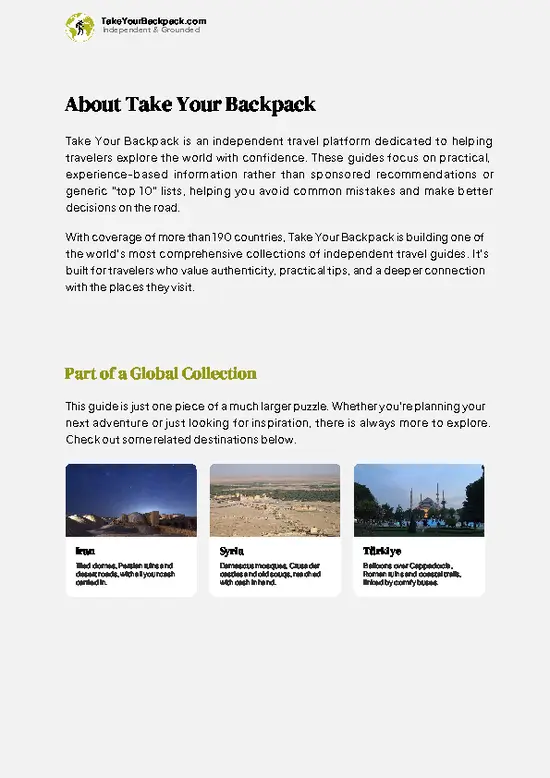
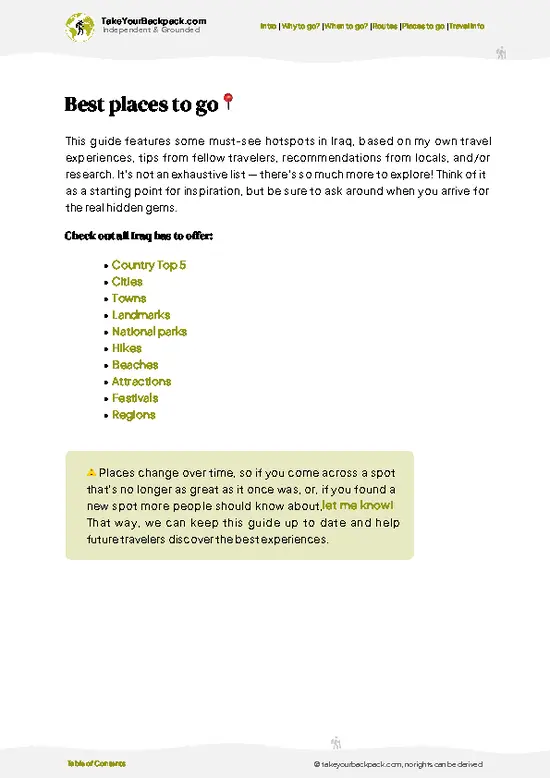
example page 0 from our offline Travel Guide for Iraq
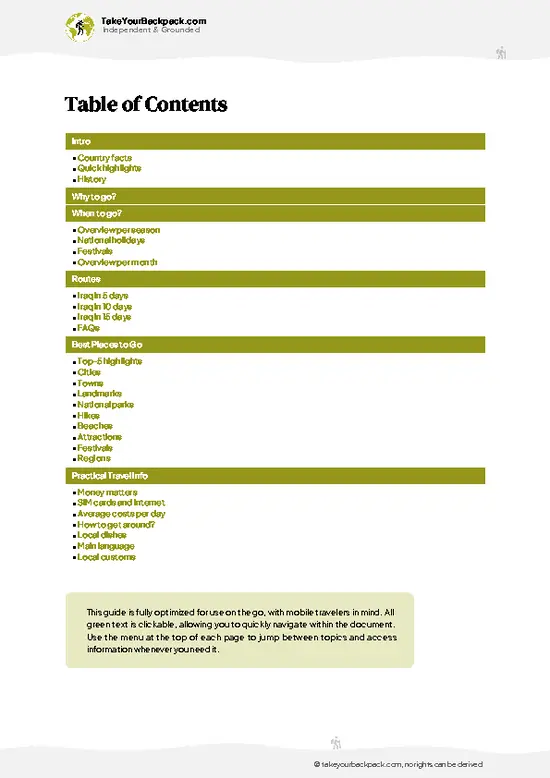
example page 1 from our offline Travel Guide for Iraq
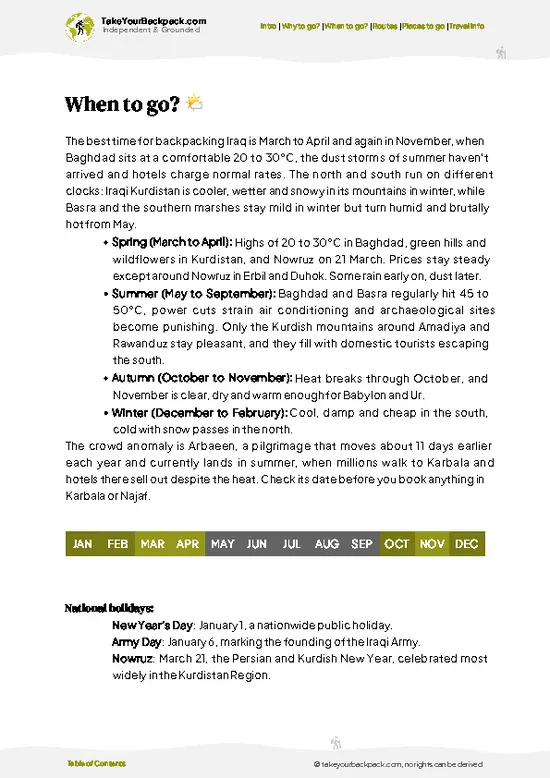
example page 2 from our offline Travel Guide for Iraq
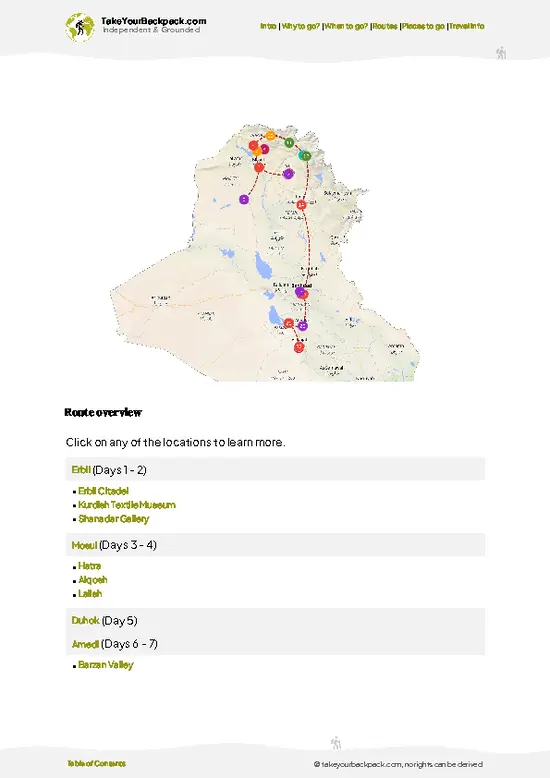
example page 3 from our offline Travel Guide for Iraq
example page 4 from our offline Travel Guide for Iraq
example page 5 from our offline Travel Guide for Iraq
example page 6 from our offline Travel Guide for Iraq
example page 7 from our offline Travel Guide for Iraq
The digital guide (327 pages) contains:
✅ 95 highlights, ranked by travel appeal
✅ Optimized 5, 10 & 15-day travel routes
✅ Cities, national parks, landmarks, beaches
✅ How to get around
✅ Offline-friendly for travel without Wi-Fi
👉 Click to see all 30+ guide features

📅 Plan smarter in minutes, not weeks
✅ Month by month travel advice
✅ Festivals & national holidays
✅ Budget expectations

🗺️ Go to the right places, skip the overrated ones
✅ Honest pros & cons of destinations
✅ Top hikes, parks & viewpoints
✅ Lesser-known places most travelers miss
✅ Clear “worth it vs skip it” guidance

🛏️ Travel smoothly without rookie mistakes
✅ Best areas to stay
✅ Transport systems explained simply
✅ Common scams & safety advice
✅ SIM cards, money & practical tips

🌍 Understand the country, not just visit it
✅ Culture & traditions
✅ 52 Essential phrases & customs
✅ Festivals worth planning around
✅ Traveler-friendly historical context
✅ Insights that make places more meaningful

📱 Built for real travel conditions
✅ Fully downloadable PDF
✅ Works completely offline
✅ Optimized for phone use
✅ Useful in remote areas & buses
✅ Everything in one place
Stop searching, start planning
Get instant access to your full guide. 30‑day money-back guarantee.
+ Add another guide for just

By proceeding you agree to our terms.
Sent to your inbox immediately after payment • 100% Secure Checkout
Best Backpacking Travel Advisor 2025 tourism awardBest Backpacking
Travel Advisor
2025
What others say about Take Your Backpack Guides:
⭐⭐⭐⭐⭐
Fantastic, amazing amount of information!
⭐⭐⭐⭐⭐
My goodness this is amazing, it's what I've been looking for hats off too you!
⭐⭐⭐⭐⭐
I think this is absolutely BRILLIANT
⭐⭐⭐⭐
Very complete and informative. It's still missing places, but I gotta to commend you
⭐⭐⭐⭐⭐
This is truly amazing, thank you, can't wait to explore it with my kids!
⭐⭐⭐⭐⭐
Awesome resource, thank you!
⭐⭐⭐⭐⭐
This is amazing! Can't wait to explore the ones I haven't seen
⭐⭐⭐⭐
I love this! Well done, great idea.
⭐⭐⭐⭐⭐
Thanks for taking the time to make this gem!
⭐⭐⭐⭐⭐
This might be the best website I've ever seen.
⭐⭐⭐⭐⭐
Congratulations, and thank you so much for your work; it's incredibly valuable.
⭐⭐⭐⭐
In all seriousness I think you did a great job pointing out the important spots
⭐⭐⭐⭐⭐
10/10 very good
⭐⭐⭐⭐⭐
As someone who's only just starting to visit regularly this is awesome, thank you.
⭐⭐⭐⭐
Thank you very much! I'm going to visit my dad, it's going to be very useful!
⭐⭐⭐⭐⭐
This is really cool! We'll be travelling for the first time and this definitely come in handy.
⭐⭐⭐⭐⭐
You are now our minister of culture, congratulations 👨‍💼
⭐⭐⭐⭐⭐
Just wanted to tell you that this is a pearl! Going to follow your recommendations.
⭐⭐⭐⭐⭐
This is so cool. I'll definitely be using the resource for my travels soon.
⭐⭐⭐⭐⭐
This is very impressive! Good work.
⭐⭐⭐⭐⭐
This is an amazing and informative site. Very well done!

🛏️ Where to stay?Where to Base Yourself

Backpacker hostels in Iraq are still rare, but cheap guesthouses and simple hotels at roughly US$15 to 35 a night exist in every major city, and a few small hostels have opened in Baghdad and the Kurdish cities. In Baghdad, Karrada has the widest choice, with riverside cafés and late-opening restaurants, while the older streets around Bab al-Sharqi and Saadoun Street are cheaper and closer to Tahrir Square and Mutanabbi Street, though louder and grittier after dark. In Erbil, budget rooms cluster around the Citadel and the bazaar for easy sightseeing on foot, the Christian district of Ankawa costs more but has bars and a calmer night, and in Sulaymaniyah the streets near the bazaar mix low prices … read more 👉
Backpacker hostels in Iraq are still rare, but cheap guesthouses and simple hotels at roughly US$15 to 35 a night exist in every major city, and a few small hostels have opened in Baghdad and the Kurdish cities. In Baghdad, Karrada has the widest choice, with riverside cafés and late-opening restaurants, while the older streets around Bab al-Sharqi and Saadoun Street are cheaper and closer to Tahrir Square and Mutanabbi Street, though louder and grittier after dark. In Erbil, budget rooms cluster around the Citadel and the bazaar for easy sightseeing on foot, the Christian district of Ankawa costs more but has bars and a calmer night, and in Sulaymaniyah the streets near the bazaar mix low prices with a lively evening crowd.

If you enjoy meeting fellow travelers, consider choosing hostels with high ratings for atmosphere. On the other hand, if you prefer having your own space, a hotel might be a better option.

IraqExpand Your Journey

👋 Meet the founderWho’s Behind Take Your Backpack?

Johan, backpacker and founder of TakeYourBackpackHi, I’m Johan (Netherlands 🇳🇱), the creator of TakeYourBackpack. Over the past 3 decades, I’ve backpacked through 90+ countries across six continents, gaining extensive experience with independent travel, long-term trips, and overland routes.

This site is built on a combination of firsthand travel experience and carefully curated insights from other backpackers. Many guides are based on places I’ve personally visited, while others bring together tips, observations, and practical advice shared by trusted travelers I’ve met along the way.

The goal is to provide realistic, experience-driven guidance — not generic itineraries — so you can explore destinations with better context, clearer expectations, and more confidence.