×
Italy🇮🇹 | 7 days itinerary

How to Spend 7 Days in Italy

By Johan Kruseman 🇳🇱 | Updated May 12, 2026
This 7-day route is for first-time Italy travelers who want a concentrated hit of art, food, and medieval streets without changing hotels every night, moving at a relaxed-but-engaged pace using trains, buses, and your own two feet. You’ll base yourself in and around Florence, with easy day trips to hill towns and countryside so you get both Renaissance masterpieces and small-town stone alleys in one tight loop.

Days 1-3: Florence & Renaissance Icons

Start in Florence, because it’s compact, walkable, and absolutely loaded with high-impact sights in a small radius. Spend your first full day wandering the historic center, climbing a viewpoint, and getting your bearings in the markets and wine bars so you’re not rushing museum lines on jet lag. Dedicate a solid half-day to the Uffizi Gallery, where you can actually slow down in front of Botticelli and Caravaggio instead of sprinting past them, and another focused visit to the Accademia Gallery (Galleria dell’Accademia to see Michelangelo’s David … read more 👉
This 7-day route is for first-time Italy travelers who want a concentrated hit of art, food, and medieval streets without changing hotels every night, moving at a relaxed-but-engaged pace using trains, buses, and your own two feet. You’ll base yourself in and around Florence, with easy day trips to hill towns and countryside so you get both Renaissance masterpieces and small-town stone alleys in one tight loop.

Days 1-3: Florence & Renaissance Icons

Start in Florence, because it’s compact, walkable, and absolutely loaded with high-impact sights in a small radius. Spend your first full day wandering the historic center, climbing a viewpoint, and getting your bearings in the markets and wine bars so you’re not rushing museum lines on jet lag. Dedicate a solid half-day to the Uffizi Gallery, where you can actually slow down in front of Botticelli and Caravaggio instead of sprinting past them, and another focused visit to the Accademia Gallery (Galleria dell’Accademia to see Michelangelo’s David with time left to explore quieter corners of the collection. Evenings are for lingering over Tuscan food and strolling the Arno rather than cramming in more checklists, which keeps the pace human and the memories sharper.

Days 4-5: Siena & San Gimignano - Tuscan Hill Town Duo

Shift gears with a short bus or train ride into the Tuscan hills, basing in Siena for two nights so you can feel the city after the day-trippers leave. Siena gives you that dense medieval core, brick piazzas, and a slower rhythm that balances Florence’s museum energy, and staying overnight means you can wander the lanes at dusk when it feels almost local. From Siena, take a day trip to San Gimignano, whose tower-studded skyline is dramatic but small enough that you can explore at an easy pace, taste some gelato, and still be back in Siena for dinner without feeling rushed or over-scheduled.

Days 6-7: Lucca & Departure via Florence

On day six, roll by train to Lucca, a walled town that’s perfect for a last, low-stress chapter of the trip. Walking or biking the tree-lined ramparts gives you a literal overview of the city and a mental breather after the heavier art days, and Lucca’s flat streets and relaxed café culture make it ideal for a final round of people-watching and shopping. On your last day, head back to Florence for your departure, padding in enough time for a final espresso or quick wander so you’re not white-knuckling your way to the airport or station at the last minute.

My favorite moment on this route is that first quiet evening in Siena, when the crowds thin out and the brick of the main square still holds the day’s warmth under your feet.
Loading the map 🌍
film
0
0
0a
Florence
Pixabay
film
1
1
1a
Uffizi Gallery
Pixabay
film
2
2
2a
Accademia Gallery (Galleria dell’Accademia
film
3
3
3a
Siena
Christian Borghetti
film
4
4
4a
San Gimignano
Muthuraja S
film
5
5
5a
Lucca

🛏️ Where to stay?Where You'll Go

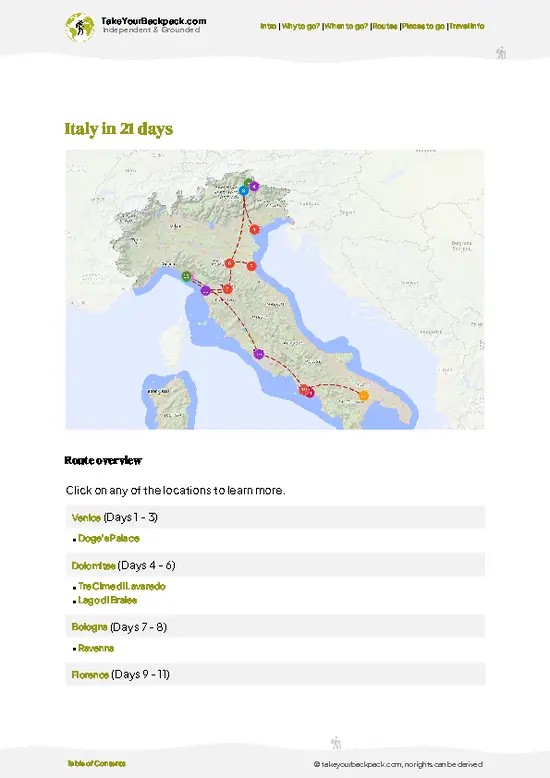
👉 Click on any of the locations to learn more.
Days 1 - 4Florence
Days 5 - 6Siena
Day 7Lucca

✈️ The backpacker research shortcutItaly Travel Guide

An offline-friendly backpacking guide with optimized travel routes, ranked highlights, transport advice, and the best areas to stay.
example page 0 from our offline Travel Guide for Italyexample page 1 from our offline Travel Guide for Italyexample page 2 from our offline Travel Guide for Italyexample page 3 from our offline Travel Guide for Italyexample page 4 from our offline Travel Guide for Italyexample page 5 from our offline Travel Guide for Italy
The digital guide (461 pages) contains:
148 highlights, ranked by travel appeal
Optimized 7, 14 & 21-day travel routes
Best neighborhoods to stay
How to get around
Offline-friendly for travel without Wi-Fi
👉 See all 30+ guide features

📅 Plan smarter in minutes, not weeks
Month by month travel advice
Festivals & national holidays
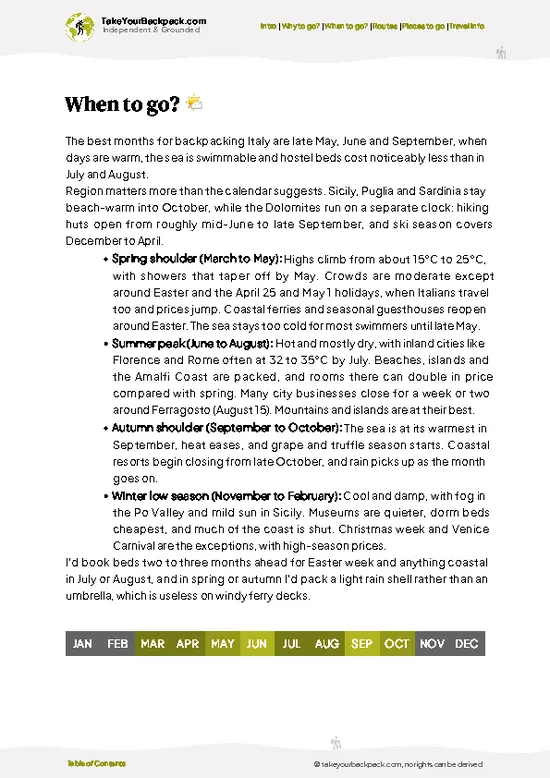
Budget expectations

🗺️ Go to the right places, skip the overrated ones
Honest pros & cons of destinations
Top hikes, parks & viewpoints
Lesser-known places most travelers miss
Clear “worth it vs skip it” guidance

🛏️ Travel smoothly without rookie mistakes
Best areas to stay
Transport systems explained simply
Common scams & safety advice
SIM cards, money & practical tips

🌍 Understand the country, not just visit it
Culture & traditions
52 Essential phrases & customs
Festivals worth planning around
Traveler-friendly historical context
Insights that make places more meaningful

📱 Built for real travel conditions
Fully downloadable PDF
Works completely offline
Optimized for phone use
Useful in remote areas & buses
Everything in one place
Save weeks of stressful planning
Get instant access to the full guide directly. 30-day money-back guarantee.


Sent to your inbox immediately after payment • 100% Secure Checkout
Best Backpacking Travel Advisor 2025 tourism awardBest Backpacking
Travel Advisor
2025
What others say about Take Your Backpack Guides:
⭐⭐⭐⭐⭐
Fantastic, amazing amount of information!
⭐⭐⭐⭐⭐
My goodness this is amazing, it's what I've been looking for hats off too you!
⭐⭐⭐⭐⭐
I think this is absolutely BRILLIANT
⭐⭐⭐⭐
Very complete and informative. It's still missing places, but I gotta to commend you
⭐⭐⭐⭐⭐
This is truly amazing, thank you, can't wait to explore it with my kids!
⭐⭐⭐⭐⭐
Awesome resource, thank you!
⭐⭐⭐⭐⭐
This is amazing! Can't wait to explore the ones I haven't seen
⭐⭐⭐⭐
I love this! Well done, great idea.
⭐⭐⭐⭐⭐
Thanks for taking the time to make this gem!
⭐⭐⭐⭐⭐
This might be the best website I've ever seen.
⭐⭐⭐⭐⭐
Congratulations, and thank you so much for your work; it's incredibly valuable.
⭐⭐⭐⭐
In all seriousness I think you did a great job pointing out the important spots
⭐⭐⭐⭐⭐
10/10 very good
⭐⭐⭐⭐⭐
As someone who's only just starting to visit regularly this is awesome, thank you.
⭐⭐⭐⭐
Thank you very much! I'm going to visit my dad, it's going to be very useful!
⭐⭐⭐⭐⭐
This is really cool! We'll be travelling for the first time and this definitely come in handy.
⭐⭐⭐⭐⭐
You are now our minister of culture, congratulations 👨‍💼
⭐⭐⭐⭐⭐
Just wanted to tell you that this is a pearl! Going to follow your recommendations.
⭐⭐⭐⭐⭐
This is so cool. I'll definitely be using the resource for my travels soon.
⭐⭐⭐⭐⭐
This is very impressive! Good work.
⭐⭐⭐⭐⭐
This is an amazing and informative site. Very well done!

🧭 RouteAdjust Your Pace

Travel Italy your way — from a quick highlights trip to a slow-paced adventure.

🙋 FAQTraveler FAQ

Italy is one of the easiest countries in Europe to backpack independently if you’re comfortable with basic logistics. Trains and buses link almost every place you’ll want to go, hostels are common in major and mid-size cities, and there’s a long history of budget travelers passing through, so you won’t feel out of place with a pack and worn-out shoes. English is widely understood in tourist areas and by younger people, but learning a few Italian basics (hello, please, thank you, ticket, platform, bill) makes life smoother and earns you better treatment. The main challenges are crowds, higher prices in famous cities, and the need to book some things in advance during peak season. You can absolutely wing it in shoulder season (spring and fall) by booking hostels a few days ahead, but in July–August you should lock in beds and long-distance trains earlier to avoid paying last-minute premiums. Safety-wise, violent crime against travelers is rare; the real risk is petty theft in busy spots like Rome Termini, Milan Centrale, Naples, and around major sights. Use a money belt or hidden pouch for passports and cards, keep your daypack zipped and in front of you on metros and crowded buses, and avoid leaving bags unattended on trains. For budget travelers, the key is to treat Italy as a chain of walkable city centers connected by public transport: stay near stations or in central hostels, walk as much as possible, use supermarkets and bakeries for cheap meals, and time your big-ticket sights (Colosseum, Vatican, Uffizi) to specific days so you don’t waste money on flexible tickets you don’t use. If you’re comfortable reading train timetables, using ticket machines, and navigating on foot, Italy is very friendly to independent backpackers.
For a first-time backpacking trip focused on value, 10–14 days is the sweet spot, and 3–4 weeks is ideal if you want both cities and slower countryside time. Under a week, you’ll be rushing and spending too much on transport for what you actually see. With 7 days, focus on one region or a tight triangle: for example, Rome + Florence + a day trip (Pisa or Siena), or Milan + Lake Como + the Cinque Terre. With 10–14 days, you can do a classic budget-friendly loop by train: Rome (3–4 nights) → Florence (3 nights with a day trip to Pisa or Siena) → Cinque Terre or La Spezia area (2–3 nights) → Milan (1–2 nights) or Venice (2 nights) depending on your interests. This gives you big history, art, coast, and at least one smaller town without spending half your trip in transit. With 3 weeks or more, you can slow down and save money by staying longer in fewer places: add Naples and the Amalfi/Salerno coast, or head east to Bologna and the cheaper university cities, or go south to Puglia or Sicily where your daily costs drop if you self-cater and use regional trains. For pure budget efficiency, plan at least 2–3 nights per stop; every extra train ride eats into your food and gelato budget. Also factor in that travel days are half days: if you change cities, assume you’ll realistically only have a relaxed afternoon and evening to explore, not a full sightseeing day. If you’re very short on time, it’s better to see fewer places well than to collect city names and mostly see train stations.
You can travel almost all of Italy without a car, and for backpackers it’s usually cheaper and less stressful to rely on trains and buses. The main rail lines connect the big hitters: Turin–Milan–Venice–Bologna–Florence–Rome–Naples–Salerno, with frequent, fast trains that are comfortable and easy to use. For budget travelers, regional trains are your friend: they’re slower but much cheaper than the high-speed options, and you don’t need to book them far in advance. Just remember to validate paper tickets in the little machines on the platform before boarding to avoid fines. Buses fill in the gaps where trains don’t go or are infrequent, especially in rural areas, parts of Tuscany, the Amalfi Coast, Puglia, and Sicily. They can be confusing because schedules vary by weekday, weekend, and school term, so always double-check times at the station or posted timetables. Inside cities, you’ll mostly walk; Italian historic centers are compact and walking is the best way to soak up the atmosphere and save money. Use metro and buses in Rome, Milan, and Naples when you’re tired or crossing long distances, but avoid taxis unless you split the cost with others, as they add up quickly. The only times a car really helps are if you want to explore remote hill towns on your own schedule, do a deep dive into rural Tuscany or Umbria, or chase small beaches in Sardinia or Sicily. Even then, a car is a liability in big cities due to restricted traffic zones, expensive parking, and fines. For most backpackers, the best strategy is: trains between cities, buses for specific rural or coastal stretches, and your feet for everything inside town.
For a budget traveler, the must-visits are the places that give you the most history, food, and atmosphere per euro and are easy to reach by train. Rome is non-negotiable: the Colosseum, Roman Forum, and Vatican Museums are big-ticket items, but the real value is in wandering the free stuff—Trastevere lanes, piazzas, fountains, and viewpoints like the Gianicolo. Florence is the best compact base for Renaissance art and Tuscan vibes on a budget: you can see the Duomo, Ponte Vecchio, and main squares for free, then choose one or two paid museums (Uffizi or Accademia) instead of trying to do everything. Venice is expensive but still worth at least a day or two if you can swing it; the trick is to stay in Mestre or on the mainland to save money and visit the islands by day, walking the backstreets away from San Marco to escape crowds and high prices. Naples is a top-tier budget stop: cheaper food, intense street life, and easy access to Pompeii, Herculaneum, and the islands. It’s gritty but incredibly alive, and pizza here is both world-class and cheap. For coast and hiking, the Cinque Terre or the cheaper nearby towns (like La Spezia or Levanto) give you dramatic sea views and trails between villages; you can base in a less famous town to cut costs and still enjoy the same coastline. If you want a smaller, less polished city with great food and fewer tour groups, Bologna is a strong choice: it’s a university town with excellent, affordable eating and easy train links to Florence, Modena, Parma, and Ravenna. If you have more time and want to stretch your budget, Puglia (think Lecce, Bari, Polignano a Mare) and Sicily (Palermo, Catania, Siracusa) offer lower daily costs, good hostels in main cities, and a slower pace, though you’ll rely more on regional trains and buses.
If you’re short on time or money, skip anything that eats hours in transit for a quick photo or that forces you into high prices for a shallow experience. The first thing to cut is trying to do all of Italy in one go: don’t attempt a Rome–Florence–Venice–Cinque Terre–Amalfi–Milan–Sicily sprint in 10 days. You’ll spend more time on trains than in streets and blow your budget on transport. Venice can be skipped only if you truly hate crowds or are on an ultra-tight schedule; if you do skip it, you can get some of that old-city-on-water feel in smaller lagoon towns or by focusing on older quarters of other cities. Pisa is an easy day trip from Florence, but the Leaning Tower area is crowded and commercial; if time is tight, you can skip Pisa entirely and put that half-day into Siena, Lucca, or just more time wandering Florence. The Amalfi Coast is gorgeous but punishingly expensive and crowded in high season; if you’re on a budget and short on days, base in Naples or Salerno instead and do one day trip (Sorrento, Amalfi, or Positano) or skip Amalfi altogether in favor of the Cinque Terre or Puglia’s coast, which are easier to manage on a backpacker budget. In big cities, you can skip some of the pricier, lower-impact attractions: for example, in Rome you don’t need to pay for every church and museum; pick a couple of key sights and enjoy the free outdoor history. In Florence, you don’t need to climb every tower and dome; choose one viewpoint and enjoy the rest from ground level. Also skip over-structured wine tours and cooking classes if money is tight; you can get a strong sense of local food culture just by eating in simple trattorias, shopping at markets, and trying house wine by the carafe. The guiding principle: cut anything that feels like a box-ticking detour and double down on walkable neighborhoods, free viewpoints, and a few carefully chosen paid experiences.

🇮🇹 ItalySee More of Italy

Ready to build a truly unique trip? Predefined routes are perfect for first-time visitors, but there is so much more to discover. Whether you are chasing a city trip, pristine national parks, local food scenes, or quiet beaches, pick a category to design your own path.