×
Italy🇮🇹 | 21 days itinerary

How to Spend 21 Days in Italy

By Johan Kruseman 🇳🇱 | Updated October 18, 2026
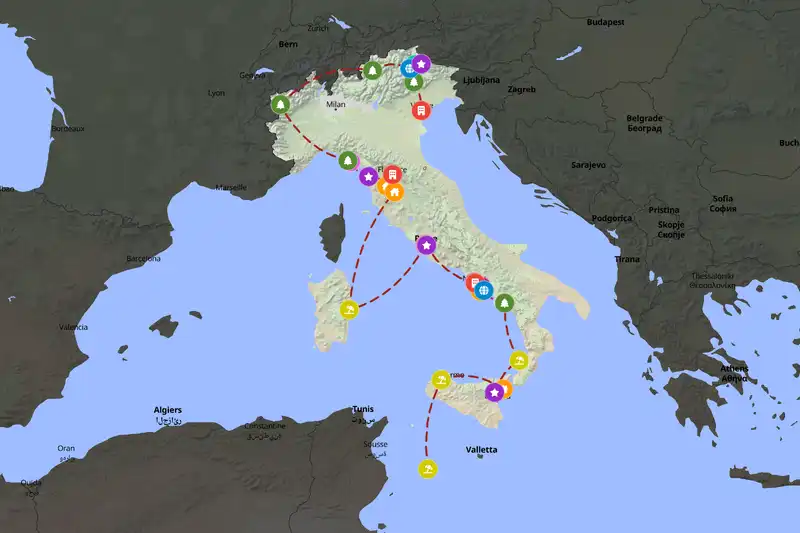
This three-week loop suits travelers who want the whole spread of Italy in one go: canals, high mountains, Renaissance cities, cliff villages, Roman ruins and the cave town of the south. It runs from north to south at a steady but unhurried pace, mostly two or three nights per base. You need high-speed and regional trains, a long-distance coach into the Dolomites and down to Basilicata, and summer-only shuttle buses in the mountains, so plan it for June to September.

Days 1-3: Venice

Start in Venice. Three nights let you see the city after the day-trippers leave, which is when it is at its best. Base yourself in Cannaregio, where rooms cost less and the bars along the Fondamenta della Misericordia serve cicchetti (small bar snacks) at €1.50 to 3 a piece. Give one morning to the Doge’s Palace. Book the guided tour that goes through the hidden offices and the cells across the Bridge of Sighs, because the standard route skips them. Spend the other two days walking with no plan. Use the vaporetto … read more 👉
This three-week loop suits travelers who want the whole spread of Italy in one go: canals, high mountains, Renaissance cities, cliff villages, Roman ruins and the cave town of the south. It runs from north to south at a steady but unhurried pace, mostly two or three nights per base. You need high-speed and regional trains, a long-distance coach into the Dolomites and down to Basilicata, and summer-only shuttle buses in the mountains, so plan it for June to September.

Days 1-3: Venice

Start in Venice. Three nights let you see the city after the day-trippers leave, which is when it is at its best. Base yourself in Cannaregio, where rooms cost less and the bars along the Fondamenta della Misericordia serve cicchetti (small bar snacks) at €1.50 to 3 a piece. Give one morning to the Doge’s Palace. Book the guided tour that goes through the hidden offices and the cells across the Bridge of Sighs, because the standard route skips them. Spend the other two days walking with no plan. Use the vaporetto only for the Grand Canal run and for getting back late at night.

Days 4-6: Dolomites

A direct coach from Venice reaches Cortina d’Ampezzo in about 2.5 hours, and Cortina works as a base for the Dolomites. From there, a summer bus via Misurina climbs to Rifugio Auronzo in roughly an hour. That is the trailhead for the loop around the Tre Cime di Lavaredo: about 10 kilometers and 3.5 to 4 hours, with the three north faces in full view from Rifugio Locatelli. On another day, ride the bus to Dobbiaco and change for Lago di Braies. Go early. In July and August, road and shuttle access to the lake has to be booked in advance, and by 10 a.m. the shore path is shoulder to shoulder. Keep the third day free for weather, because afternoon storms are common.

Days 7-8: Bologna

Day 7 is the longest travel day of the trip: a coach back down to Venice Mestre, then about 1.5 hours by train to Bologna, roughly 5 hours door to door. Bologna pays you back fast with tortellini in brodo and around 40 kilometers of porticoes. On day 8, take the train to Ravenna, 60 to 80 minutes each way. Inside the Basilica of San Vitale and the Mausoleum of Galla Placidia, the 5th and 6th century mosaics still glow gold and deep blue. You can see most of the main sites on one combined ticket.

Days 9-11: Florence

Florence is only 37 minutes away by high-speed train, so day 9 is an easy hop. This time, put the Accademia Gallery (Galleria dell’Accademia) first. Michelangelo’s David is 5.17 meters of marble, and the unfinished “Prisoners” lining the corridor show the stone being cut away. A timed ticket saves you an hour in the summer queue. Use the other days for the climb up Brunelleschi’s dome (book ahead) and dinner in the Oltrarno, across the river, where the trattorias are cheaper.

Days 12-13: Cinque Terre

On day 12, break the train ride to La Spezia at Pisa. About two hours covers the Piazza del Duomo, Pisa, with its tower, cathedral and baptistery set on one lawn. Leave your bag at the station before you walk over. Then continue to Cinque Terre and sleep in one of the villages or in La Spezia, which is cheaper. Day 13 is for the Sentiero Azzurro (Cinque Terre). Walk from Monterosso to Vernazza in about 2 hours of steep stone steps, then take the train on to Manarola for its stacked pastel houses at sunset. You need a Cinque Terre Card for the trail, and the line trains run every 15 to 30 minutes in summer.

Days 14-16: Rome

Direct trains from La Spezia reach Rome in 3.5 to 4 hours. You have three nights, so be deliberate. Spend one morning on the Colosseum and the Forum on a combined timed ticket, and the next morning at the Vatican Museums. Book the first entry slot so the Sistine Chapel is still bearable. The Capitoline Museums see a fraction of the Vatican’s crowds. Inside are the original bronze Marcus Aurelius and the Capitoline Wolf, and the underground passage through the Tabularium opens onto the best free-standing view of the Forum in the city.

Days 17-18: Naples

It’s 70 minutes by high-speed train to Naples, where the noise level doubles and the price of a margherita halves (€5 to 8 at the classic pizzerias). Join a guided tour of the Teatro di San Carlo, which opened in 1737 and is the oldest opera house in Europe still in use. Six tiers of red and gold boxes rise around the stage. The next day, take the Circumvesuviana train to the Pompeii Archaeological Park, about 35 minutes. Give it at least 5 hours, and bring water and a hat, because shade is scarce along its 66 hectares of streets.

Days 19-21: Matera

Coaches from Naples reach Matera in about 3.5 to 4 hours, and this ending feels nothing like the north. The Sassi are two districts of cave houses and rock churches cut into a ravine, with lanes stepping down over one another. Two nights let you see the stone turn honey-colored in the evening light and empty out after dark. On day 21, the FAL train or a shuttle bus reaches Bari and its airport in about 1.5 hours.

If I had one free afternoon in Matera, I would cross the gravina gorge on the suspension footbridge and climb to the Belvedere di Murgia Timone for the view back at the whole Sassi, wearing proper shoes and carrying two liters of water, since there is nothing to buy on that side.
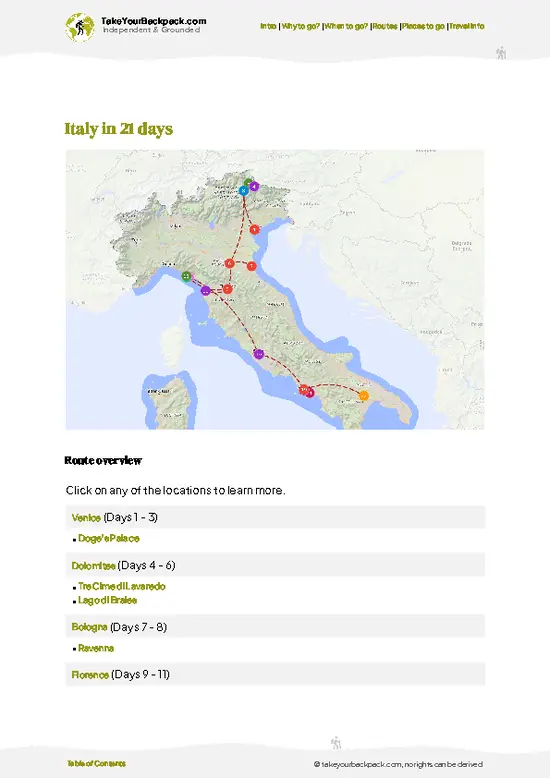
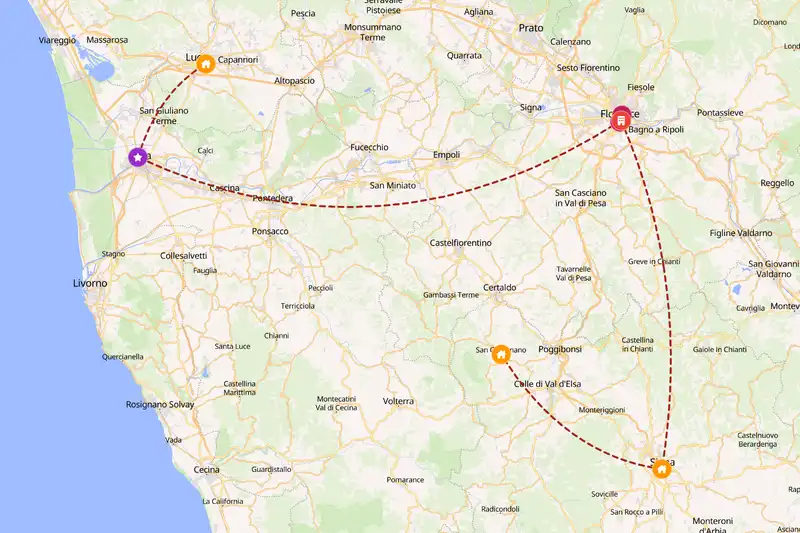
Loading the map 🌍

🛏️ Where to stay?21 Days of Adventure

👉 Click on any of the locations to learn more.
 
Venice(Days 1 - 3)
 
Dolomites(Days 4 - 6)
 
Bologna(Days 7 - 8)
 
Florence(Days 9 - 11)
 
Cinque Terre(Days 12 - 13)
 
Rome(Days 14 - 16)
 
Naples(Days 17 - 18)
 
Matera(Days 19 - 20)

⚠️ This itinerary is intended as inspiration, not a fixed travel plan. Suggested routes and travel times may not always be feasible due to transport availability, seasonal conditions or other local factors. Always verify all travel logistics before booking.

✈️ The backpacker research shortcutItaly Travel Guide

An offline-friendly backpacking guide with optimized travel routes, ranked highlights, transport advice, and the best areas to stay.
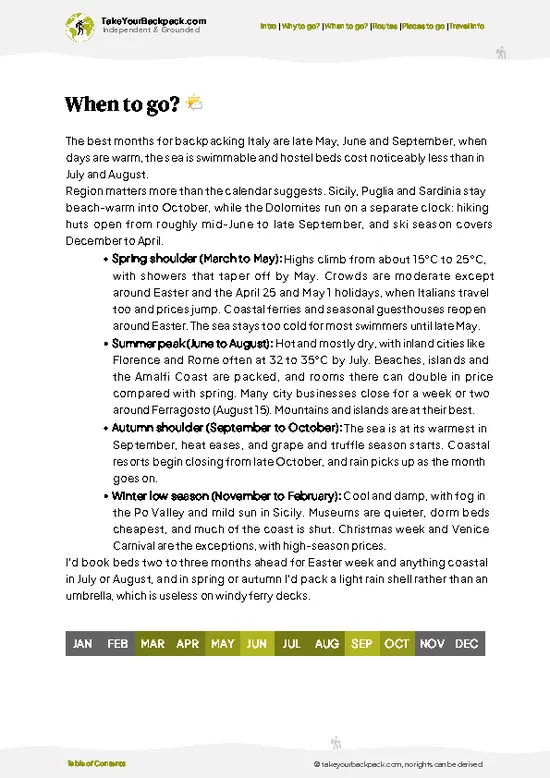
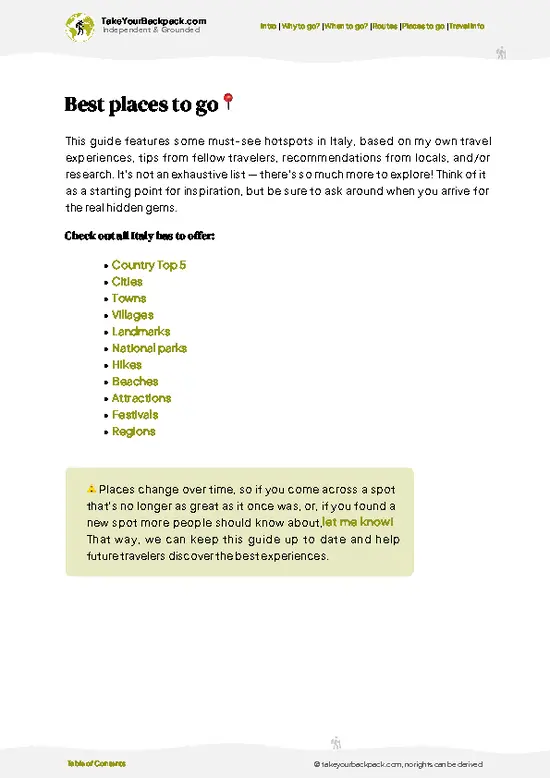
example page 0 from our offline Travel Guide for Italy
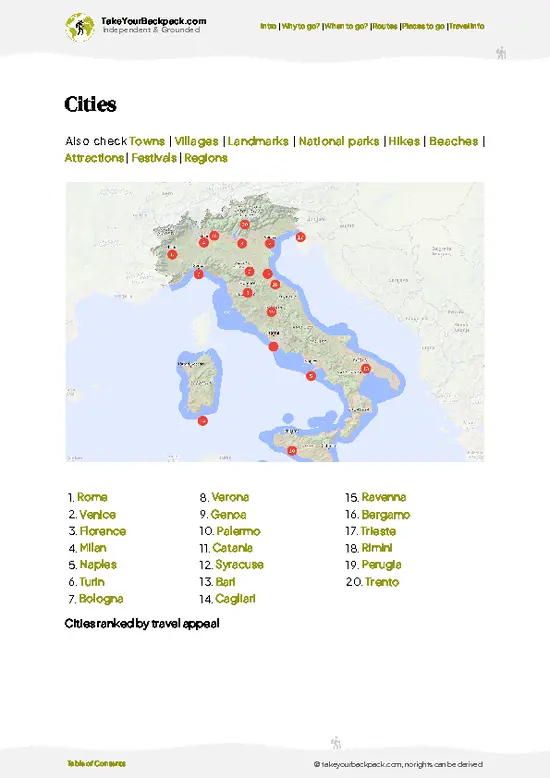
example page 1 from our offline Travel Guide for Italy
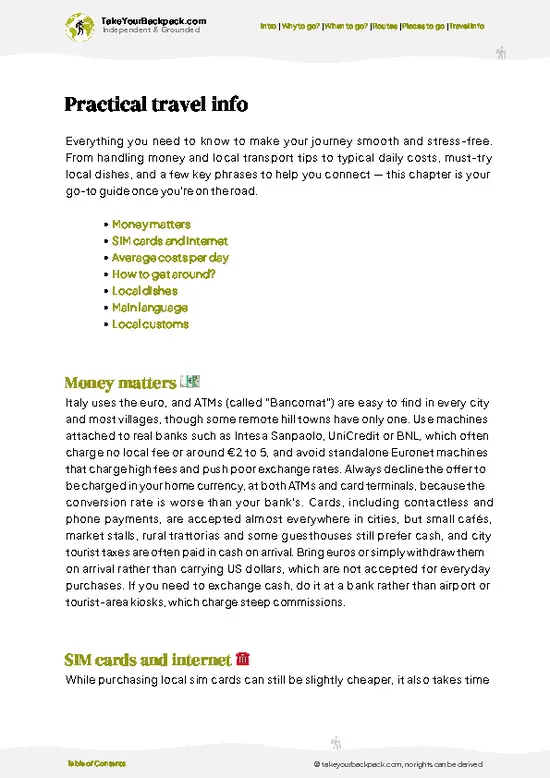
example page 2 from our offline Travel Guide for Italy
example page 3 from our offline Travel Guide for Italy
example page 4 from our offline Travel Guide for Italy
example page 5 from our offline Travel Guide for Italy
example page 6 from our offline Travel Guide for Italy
example page 7 from our offline Travel Guide for Italy
The digital guide (523 pages) contains:
✅ 142 highlights, ranked by travel appeal
✅ Optimized 7, 14 & 21-day travel routes
✅ Cities, national parks, landmarks, beaches
✅ How to get around
✅ Offline-friendly for travel without Wi-Fi
👉 Click to see all 30+ guide features

📅 Plan smarter in minutes, not weeks
✅ Month by month travel advice
✅ Festivals & national holidays
✅ Budget expectations

🗺️ Go to the right places, skip the overrated ones
✅ Honest pros & cons of destinations
✅ Top hikes, parks & viewpoints
✅ Lesser-known places most travelers miss
✅ Clear “worth it vs skip it” guidance

🛏️ Travel smoothly without rookie mistakes
✅ Best areas to stay
✅ Transport systems explained simply
✅ Common scams & safety advice
✅ SIM cards, money & practical tips

🌍 Understand the country, not just visit it
✅ Culture & traditions
✅ 52 Essential phrases & customs
✅ Festivals worth planning around
✅ Traveler-friendly historical context
✅ Insights that make places more meaningful

📱 Built for real travel conditions
✅ Fully downloadable PDF
✅ Works completely offline
✅ Optimized for phone use
✅ Useful in remote areas & buses
✅ Everything in one place
Stop searching, start planning
Get instant access to your full guide. 30‑day money-back guarantee.
+ Add another guide for just

By proceeding you agree to our terms.
Sent to your inbox immediately after payment • 100% Secure Checkout
Best Backpacking Travel Advisor 2025 tourism awardBest Backpacking
Travel Advisor
2025
What others say about Take Your Backpack Guides:
⭐⭐⭐⭐⭐
Fantastic, amazing amount of information!
⭐⭐⭐⭐⭐
My goodness this is amazing, it's what I've been looking for hats off too you!
⭐⭐⭐⭐⭐
I think this is absolutely BRILLIANT
⭐⭐⭐⭐
Very complete and informative. It's still missing places, but I gotta to commend you
⭐⭐⭐⭐⭐
This is truly amazing, thank you, can't wait to explore it with my kids!
⭐⭐⭐⭐⭐
Awesome resource, thank you!
⭐⭐⭐⭐⭐
This is amazing! Can't wait to explore the ones I haven't seen
⭐⭐⭐⭐
I love this! Well done, great idea.
⭐⭐⭐⭐⭐
Thanks for taking the time to make this gem!
⭐⭐⭐⭐⭐
This might be the best website I've ever seen.
⭐⭐⭐⭐⭐
Congratulations, and thank you so much for your work; it's incredibly valuable.
⭐⭐⭐⭐
In all seriousness I think you did a great job pointing out the important spots
⭐⭐⭐⭐⭐
10/10 very good
⭐⭐⭐⭐⭐
As someone who's only just starting to visit regularly this is awesome, thank you.
⭐⭐⭐⭐
Thank you very much! I'm going to visit my dad, it's going to be very useful!
⭐⭐⭐⭐⭐
This is really cool! We'll be travelling for the first time and this definitely come in handy.
⭐⭐⭐⭐⭐
You are now our minister of culture, congratulations 👨‍💼
⭐⭐⭐⭐⭐
Just wanted to tell you that this is a pearl! Going to follow your recommendations.
⭐⭐⭐⭐⭐
This is so cool. I'll definitely be using the resource for my travels soon.
⭐⭐⭐⭐⭐
This is very impressive! Good work.
⭐⭐⭐⭐⭐
This is an amazing and informative site. Very well done!

🧭 RouteMore Ways to Explore

Travel Italy your way — from a quick highlights trip to a slow-paced adventure. Or build your custom route based on your own interests, time and travel style.
👉 Build your own Italy route

🙋 FAQGood to Know

Yes. Backpacking Italy on your own is easy, because frequent trains link every major city and hostels are plentiful wherever travelers go.

Expect dorm beds of €25 to 50 in Rome, Florence and Venice in summer, and €20 to 35 in Naples and Bologna. Cities add a tourist tax of roughly €2 to 6 per person per night. Rome to Florence takes about 1.5 hours by fast train, at €20 to 50 if you book ahead. A realistic backpacker budget is €60 to 90 a day. The south, around Matera and Puglia, is where you rely more on buses and plan around thinner timetables.
Plan on two weeks for a first trip to Italy. That covers the classic cities plus one stretch of coast without rushing.

In 7 days, stick to one region, such as Tuscany with Florence and Siena. In 14 days, you can run Venice, Florence, Rome, Naples and the Amalfi Coast, with 2 to 4 nights each. 21 days adds the Dolomites, Cinque Terre and Matera. Give Rome at least 3 nights and the big cities 2 or more, because the major museums need timed tickets and half a day each. Above all, avoid one-night stops.
Yes, you can easily travel around Italy without a car, since trains and buses connect every major city and most well-known towns.

By high-speed train, Milan to Rome takes about 3 hours, Florence to Venice about 2 hours and Rome to Naples 70 minutes. The Cinque Terre villages are 5 to 10 minutes apart by train. The Amalfi Coast runs on buses and summer ferries. A car only helps for the Val d’Orcia countryside, the Dolomites outside the June to September bus season, and inland Sicily and Sardinia. In cities, parking and restricted traffic zones make a car a liability.
For a first visit to Italy, the must-sees are Rome, Florence, Venice, and Naples with Pompeii, plus one coastline or mountain range.

Rome needs 3 to 4 nights for the Colosseum and the Vatican Museums. Florence needs 3 nights for the Uffizi and Michelangelo’s David. Venice needs 2 to 3 nights, ideally staying overnight. Pompeii is a 35-minute train ride from Naples and takes 5 hours to see. For nature, choose the Amalfi Coast and its Path of the Gods, the Cinque Terre cliff trail, or the Dolomites loop around the Tre Cime di Lavaredo. Matera’s cave districts are the best reason to head further south.
If time is short in Italy, skip overnight stays in Pisa, Milan and the big beach resorts. Spend those nights in Rome, Florence or on the coast.

Pisa works as a 2-hour stop at the Leaning Tower, 1 hour by train from Florence. Milan is worth a day if you fly in, but its sights fill one afternoon. Rimini and the Gardaland theme park suit families more than backpackers. Sardinia needs a ferry or flight and at least 5 days to pay off, so save it for a separate trip. In under a week, choose one region instead of crossing the country.
Yes, our itinerary-planner does exactly that. Set your trip length in days, give your interests and travel style, optionally give start- and end location and/or some mandatory stops you would like to include and the itinerary planner creates your personalized routes for Italy in seconds. Try it out!


Try the itinerary planner

🇮🇹 ItalyDiscover the Country

Ready to build a truly unique trip? Predefined routes are perfect for first-time visitors, but there is so much more to discover. Whether you are chasing a city trip, pristine national parks, local food scenes, or quiet beaches, pick a category to design your own path.