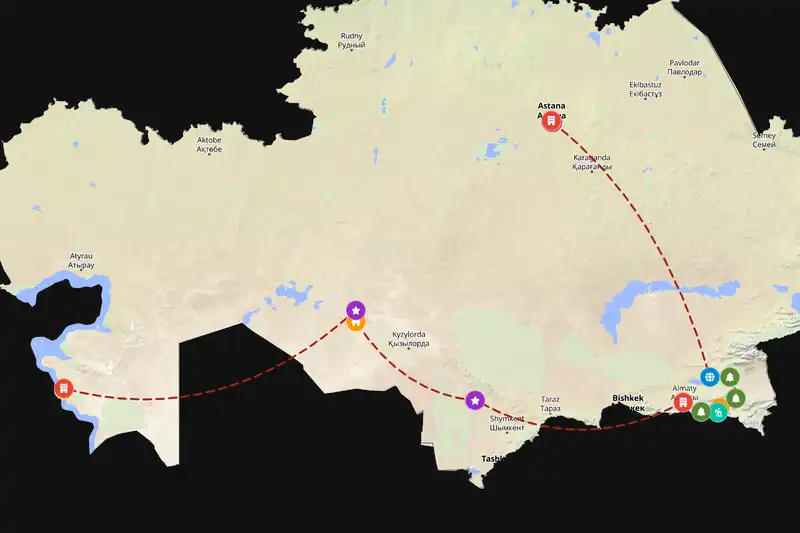
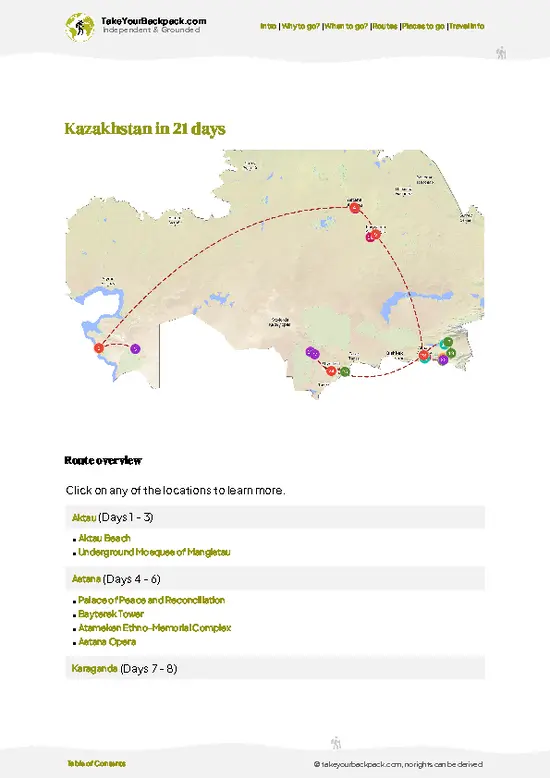
Three weeks in Kazakhstan is enough to see the country as one connected story: the Caspian coast, the planned capital on the northern steppe, the Gulag history of the mining belt, the Tien Shan foothills around Almaty and the Silk Road shrines of the south. This route is for travelers who don’t mind covering big distances to see a place in full. The pace is steady, with two or three nights per base and short-hop days between the long ones. You’ll combine domestic flights for the largest gaps (Aktau to Astana, Karaganda to Almaty, Almaty to Shymkent), a fast intercity train from Astana to Karaganda, trains or buses between Shymkent and Turkestan, and hired 4x4s with drivers for Mangystau, Altyn Emel and the Kolsai region, where public transport stops being useful.
Days 1-4: Aktau and the Mangystau Desert
Starting on the Caspian gets the remotest region done while you’re fresh.
Aktau is a Soviet-built city where addresses are given by microdistrict, building and apartment number instead of …
read more 👉Three weeks in Kazakhstan is enough to see the country as one connected story: the Caspian coast, the planned capital on the northern steppe, the Gulag history of the mining belt, the Tien Shan foothills around Almaty and the Silk Road shrines of the south. This route is for travelers who don’t mind covering big distances to see a place in full. The pace is steady, with two or three nights per base and short-hop days between the long ones. You’ll combine domestic flights for the largest gaps (Aktau to Astana, Karaganda to Almaty, Almaty to Shymkent), a fast intercity train from Astana to Karaganda, trains or buses between Shymkent and Turkestan, and hired 4x4s with drivers for Mangystau, Altyn Emel and the Kolsai region, where public transport stops being useful.
Days 1-4: Aktau and the Mangystau Desert
Starting on the Caspian gets the remotest region done while you’re fresh. Aktau is a Soviet-built city where addresses are given by microdistrict, building and apartment number instead of street names, and the sea is the main event. Spend your first evening on Aktau Beach, where the promenade faces due west and the sun drops straight into the water.
Day two is a full-day 4x4 trip into the desert to the Underground Mosques of Mangistau. Shakpak-Ata is the one to prioritize: rooms carved into a limestone cliff above the steppe, with an old necropolis of carved tombstones spread below it. Keep day three loose for a swim, a seafood lunch and an early night before the flight north.Days 4-7: Astana
Fly direct to Astana and spend three nights on the parts of the capital that show how it wants to be seen. The Palace of Peace and Reconciliation is Norman Foster’s glass-topped pyramid, with an opera hall in its base and stained-glass doves at the apex. Ride up Bayterek Tower for the long view of the government axis, then walk out to the Ethno-memorial Complex Map of Kazakhstan Atameken, an open-air map of the country with miniature models of its landmarks, useful for picturing the distances you’re about to cover. Book one evening at the Astana Opera. Ballet tickets here cost a fraction of what you’d pay in Western Europe, and the hall itself is worth dressing up for.Days 7-9: Karaganda and KarLag
A fast train covers the 200-odd kilometers to Karaganda in roughly 2.5 to 3 hours, which makes this a gentle transit day. The city grew up around coal mines and labor camps, and the reason to come is the KarLag Museum of Political Repression in Dolinka, about 45 kilometers away, housed in the camp’s former administration building. The basement cells and the prisoner records are heavy going. Give it a full morning and nothing else that day.Days 9-12: Almaty
Fly to Almaty and treat the first day as a city day. The Central State Museum of the Republic of Kazakhstan covers the archaeology, including Saka-era gold, and the Museum of Folk Musical Instruments sits in a wooden pre-revolutionary building in Panfilov Park, full of dombras and horsehair kobyz fiddles. Finish at the Green Bazaar near the Arbat for dried apricots and a plate of lagman.
Then go up. Take one day for Big Almaty Lake, the milky-turquoise reservoir at about 2,500 meters where swimming is banned because it supplies the city’s water, and another for the gondola to the Shymbulak Ski & Mountain Resort Base Area and on toward Talgar Pass, above 3,000 meters.Days 12-14: Altyn Emel National Park
It’s a 4 to 5 hour drive to Basshi village, the base for Altyn Emel National Park, where guesthouses arrange the required permits and 4x4 transport. Two nights make the trip worthwhile. Walk the Altyn Emel Singing Dunes Trail late in the day, when a dry wind sets the 150-meter dune humming like a distant engine, and spend the next day on the striped red and white clay hills deeper in the park.Days 14-16: Charyn Canyon, Saty and the Kolsai Lakes
Drive south across the steppe to Charyn and hike the Charyn Canyon Trek through the Valley of Castles down to the river before the afternoon heat builds. Continue to Saty, a village of homestays with home-cooked beshbarmak. Day fifteen is the Kolsai Lakes Trek, roughly 8 to 9 kilometers one way from the lower lake to the second, through spruce forest. On day sixteen visit Lake Kaindy at first light, when the drowned spruce trunks left by a 1911 earthquake landslide stand out of still water. Then make the long drive back to Almaty for one night.Days 17-19: Shymkent and Aksu-Zhabagly
A short flight takes you to Shymkent, where the air is warmer, the food leans Uzbek and plov arrives by the kilo. Use your full day for Aksu-Zhabagly Nature Reserve, about two hours away and founded in 1926 as the oldest nature reserve in Central Asia. The Aksu canyon rim is the highlight, and in April the slopes are covered in wild tulips.Days 19-21: Turkestan and Sauran
End where Kazakh pilgrims go. In Turkestan, the Mausoleum of Khoja Ahmed Yasawi was commissioned by Timur and left unfinished, so the bare brick facade still shows its scaffolding holes beneath the turquoise dome. On your last full day, take a taxi about 40 kilometers out to Sauran, where the clay walls of a medieval city rise from empty steppe with almost no one around. Fly home from Turkestan’s airport or via Shymkent.
If Mangystau gets under your skin, return for Boszhira, a cluster of white chalk spires and tablelands on the edge of the Ustyurt Plateau, a full day’s 4x4 run from Aktau.
 Best Backpacking