×
Kiribati🇰🇮 | 2 days itinerary

The Perfect 2-Day Route for Kiribati

By Johan Kruseman 🇳🇱 | Updated May 8, 2026
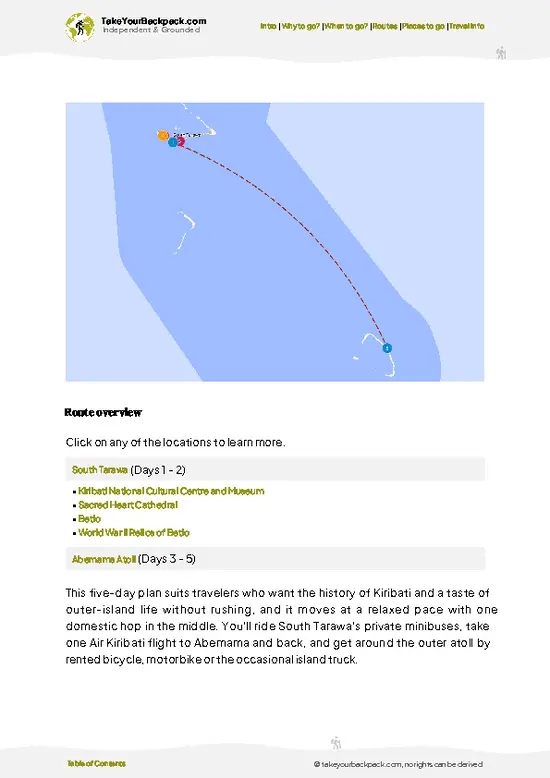
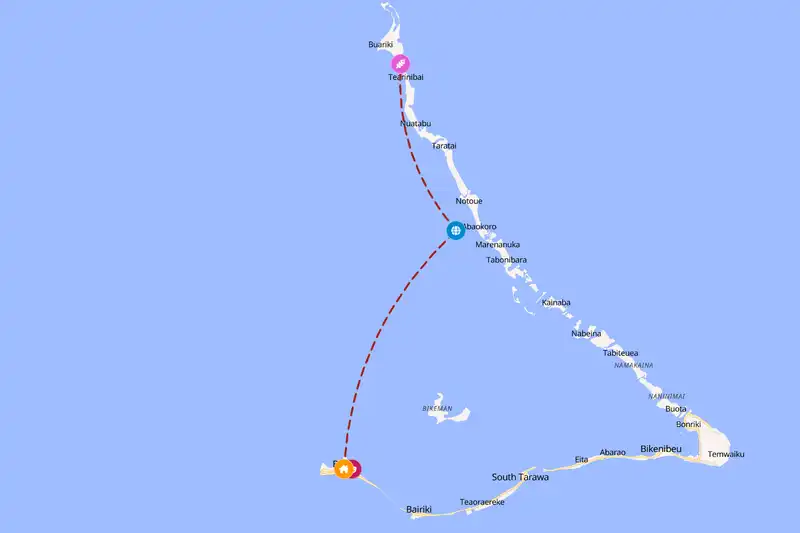
This 2-day Tarawa sprint is for travelers who want a compact hit of Kiribati history and lagoon life without messing around with domestic flights; you’ll move at a relaxed but full days’ pace, using taxis and short local bus hops across South Tarawa. You’ll base yourself around Tarawa Atoll, bouncing between war relics, local culture, and an easy beach escape so you actually feel the place instead of just ticking it off.

Day 1: Betio & the WWII shoreline

Wake up on Tarawa Atoll and head straight to Betio, the gritty, historically loaded western tip that was once one of the fiercest Pacific battlefields. Spend the morning walking the World War II Relics of Betio—rusted guns, bunkers, and wreckage half-swallowed by sand and sea—so you can connect the calm lagoon you see today with the chaos that shaped it. In the afternoon, loop back through central Tarawa to the Kiribati National Cultural Centre and Museum, where simple but powerful exhibits on navigation, dance, and daily life give context … read more 👉
This 2-day Tarawa sprint is for travelers who want a compact hit of Kiribati history and lagoon life without messing around with domestic flights; you’ll move at a relaxed but full days’ pace, using taxis and short local bus hops across South Tarawa. You’ll base yourself around Tarawa Atoll, bouncing between war relics, local culture, and an easy beach escape so you actually feel the place instead of just ticking it off.

Day 1: Betio & the WWII shoreline

Wake up on Tarawa Atoll and head straight to Betio, the gritty, historically loaded western tip that was once one of the fiercest Pacific battlefields. Spend the morning walking the World War II Relics of Betio—rusted guns, bunkers, and wreckage half-swallowed by sand and sea—so you can connect the calm lagoon you see today with the chaos that shaped it. In the afternoon, loop back through central Tarawa to the Kiribati National Cultural Centre and Museum, where simple but powerful exhibits on navigation, dance, and daily life give context to everything you’re seeing outside, from maneaba meeting houses to outrigger canoes along the causeway. As the light softens, swing by Sacred Heart Cathedral, not for grandeur but to watch how Catholic ritual and Kiribati tradition blend in the flow of people, music, and lagoon breeze around the church grounds.

Day 2: North Tarawa lagoon escape

On your second day, trade concrete causeways for sand tracks by heading up to North Tarawa, the quieter, more traditional side of Tarawa Atoll that feels like a different world despite being just a short boat or truck ride away. Base yourself near Bamboo Beach, where you can spend lazy hours swimming, walking the shallows at low tide, and watching village life unfold under pandanus trees while kids play in the lagoon. With only two days, the goal is to slow down rather than stack more stops, so you linger here until late afternoon before drifting back toward your guesthouse on South Tarawa, salty, sun-tired, and with just enough Kiribati under your skin to know you’ll want to come back.

As a quiet bonus, end your evening by asking around for a sunset walk out to the sand spit near Taborio, where you can watch the lagoon turn glassy pink with almost no one else around.
Loading the map 🌍
film
0
0
0a
World War II Relics of Betio
film
1
1
1a
Sacred Heart Cathedral
film
2
2
2a
Bamboo Beach
Kaboua John

🛏️ Where to stay?Your Route at a Glance

✈️ The backpacker research shortcutKiribati Travel Guide

An offline-friendly backpacking guide with optimized travel routes, ranked highlights, transport advice, and the best areas to stay.
example page 0 from our offline Travel Guide for Kiribatiexample page 1 from our offline Travel Guide for Kiribatiexample page 2 from our offline Travel Guide for Kiribatiexample page 3 from our offline Travel Guide for Kiribatiexample page 4 from our offline Travel Guide for Kiribatiexample page 5 from our offline Travel Guide for Kiribati
The digital guide (127 pages) contains:
30 highlights, ranked by travel appeal
Optimized 2, 3 & 5-day travel routes
Best neighborhoods to stay
How to get around
Offline-friendly for travel without Wi-Fi
👉 See all 30+ guide features

📅 Plan smarter in minutes, not weeks
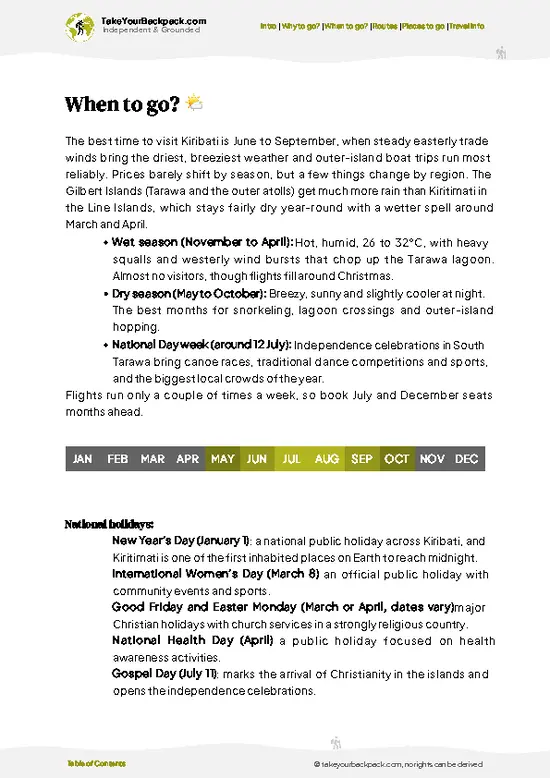
Month by month travel advice
Festivals & national holidays
Budget expectations

🗺️ Go to the right places, skip the overrated ones
Honest pros & cons of destinations
Top hikes, parks & viewpoints
Lesser-known places most travelers miss
Clear “worth it vs skip it” guidance

🛏️ Travel smoothly without rookie mistakes
Best areas to stay
Transport systems explained simply
Common scams & safety advice
SIM cards, money & practical tips

🌍 Understand the country, not just visit it
Culture & traditions
52 Essential phrases & customs
Festivals worth planning around
Traveler-friendly historical context
Insights that make places more meaningful

📱 Built for real travel conditions
Fully downloadable PDF
Works completely offline
Optimized for phone use
Useful in remote areas & buses
Everything in one place
Save weeks of stressful planning
Get instant access to the full guide directly. 30-day money-back guarantee.


Sent to your inbox immediately after payment • 100% Secure Checkout
Best Backpacking Travel Advisor 2025 tourism awardBest Backpacking
Travel Advisor
2025
What others say about Take Your Backpack Guides:
⭐⭐⭐⭐⭐
Fantastic, amazing amount of information!
⭐⭐⭐⭐⭐
My goodness this is amazing, it's what I've been looking for hats off too you!
⭐⭐⭐⭐⭐
I think this is absolutely BRILLIANT
⭐⭐⭐⭐
Very complete and informative. It's still missing places, but I gotta to commend you
⭐⭐⭐⭐⭐
This is truly amazing, thank you, can't wait to explore it with my kids!
⭐⭐⭐⭐⭐
Awesome resource, thank you!
⭐⭐⭐⭐⭐
This is amazing! Can't wait to explore the ones I haven't seen
⭐⭐⭐⭐
I love this! Well done, great idea.
⭐⭐⭐⭐⭐
Thanks for taking the time to make this gem!
⭐⭐⭐⭐⭐
This might be the best website I've ever seen.
⭐⭐⭐⭐⭐
Congratulations, and thank you so much for your work; it's incredibly valuable.
⭐⭐⭐⭐
In all seriousness I think you did a great job pointing out the important spots
⭐⭐⭐⭐⭐
10/10 very good
⭐⭐⭐⭐⭐
As someone who's only just starting to visit regularly this is awesome, thank you.
⭐⭐⭐⭐
Thank you very much! I'm going to visit my dad, it's going to be very useful!
⭐⭐⭐⭐⭐
This is really cool! We'll be travelling for the first time and this definitely come in handy.
⭐⭐⭐⭐⭐
You are now our minister of culture, congratulations 👨‍💼
⭐⭐⭐⭐⭐
Just wanted to tell you that this is a pearl! Going to follow your recommendations.
⭐⭐⭐⭐⭐
This is so cool. I'll definitely be using the resource for my travels soon.
⭐⭐⭐⭐⭐
This is very impressive! Good work.
⭐⭐⭐⭐⭐
This is an amazing and informative site. Very well done!

🧭 RouteAlternative Routes

Travel Kiribati your way — from a quick highlights trip to a slow-paced adventure.

🙋 FAQBackpacking FAQ

Short version: Kiribati is doable to backpack independently, but it’s not plug-and-play like Southeast Asia. It rewards patience, flexibility, and a high tolerance for slow logistics.

English is widely spoken on South Tarawa and in most guesthouses, so basic communication is easy. The challenge is infrastructure: limited public transport, few accommodation options, and flights/boats that don’t always run on the day you expect. You can’t just show up on a random outer island and assume there’s a room and a shop open.

For a budget traveler, the key is to think of Kiribati as a semi-expedition, not a casual hop. You’ll be fine if you:
- Pre-book at least your first and last nights on South Tarawa.
- Confirm domestic flights or boat schedules directly with airlines or local agents before you lock in dates.
- Carry some emergency cash in AUD or local currency because ATMs and card machines are limited and can be offline.
- Accept that Wi‑Fi is weak or nonexistent, so you can’t rely on last-minute online planning.

If you’re comfortable with basic island conditions (heat, humidity, bucket showers, simple food, and sometimes erratic power), independent backpacking is not just possible, it’s fantastic. If you need constant structure, nightlife, and lots of hostel choices, Kiribati will feel tough and occasionally frustrating.
For a first-time backpacker in Kiribati, 7–10 days is the sweet spot if you’re focusing on the main islands, and 2–3 weeks if you want to add outer islands or another island group.

Rough breakdown for a budget-minded trip:
- 3–4 days: South Tarawa and nearby islets. Enough to get over the flight, understand daily life, visit WWII sites, and do a lagoon trip.
- 2–3 days: A quieter outer area in the Gilbert group (if flights/boats line up) for village stays, beaches, and slower days.
- Extra 4–7 days: If you’re adding Kiritimati (Christmas Island) or another remote island group, you need buffer days because flights are infrequent and delays are normal.

Anything under 5 days feels rushed because you’ll lose at least a day to arrival and another to departure, plus you need slack for schedule changes. If you’re on a long round-the-Pacific backpacking loop, 10–14 days lets you see more than one island area without feeling like you’re just bouncing between airports.
You can get around parts of Kiribati without a car, but you can’t rely on public transport the way you might in more developed countries. Think of it as a patchwork of options you combine creatively.

On South Tarawa:
- Minibuses and shared pickups run along the main causeway. They’re cheap and frequent by local standards, but not always on a fixed timetable. You flag them down roadside and tell the driver where to stop.
- Walking is realistic for short stretches, but heat and sun are intense, so plan early-morning or late-afternoon walks.
- Some guesthouses can arrange bicycles or scooters; roads are rough in places, and traffic can be chaotic, so ride defensively.

Between islands:
- You’ll mostly rely on domestic flights or scheduled boats. These are not daily, and they can be delayed or rescheduled, so you need buffer days and a flexible mindset.
- On smaller islands, walking is usually enough; many are small enough to cross in under an hour. Locals may offer boat rides between nearby islets for a small fee or fuel contribution.

You don’t need to rent a car to have a good trip, especially if you’re comfortable with shared transport and walking. For tight schedules or if you’re traveling as a small group, hiring a car with driver for a day on South Tarawa can be worth the cost to hit multiple sites efficiently, but it’s not mandatory for a solid backpacking experience.
For a budget traveler, the must-visits in Kiribati are less about ticking landmarks and more about experiencing daily life, lagoon time, and the feeling of being far from the usual backpacker circuit. Prioritize:

1. South Tarawa (Gilbert Islands)
This is where you’ll likely land and where you see Kiribati’s modern reality: dense population, causeways, markets, schools, churches, and government buildings. Key experiences:
- Walk or bus along the causeway to see maneaba (meeting houses), local shops, and everyday life.
- Visit WWII sites and relics; they’re low-key but powerful if you’re into history.
- Hit a local market for fresh fish, simple snacks, and conversation.

2. A quieter outer area in the Gilbert group
If you can reach an outer island or a less crowded part of Tarawa’s lagoon, do it. This is where Kiribati feels like the Pacific you imagine:
- Simple guesthouses or village stays with basic rooms, shared bathrooms, and home-cooked meals.
- Swimming and snorkeling in clear lagoon water, often with no one else around.
- Watching daily routines: fishing, weaving, church gatherings, and kids playing in the shallows.

3. Lagoon islets and sandbars
Even if you never leave Tarawa, try to arrange a boat trip to nearby islets:
- Spend a day on a small motu with shade, a simple picnic, and snorkeling.
- Go at low tide if possible to see reef flats and tidal pools.

4. Kiritimati (Christmas Island), if your route and budget allow
This is a bigger detour, but for some travelers it’s the highlight:
- World-class fishing and birdlife, plus a raw, end-of-the-world feel.
- More space and fewer people than South Tarawa, with long, wild coastlines.

If you’re on a tight budget and schedule, focus on South Tarawa plus at least one quieter lagoon area. That combination gives you both the social side of Kiribati and the classic Pacific-island water time without needing a luxury resort.
If you’re short on time or cash, skip anything that eats days in transit without adding much to your personal interests. Kiribati’s charm is in slow, local experiences, so you want to cut long, expensive detours that duplicate what you’re already seeing.

You can usually skip:
- Multiple far-flung island groups in one short trip. Trying to do South Tarawa, Kiritimati, and another remote island in under two weeks is a recipe for stress, missed connections, and budget pain. Pick one main base and maybe one side trip.
- Chasing every WWII site. See a couple of the more accessible ones near where you’re staying instead of burning a whole day on marginal relics that look similar.
- Overpriced, resort-style activities that you’re only doing because you feel you “should.” Kiribati is not about big resort culture; your money goes further on simple guesthouses, local food, and boat trips arranged through locals.
- Long, repetitive road trips on South Tarawa. Once you’ve ridden the causeway a few times, you’ve basically seen it. Don’t spend extra days just looping the same stretch unless you’re visiting specific people or events.

If you’re really squeezed, the core you should protect is: a few days on South Tarawa to understand daily life, plus at least one full day out on the lagoon or a quieter islet. Everything beyond that is optional layering, not essential Kiribati.

🇰🇮 KiribatiMore of Kiribati

Ready to build a truly unique trip? Predefined routes are perfect for first-time visitors, but there is so much more to discover. Whether you are chasing a city trip, pristine national parks, local food scenes, or quiet beaches, pick a category to design your own path.