×

Laos🇱🇦 | best villagesDiscover the 7 Best villages Across Laos

Villages in Laos run on river time. Mornings start with sticky rice steam, roosters, and woodsmoke hanging in cold valley air, and by noon the heat flattens everything into a hum of cicadas. In the north, stilt houses of Khmu, Hmong and Akha families cling to red-dirt ridges, reached by bumpy, sometimes muddy roads. Along the Mekong, wooden Lao and Tai Lue houses sit above slow brown water, easier to reach and pricier. The south and the Bolaven Plateau bring coffee fields, waterfalls and far fewer visitors. Independent travelers do best choosing one region and accepting that power cuts, cold bucket showers and slow boats are part of the deal.

By Johan Kruseman 🇳🇱 | Updated October 19, 2026
Explore the best landmarks in Laos

Why go?Why These village Stand Out

Laos is a country of mountains and one great river, and that shapes everything about its villages. Roughly 80 percent of the land is hilly or mountainous, and for centuries communities settled in separate valleys, on ridges, or beside the Mekong and its tributaries. The result is striking diversity. The government recognizes around 50 ethnic groups, and in one day's travel you can pass from a Tai Lue weaving village to a Khmu or Hmong settlement where the language, house style, dress and rituals all change. Most people still live in rural communities, farming rice, cutting bamboo and fishing, so village life here is the working norm rather than a staged display.

The flip side is infrastructure. Roads in the uplands can wash out in the rainy season, buses run slowly, and many villages have … read more 👉
Laos is a country of mountains and one great river, and that shapes everything about its villages. Roughly 80 percent of the land is hilly or mountainous, and for centuries communities settled in separate valleys, on ridges, or beside the Mekong and its tributaries. The result is striking diversity. The government recognizes around 50 ethnic groups, and in one day's travel you can pass from a Tai Lue weaving village to a Khmu or Hmong settlement where the language, house style, dress and rituals all change. Most people still live in rural communities, farming rice, cutting bamboo and fishing, so village life here is the working norm rather than a staged display.

The flip side is infrastructure. Roads in the uplands can wash out in the rainy season, buses run slowly, and many villages have only basic electricity, simple guesthouses or homestays, and little English. Phone signal fades fast outside towns. That gives the experience its texture: smoke from cooking fires, the slap of looms, dogs and chickens underfoot, and evenings lit by a single bulb. Travelers should also know that Laos is Buddhist in the lowlands and animist in many highland communities, so customs differ from place to place. Go expecting simplicity and slow logistics, and the country repays you generously.
Why These Made the Cut
The list of best villages in Laos is created based on authenticity, scenic beauty, community spirit, traditions, and overall character. If you feel a village is missing in this list, please let us know.

When to go?Optimal Periods for Travel

Best months for village visits: The best months for villages in Laos are November to February, when the rains have stopped, skies are clear, and daytime temperatures sit around 25 to 30°C. Dry roads make remote tracks passable, and rivers are calm for boat access. Nights in the northern highlands drop sharply, often to 5 to 10°C at elevation, so mornings bring mist, woodsmoke and a real need for a jacket.
Shoulder and low seasons: March and April are hot, reaching 35 to 40°C in the Mekong valley, and burning season smoke can turn the north's air hazy and acrid, hurting views and breathing. Late April brings the Lao New Year, when prices rise and transport fills up. May to October is the wet season, with heavy afternoon downpours, red mud, leeches on forest trails and some roads or river routes … read more 👉
Best months for village visits: The best months for villages in Laos are November to February, when the rains have stopped, skies are clear, and daytime temperatures sit around 25 to 30°C. Dry roads make remote tracks passable, and rivers are calm for boat access. Nights in the northern highlands drop sharply, often to 5 to 10°C at elevation, so mornings bring mist, woodsmoke and a real need for a jacket.
Shoulder and low seasons: March and April are hot, reaching 35 to 40°C in the Mekong valley, and burning season smoke can turn the north's air hazy and acrid, hurting views and breathing. Late April brings the Lao New Year, when prices rise and transport fills up. May to October is the wet season, with heavy afternoon downpours, red mud, leeches on forest trails and some roads or river routes closed. The upside is vivid green rice terraces and fewer travelers. In the south, including the Bolaven Plateau, rain is heavier and lasts longer, with peak flooding around August and September. Expect guesthouse prices to climb 20 to 50 percent in the cool-season peak, especially around December and January, so book key stays ahead.

village hoppingSuggested Travel Strategies

How long to allow: A trip combining several villages in Laos needs 10 to 16 days, because the distances look short on a map but roads are slow. Plan 1 to 2 nights per stop, or 2 to 3 where you want treks, boat rides or a homestay with an evening meal.
Regions and direction: The north and the Mekong corridor group well. Base around Luang Prabang and Luang Namtha, then move south by road or river toward Vientiane and, if time allows, Pakse for the south. North to south works best because the Bolaven Plateau and the Four Thousand Islands make a relaxed finish, and you can fly or take a night bus back from Pakse. Typical transfers run 4 to 8 hours in the north, 8 to 10 hours by bus between Luang Prabang and Vientiane (the high-speed train covers it in about 2 hours), and 10 to 12 hours from Vientiane … read more 👉
How long to allow: A trip combining several villages in Laos needs 10 to 16 days, because the distances look short on a map but roads are slow. Plan 1 to 2 nights per stop, or 2 to 3 where you want treks, boat rides or a homestay with an evening meal.
Regions and direction: The north and the Mekong corridor group well. Base around Luang Prabang and Luang Namtha, then move south by road or river toward Vientiane and, if time allows, Pakse for the south. North to south works best because the Bolaven Plateau and the Four Thousand Islands make a relaxed finish, and you can fly or take a night bus back from Pakse. Typical transfers run 4 to 8 hours in the north, 8 to 10 hours by bus between Luang Prabang and Vientiane (the high-speed train covers it in about 2 hours), and 10 to 12 hours from Vientiane to Pakse by road.
Planning mistakes: Travelers often cram in a village a day, spend half of it in a minivan, and arrive after dark. Build in buffer days instead, travel in the morning when buses are most reliable, and keep cash for rural stops since ATMs are rare. Rainy-season landslides can add hours, so avoid tight flight connections.

The ListMust-Visit villages in Laos

1 Muang Ngoi Neua

riverbank village, mountain backdrop, off-grid living

Disconnect from modern routines as you settle into riverside bungalows, surrounded by forested hills and accessible only by boat.

2 Nong Khiaw

karst cliffs, suspension bridge, riverside guesthouses

Wake to mist over the Nam Ou, cross the river on foot, and hike into valleys where rural life and dramatic scenery meet.

3 Ban Sop Houn

Nam Ou riverbank, stilt houses, boat landing

Arrive by boat to a riverside village where wooden homes line the banks and daily life centers on the water’s edge.

4 Ban Xieng Lom

forest edge, eco-lodges, elephant camp

Experience a forest-fringed village where travelers come for wildlife encounters and quiet nights close to nature.

5 Ban Xieng Mene

Mekong ferry point, temple ruins, riverside hamlet

Cross the river to a small settlement with faded temples and a slow pace, offering a glimpse of life opposite Luang Prabang.

laos-city-ban-xieng-mene
© Google |

6 Ban Nahin

karst cliffs, cave access, rural crossroads

Base yourself in a quiet village surrounded by limestone peaks, where local life unfolds near the entrance to Kong Lor Cave.

7 Ban Khoun Kham

market village, river junction, cave gateway

Stay in a small settlement at the meeting point of rivers and roads, ideal for organizing trips into the region’s extensive cave systems.

Loading the map 🌍

Expert viewExpert Commentary on villages

How many villages to visit: I advise three to five villages on a trip of two weeks. Fewer than three and you cannot compare the lowland Lao, highland ethnic minority and riverside styles. More than five and you spend your days in vehicles rather than sitting on a bamboo porch watching rice dry in the late light. Each village rewards at least one night, because the evening is when the place speaks: pigs and chickens settle, smoke rises from kitchens, and families eat on the floor around a shared bowl of sticky rice.
Which kind to prioritize: If you want comfort and easy logistics, favor Mekong and lowland villages with guesthouses, cafés, and craft stalls selling hand-woven silk. If you want culture and quiet, pick highland ethnic minority communities in the north, reached on foot or by rough … read more 👉
How many villages to visit: I advise three to five villages on a trip of two weeks. Fewer than three and you cannot compare the lowland Lao, highland ethnic minority and riverside styles. More than five and you spend your days in vehicles rather than sitting on a bamboo porch watching rice dry in the late light. Each village rewards at least one night, because the evening is when the place speaks: pigs and chickens settle, smoke rises from kitchens, and families eat on the floor around a shared bowl of sticky rice.
Which kind to prioritize: If you want comfort and easy logistics, favor Mekong and lowland villages with guesthouses, cafés, and craft stalls selling hand-woven silk. If you want culture and quiet, pick highland ethnic minority communities in the north, reached on foot or by rough track, where homestays are basic: a thin mattress, a mosquito net, a squat toilet and cold water. If you care about coffee, waterfalls and few crowds, the southern plateau is the better call. Trekkers should lean north, slow-travelers south, and short-trip visitors the Mekong.
What it costs: Budget US$25 to 45 a day for a comfortable independent trip, or US$18 to 25 on homestays and local food. Homestays run roughly US$8 to 15 per person with dinner and breakfast. Guided village treks cost US$25 to 50 per person in a group, often including lunch. Village entry or community fees are commonly US$1 to 5. Local transport is US$3 to 15 per leg, and a shared songthaew, tuk-tuk or motorbike hire adds US$10 to 20 a day. Carry plenty of Lao kip in small notes, because cards and ATMs rarely exist in villages.
Safety and etiquette: Dress modestly: cover shoulders and knees, and take shoes off before entering a house. Never touch someone’s head, and do not point your feet at people or at a spirit shelf. Ask before photographing people, especially children, and avoid handing out sweets or money, which builds begging habits. Buy crafts or meals directly from families instead. Unexploded ordnance remains a real risk in parts of the east and north, so stay on well-used paths and never touch metal objects. Drink only bottled or boiled water, use mosquito repellent, and take a basic first-aid kit, since the nearest clinic can be hours away.

✈️ The backpacker research shortcutLaos Travel Guide

An offline-friendly backpacking guide with optimized travel routes, ranked highlights, transport advice, and the best areas to stay.
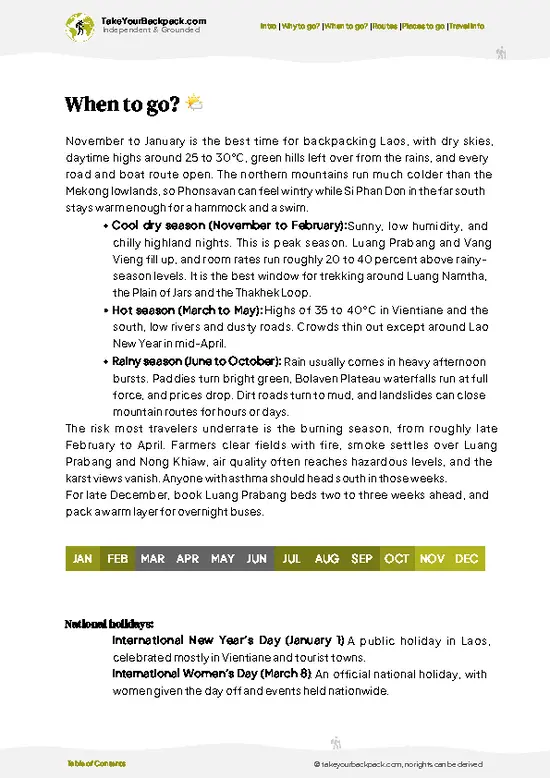
example page 0 from our offline Travel Guide for Laos
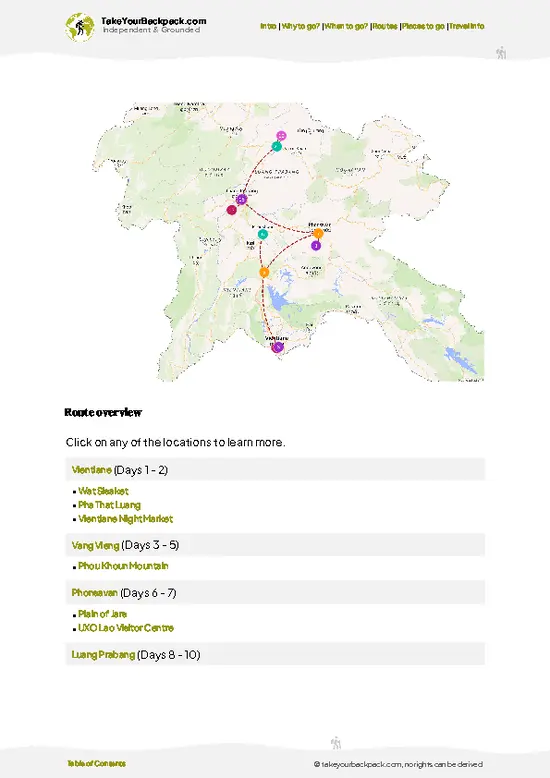
example page 1 from our offline Travel Guide for Laos
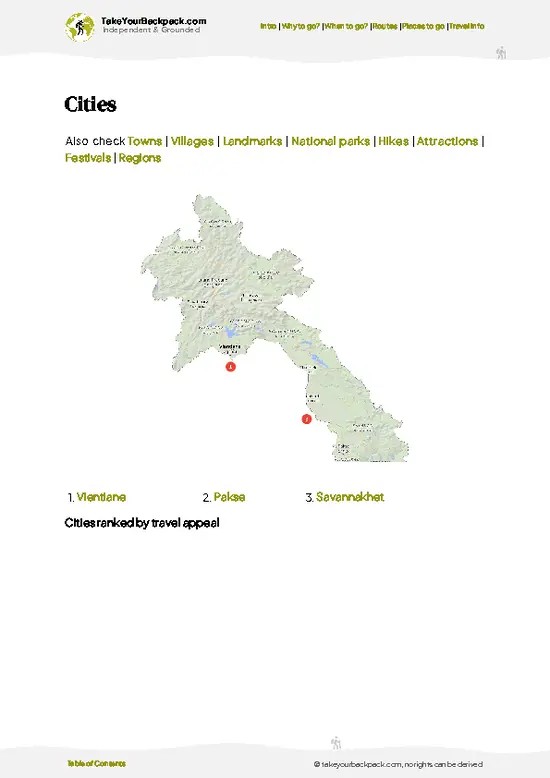
example page 2 from our offline Travel Guide for Laos
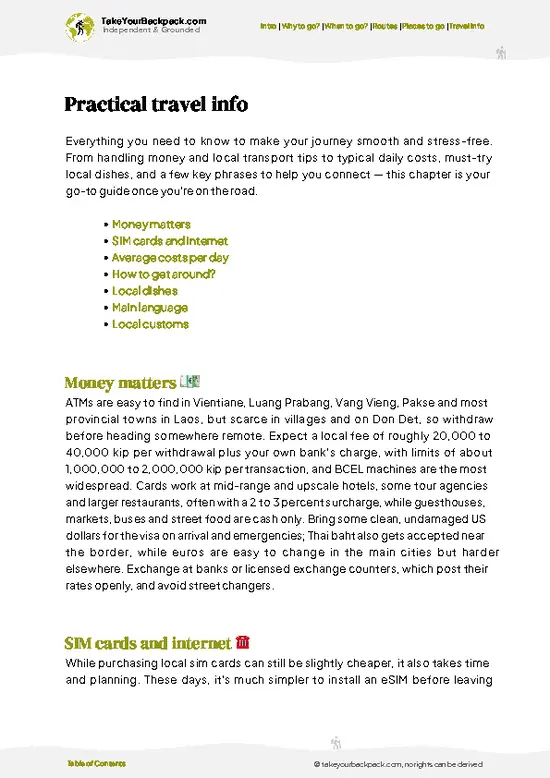
example page 3 from our offline Travel Guide for Laos
example page 4 from our offline Travel Guide for Laos
example page 5 from our offline Travel Guide for Laos
example page 6 from our offline Travel Guide for Laos
example page 7 from our offline Travel Guide for Laos
The digital guide (276 pages) contains:
✅ 73 highlights, ranked by travel appeal
✅ Optimized 5, 10 & 15-day travel routes
✅ Cities, national parks, landmarks, beaches
✅ How to get around
✅ Offline-friendly for travel without Wi-Fi
👉 Click to see all 30+ guide features

📅 Plan smarter in minutes, not weeks
✅ Month by month travel advice
✅ Festivals & national holidays
✅ Budget expectations

🗺️ Go to the right places, skip the overrated ones
✅ Honest pros & cons of destinations
✅ Top hikes, parks & viewpoints
✅ Lesser-known places most travelers miss
✅ Clear “worth it vs skip it” guidance

🛏️ Travel smoothly without rookie mistakes
✅ Best areas to stay
✅ Transport systems explained simply
✅ Common scams & safety advice
✅ SIM cards, money & practical tips

🌍 Understand the country, not just visit it
✅ Culture & traditions
✅ 52 Essential phrases & customs
✅ Festivals worth planning around
✅ Traveler-friendly historical context
✅ Insights that make places more meaningful

📱 Built for real travel conditions
✅ Fully downloadable PDF
✅ Works completely offline
✅ Optimized for phone use
✅ Useful in remote areas & buses
✅ Everything in one place
Stop searching, start planning
Get instant access to your full guide. 30‑day money-back guarantee.
+ Add another guide for just

By proceeding you agree to our terms.
Sent to your inbox immediately after payment • 100% Secure Checkout
Best Backpacking Travel Advisor 2025 tourism awardBest Backpacking
Travel Advisor
2025
What others say about Take Your Backpack Guides:
⭐⭐⭐⭐⭐
Fantastic, amazing amount of information!
⭐⭐⭐⭐⭐
My goodness this is amazing, it's what I've been looking for hats off too you!
⭐⭐⭐⭐⭐
I think this is absolutely BRILLIANT
⭐⭐⭐⭐
Very complete and informative. It's still missing places, but I gotta to commend you
⭐⭐⭐⭐⭐
This is truly amazing, thank you, can't wait to explore it with my kids!
⭐⭐⭐⭐⭐
Awesome resource, thank you!
⭐⭐⭐⭐⭐
This is amazing! Can't wait to explore the ones I haven't seen
⭐⭐⭐⭐
I love this! Well done, great idea.
⭐⭐⭐⭐⭐
Thanks for taking the time to make this gem!
⭐⭐⭐⭐⭐
This might be the best website I've ever seen.
⭐⭐⭐⭐⭐
Congratulations, and thank you so much for your work; it's incredibly valuable.
⭐⭐⭐⭐
In all seriousness I think you did a great job pointing out the important spots
⭐⭐⭐⭐⭐
10/10 very good
⭐⭐⭐⭐⭐
As someone who's only just starting to visit regularly this is awesome, thank you.
⭐⭐⭐⭐
Thank you very much! I'm going to visit my dad, it's going to be very useful!
⭐⭐⭐⭐⭐
This is really cool! We'll be travelling for the first time and this definitely come in handy.
⭐⭐⭐⭐⭐
You are now our minister of culture, congratulations 👨‍💼
⭐⭐⭐⭐⭐
Just wanted to tell you that this is a pearl! Going to follow your recommendations.
⭐⭐⭐⭐⭐
This is so cool. I'll definitely be using the resource for my travels soon.
⭐⭐⭐⭐⭐
This is very impressive! Good work.
⭐⭐⭐⭐⭐
This is an amazing and informative site. Very well done!

🛏️ Where to stay?Best Places to Stay in Laos

Laos has plenty of hostels and guesthouses, with dorm beds typically running 80,000 to 200,000 kip (about US$4 to 9) and simple private rooms from roughly 200,000 kip (US$9). In Vientiane, the riverside grid around Nam Phu and Chao Anouvong puts you within walking distance of the night market and most bars, while Luang Prabang’s old town peninsula is beautiful and very quiet after its early curfew, so the guesthouses along the Nam Khan side or near Phousi Hill often cost less for the same walkability. In Vang Vieng, the main strip keeps you close to the party and the tubing drop-off, the bungalows across the Nam Song river trade that for mountain views and real sleep, and on Don Det in Si Phan … read more 👉
Laos has plenty of hostels and guesthouses, with dorm beds typically running 80,000 to 200,000 kip (about US$4 to 9) and simple private rooms from roughly 200,000 kip (US$9). In Vientiane, the riverside grid around Nam Phu and Chao Anouvong puts you within walking distance of the night market and most bars, while Luang Prabang’s old town peninsula is beautiful and very quiet after its early curfew, so the guesthouses along the Nam Khan side or near Phousi Hill often cost less for the same walkability. In Vang Vieng, the main strip keeps you close to the party and the tubing drop-off, the bungalows across the Nam Song river trade that for mountain views and real sleep, and on Don Det in Si Phan Don the sunset side is busier and more social while the sunrise side is calmer and cheaper.

If you enjoy meeting fellow travelers, consider choosing hostels with high ratings for atmosphere. On the other hand, if you prefer having your own space, a hotel might be a better option.

LaosExplore Laos

👋 Meet the founderWho’s Behind Take Your Backpack?

Johan, backpacker and founder of TakeYourBackpackHi, I’m Johan (Netherlands 🇳🇱), the creator of TakeYourBackpack. Over the past 3 decades, I’ve backpacked through 90+ countries across six continents, gaining extensive experience with independent travel, long-term trips, and overland routes.

This site is built on a combination of firsthand travel experience and carefully curated insights from other backpackers. Many guides are based on places I’ve personally visited, while others bring together tips, observations, and practical advice shared by trusted travelers I’ve met along the way.

The goal is to provide realistic, experience-driven guidance — not generic itineraries — so you can explore destinations with better context, clearer expectations, and more confidence.