×

Lebanon🇱🇧 | best townsYour Guide to the 10 Best towns in Lebanon

Towns in Lebanon sit close together, so the country works as a base-and-day-trip map rather than a long transit slog. The coast (Byblos, Batroun, Tyre, Sidon) gives you Phoenician ruins, seafood and beach clubs, but also the highest prices and summer crowds. The mountains are cooler, cheaper and quieter outside July and August, though buses are thin. The north and the Bekaa offer the most local, least staged experience, with fewer hostels. For backpacking or any independent travel, pick the coast for ease and the mountains for value. Skip towns that are only a highway stop; they are not worth your time.

By Johan Kruseman 🇳🇱 | Updated October 19, 2026
Explore the best landmarks in Lebanon

Why go?Key Factors That Shape the Experience

Lebanon packs Phoenician, Roman, Crusader, Ottoman and French Mandate layers into an area smaller than Connecticut, and towns are where those layers survive. Ports like Tyre and Byblos were trading cities thousands of years ago, while mountain villages grew around monasteries, silk and terraced farming. Eighteen officially recognized religious communities share the country, so one day can take you from a church bell to a call to prayer within a few kilometers. That density is the real draw.

The geography helps too. A narrow coastal strip, the Mount Lebanon range and the Bekaa Valley sit within roughly 1 to 2 hours of each other, so you can ski, swim and eat mezze in one week.

Know the limits before you commit. Public transport is informal: shared vans and minibuses with no timetables, and … read more 👉
Lebanon packs Phoenician, Roman, Crusader, Ottoman and French Mandate layers into an area smaller than Connecticut, and towns are where those layers survive. Ports like Tyre and Byblos were trading cities thousands of years ago, while mountain villages grew around monasteries, silk and terraced farming. Eighteen officially recognized religious communities share the country, so one day can take you from a church bell to a call to prayer within a few kilometers. That density is the real draw.

The geography helps too. A narrow coastal strip, the Mount Lebanon range and the Bekaa Valley sit within roughly 1 to 2 hours of each other, so you can ski, swim and eat mezze in one week.

Know the limits before you commit. Public transport is informal: shared vans and minibuses with no timetables, and almost nothing reliable after dark. Electricity cuts are frequent, so many guesthouses run generators. The economy is unstable, and prices are often quoted in US dollars, with cash still the safest way to pay. The south and the Syrian border areas can change quickly, so check current government travel advice before choosing towns there. Lebanon rewards flexible travelers who like talking to locals; it punishes anyone who needs rigid schedules.
Why These Made the Cut
The list of best towns in Lebanon is created based on charm, local culture, atmosphere, hidden gems, and visitor appeal. If you feel a town is missing in this list, please let us know.

When to go?Optimal Periods for Travel

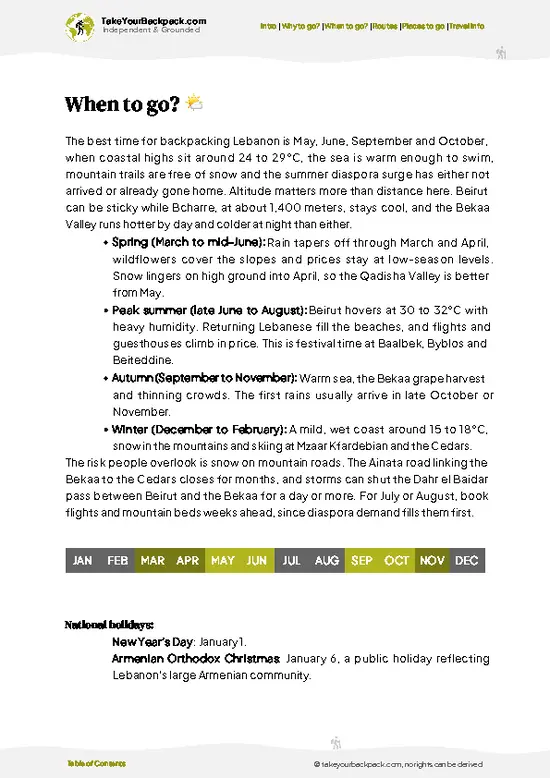
Best months: April to June and September to October are the best months for towns in Lebanon, because daytime highs stay around 20 to 28°C on the coast and the mountains, and the sea is warm enough to swim from roughly late May.
Shoulder and peak seasons: Spring brings green hillsides and the last snow on the upper slopes, but March can still be wet. Autumn is the most comfortable for walking in the mountain villages, with harvest season in vineyards and orchards. July and August are peak. Coastal towns reach 30 to 33°C with heavy humidity, beach clubs fill, and diaspora visitors push accommodation prices up, often 30 to 60 percent above spring rates. Mountain towns are 5 to 10°C cooler, so they are the better choice then.
Winter: Rain falls mostly from November to March, and the coast gets … read more 👉
Best months: April to June and September to October are the best months for towns in Lebanon, because daytime highs stay around 20 to 28°C on the coast and the mountains, and the sea is warm enough to swim from roughly late May.
Shoulder and peak seasons: Spring brings green hillsides and the last snow on the upper slopes, but March can still be wet. Autumn is the most comfortable for walking in the mountain villages, with harvest season in vineyards and orchards. July and August are peak. Coastal towns reach 30 to 33°C with heavy humidity, beach clubs fill, and diaspora visitors push accommodation prices up, often 30 to 60 percent above spring rates. Mountain towns are 5 to 10°C cooler, so they are the better choice then.
Winter: Rain falls mostly from November to March, and the coast gets about 600 to 900 mm a year, with heavy bursts in January and February. Highs on the coast are 15 to 18°C. Above 1,500 meters, snow closes some roads and many mountain guesthouses, and some seaside restaurants shut. Winter is fine for Beirut-adjacent and southern coastal towns if you carry a rain jacket, but it is not worth coming for beach time. The Bekaa is drier and noticeably colder at night, often near freezing in January.

town hoppingPlanning Your Route Efficiently

How many days: A trip combining several towns in Lebanon needs 7 to 10 days, and 5 days is the minimum for a sensible loop without rushing.
Regions and direction: Use Beirut as the transport hub, since nearly all vans and buses start there. Group the north coast and mountains together, then the south coast, then the Bekaa as a separate leg. A clockwise or counterclockwise loop works. Starting north and finishing south keeps you near the airport on the last day if you plan it that way. Beirut to Byblos or Batroun takes 45 to 90 minutes depending on traffic, Beirut to Sidon or Tyre 1 to 2.5 hours, and Beirut to Baalbek about 2 to 2.5 hours across the pass.
Time per stop: Allow 1 night for a small coastal town, and 2 nights for a mountain base if you want to hike or drive onward. A half-day is … read more 👉
How many days: A trip combining several towns in Lebanon needs 7 to 10 days, and 5 days is the minimum for a sensible loop without rushing.
Regions and direction: Use Beirut as the transport hub, since nearly all vans and buses start there. Group the north coast and mountains together, then the south coast, then the Bekaa as a separate leg. A clockwise or counterclockwise loop works. Starting north and finishing south keeps you near the airport on the last day if you plan it that way. Beirut to Byblos or Batroun takes 45 to 90 minutes depending on traffic, Beirut to Sidon or Tyre 1 to 2.5 hours, and Beirut to Baalbek about 2 to 2.5 hours across the pass.
Time per stop: Allow 1 night for a small coastal town, and 2 nights for a mountain base if you want to hike or drive onward. A half-day is enough for a compact old center. Day trips from Beirut cover the nearest coastal towns but waste hours in traffic.
Planning mistakes: The biggest error is packing too many towns into short stays. Four stops in four days means constant van waiting. Another is relying on late afternoon departures, when vans fill slowly and roads clog near Beirut. Leave early in the morning, book a base for at least two nights, and keep a buffer day for road closures.

The ListThe Best towns of Lebanon

1 Byblos

ancient port, Phoenician ruins, harbor restaurants

Walk through archaeological layers beside the sea, then dine by the harbor in a town where history and daily life intersect.

2 Bcharre

Qadisha Valley, Gibran museum, cliffside village

Hike into deep valleys or visit the birthplace of Gibran, with every path revealing dramatic scenery and cultural depth.

3 Deir el Qamar

stone palaces, central square, mountain setting

Explore a preserved town where palaces and public squares recall Lebanon’s princely past, set against a backdrop of wooded hills.

4 Broummana

pine hills, resort hotels, panoramic terraces

Relax in a hilltop town known for its breezy climate, outdoor dining, and sweeping views across the coastal plain.

5 Aley

mountain promenade, summer cafes, urban escape

Join locals escaping the city heat, strolling wide boulevards lined with open-air cafes and enjoying cool evenings above Beirut.

6 Ehden

nature reserve, summer escape, mountain plateau

Hike through cedar groves and open plateaus, then unwind in a town that draws locals for its crisp air and seasonal festivals.

7 Jezzine

pine forests, waterfall views, mountain air

Walk forested trails above dramatic cliffs, then descend to taste local specialties in a town known for its cool summers and panoramic scenery.

8 Douma

red-tiled roofs, market square, mountain terraces

Wander cobbled lanes lined with stone houses, pausing in shaded squares where local produce and mountain views define the pace.

9 Tannourine

limestone cliffs, deep valleys, cedar groves

Descend into dramatic gorges or climb to cedar forests, with every route offering a different perspective on rugged mountain terrain.

lebanon-city-tannourine
© Google |

10 Barouk

cedar reserve, mountain springs, rural guesthouses

Walk beneath ancient cedar trees, then stay in simple lodges where mountain water and quiet nights define the experience.

11 Kfardebian

ski slopes, mountain resorts, snow season

Arrive in winter for skiing and après-ski gatherings, or visit off-season to hike alpine trails and enjoy clear mountain air.

12 Amchit

sea cliffs, old churches, coastal walks

Follow cliffside paths past centuries-old churches, then watch the sun set over the Mediterranean from a town shaped by fishing and trade.

13 Qobayat

northern forests, hiking base, rural monasteries

Set out from a quiet town surrounded by dense woods, using it as a launch point for trails and visits to remote religious sites.

14 Qartaba

apple orchards, highland village, seasonal harvests

Visit during harvest to see orchards in full swing, or explore quiet lanes in a village shaped by agriculture and changing seasons.

15 Hasbaya

medieval castle, river valley, Druze heritage

Stroll riverside paths beneath a looming fortress, discovering a community shaped by layered histories and enduring local traditions.

16 Rachaya

stone houses, Ottoman fortress, border hills

Trace the contours of a hillside village where narrow lanes lead to a centuries-old citadel and distant mountain borders shape daily life.

17 Marjayoun

hilltop views, colonial houses, fertile plains

Survey wide landscapes from a town perched above farmland, where old mansions and open fields reflect a layered past.

18 Hermel

Orontes source, Roman pyramid, remote plains

Venture north to a town where the river begins, ancient monuments rise from fields, and the landscape feels open and untamed.

19 Bint Jbeil

southern market, borderland town, local crafts

Browse bustling markets and meet artisans in a town where southern traditions and proximity to the border influence daily rhythms.

Think you know Lebanon?

Prove you’re a true local — uncover 9 lesser-known towns in Lebanon that locals tend to keep to themselves.
Loading the map 🌍

Expert viewPro Tips for Exploring the Best

How many towns: I would advise four to six towns in one trip. Lebanon is small, but traffic around Beirut can turn a 40 km hop into two hours, and vans leave only when full. Fewer stops mean you actually walk the old souks and sit through a long lunch, which is where the country pays you back.
Which kind for which style: For history lovers, prioritize the coastal port towns: stone harbors, Phoenician and Crusader remains, and fresh fish on the quay. For hikers and budget travelers, favor mountain villages, where the air is cooler, guesthouses cost less, and trails run through cedar and oak forests with views down to the sea. For cultural depth, add one inland or northern town, where a coffee with a shopkeeper often turns into a long conversation and an invitation to eat. Skip towns that are … read more 👉
How many towns: I would advise four to six towns in one trip. Lebanon is small, but traffic around Beirut can turn a 40 km hop into two hours, and vans leave only when full. Fewer stops mean you actually walk the old souks and sit through a long lunch, which is where the country pays you back.
Which kind for which style: For history lovers, prioritize the coastal port towns: stone harbors, Phoenician and Crusader remains, and fresh fish on the quay. For hikers and budget travelers, favor mountain villages, where the air is cooler, guesthouses cost less, and trails run through cedar and oak forests with views down to the sea. For cultural depth, add one inland or northern town, where a coffee with a shopkeeper often turns into a long conversation and an invitation to eat. Skip towns that are strip-mall highway stretches, since they offer nothing to see.
What it costs: Budget US$35 to 60 a day for hostels or simple guesthouses, local food and shared transport. Midrange comfort runs US$70 to 120. Dorm beds are US$15 to 30, a falafel or manakish breakfast US$2 to 5, and a seafood lunch US$15 to 30. Shared vans cost roughly US$1 to 4 per ride, and private taxis US$20 to 60 for longer hops. Archaeological sites charge about US$5 to 15, and a local guide US$20 to 50 for a few hours. Per town visit, expect US$10 to 25 for entry and snacks if you stay a half-day.
Safety and culture: Check government advice before you go, especially for the south and border areas, where situations can shift fast. Stay on main roads after dark and avoid hitchhiking at night. Carry your passport for army checkpoints, answer politely and keep your hands visible. Dress modestly in mountain and religious towns: covered shoulders and knees, and a scarf for mosques and some churches. Ask before photographing people, and never photograph military posts. Cash in US dollars and small Lebanese lira notes is still widely used, so carry small bills. Power cuts mean you should bring a power bank and a headlamp, which come in handy on dark stone lanes at night.

✈️ The backpacker research shortcutLebanon Travel Guide

An offline-friendly backpacking guide with optimized travel routes, ranked highlights, transport advice, and the best areas to stay.
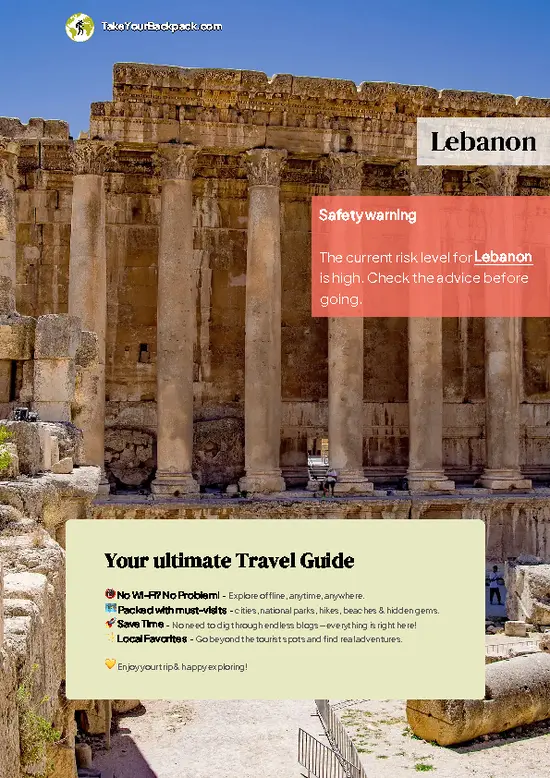
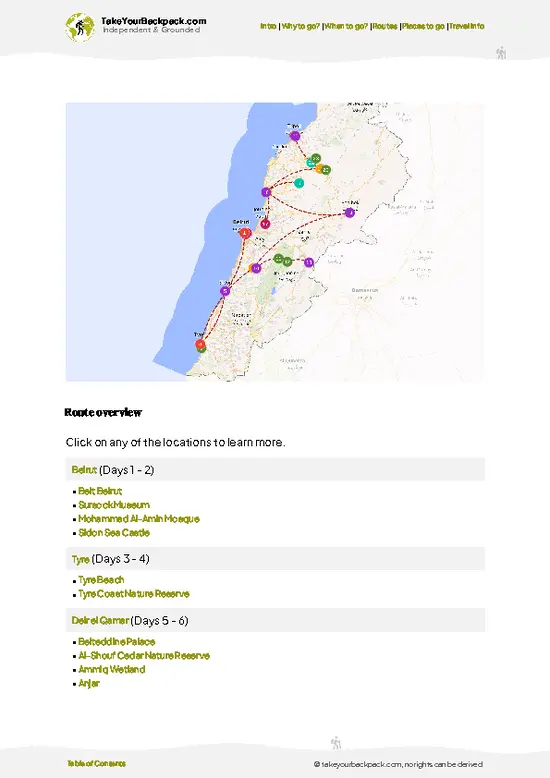
example page 0 from our offline Travel Guide for Lebanon
example page 1 from our offline Travel Guide for Lebanon
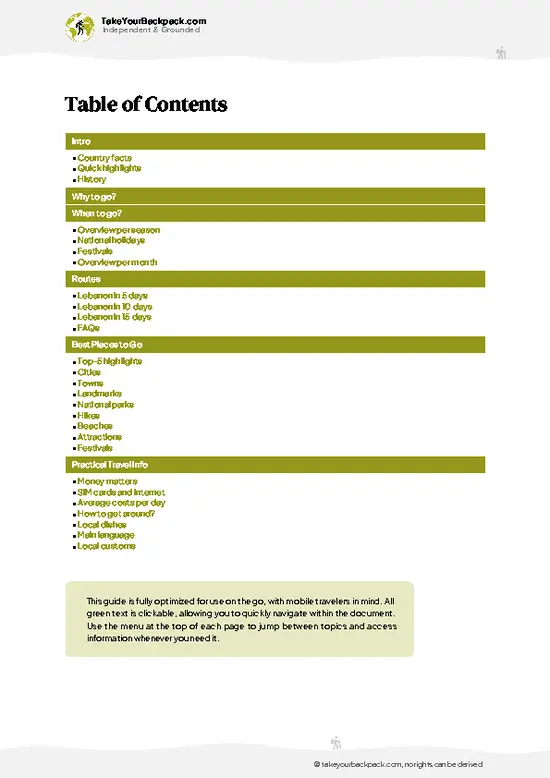
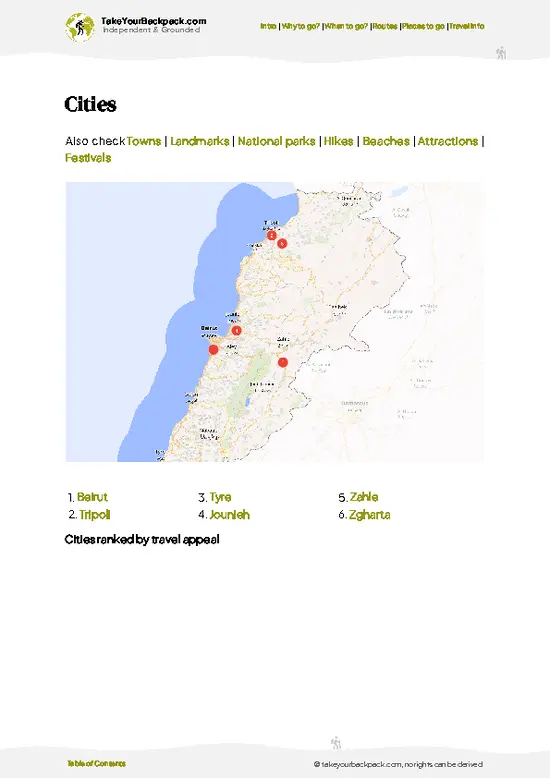
example page 2 from our offline Travel Guide for Lebanon
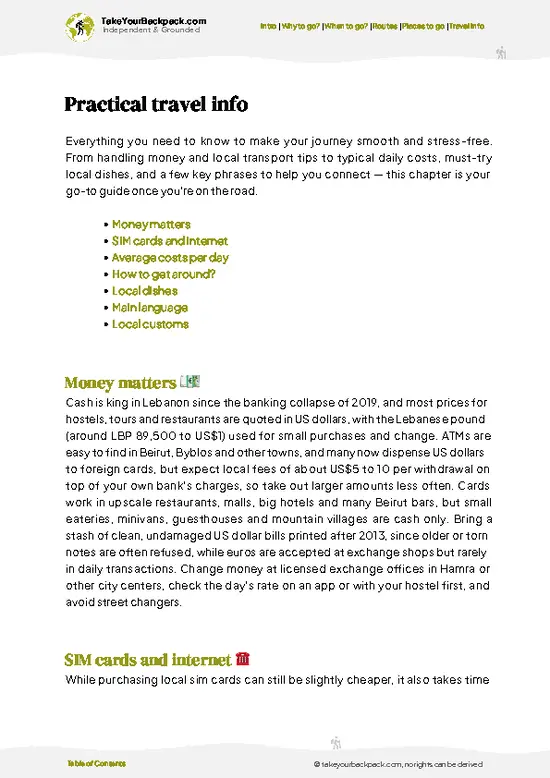
example page 3 from our offline Travel Guide for Lebanon
example page 4 from our offline Travel Guide for Lebanon
example page 5 from our offline Travel Guide for Lebanon
example page 6 from our offline Travel Guide for Lebanon
example page 7 from our offline Travel Guide for Lebanon
The digital guide (286 pages) contains:
✅ 77 highlights, ranked by travel appeal
✅ Optimized 5, 10 & 15-day travel routes
✅ Cities, national parks, landmarks, beaches
✅ How to get around
✅ Offline-friendly for travel without Wi-Fi
👉 Click to see all 30+ guide features

📅 Plan smarter in minutes, not weeks
✅ Month by month travel advice
✅ Festivals & national holidays
✅ Budget expectations

🗺️ Go to the right places, skip the overrated ones
✅ Honest pros & cons of destinations
✅ Top hikes, parks & viewpoints
✅ Lesser-known places most travelers miss
✅ Clear “worth it vs skip it” guidance

🛏️ Travel smoothly without rookie mistakes
✅ Best areas to stay
✅ Transport systems explained simply
✅ Common scams & safety advice
✅ SIM cards, money & practical tips

🌍 Understand the country, not just visit it
✅ Culture & traditions
✅ 52 Essential phrases & customs
✅ Festivals worth planning around
✅ Traveler-friendly historical context
✅ Insights that make places more meaningful

📱 Built for real travel conditions
✅ Fully downloadable PDF
✅ Works completely offline
✅ Optimized for phone use
✅ Useful in remote areas & buses
✅ Everything in one place
Stop searching, start planning
Get instant access to your full guide. 30‑day money-back guarantee.
+ Add another guide for just

By proceeding you agree to our terms.
Sent to your inbox immediately after payment • 100% Secure Checkout
Best Backpacking Travel Advisor 2025 tourism awardBest Backpacking
Travel Advisor
2025
What others say about Take Your Backpack Guides:
⭐⭐⭐⭐⭐
Fantastic, amazing amount of information!
⭐⭐⭐⭐⭐
My goodness this is amazing, it's what I've been looking for hats off too you!
⭐⭐⭐⭐⭐
I think this is absolutely BRILLIANT
⭐⭐⭐⭐
Very complete and informative. It's still missing places, but I gotta to commend you
⭐⭐⭐⭐⭐
This is truly amazing, thank you, can't wait to explore it with my kids!
⭐⭐⭐⭐⭐
Awesome resource, thank you!
⭐⭐⭐⭐⭐
This is amazing! Can't wait to explore the ones I haven't seen
⭐⭐⭐⭐
I love this! Well done, great idea.
⭐⭐⭐⭐⭐
Thanks for taking the time to make this gem!
⭐⭐⭐⭐⭐
This might be the best website I've ever seen.
⭐⭐⭐⭐⭐
Congratulations, and thank you so much for your work; it's incredibly valuable.
⭐⭐⭐⭐
In all seriousness I think you did a great job pointing out the important spots
⭐⭐⭐⭐⭐
10/10 very good
⭐⭐⭐⭐⭐
As someone who's only just starting to visit regularly this is awesome, thank you.
⭐⭐⭐⭐
Thank you very much! I'm going to visit my dad, it's going to be very useful!
⭐⭐⭐⭐⭐
This is really cool! We'll be travelling for the first time and this definitely come in handy.
⭐⭐⭐⭐⭐
You are now our minister of culture, congratulations 👨‍💼
⭐⭐⭐⭐⭐
Just wanted to tell you that this is a pearl! Going to follow your recommendations.
⭐⭐⭐⭐⭐
This is so cool. I'll definitely be using the resource for my travels soon.
⭐⭐⭐⭐⭐
This is very impressive! Good work.
⭐⭐⭐⭐⭐
This is an amazing and informative site. Very well done!

🛏️ Where to stay?Best Stay Options in Lebanon

Backpacking Lebanon is easy on a budget, with hostel dorms around US$12 to 25 a night and simple guesthouses beyond Beirut. In the capital, Hamra has the widest and cheapest choice and is walkable to the Corniche and university cafés, though traffic noise never stops, while Mar Mikhael and Gemmayzeh put you on the city’s best bar streets at the cost of loud weekend nights and pricier beds. For quieter nights, coastal Byblos and Batroun have small guesthouses near the old souks and beaches, and they work well as bases for trips north.

If you enjoy meeting fellow travelers, consider choosing hostels with high ratings for atmosphere. On the other hand, if you prefer having your own space, a hotel might be a better option.

LebanonWhere to Go Next

👋 Meet the founderWho’s Behind Take Your Backpack?

Johan, backpacker and founder of TakeYourBackpackHi, I’m Johan (Netherlands 🇳🇱), the creator of TakeYourBackpack. Over the past 3 decades, I’ve backpacked through 90+ countries across six continents, gaining extensive experience with independent travel, long-term trips, and overland routes.

This site is built on a combination of firsthand travel experience and carefully curated insights from other backpackers. Many guides are based on places I’ve personally visited, while others bring together tips, observations, and practical advice shared by trusted travelers I’ve met along the way.

The goal is to provide realistic, experience-driven guidance — not generic itineraries — so you can explore destinations with better context, clearer expectations, and more confidence.