×
Libya🇱🇾 | 5 days itinerary

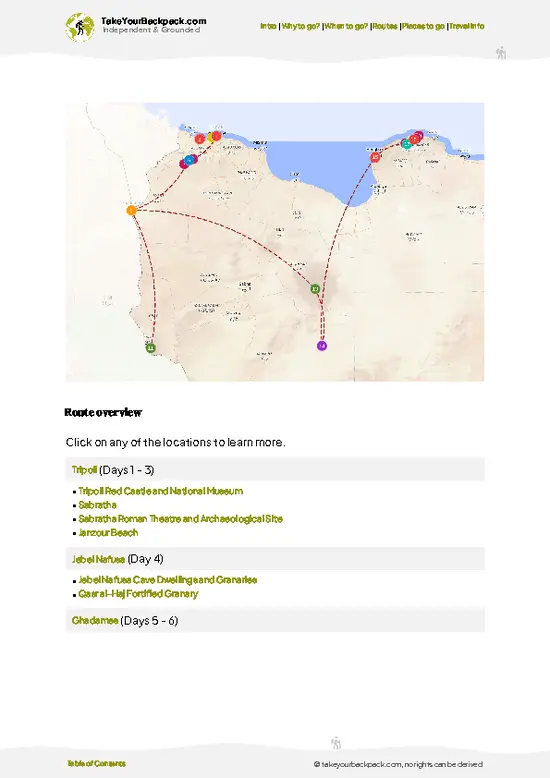
The Perfect 5-Day Route for Libya

By Johan Kruseman 🇳🇱 | Updated May 8, 2026
This 5-day coastal-and-ruins sprint is for travelers who want Libya’s greatest hits without burning out: think strong coffee, big Roman stones, and easy day trips from one base. The pace is relaxed but not lazy, using private car or hired driver between cities, with short hops along the Mediterranean coast and no internal flights needed.

Days 1-2: Tripoli & the Mediterranean Coast Hub

Base yourself in Tripoli so you can land, adjust, and still feel like you’re in the middle of the story. Spend your first afternoon wandering the old city streets around the Tripoli Red Castle and National Museum, getting a crash course in Libyan history before you see the ruins in the wild. The next morning, slide west along the coast to stretch your legs at Janzour Beach, where you can reset your body clock with a swim and a slow seaside lunch before heading back to Tripoli for the night, keeping the logistics simple while your brain catches up with your passport stamps.

Days 3-4: Leptis Magna - The Roman

read more 👉
This 5-day coastal-and-ruins sprint is for travelers who want Libya’s greatest hits without burning out: think strong coffee, big Roman stones, and easy day trips from one base. The pace is relaxed but not lazy, using private car or hired driver between cities, with short hops along the Mediterranean coast and no internal flights needed.

Days 1-2: Tripoli & the Mediterranean Coast Hub

Base yourself in Tripoli so you can land, adjust, and still feel like you’re in the middle of the story. Spend your first afternoon wandering the old city streets around the Tripoli Red Castle and National Museum, getting a crash course in Libyan history before you see the ruins in the wild. The next morning, slide west along the coast to stretch your legs at Janzour Beach, where you can reset your body clock with a swim and a slow seaside lunch before heading back to Tripoli for the night, keeping the logistics simple while your brain catches up with your passport stamps.

Days 3-4: Leptis Magna - The Roman Epic

Shift your base east to Al Khums, the gateway to Leptis Magna Archaeological Site, and give this place the time it deserves instead of treating it like a rushed photo stop. Spend one full day roaming the arches, forum, and amphitheater of Leptis Magna, letting the scale sink in as you wander through streets that still feel like a functioning city if you squint a little. Use the second day to revisit your favorite corners in softer light, or to simply slow down in Al Khums, sipping tea and watching daily life roll by so the trip doesn’t turn into a checklist of ruins.

Day 5: Coastal Return via Sabratha

On your final day, drive back toward Tripoli with a long, lazy stop in Sabratha to explore the Sabratha Roman Theatre and Archaeological Site, where the sea and the stone feel like they’re in conversation. The theatre alone justifies the detour, and wandering the site at your own pace is the perfect way to let the week’s history lessons settle in before you roll back into Tripoli for your last evening, ready to fly out the next morning or continue deeper into the country.

As a quiet bonus for those who like to wander off the map, consider a future detour to the remote coastal caves near Ras al-Hilal, where the cliffs drop into clear water and time feels pleasantly out of sync with the rest of the world.
Loading the map 🌍

🛏️ Where to stay?Your Route at a Glance

✈️ The backpacker research shortcutLibya Travel Guide

An offline-friendly backpacking guide with optimized travel routes, ranked highlights, transport advice, and the best areas to stay.
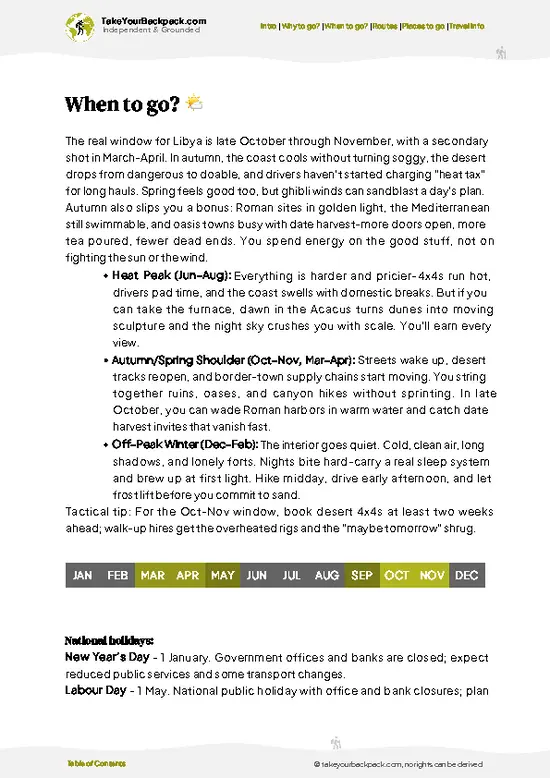
example page 0 from our offline Travel Guide for Libyaexample page 1 from our offline Travel Guide for Libyaexample page 2 from our offline Travel Guide for Libyaexample page 3 from our offline Travel Guide for Libyaexample page 4 from our offline Travel Guide for Libyaexample page 5 from our offline Travel Guide for Libya
The digital guide (226 pages) contains:
61 highlights, ranked by travel appeal
Optimized 5, 10 & 15-day travel routes
Best neighborhoods to stay
How to get around
Offline-friendly for travel without Wi-Fi
👉 See all 30+ guide features

📅 Plan smarter in minutes, not weeks
Month by month travel advice
Festivals & national holidays
Budget expectations

🗺️ Go to the right places, skip the overrated ones
Honest pros & cons of destinations
Top hikes, parks & viewpoints
Lesser-known places most travelers miss
Clear “worth it vs skip it” guidance

🛏️ Travel smoothly without rookie mistakes
Best areas to stay
Transport systems explained simply
Common scams & safety advice
SIM cards, money & practical tips

🌍 Understand the country, not just visit it
Culture & traditions
52 Essential phrases & customs
Festivals worth planning around
Traveler-friendly historical context
Insights that make places more meaningful

📱 Built for real travel conditions
Fully downloadable PDF
Works completely offline
Optimized for phone use
Useful in remote areas & buses
Everything in one place
Save weeks of stressful planning
Get instant access to the full guide directly. 30-day money-back guarantee.


Sent to your inbox immediately after payment • 100% Secure Checkout
Best Backpacking Travel Advisor 2025 tourism awardBest Backpacking
Travel Advisor
2025
What others say about Take Your Backpack Guides:
⭐⭐⭐⭐⭐
Fantastic, amazing amount of information!
⭐⭐⭐⭐⭐
My goodness this is amazing, it's what I've been looking for hats off too you!
⭐⭐⭐⭐⭐
I think this is absolutely BRILLIANT
⭐⭐⭐⭐
Very complete and informative. It's still missing places, but I gotta to commend you
⭐⭐⭐⭐⭐
This is truly amazing, thank you, can't wait to explore it with my kids!
⭐⭐⭐⭐⭐
Awesome resource, thank you!
⭐⭐⭐⭐⭐
This is amazing! Can't wait to explore the ones I haven't seen
⭐⭐⭐⭐
I love this! Well done, great idea.
⭐⭐⭐⭐⭐
Thanks for taking the time to make this gem!
⭐⭐⭐⭐⭐
This might be the best website I've ever seen.
⭐⭐⭐⭐⭐
Congratulations, and thank you so much for your work; it's incredibly valuable.
⭐⭐⭐⭐
In all seriousness I think you did a great job pointing out the important spots
⭐⭐⭐⭐⭐
10/10 very good
⭐⭐⭐⭐⭐
As someone who's only just starting to visit regularly this is awesome, thank you.
⭐⭐⭐⭐
Thank you very much! I'm going to visit my dad, it's going to be very useful!
⭐⭐⭐⭐⭐
This is really cool! We'll be travelling for the first time and this definitely come in handy.
⭐⭐⭐⭐⭐
You are now our minister of culture, congratulations 👨‍💼
⭐⭐⭐⭐⭐
Just wanted to tell you that this is a pearl! Going to follow your recommendations.
⭐⭐⭐⭐⭐
This is so cool. I'll definitely be using the resource for my travels soon.
⭐⭐⭐⭐⭐
This is very impressive! Good work.
⭐⭐⭐⭐⭐
This is an amazing and informative site. Very well done!

🧭 RouteAlternative Routes

Travel Libya your way — from a quick highlights trip to a slow-paced adventure.

🙋 FAQBackpacking FAQ

Short version: Libya is currently one of the hardest countries on earth to backpack independently, especially for budget travelers, and in many cases it is not realistically possible or safe.

Libya has had years of conflict, fragmented authority, and unpredictable security. That affects everything you care about as a backpacker: visas, permits, checkpoints, transport, and basic safety. Independent, shoestring-style backpacking (show up, grab a bus, find a cheap guesthouse, wander around) is usually not an option.

Visas are the first wall. Tourist visas have often been restricted, and rules change fast. Many travelers have only been able to enter on pre-arranged tours or with a local sponsor who handles paperwork and meets them at the airport. That alone kills the classic “wing it” approach.

Once inside, you hit the second wall: movement. There are checkpoints between cities, and officials may expect you to have a local contact, a guide, or specific permits. If your Arabic is weak and you don’t have a fixer, this can turn from annoying to risky very quickly. This is not like hitchhiking across Jordan or Egypt; the margin for error is much smaller.

Accommodation is another constraint. There is no big network of hostels or backpacker guesthouses. You’re mostly looking at mid-range hotels used by business travelers or aid workers, plus whatever your local contact can arrange. That pushes costs up and makes spontaneous, low-budget wandering difficult.

For now, the realistic way to visit Libya is:
- Join a reputable, security-aware tour operator that specializes in Libya.
- Or arrange a custom trip with a trusted local fixer/guide who handles permits, transport, and accommodation.

If your priority is pure independent backpacking freedom, Libya is not the right target right now. If your priority is seeing world-class Roman ruins and Sahara landscapes with a controlled, semi-expedition feel, then a guided setup can be worth the money and the constraints.
If you somehow have a green light to visit (visa, security, local support), the sweet spot for most travelers is 7–10 days, with 14 days if you want to go deeper into the desert.

Here’s how time breaks down in a realistic, structured trip:

3–4 days: Tripoli and surrounds
- 1–2 days for Tripoli itself: medina, Italian-era architecture, coastal walks, and logistics.
- 1 full day for Leptis Magna: this is the main reason many people come to Libya at all.
- Optional half-day for nearby coastal sites or extra time in the medina.

2–3 days: Western coastal ruins
- 1 day for Sabratha (another major Roman site) and coastal driving.
- 1–2 days to slow down, deal with checkpoints, and absorb the history without rushing.

2–4 days: Desert and interior
- If security and logistics allow, 2–4 days for the Sahara: oases, dunes, rock formations, and small towns.
- Travel days are long; you lose time to driving, fuel stops, and bureaucracy.

Ultra-short trip (3–4 days)
- Fly in, base in Tripoli, do a full-day trip to Leptis Magna, maybe a quick look at Sabratha if logistics are tight but workable.
- This is rushed but still worthwhile if you’re focused on ruins.

One week
- Enough for Tripoli, Leptis Magna, Sabratha, and at least a taste of the desert or smaller towns.
- This is the minimum that feels like a real trip rather than a hit-and-run.

Two weeks
- Lets you add deeper desert time, more ruins, and buffer days for delays, which are common.
- Also gives you space to slow down and not feel like you’re sprinting between checkpoints.

Because logistics are heavy and movement can be slow, short trips feel more rushed than in neighboring countries. If you’re going to invest the effort and cost to get in, aim for at least a week, and build in 1–2 buffer days for things going sideways.
Technically you can move around Libya without driving yourself, but in practice you should assume you’ll be in a private car with a driver or guide most of the time.

Why self-navigation is tough
- Checkpoints: You’ll pass through multiple checkpoints between cities. A local driver or guide who knows the routine, speaks Arabic, and has the right paperwork makes these much smoother.
- Limited public transport: There are shared taxis and some buses between major towns, but schedules are unreliable, safety standards vary, and foreigners stand out.
- Safety and information: Road conditions, fuel availability, and security can change quickly. Locals know which routes are currently considered safe.

Realistic options for a budget-minded traveler
- Private car with driver via a local fixer or tour: This is the default. It’s not cheap, but it’s the safest and most efficient way to hit multiple sites.
- City taxis in Tripoli: For short hops within Tripoli, taxis or ride-style services (if available) can work, but you still want local advice on which areas are currently okay.
- Domestic flights: Routes and reliability change, and flights may be limited. They can save time on long distances but require local booking help.

What you should not rely on
- Hitchhiking: Beyond the usual safety concerns, the security context and checkpoints make this a bad idea.
- Renting a car and driving yourself: Even if you could rent one, dealing with checkpoints, navigation, and local driving norms as a foreigner is high-risk and high-stress.

For now, plan your Libya route around having a car and driver arranged in advance. Think of it less like backpacking Southeast Asia and more like a semi-expedition where transport is part of the package.
Assuming security and access are workable, these are the places that justify the effort and cost of coming to Libya.

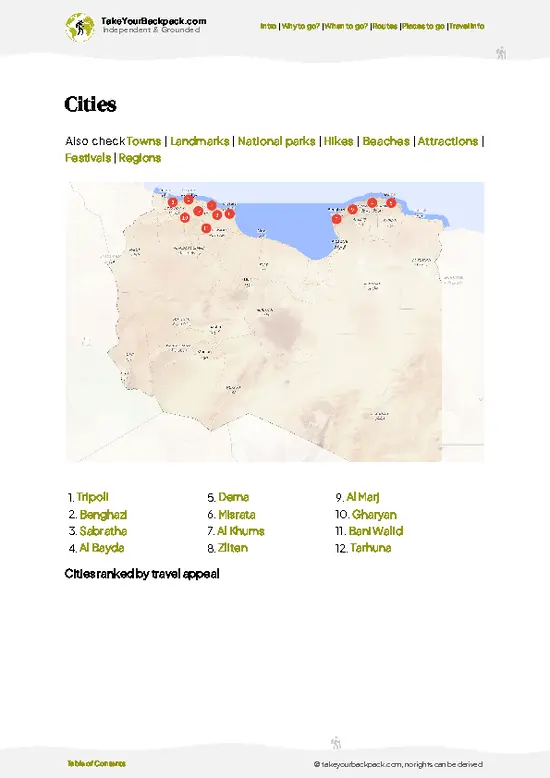
1. Leptis Magna
If you see only one place in Libya, make it this. Leptis Magna is one of the most impressive Roman cities anywhere: massive arches, a theater, baths, a forum, and streets you can actually walk without crowds. The scale and preservation are on par with the big hitters in Italy and Tunisia, but with a fraction of the people.

2. Sabratha
Another coastal Roman site, famous for its theater facing the sea. It’s smaller than Leptis Magna but still powerful, and the combination of ruins and coastline gives it a different feel. If you’re into ancient history, the Leptis–Sabratha combo alone can justify the trip.

3. Tripoli’s old city (medina)
Tripoli is your base and your introduction to Libyan daily life. The medina has narrow lanes, old mosques, traditional shops, and traces of Ottoman and Italian influence. It’s not polished, and that’s the point: this is where you feel the country beyond the ruins.

4. The Sahara (if security allows)
Libya’s slice of the Sahara is huge and varied: dunes, rocky plateaus, oases, and remote towns. With a good local operator, you can camp under absurdly clear skies, visit palm-filled oases, and see rock formations that feel like another planet. It’s logistically heavy and not cheap, but it’s one of the most rewarding parts of the country.

5. Coastal drives around Tripoli
Even short drives along the coast near Tripoli can be worthwhile: sea views, small towns, and a sense of how people live outside the capital. These are easy add-ons to a ruins-focused itinerary.

For a backpacker-style mindset, the core must-visit list is: Tripoli, Leptis Magna, Sabratha, and at least a short Sahara segment if conditions and budget allow.
Because movement is slow and logistics are heavy, you want to be ruthless about what you skip.

1. Over-ambitious cross-country itineraries
Trying to zigzag across the entire country in a short trip is a mistake. Long drives, checkpoints, and potential delays will eat your time and energy. Focus on one main region (usually Tripoli + western coast + nearby desert) instead of trying to “see it all.”

2. Secondary ruins if you’re not a hardcore history nerd
Leptis Magna and Sabratha are the headliners. Beyond those, smaller or more damaged sites are interesting but not essential if you’re short on time. Save your bandwidth for the big two and the desert.

3. Deep interior towns with limited payoff
Some interior towns are important historically or politically but don’t offer much for a short-term visitor compared to the time and risk of getting there. Unless you have a specific reason (research, family, work), skip long detours to places that don’t add clear cultural or landscape value.

4. Trying to DIY remote desert trips
If you can’t afford a proper guided desert excursion with a reliable operator, it’s better to skip the deep Sahara than to attempt a half-baked version. The desert is unforgiving: fuel, navigation, and security all matter. Stick to coastal and near-Tripoli experiences instead of gambling on a risky cheap desert run.

5. Extended time in Tripoli without a purpose
Tripoli is worth a couple of days, but if you’re short on time, don’t linger just because it’s the capital. Once you’ve explored the medina, key landmarks, and had a few good walks and meals, extra days are usually better spent at Leptis Magna, Sabratha, or in the desert.

If you’re on a tight schedule, the lean, high-value plan is: base in Tripoli, do Leptis Magna and Sabratha, add a short, well-organized desert or coastal extension if conditions allow, and skip everything that requires long detours or complex permits without a big payoff.

🇱🇾 LibyaMore of Libya

Ready to build a truly unique trip? Predefined routes are perfect for first-time visitors, but there is so much more to discover. Whether you are chasing a city trip, pristine national parks, local food scenes, or quiet beaches, pick a category to design your own path.