×
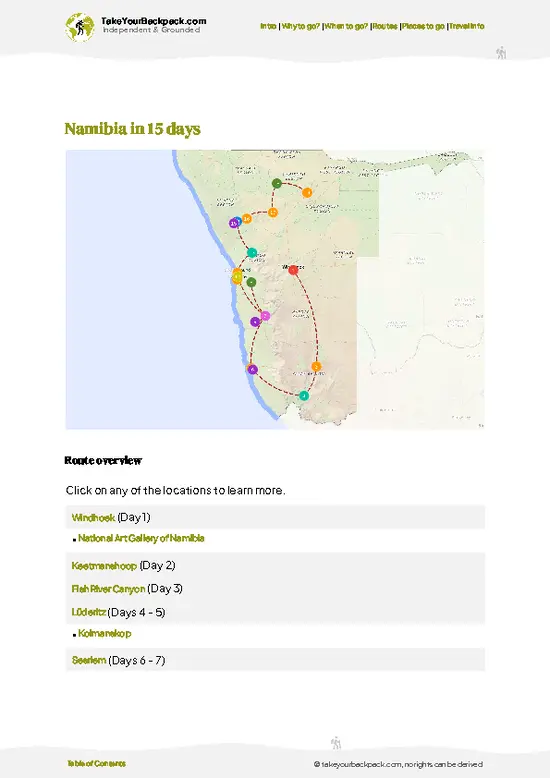
Namibia🇳🇦 | 5 days itinerary

Your 5-Day Namibia Itinerary

By Johan Kruseman 🇳🇱 | Updated May 8, 2026
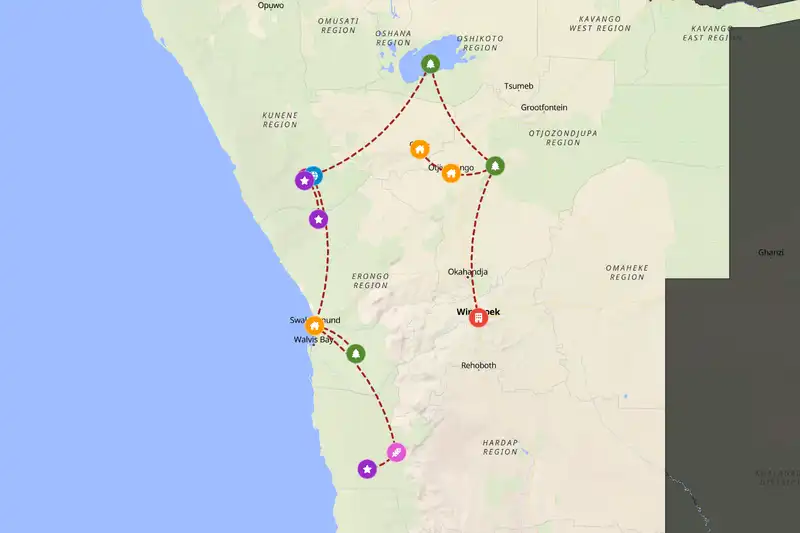
This 5-day route is for travelers who want a deep dive into Namibia’s coast and desert without racing across the whole country, using a rental car as the main transport and keeping the pace relaxed but full. You’ll base yourself around Swakopmund and Sesriem/Sossusvlei, mixing easy walks, big desert views, and a bit of history instead of long, exhausting drive days.

Days 1-2: Swakopmund & the Atlantic edge

Fly or drive into Swakopmund and settle into this German-colonial-by-the-sea base, where the cold Atlantic crashes into the edge of the Namib Desert. Spend your first afternoon walking the promenade and feeling out the town, then dive into the compact but rich Swakopmund Museum to get your bearings on Namibia’s natural history, colonial past, and coastal ecology. Use the second day to slow down: wander Swakopmund Beach for sunrise or sunset, then stroll out along the Swakopmund Jetty & Old Mole Seafront for sea spray, fresh air, and a sense of how harsh this coastline really is when you … read more 👉
This 5-day route is for travelers who want a deep dive into Namibia’s coast and desert without racing across the whole country, using a rental car as the main transport and keeping the pace relaxed but full. You’ll base yourself around Swakopmund and Sesriem/Sossusvlei, mixing easy walks, big desert views, and a bit of history instead of long, exhausting drive days.

Days 1-2: Swakopmund & the Atlantic edge

Fly or drive into Swakopmund and settle into this German-colonial-by-the-sea base, where the cold Atlantic crashes into the edge of the Namib Desert. Spend your first afternoon walking the promenade and feeling out the town, then dive into the compact but rich Swakopmund Museum to get your bearings on Namibia’s natural history, colonial past, and coastal ecology. Use the second day to slow down: wander Swakopmund Beach for sunrise or sunset, then stroll out along the Swakopmund Jetty & Old Mole Seafront for sea spray, fresh air, and a sense of how harsh this coastline really is when you look beyond the ice cream stands.

Days 3-4: Namib Desert, Sesriem & Sossusvlei

On Day 3, drive inland toward Sesriem, watching the landscape shift from foggy coast to wide gravel plains and finally to the rust-colored dunes of the Namib Desert. Base yourself in or near Sesriem so you can hit Sossusvlei at prime light: one early morning for climbing a dune and wandering the cracked white pans, and another for exploring the surrounding Namib-Naukluft National Park landscapes at a slower pace. Use the heat of the day to rest in camp or lodge shade, then head back out for late-afternoon walks when the dunes glow and the desert feels almost otherworldly.

Day 5: Back to Swakopmund or onward

Drive back to Swakopmund for a last coastal walk and a final coffee or seafood lunch before you either overnight again or continue toward Windhoek or your next leg. This final day is intentionally light on activities so you’re not sprinting to the airport; it’s about letting the contrast between ocean chill and desert heat sink in before you move on.

For a bonus off-the-beaten-path idea once you’ve tasted the desert, consider a future detour to the remote Kuiseb Canyon viewpoints, where the river has carved a quiet, stark trench through the Namib’s gravel plains.
Loading the map 🌍
film
0
0
0a
Namib Desert
film
1
1
1a
Sossusvlei
film
2
2
2a
Namib-Naukluft

🛏️ Where to stay?5 Days of Adventure

✈️ The backpacker research shortcutNamibia Travel Guide

An offline-friendly backpacking guide with optimized travel routes, ranked highlights, transport advice, and the best areas to stay.
example page 0 from our offline Travel Guide for Namibiaexample page 1 from our offline Travel Guide for Namibiaexample page 2 from our offline Travel Guide for Namibiaexample page 3 from our offline Travel Guide for Namibiaexample page 4 from our offline Travel Guide for Namibiaexample page 5 from our offline Travel Guide for Namibia
The digital guide (274 pages) contains:
79 highlights, ranked by travel appeal
Optimized 5, 10 & 15-day travel routes
Best neighborhoods to stay
How to get around
Offline-friendly for travel without Wi-Fi
👉 See all 30+ guide features

📅 Plan smarter in minutes, not weeks
Month by month travel advice
Festivals & national holidays
Budget expectations

🗺️ Go to the right places, skip the overrated ones
Honest pros & cons of destinations
Top hikes, parks & viewpoints
Lesser-known places most travelers miss
Clear “worth it vs skip it” guidance

🛏️ Travel smoothly without rookie mistakes
Best areas to stay
Transport systems explained simply
Common scams & safety advice
SIM cards, money & practical tips

🌍 Understand the country, not just visit it
Culture & traditions
52 Essential phrases & customs
Festivals worth planning around
Traveler-friendly historical context
Insights that make places more meaningful

📱 Built for real travel conditions
Fully downloadable PDF
Works completely offline
Optimized for phone use
Useful in remote areas & buses
Everything in one place
Save weeks of stressful planning
Get instant access to the full guide directly. 30-day money-back guarantee.


Sent to your inbox immediately after payment • 100% Secure Checkout
Best Backpacking Travel Advisor 2025 tourism awardBest Backpacking
Travel Advisor
2025
What others say about Take Your Backpack Guides:
⭐⭐⭐⭐⭐
Fantastic, amazing amount of information!
⭐⭐⭐⭐⭐
My goodness this is amazing, it's what I've been looking for hats off too you!
⭐⭐⭐⭐⭐
I think this is absolutely BRILLIANT
⭐⭐⭐⭐
Very complete and informative. It's still missing places, but I gotta to commend you
⭐⭐⭐⭐⭐
This is truly amazing, thank you, can't wait to explore it with my kids!
⭐⭐⭐⭐⭐
Awesome resource, thank you!
⭐⭐⭐⭐⭐
This is amazing! Can't wait to explore the ones I haven't seen
⭐⭐⭐⭐
I love this! Well done, great idea.
⭐⭐⭐⭐⭐
Thanks for taking the time to make this gem!
⭐⭐⭐⭐⭐
This might be the best website I've ever seen.
⭐⭐⭐⭐⭐
Congratulations, and thank you so much for your work; it's incredibly valuable.
⭐⭐⭐⭐
In all seriousness I think you did a great job pointing out the important spots
⭐⭐⭐⭐⭐
10/10 very good
⭐⭐⭐⭐⭐
As someone who's only just starting to visit regularly this is awesome, thank you.
⭐⭐⭐⭐
Thank you very much! I'm going to visit my dad, it's going to be very useful!
⭐⭐⭐⭐⭐
This is really cool! We'll be travelling for the first time and this definitely come in handy.
⭐⭐⭐⭐⭐
You are now our minister of culture, congratulations 👨‍💼
⭐⭐⭐⭐⭐
Just wanted to tell you that this is a pearl! Going to follow your recommendations.
⭐⭐⭐⭐⭐
This is so cool. I'll definitely be using the resource for my travels soon.
⭐⭐⭐⭐⭐
This is very impressive! Good work.
⭐⭐⭐⭐⭐
This is an amazing and informative site. Very well done!

🧭 RouteMore Ways to Explore

Travel Namibia your way — from a quick highlights trip to a slow-paced adventure.

🙋 FAQGood to Know

Short version: Namibia is absolutely doable independently, but it’s a logistics game, not a spontaneous hop-on-hop-off country.

For budget backpackers, the biggest challenge is distance. Towns are far apart, public transport is limited, and most of the famous sights sit well off main roads. That means you either rent a car, join short tours from hubs, or get very comfortable with hitchhiking and long waits.

If you rent a car, independent travel becomes straightforward: roads are generally safe, crime against tourists is relatively low compared to many countries, and campsites are well set up. The catch is cost: car + fuel + park fees add up fast, especially if you go for a 4x4. Splitting a rental between 2–4 people is the sweet spot for backpackers.

If you avoid renting a car, you can still backpack Namibia, but you need to accept a slower, more limited route. You’ll move mostly between Windhoek, Swakopmund, Walvis Bay, Luderitz, and a few northern towns using buses and shared taxis, then use day tours to reach the big-ticket sights.

Safety-wise, wild camping off random roads is not smart because of wildlife and private land; stick to official campsites, community camps, or backpacker hostels. Booking ahead in peak season (July–October) matters, especially around Etosha and Sossusvlei.

So: easy if you’re organized, flexible with comfort, and ideally sharing costs. Hard if you expect Southeast-Asia-style buses and walk-in everything.
If you’re flying all the way to Namibia, anything under 7 days feels rushed. The country is huge, and driving days are long.

Good rules of thumb for backpackers:

7–10 days (fast but focused)
You can do one main loop, not the whole country.
• Windhoek → Sossusvlei → Swakopmund → Windhoek, or
• Windhoek → Etosha → Swakopmund → Windhoek
Expect a couple of long driving days and limited time for detours.

2 weeks (solid first trip)
This is the sweet spot for most budget travelers.
• Classic loop: Windhoek → Sossusvlei → Swakopmund → Skeleton Coast/Damaraland → Etosha → back to Windhoek.
You get dunes, coast, desert landscapes, and wildlife without sprinting.

3 weeks (ideal backpacker pace)
You can slow down, add side trips, and chase value instead of rushing.
• Add: Spitzkoppe, Waterberg Plateau, more time in Damaraland, or a detour to Luderitz and Kolmanskop.
You’ll spend fewer days just sitting in a car and more actually hiking, watching wildlife, and enjoying campsites.

1 month+
Worth it if you’re overlanding or combining with South Africa/Botswana. You can explore the far north (Kaokoland, Epupa Falls) and more remote community camps.

If you’re on a tight budget, longer is actually better: you can spread out rental costs, choose cheaper campsites, and avoid last-minute, overpriced tours.
You can get around Namibia without a car, but you’ll trade freedom for patience and you’ll miss some remote highlights unless you join tours.

What works without a car
• Intercity buses and shuttles: Connect Windhoek with Swakopmund, Walvis Bay, Luderitz, and some northern towns. They’re affordable and reasonably reliable.
• Shared taxis/minibuses: Run between towns along main routes. They leave when full, so timing is flexible rather than fixed. Good for budget travelers who aren’t on a tight schedule.
• City taxis: In Windhoek and Swakopmund, cheap shared taxis get you around town and to supermarkets/hostels.

How to reach major sights without driving
• Sossusvlei: Base yourself in Sesriem or a nearby lodge/hostel and join a day tour from Swakopmund or Windhoek, or pre-arrange a shuttle + camp package.
• Etosha: Take a shuttle or bus to a gateway town (like Tsumeb or Outjo) and then join a safari from there, or book a budget package that includes transport, camping, and game drives.
• Skeleton Coast / Damaraland / Spitzkoppe: Reach Swakopmund by bus, then use local tour operators for day or overnight trips.

Hitchhiking
Common among locals and travelers, especially along main roads. It’s not risk-free, so it’s best done in daylight, from fuel stations or police checkpoints, and ideally in pairs. Always keep enough cash to bail out and pay for a guesthouse if a ride drops you short.

Reality check
Without a car, you’ll mostly bounce between a few hubs and join tours for the famous spots. It’s cheaper upfront than renting solo, but if you’re two or more people, a shared rental often gives better value and far more flexibility.
For a first-time, budget-conscious backpacker, these are the places that justify the time, money, and effort.

1. Sossusvlei & the Namib Desert
• Why it’s worth it: Giant red dunes, surreal dead-tree pans, and some of the best desert light you’ll ever see. Sunrise from a dune is one of those rare experiences that actually lives up to the hype.
• Backpacker angle: Camp at Sesriem to save money, cook your own food, and share a vehicle or tour to get into the park.

2. Etosha National Park
• Why it’s worth it: One of Africa’s easiest and most rewarding self-drive safari parks. In dry season, animals crowd around waterholes, so you see a lot even on a budget.
• Backpacker angle: Stay at campsites inside or just outside the park, self-cater, and do self-drive game viewing if you have a car. If not, join group game drives.

3. Swakopmund & the Atlantic Coast
• Why it’s worth it: A chilled base between desert and ocean with cheap-ish hostels, supermarkets, and adventure activities (sandboarding, quad biking, kayaking with seals).
• Backpacker angle: Good place to reset, do laundry, and join day trips without needing your own vehicle.

4. Damaraland (around Twyfelfontein / Brandberg area)
• Why it’s worth it: Stark desert landscapes, desert-adapted elephants if you’re lucky, and ancient rock engravings. It feels remote without requiring extreme expedition skills.
• Backpacker angle: Community campsites keep costs down, and you can often join local guides for short, affordable excursions.

5. Spitzkoppe
• Why it’s worth it: Massive granite domes rising out of the desert, incredible night skies, and cheap camping. It’s one of the best-value wild-feeling camping experiences in the country.
• Backpacker angle: Bring your own food and water, camp under the rocks, and hike/scramble independently.

6. A taste of local life (Windhoek or a northern town)
• Why it’s worth it: Namibia isn’t just landscapes. Spending time in Windhoek’s markets or in a northern town like Oshakati or Ondangwa gives context to everything else you see.
• Backpacker angle: Use cheap guesthouses or hostels, eat at local shebeens, and use shared taxis to get around.
If you’re short on time or cash, skip anything that adds huge transit hours without giving you a new type of experience.

1. Luderitz & Kolmanskop (if you’re on a tight schedule)
• Why skip: It’s a long detour from the main backpacker loop, and while the ghost town is photogenic, it’s another desert stop when you’ve likely already done Sossusvlei.
• When to go anyway: If you’re into photography or history and have 3+ weeks.

2. Deep Kaokoland (far northwest)
• Why skip: Requires serious 4x4, time, and fuel money. It’s incredible but logistically heavy and not beginner-friendly on a tight budget.
• When to go anyway: If you’re overlanding with your own rig or joining a specialized expedition.

3. Multiple days in Windhoek
• Why skip: One full day is enough for most travelers: stock up, sort transport, see a couple of sights, and move on. It’s a practical hub, not the main event.
• When to stay longer: If you’re working remotely or need a base to organize gear and tours.

4. Too many paid activities in Swakopmund
• Why skip: It’s easy to burn your budget on back-to-back adrenaline tours. Pick one or two (sandboarding, kayaking with seals) instead of doing everything.
• When to splurge: If this is your only adventure-sports stop in southern Africa.

5. Trying to ‘do it all’ in one short trip
• Why skip: Rushing to squeeze in every region means more time in transit, less time actually enjoying places, and higher costs on fuel and tours.
• Smarter move: For 7–10 days, focus on Sossusvlei + Swakopmund or Etosha + Swakopmund. For 2 weeks, add Damaraland and maybe Spitzkoppe. Leave the far south and far northwest for a future trip.

Cutting these corners lets you put your money where it counts: a few high-impact places, good campsites, and enough time to actually feel the desert instead of just driving through it.

🇳🇦 NamibiaDiscover the Country

Ready to build a truly unique trip? Predefined routes are perfect for first-time visitors, but there is so much more to discover. Whether you are chasing a city trip, pristine national parks, local food scenes, or quiet beaches, pick a category to design your own path.