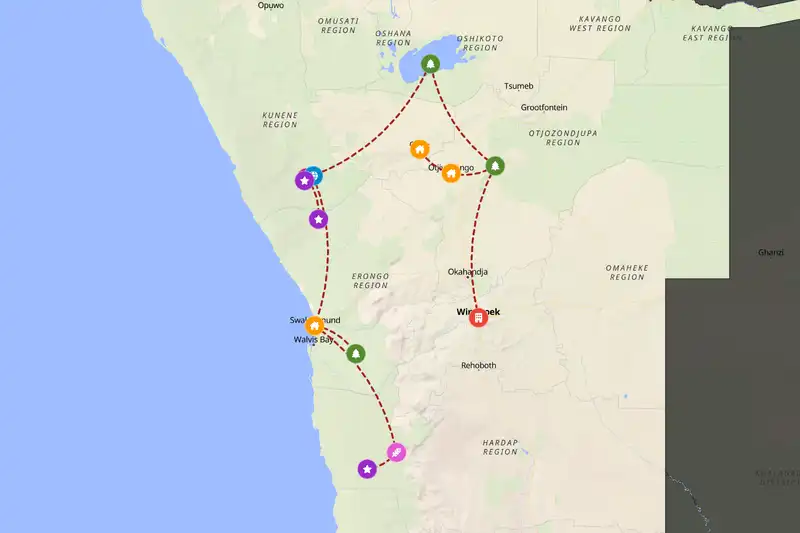
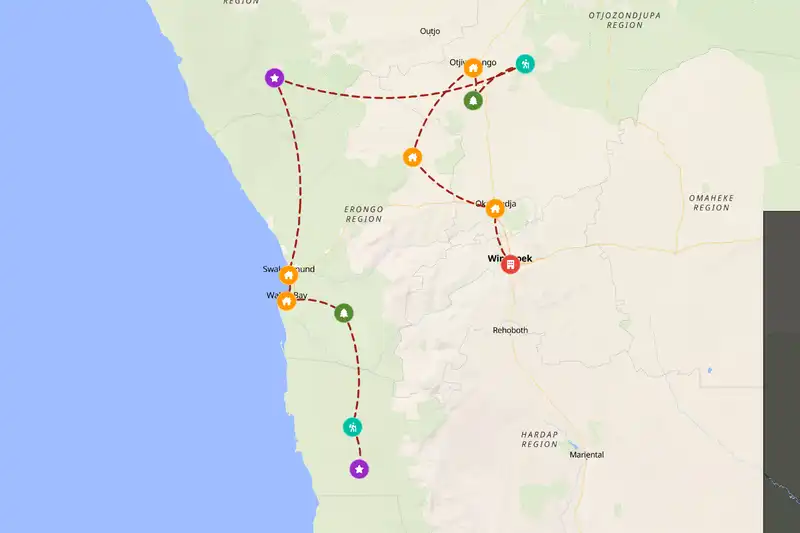
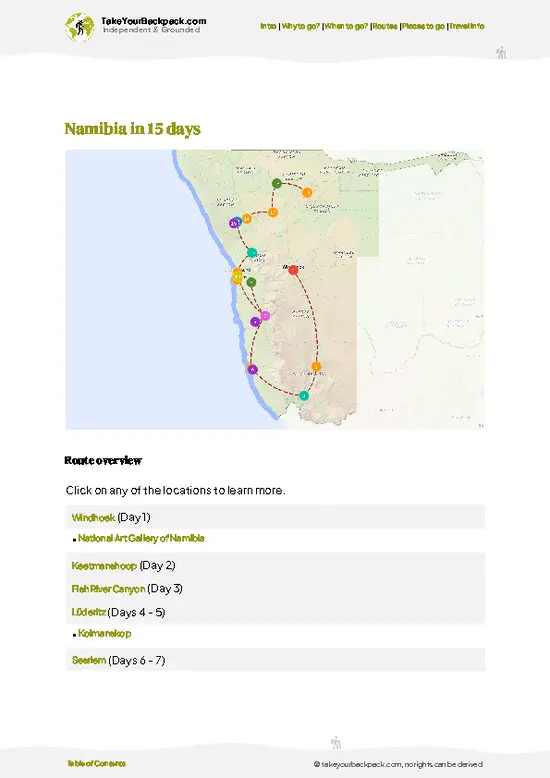
This fifteen-day self-drive loop is for travelers who want to see Namibia properly, from the canyon country of the far south to the waterholes of Etosha, and who are happy to trade hostel bunks for campsites and a rooftop tent. The pace is steady rather than rushed: no two long driving days fall back-to-back, and most stops get two nights. Public transport covers only fragments of it. The Intercape bus runs Windhoek to Keetmanshoop (about 6 hours) and combis link Keetmanshoop with Lüderitz, but from Fish River Canyon onward you need a rented car, ideally a 4x4 or high-clearance vehicle shared between two to four people (roughly US$80 to 150 a day for a camping-equipped 4x4).
Day 1: Windhoek
Use your first afternoon in
Windhoek to sort the car, buy a local SIM and fill a cool box at a big supermarket, because shops thin out fast once you head south. If you have energy left, the
National Art Gallery of Namibia on Robert Mugabe Avenue gives a quick look at contemporary Namibian work, and an …
read more 👉This fifteen-day self-drive loop is for travelers who want to see Namibia properly, from the canyon country of the far south to the waterholes of Etosha, and who are happy to trade hostel bunks for campsites and a rooftop tent. The pace is steady rather than rushed: no two long driving days fall back-to-back, and most stops get two nights. Public transport covers only fragments of it. The Intercape bus runs Windhoek to Keetmanshoop (about 6 hours) and combis link Keetmanshoop with Lüderitz, but from Fish River Canyon onward you need a rented car, ideally a 4x4 or high-clearance vehicle shared between two to four people (roughly US$80 to 150 a day for a camping-equipped 4x4).
Day 1: Windhoek
Use your first afternoon in Windhoek to sort the car, buy a local SIM and fill a cool box at a big supermarket, because shops thin out fast once you head south. If you have energy left, the National Art Gallery of Namibia on Robert Mugabe Avenue gives a quick look at contemporary Namibian work, and an evening at the Single Quarters market in Katutura, where kapana (street-grilled beef with chili salt) sizzles on open grills, is a far better first meal than any hotel restaurant.
Days 2-3: Keetmanshoop and Fish River Canyon
Day 2 is the longest straight run of the trip, about 500 km of tarred B1 to Keetmanshoop, a dusty railway town that works as a sensible overnight halfway point. The next morning is short: roughly 2 hours to Hobas, the campsite near the main viewpoint of Fish River Canyon. The canyon runs for about 160 km and drops up to 550 meters, and standing at the rim at sunset, with the river looping in tight bends far below, is the moment the scale of the south lands. The famous five-day, 85 km hike needs a permit, a medical certificate and the May to mid-September window, so treat it as a separate trip and stick to rim walks here.
Days 4-5: Lüderitz and Kolmanskop
Day 4 is a solid 5-hour drive west through Aus, where the wild horses of Garub often stand at the trackside waterhole, to Lüderitz. The town is wind-blasted, fog-damp and painted in pastel colonial facades, with the Felsenkirche on its rock above the harbor and Shark Island poking into the bay. Day 5 is for Kolmanskop, the abandoned diamond town 10 km inland, where sand has poured through doorways and settled waist-deep in bathtubs. Go on the morning guided tour, when the light slants through the empty rooms and the wind has not yet picked up.
Days 6-7: Sesriem and Sossusvlei
The drive north to Sesriem is a full day on gravel (about 6 to 7 hours), mostly along the D707, which runs between red dunes and the Tiras Mountains and is one of the best-looking roads in the country. Sleep inside the park gate at Sesriem so you get early access before the outside crowd. On day 7, drive into Sossusvlei in the Namib-Naukluft National Park at first light and climb Big Daddy, at around 325 meters one of the tallest dunes in the area, then run down its steep face into Deadvlei, where 900-year-old dead camelthorn trees stand black against a white clay pan. Save the late afternoon for Sesriem Canyon, a narrow gorge only a few minutes from camp.
Days 8-9: Swakopmund and Walvis Bay
Day 8 crosses the Gaub and Kuiseb passes to the coast in about 5 to 6 hours, and the temperature can drop 20 degrees as you hit the fog belt. Swakopmund is where you catch your breath: laundry, a proper restaurant dinner and a bed with walls. On day 9 drive 35 km south to Walvis Bay for a morning kayak among Cape fur seals near Pelican Point, then stop at Dolphin Beach on the way back, a sheltered stretch where locals braai on weekends and the water is calm enough to paddle.
Day 10: Spitzkoppe
A short 2-hour drive inland brings you to Spitzkoppe, a cluster of granite peaks rising about 700 meters out of a flat gravel plain. Camp at the community-run site, where pitches are tucked between boulders, scramble up to the Rock Arch for sunset and walk to the faded San paintings at Bushman’s Paradise. After the coast, the silence and the star-heavy sky here are the point.
Day 11: Damaraland and Twyfelfontein
Head north through Uis to Damaraland, roughly 3 to 4 hours of red rock and flat-topped mountains. At Twyfelfontein, a local guide leads you through more than 2,000 rock engravings of giraffes, rhinos and animal tracks cut into sandstone slabs. Stay at one of the campsites along the Aba-Huab riverbed, where desert-adapted elephants sometimes wander through after dark.
Days 12-13: Khorixas, Outjo and Etosha
Day 12 runs east via Khorixas and Outjo, the last good spot for fuel, cash and a slice of German-style cake before the park, into Etosha National Park in about 4 to 5 hours. This time, cross the park west to east: a night at Okaukuejo, then a full day driving the edge of the vast white pan past Halali to Namutoni, stopping at every waterhole along the way. Elephant, lion, black rhino, springbok in their hundreds: Etosha delivers big game with a regularity that makes it one of the easiest safari parks in Africa for a self-driver.
Days 14-15: Tsumeb and back to Windhoek
Leave through the eastern Von Lindequist Gate to Tsumeb, a green, jacaranda-lined copper-mining town whose museum displays some of the mineral specimens that made its mine famous with collectors worldwide. On day 15, the tarred road south to Windhoek takes about 5 hours, which leaves time for an evening flight.
If you can spare one more hour near Tsumeb, detour to the Hoba Meteorite outside Grootfontein, a 60-tonne slab of iron that has sat in the same farmland since it fell around 80,000 years ago.
 Best Backpacking