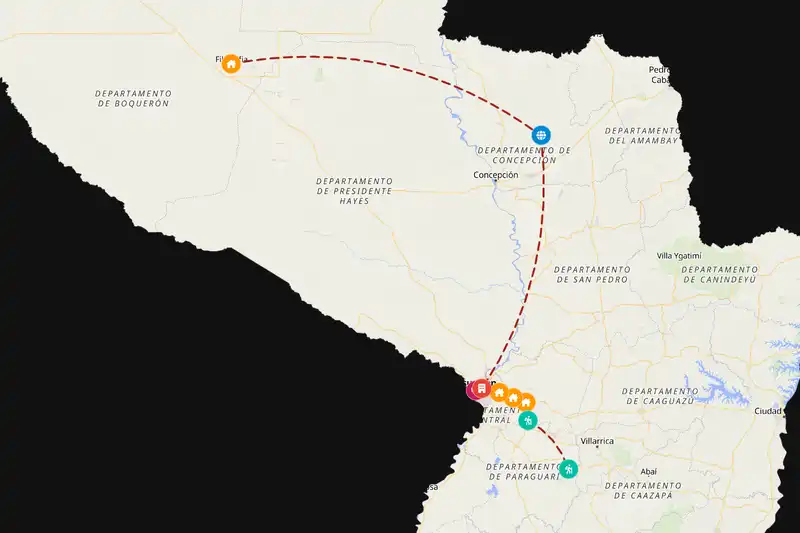
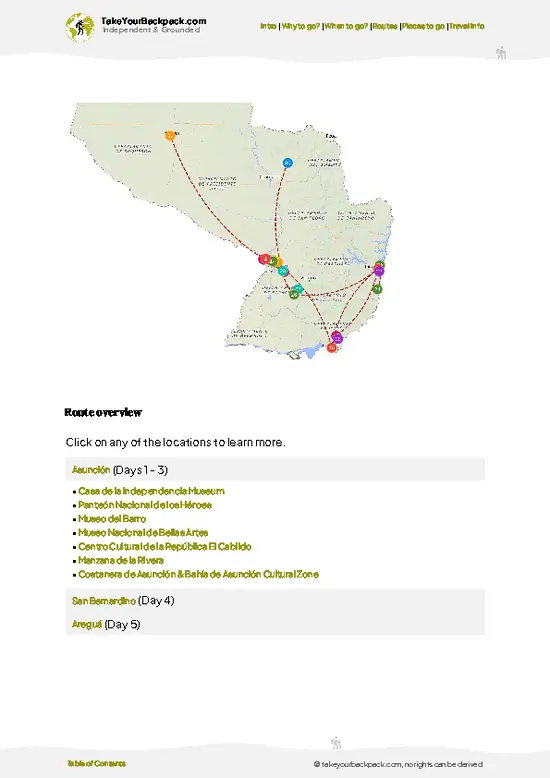
This 15-day route is for travelers who want to go deep into Paraguay’s contrasts: capital-city culture, lake towns, Jesuit missions, big waterfalls, and a real taste of the Chaco, all at a measured pace that still leaves room for hammocks and long lunches. You’ll use a mix of intercity buses, a couple of longer hauls to reach the Chaco and mission country, plus local taxis and short transfers to trailheads and reserves, with no back-to-back marathon travel days.
Days 1-3: Asunción foundations and creative pulse
Begin with three nights in
Asunción, giving yourself time to peel back layers instead of just ticking landmarks. Start at the
Casa de la Independencia Museum to walk through the rooms where independence was plotted, then cross to the
Panteón Nacional de los Héroes to see how the country memorializes its heroes and losses. Spend a half day at the
Museo del Barro, where indigenous pieces, folk art, and sharp contemporary works sit in conversation and quietly explain Paraguay better …
read more 👉This 15-day route is for travelers who want to go deep into Paraguay’s contrasts: capital-city culture, lake towns, Jesuit missions, big waterfalls, and a real taste of the Chaco, all at a measured pace that still leaves room for hammocks and long lunches. You’ll use a mix of intercity buses, a couple of longer hauls to reach the Chaco and mission country, plus local taxis and short transfers to trailheads and reserves, with no back-to-back marathon travel days.
Days 1-3: Asunción foundations and creative pulse
Begin with three nights in Asunción, giving yourself time to peel back layers instead of just ticking landmarks. Start at the Casa de la Independencia Museum to walk through the rooms where independence was plotted, then cross to the Panteón Nacional de los Héroes to see how the country memorializes its heroes and losses. Spend a half day at the Museo del Barro, where indigenous pieces, folk art, and sharp contemporary works sit in conversation and quietly explain Paraguay better than any guidebook paragraph. Add the Museo Nacional de Bellas Artes and the Centro Cultural de la República El Cabildo for a more classical and institutional angle, then wander Manzana de la Rivera to see how old houses have been turned into living cultural spaces. Evenings belong to the Costanera de Asunción & Bahía de Asunción Cultural Zone, where you can walk, snack, and watch the city unwind by the river.Days 4-5: Lake Ypacaraí towns and easy hills
On day four, head out of the capital to the lakeside town of San Bernardino, Paraguay’s classic summer escape, and spend a night soaking up its resort-town energy and lake views. Continue to Areguá for another night, trading party vibes for pottery workshops, cobbled streets, and a more low-key feel along Areguá Beach on Lake Ypacaraí. Use your time here to hike the nearby Areguá Hill Trail for gentle elevation and lake panoramas, then tackle the Cerro Koi Trail inside the Cerro Koi and Chororí Hill Nature Reserve, where the geometric sandstone formations feel like a geology lesson under open sky. This phase gives you fresh air and small-town character before you dive into heavier history and longer rides.Days 6-8: Missions, riverfront, and Itaipú from Encarnación and Ciudad del Este
Travel south to Encarnación for two nights, using the city as your base for both riverfront downtime and Jesuit history. Split your time between Playa de Encarnación and San José beach, walking the costanera and swimming when the heat kicks in, then dedicate a day to La Santísima Trinidad de Paraná, where the mission ruins, open courtyards, and Guaraní context make the colonial story feel textured rather than one-sided. From there, ride northeast to Ciudad del Este for a night or two, using the city not just as a shopping stop but as a launchpad for the Itaipu Nature Reserve, where forest trails and viewpoints sit in the shadow of the massive dam, and for the mission site of Jesús de Tavarangüé, whose unfinished church and broad layout give you a very different feel from Trinidad. Nights in both cities are about river breezes, street food, and watching border life flow around you.Days 9-10: Waterfalls and forest in the east
Stay based in Ciudad del Este and devote a full day to Saltos del Monday and the Saltos del Monday Viewpoints & Visitor Area, where multiple platforms let you feel the thunder of the falls from different angles and the spray cools you down better than any air-con. If you want a wilder, less developed waterfall experience, add a day trip to Ñacunday National Park and its Ñacunday Falls, where forest paths, fewer people, and a broad curtain of water make it feel like you’ve slipped into a quieter corner of the country. This is your nature-heavy stretch in the east, balancing the built history of missions and dams with raw river power and green shade.Days 11-13: Ybycuí National Park and Mbatoví adventure
Head back toward the central region and base yourself near Ybycui National Park for two nights, giving yourself a full day to hike forest trails, swim in natural pools, and explore remnants of old ironworks that tie the landscape to Paraguay’s industrial past. From there, move to the Mbatovi Forest Reserve area for a night and spend a day at the Eco Reserva Mbatoví Adventure Facilities, where canopy walkways, zip lines, and cliffside paths let you experience the Atlantic forest from above as much as from within. This phase is all about legs and lungs: moderate hikes, waterfalls, and just enough adrenaline to feel alive without needing expedition-level fitness.Days 14-15: First taste of the Chaco and return
Finish with a two-day foray into the Chaco Region, basing yourself in Filadelfia, the Mennonite-founded town that acts as a gateway to this vast, dry landscape. Use your time to explore the town’s museums and streets, then venture into the broader Chaco Region environment, where long, straight roads, thorny scrub, and big skies give you a completely different Paraguay than the green east. If logistics and conditions allow, add a day trip into Defensores del Chaco National Park for a taste of real Chaco wilderness, knowing that distances are big and infrastructure is sparse, so you move slowly and deliberately here. Wrap up by returning toward Asunción or onward travel with the sense that you’ve seen not just Paraguay’s highlights, but its extremes as well.
My favorite stretch of this long route is the jump from the lush trails of Ybycuí to the wide, dry horizons around Filadelfia, because that contrast is where Paraguay’s character really snaps into focus.v2.webp)

 Best Backpacking