×

Solomon Islands🇸🇧 | best townsTop-Rated 5 towns in Solomon Islands

Towns in Solomon Islands are small, low-slung and loud with the right things: market sellers calling over piles of taro, outboard motors whining at the wharf, Pijin drifting from every verandah. Honiara on Guadalcanal is the only real city, hot, dusty and the most expensive place in the country. Provincial centers like Gizo in the Western Province or Auki on Malaita trade size for sea breeze and woodsmoke. Roads end quickly, flights are weather-dependent and boats keep their own hours. For independent travel, that means slower, pricier and far less crowded than anywhere else in the Pacific, with almost no other visitors.

By Johan Kruseman 🇳🇱 | Updated October 23, 2026
Explore the best villages in Solomon Islands

Why go?Why Travelers Love These Spots

Solomon Islands is spread across nearly 1,000 islands, and that scattering shapes every town. There is no central network. Each provincial capital is a port first, a place where copra, fish, betel nut and passengers move on boats and small planes. Towns stay compact because land is mostly held by customary ownership rather than sold freely, so settlements grow around markets, churches and wharves instead of sprawling. Expect corrugated roofs, red-stained pavements from spat betel nut, and the smell of diesel mixed with frying dough and salt.

The history is visible too. World War II left rusting hardware and memorials around Guadalcanal, and the 1998 to 2003 ethnic tensions still color how people talk about Honiara. Pijin is the common language, English is widely understood, and churches shape … read more 👉
Solomon Islands is spread across nearly 1,000 islands, and that scattering shapes every town. There is no central network. Each provincial capital is a port first, a place where copra, fish, betel nut and passengers move on boats and small planes. Towns stay compact because land is mostly held by customary ownership rather than sold freely, so settlements grow around markets, churches and wharves instead of sprawling. Expect corrugated roofs, red-stained pavements from spat betel nut, and the smell of diesel mixed with frying dough and salt.

The history is visible too. World War II left rusting hardware and memorials around Guadalcanal, and the 1998 to 2003 ethnic tensions still color how people talk about Honiara. Pijin is the common language, English is widely understood, and churches shape Sundays: almost everything closes.

Before choosing the country for its towns, know that infrastructure is thin. Power cuts happen, internet is slow and costly, ATMs are rare outside the main centers, and guesthouse choice is limited. Humidity sits heavy year-round. In return, you get towns where markets run on real local produce, nobody is selling you a package, and a conversation on the wharf is likely to end with an invitation.
Why These Made the Cut
The list of best towns in Solomon Islands is created based on charm, local culture, atmosphere, hidden gems, and visitor appeal. If you feel a town is missing in this list, please let us know.

When to go?Best Time to Visit Solomon Islands for towns

Best months for visiting towns: The best months are May to October, when the southeast trade winds bring drier, slightly cooler air and calmer days for boat transfers between islands. Daytime temperatures hover around 28 to 31°C, nights drop to about 23 to 25°C, and humidity eases enough that walking around a market at midday is manageable.

Wet season and shoulder months: From November to April it is hotter, often 30 to 33°C, and rain arrives in heavy, sudden downpours that turn dirt lanes to red mud. Annual rainfall is typically 3,000 mm or more, with Honiara drier than the Western Province and Malaita. Cyclone risk runs roughly November to April, though direct hits are uncommon. Flights get delayed and small boats are canceled in rough weather, so build slack around any connection. November … read more 👉
Best months for visiting towns: The best months are May to October, when the southeast trade winds bring drier, slightly cooler air and calmer days for boat transfers between islands. Daytime temperatures hover around 28 to 31°C, nights drop to about 23 to 25°C, and humidity eases enough that walking around a market at midday is manageable.

Wet season and shoulder months: From November to April it is hotter, often 30 to 33°C, and rain arrives in heavy, sudden downpours that turn dirt lanes to red mud. Annual rainfall is typically 3,000 mm or more, with Honiara drier than the Western Province and Malaita. Cyclone risk runs roughly November to April, though direct hits are uncommon. Flights get delayed and small boats are canceled in rough weather, so build slack around any connection. November and May are workable shoulder months with fewer surprises than midsummer.

Crowds and prices: There is no real crowd season, since visitor numbers stay low all year. Honiara hotels can fill during government events or the national festival periods and in the lead-up to Christmas, when families travel home by ferry and flights book out. Accommodation prices barely shift by season, but domestic flights and ferries are tightest in December and January.

town hoppingHow to Combine towns Into One Trip

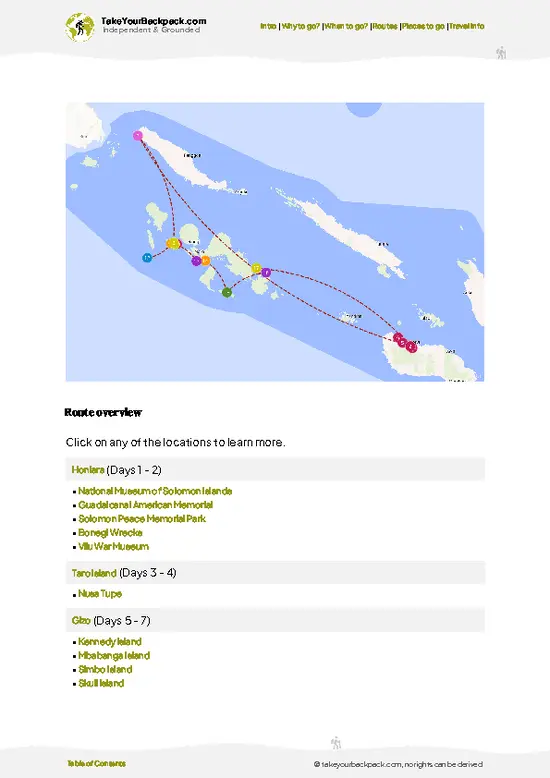
How long a multi-town trip takes: A trip linking several towns needs 10 to 16 days, because transport is slow and weather can rearrange it. Honiara is the natural hub, as international flights land at Henderson Airport and domestic planes and ferries fan out from there.

Grouping regions and direction: Group by sea and air corridors. The Guadalcanal and Malaita pair works well, with fast boats from Honiara to Auki taking roughly 2 to 3 hours. The Western Province is a separate leg: flights from Honiara to Munda or Gizo take about 1 to 1.5 hours, while the ferry takes much longer, often overnight. Fly west first, then work back east by plane or boat toward Honiara, so a delayed flight does not collide with your international departure.

Time per stop and common mistakes: Allow 2 to 4 nights … read more 👉
How long a multi-town trip takes: A trip linking several towns needs 10 to 16 days, because transport is slow and weather can rearrange it. Honiara is the natural hub, as international flights land at Henderson Airport and domestic planes and ferries fan out from there.

Grouping regions and direction: Group by sea and air corridors. The Guadalcanal and Malaita pair works well, with fast boats from Honiara to Auki taking roughly 2 to 3 hours. The Western Province is a separate leg: flights from Honiara to Munda or Gizo take about 1 to 1.5 hours, while the ferry takes much longer, often overnight. Fly west first, then work back east by plane or boat toward Honiara, so a delayed flight does not collide with your international departure.

Time per stop and common mistakes: Allow 2 to 4 nights per town. One night is mostly spent waiting at wharves, in the sticky heat, for a boat that leaves when it is full. The usual errors are booking tight connections, trusting printed ferry schedules and arranging a flight home the day after a long sea crossing. Instead, keep a 2 to 3 day buffer before departing, confirm sailings the day before at the wharf, carry cash since cards fail outside Honiara, and treat Sundays as dead travel days.

The ListHighly Recommended towns of Solomon Islands

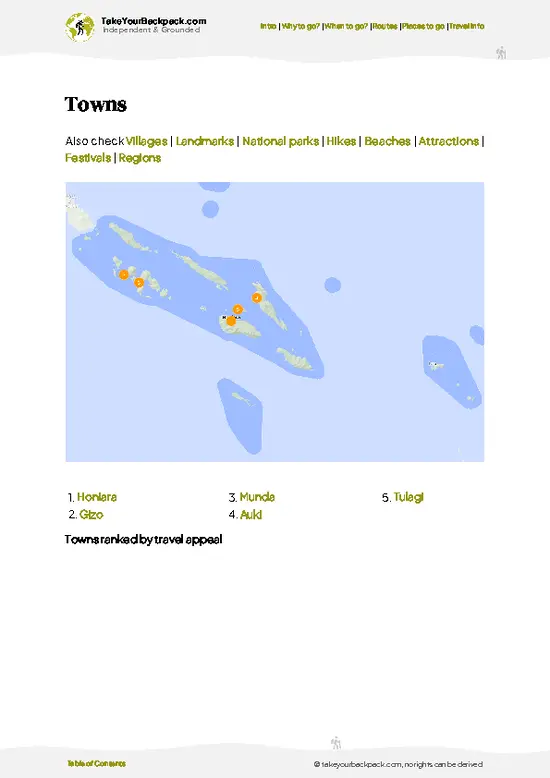
1 Honiara

Guadalcanal memorial, Central Market, national museum, Mataniko Falls

Use the capital as a base for Pacific war history, a morning market of fresh tuna and taro, and a guided river walk to the falls.

2 Gizo

Reef diving, Kennedy Island, harbor deck sunsets, Western Province hub

Head out by boat to wartime wrecks and the palm-fringed islet where Kennedy swam ashore, then watch Kolombangara fade from the hotel deck.

3 Munda

Kokengolo bunkers, airstrip relics, Roviana snorkeling, dawn fish market

Climb a ridge riddled with Japanese gun positions, then cool off in clear lagoon shallows near the point and finish at the airstrip edge.

4 Auki

Shell money market, Malaita capital, Lau Lagoon launch point, harbor wharf

Wander a working harbor town where women sell betel nut and smoked fish at dawn, then watch boats and outboards come and go.

5 Tulagi

Town wharf, Iron Bottom Sound, wartime caves, harbor sunsets

Step off the boat into reef snorkeling, join wreck dives from town, and climb hillside paths past old Japanese gun emplacements.

solomon-islands-city-tulagi
© Google |
Loading the map 🌍

Expert viewExpert Commentary on towns

How many towns to visit: Three towns is the sensible number for most backpackers, four at most. Transport takes up whole days, so each extra town costs roughly a day of waiting around a wharf or airstrip. Three lets you stay long enough to learn a market, find the best fried fish stall and be recognized by the guesthouse cook, which is where the trip really pays off.

Which kind of town for which traveler: Choose the capital for logistics: banks, supermarkets, SIM cards, dive operators and the widest guesthouse range. Choose provincial centers if you want a slower pace, with market mornings thick with smoke and fresh produce, and evenings with kids swimming off the jetty. Choose small island settlements if diving, village stays or quiet are the priority, accepting basic rooms, bucket showers … read more 👉
How many towns to visit: Three towns is the sensible number for most backpackers, four at most. Transport takes up whole days, so each extra town costs roughly a day of waiting around a wharf or airstrip. Three lets you stay long enough to learn a market, find the best fried fish stall and be recognized by the guesthouse cook, which is where the trip really pays off.

Which kind of town for which traveler: Choose the capital for logistics: banks, supermarkets, SIM cards, dive operators and the widest guesthouse range. Choose provincial centers if you want a slower pace, with market mornings thick with smoke and fresh produce, and evenings with kids swimming off the jetty. Choose small island settlements if diving, village stays or quiet are the priority, accepting basic rooms, bucket showers and generator power. A mix of one hub and two quieter places suits most people.

What it costs: Solomon Islands is expensive for the region. Budget about US$50 to 90 a day (roughly SBD 420 to 760) if you use guesthouses and eat at markets. Guesthouse rooms run around US$30 to 70 a night, a market meal US$3 to 6, and a restaurant dinner in Honiara US$12 to 20. Per visit, expect domestic flights around US$80 to 200 one way, fast boats US$15 to 40, local minibuses under US$1 to 3 and guided village or reef visits US$15 to 50. Custom fees for reefs, WWII sites or village land are normally SBD 50 to 200 (about US$6 to 24), paid in cash to the owners.

Safety and cultural considerations: Daytime walking in town is generally relaxed, but avoid walking alone after dark, especially in Honiara, and keep phones and cash out of sight. Land and reefs are customary property, so ask permission and agree a fee before swimming, snorkeling or photographing. Dress modestly: shoulders and knees covered in town, and women in village settings should swim in a t-shirt and shorts or sarong. Sundays are for church, with shops shut and noisy activity frowned on. Malaria is present, so carry prophylaxis and repellent. Crocodiles live in some rivers and estuaries, so check locally before swimming. Carry plenty of small notes, as change is scarce and the nearest ATM may be a boat ride away.

A gift of a bag of rice or sugar for a host family goes down well and costs about US$5 to 10, and the reward is often a shared meal of fish, sweet potato and coconut cream.

✈️ The backpacker research shortcutSolomon Islands Travel Guide

An offline-friendly backpacking guide with optimized travel routes, ranked highlights, transport advice, and the best areas to stay.
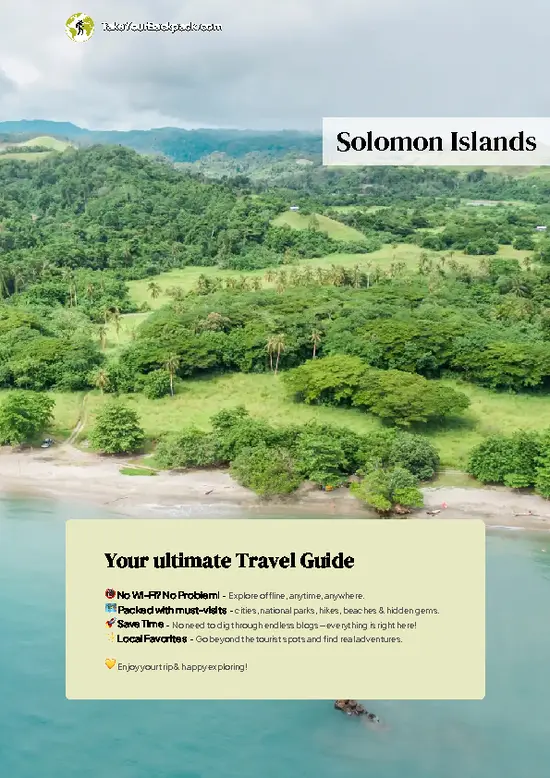
example page 0 from our offline Travel Guide for Solomon Islands
example page 1 from our offline Travel Guide for Solomon Islands
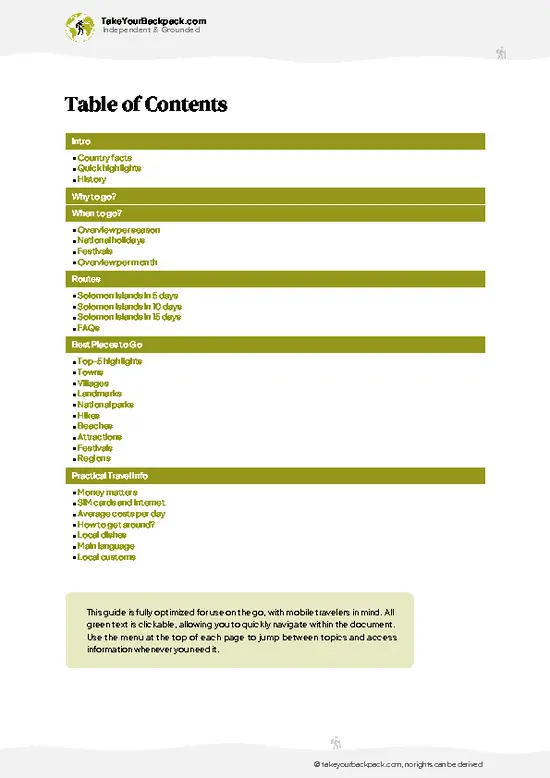
example page 2 from our offline Travel Guide for Solomon Islands
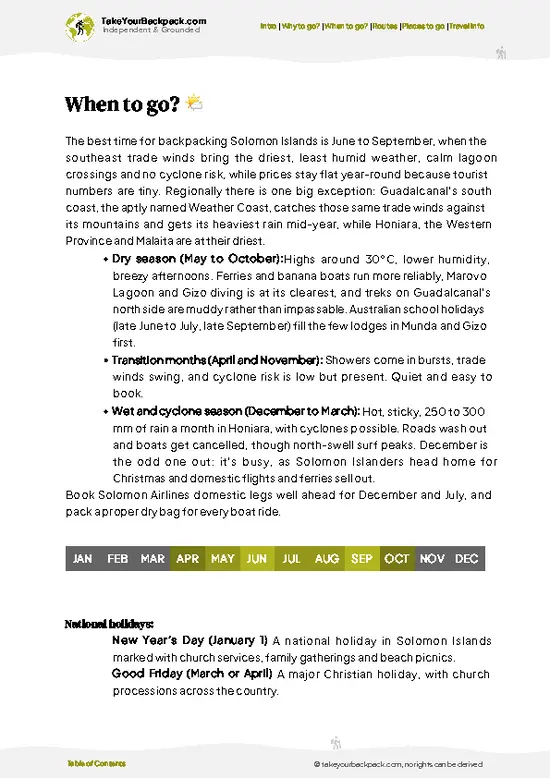
example page 3 from our offline Travel Guide for Solomon Islands
example page 4 from our offline Travel Guide for Solomon Islands
example page 5 from our offline Travel Guide for Solomon Islands
example page 6 from our offline Travel Guide for Solomon Islands
example page 7 from our offline Travel Guide for Solomon Islands
The digital guide (145 pages) contains:
✅ 33 highlights, ranked by travel appeal
✅ Optimized 5, 10 & 15-day travel routes
✅ Cities, national parks, landmarks, beaches
✅ How to get around
✅ Offline-friendly for travel without Wi-Fi
👉 Click to see all 30+ guide features

📅 Plan smarter in minutes, not weeks
✅ Month by month travel advice
✅ Festivals & national holidays
✅ Budget expectations

🗺️ Go to the right places, skip the overrated ones
✅ Honest pros & cons of destinations
✅ Top hikes, parks & viewpoints
✅ Lesser-known places most travelers miss
✅ Clear “worth it vs skip it” guidance

🛏️ Travel smoothly without rookie mistakes
✅ Best areas to stay
✅ Transport systems explained simply
✅ Common scams & safety advice
✅ SIM cards, money & practical tips

🌍 Understand the country, not just visit it
✅ Culture & traditions
✅ 52 Essential phrases & customs
✅ Festivals worth planning around
✅ Traveler-friendly historical context
✅ Insights that make places more meaningful

📱 Built for real travel conditions
✅ Fully downloadable PDF
✅ Works completely offline
✅ Optimized for phone use
✅ Useful in remote areas & buses
✅ Everything in one place
Stop searching, start planning
Get instant access to your full guide. 30‑day money-back guarantee.
+ Add another guide for just

By proceeding you agree to our terms.
Sent to your inbox immediately after payment • 100% Secure Checkout
Best Backpacking Travel Advisor 2025 tourism awardBest Backpacking
Travel Advisor
2025
What others say about Take Your Backpack Guides:
⭐⭐⭐⭐⭐
Fantastic, amazing amount of information!
⭐⭐⭐⭐⭐
My goodness this is amazing, it's what I've been looking for hats off too you!
⭐⭐⭐⭐⭐
I think this is absolutely BRILLIANT
⭐⭐⭐⭐
Very complete and informative. It's still missing places, but I gotta to commend you
⭐⭐⭐⭐⭐
This is truly amazing, thank you, can't wait to explore it with my kids!
⭐⭐⭐⭐⭐
Awesome resource, thank you!
⭐⭐⭐⭐⭐
This is amazing! Can't wait to explore the ones I haven't seen
⭐⭐⭐⭐
I love this! Well done, great idea.
⭐⭐⭐⭐⭐
Thanks for taking the time to make this gem!
⭐⭐⭐⭐⭐
This might be the best website I've ever seen.
⭐⭐⭐⭐⭐
Congratulations, and thank you so much for your work; it's incredibly valuable.
⭐⭐⭐⭐
In all seriousness I think you did a great job pointing out the important spots
⭐⭐⭐⭐⭐
10/10 very good
⭐⭐⭐⭐⭐
As someone who's only just starting to visit regularly this is awesome, thank you.
⭐⭐⭐⭐
Thank you very much! I'm going to visit my dad, it's going to be very useful!
⭐⭐⭐⭐⭐
This is really cool! We'll be travelling for the first time and this definitely come in handy.
⭐⭐⭐⭐⭐
You are now our minister of culture, congratulations 👨‍💼
⭐⭐⭐⭐⭐
Just wanted to tell you that this is a pearl! Going to follow your recommendations.
⭐⭐⭐⭐⭐
This is so cool. I'll definitely be using the resource for my travels soon.
⭐⭐⭐⭐⭐
This is very impressive! Good work.
⭐⭐⭐⭐⭐
This is an amazing and informative site. Very well done!

🛏️ Where to stay?Where to Stay: Solomon Islands Edition

True dorm-style hostels are rare in the Solomon Islands, so budget travel here usually means simple family guesthouses and church-run lodges at roughly SI$300 to 600 (US$35 to 70) a night for a room, with traditional leaf-hut ecolodges taking over in the provinces. In Honiara, Point Cruz puts you closest to the Central Market, the museum and the few bars that stay open late, but it gets congested by day and is best avoided on foot after dark, while the hillside streets of Lengakiki and Vura are quieter and cooler at the cost of a bus or taxi ride into town. Outside the capital, Gizo has the widest spread of budget guesthouses near the dive shops and waterfront, and Munda offers lagoon-side lodges … read more 👉
True dorm-style hostels are rare in the Solomon Islands, so budget travel here usually means simple family guesthouses and church-run lodges at roughly SI$300 to 600 (US$35 to 70) a night for a room, with traditional leaf-hut ecolodges taking over in the provinces. In Honiara, Point Cruz puts you closest to the Central Market, the museum and the few bars that stay open late, but it gets congested by day and is best avoided on foot after dark, while the hillside streets of Lengakiki and Vura are quieter and cooler at the cost of a bus or taxi ride into town. Outside the capital, Gizo has the widest spread of budget guesthouses near the dive shops and waterfront, and Munda offers lagoon-side lodges that are very quiet with almost no nightlife.

If you enjoy meeting fellow travelers, consider choosing hostels with high ratings for atmosphere. On the other hand, if you prefer having your own space, a hotel might be a better option.

Solomon IslandsExplore Beyond This Category

👋 Meet the founderWho’s Behind Take Your Backpack?

Johan, backpacker and founder of TakeYourBackpackHi, I’m Johan (Netherlands 🇳🇱), the creator of TakeYourBackpack. Over the past 3 decades, I’ve backpacked through 90+ countries across six continents, gaining extensive experience with independent travel, long-term trips, and overland routes.

This site is built on a combination of firsthand travel experience and carefully curated insights from other backpackers. Many guides are based on places I’ve personally visited, while others bring together tips, observations, and practical advice shared by trusted travelers I’ve met along the way.

The goal is to provide realistic, experience-driven guidance — not generic itineraries — so you can explore destinations with better context, clearer expectations, and more confidence.