×

South Africa🇿🇦 | best citiesWhere to Find the 7 Best cities in South Africa

South Africa has three capital cities, a coastline of more than 2,500 kilometers and a spread of urban life that varies sharply by region. Coastal cities in the Western Cape and KwaZulu-Natal give you beaches, hostels and walkable neighborhoods. Inland cities such as those in Gauteng are sprawling, car-dependent and built around business, so they suit a short stop rather than a week. Distances are the main problem. Cities sit 1,000 to 1,400 kilometers apart, which means flights or long buses rather than quick hops. Costs stay moderate: a hostel dorm runs roughly R250 to 500 (US$14 to 28) a night. For backpacking and independent travel, the coastal and Cape cities are the easy, rewarding choice. Skip anything that needs a rental car for every errand unless you have one booked, and treat the inland metropolises as gateways with a few strong sights, not places to linger.

By Johan Kruseman 🇳🇱 | Updated October 23, 2026
Explore the best towns in South Africa

Why go?Understanding Their Importance

South Africa suits city travel because its urban centers grew from very different histories: Dutch and British colonial ports, a gold rush that created an inland metropolis almost overnight, and a long apartheid planning legacy that still shapes how places look and feel. That gives you real contrast within one country, from compact harbor towns to sprawling mining-era grids, and few countries of this size offer that range with decent infrastructure.

The geography matters just as much. The country is large and the population is concentrated around a handful of urban regions, so cities are far apart and the land between them is mostly farmland, semi-desert or mountains. Public transport inside cities is patchy. Minibus taxis carry most commuters but are hard for visitors to read, and only a … read more 👉
South Africa suits city travel because its urban centers grew from very different histories: Dutch and British colonial ports, a gold rush that created an inland metropolis almost overnight, and a long apartheid planning legacy that still shapes how places look and feel. That gives you real contrast within one country, from compact harbor towns to sprawling mining-era grids, and few countries of this size offer that range with decent infrastructure.

The geography matters just as much. The country is large and the population is concentrated around a handful of urban regions, so cities are far apart and the land between them is mostly farmland, semi-desert or mountains. Public transport inside cities is patchy. Minibus taxis carry most commuters but are hard for visitors to read, and only a few cities have reliable rail or bus rapid transit. Ride-hailing apps such as Uber and Bolt fill the gap and are cheap by international standards.

The apartheid layout is the thing to understand before you commit. Many cities have a tourist-friendly core, then townships and distant suburbs separated by highways. Sights are spread out, so a city that looks close on a map can eat half a day in transfers. Guided township visits are worth paying for because they explain this history properly, whereas wandering alone without local knowledge is not recommended.

The climate is generally mild and sunny, which makes outdoor city life easy, but regional differences are big. Also plan around safety: crime is a real factor, and the standard approach is to use ride-hailing after dark, avoid displaying valuables and stay in well-reviewed accommodation. If you want cheap, spontaneous urban wandering on foot at all hours, this is not that country. If you want varied, affordable, scenic cities with strong food and history, it is excellent.
Evaluating the Top Choices
The list of best cities in South Africa is created based on culture, vibe, attractions, transport ease, and local charm. If you feel a city is missing in this list, please let us know.

When to go?Best Time to Visit South Africa for cities

Best months for city travel: The best months for South Africa’s cities are March to May and September to November, when days are mostly dry and warm, typically 18 to 27°C, and crowds and prices sit below summer peaks. These shoulder seasons suit almost every region.
Summer (December to February): Summer is hot and busy. Coastal Western Cape cities see dry, sunny days of 25 to 30°C and are the most crowded, with accommodation prices often 30 to 60 percent above shoulder-season rates and dorm beds booked out around Christmas and New Year. Inland Gauteng gets afternoon thunderstorms most days, with highs of 25 to 30°C. The KwaZulu-Natal coast is hot and humid, often above 30°C, with heavy rain. Avoid the Durban area at peak school holidays if you dislike crowded beaches.
Winter (June to August): … read more 👉
Best months for city travel: The best months for South Africa’s cities are March to May and September to November, when days are mostly dry and warm, typically 18 to 27°C, and crowds and prices sit below summer peaks. These shoulder seasons suit almost every region.
Summer (December to February): Summer is hot and busy. Coastal Western Cape cities see dry, sunny days of 25 to 30°C and are the most crowded, with accommodation prices often 30 to 60 percent above shoulder-season rates and dorm beds booked out around Christmas and New Year. Inland Gauteng gets afternoon thunderstorms most days, with highs of 25 to 30°C. The KwaZulu-Natal coast is hot and humid, often above 30°C, with heavy rain. Avoid the Durban area at peak school holidays if you dislike crowded beaches.
Winter (June to August): Winter splits by region. Cape Town and the Western Cape get their rain now, with cold fronts, wind and highs of 15 to 19°C. Many days are gray and wet, which makes it the weakest time for outdoor sightseeing there, though prices drop and the city is quiet. Inland cities are the opposite: crisp, dry, sunny days of 17 to 20°C but near-freezing nights, sometimes below 5°C. The KwaZulu-Natal coast stays mild at 20 to 25°C and dry, which makes it a strong winter choice.
Peak periods and closures: South African school holidays, especially mid-December to mid-January and around Easter, push up domestic demand on flights, buses and beds. Book ahead then. Public holidays can close some museums and shops, and many businesses wind down in the last week of December. Outside those windows, availability is easy and last-minute bookings are normally fine.

city hoppingPlanning Your Route Efficiently

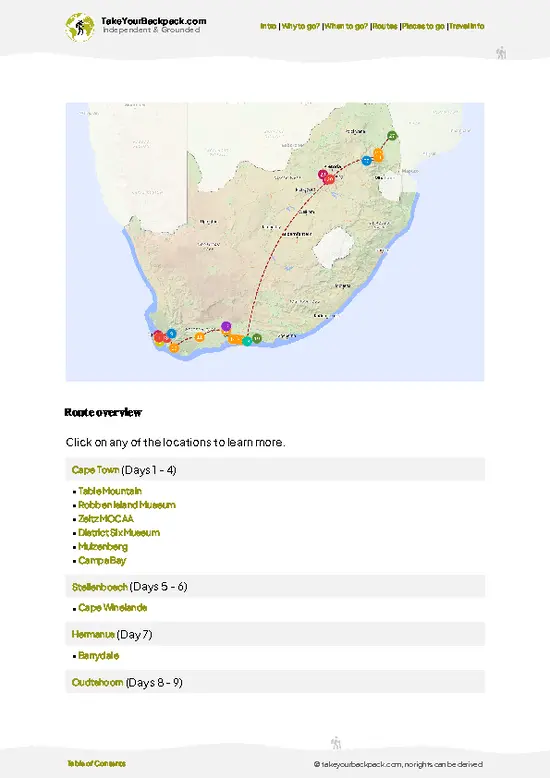
How long a multi-city trip takes: A trip combining several South African cities needs 10 to 21 days, and under 10 days is a mistake if it spans more than two regions. Distances are large, so the plan is built around flights and long-distance buses, not casual hops.
Which regions pair well: The easiest cluster is the Western Cape, where stops are 1 to 3 hours apart by road and rental cars or shuttle buses work well. The Eastern Cape coast and KwaZulu-Natal form another loose pairing, though they are separated by long stretches of rural road. Gauteng, with its main international hub at OR Tambo Airport, is best treated as an entry or exit point rather than a place to travel overland from. A sensible direction is to fly into Johannesburg or Cape Town, move through the coast in one direction, and … read more 👉
How long a multi-city trip takes: A trip combining several South African cities needs 10 to 21 days, and under 10 days is a mistake if it spans more than two regions. Distances are large, so the plan is built around flights and long-distance buses, not casual hops.
Which regions pair well: The easiest cluster is the Western Cape, where stops are 1 to 3 hours apart by road and rental cars or shuttle buses work well. The Eastern Cape coast and KwaZulu-Natal form another loose pairing, though they are separated by long stretches of rural road. Gauteng, with its main international hub at OR Tambo Airport, is best treated as an entry or exit point rather than a place to travel overland from. A sensible direction is to fly into Johannesburg or Cape Town, move through the coast in one direction, and fly out of the other. A one-way route avoids paying to backtrack.
Time per stop and transfers: Plan 2 to 4 nights per city. One night is not enough because arrival and orientation eat most of a day, and more than five nights in a single urban center rarely adds anything. Between regions, flights take roughly 1.5 to 2 hours and typically cost R800 to 2,000 (US$45 to 110) one way when booked ahead. Long-distance coach services take 12 to 20 hours for the major intercity runs, which is tiring and rarely saves money once you count lost time.
Planning mistakes to avoid: The most common error is trying to drive between distant cities in one sitting. Roads are good but long, and night driving is risky because of livestock and unlit sections, so cap days at 5 to 6 hours behind the wheel. Another is booking too many stops: three or four cities in two weeks is plenty. Finally, avoid arriving anywhere after dark by bus. Choose daytime arrivals and pre-book your first night.

The ListThe Best cities of South Africa

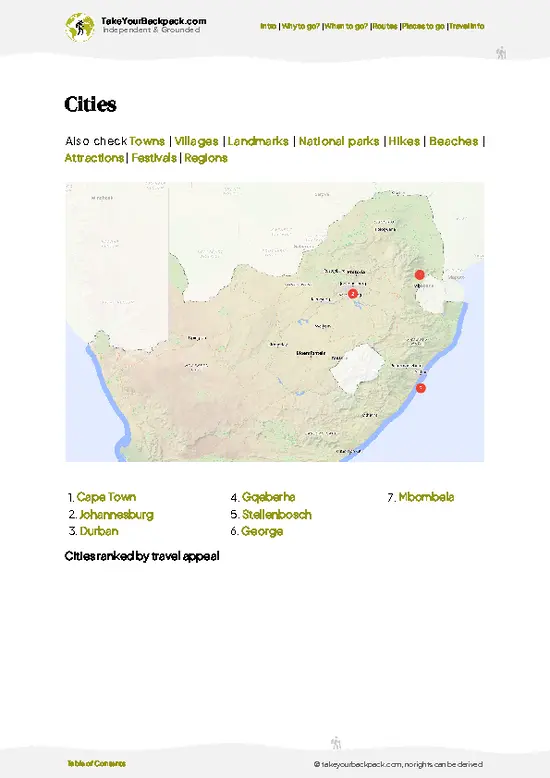
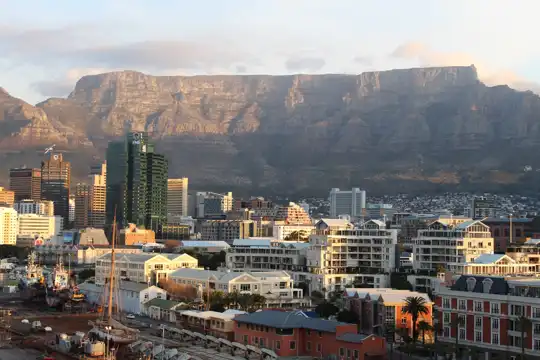
1 Cape Town

Table Mountain, Robben Island ferry, Bo-Kaap streets, penguin cove

Climb Platteklip Gorge or ride the cable car, then take the ferry to Mandela’s cell and finish among the penguins at Boulders.

South Africa - Cape Town

2 Johannesburg

Apartheid history, Soweto, Maboneng rooftops, Saturday food market

Trace the struggle story from the Apartheid Museum to Vilakazi Street, then eat your way through Braamfontein and Maboneng by ride-hail.

3 Durban

Warm surf, Golden Mile, masala markets, harborside arts

Swim at dawn along the Golden Mile, then follow the smell of spice into Victoria Street Market and the domes of Juma Masjid.

4 Gqeberha

Donkin pyramid, Route 67 art, Humewood surf, oceanarium

Walk the mosaic and steel sculptures of Route 67 up to the Donkin Reserve, then spend afternoons on patrolled beaches near the promenade.

5 Stellenbosch

Cape Dutch oaks, cellar tastings, student bars, Jonkershoek trails

Cycle between oak-shaded Dorp Street and wine estates, then hike fynbos trails to waterfalls in the Jonkershoek mountains outside town.

south-africa-city-stellenbosch
© Google |

6 George

Garden Route gateway, Slave Tree, railway yard, mountain passes

Use the town as a practical base, wander oak-lined streets, and drive the old gravel Montagu Pass between stone bridges and fynbos.

7 Mbombela

Kruger gateway, canopy walkway, giraffe stadium, fruit stalls

Cross the suspended walkway above the Crocodile River, buy mangoes and litchis at roadside stalls, and descend into the ancient Sudwala Caves.

Loading the map 🌍

Expert viewTips and Advice from Travelers

How many cities to visit: Three cities is the number I advise for most trips of two to three weeks. South Africa is large, transfers are long, and each stop needs at least three nights to feel worth the transit. Four is workable with 21 days or more. Five or more means you spend your trip in airports and bus stations, which is not worth the time.
Choosing between kinds of cities: Match the type to your style. Coastal, walkable cities with hostels, restaurants and outdoor activity suit first-timers and budget travelers best, because you can move around cheaply and meet other backpackers. Inland business and mining-era cities suit history and culture seekers who are willing to use guides and rideshares. Skip them if you want relaxed street wandering. If you only have time for one inland stop, … read more 👉
How many cities to visit: Three cities is the number I advise for most trips of two to three weeks. South Africa is large, transfers are long, and each stop needs at least three nights to feel worth the transit. Four is workable with 21 days or more. Five or more means you spend your trip in airports and bus stations, which is not worth the time.
Choosing between kinds of cities: Match the type to your style. Coastal, walkable cities with hostels, restaurants and outdoor activity suit first-timers and budget travelers best, because you can move around cheaply and meet other backpackers. Inland business and mining-era cities suit history and culture seekers who are willing to use guides and rideshares. Skip them if you want relaxed street wandering. If you only have time for one inland stop, choose it for a specific museum or neighborhood tour, not general sightseeing.
What it costs: Budget about R900 to 1,500 (US$50 to 85) a day as a backpacker, covering a dorm bed at R250 to 500, meals at R150 to 350 a day in casual cafes and markets, and local transport. A mid-range traveler should plan R1,800 to 3,000 (US$100 to 165) a day. Rideshare trips within a city typically cost R50 to 200 (US$3 to 11), and they add up fast if you use them for every move. Guided township or history tours run R500 to 1,200 (US$28 to 65) per person and are one of the better uses of money. Museum entry is usually R50 to 250 (US$3 to 14). Table Mountain-style cable rides and similar attractions cost more, so check prices and book online for a discount where offered.
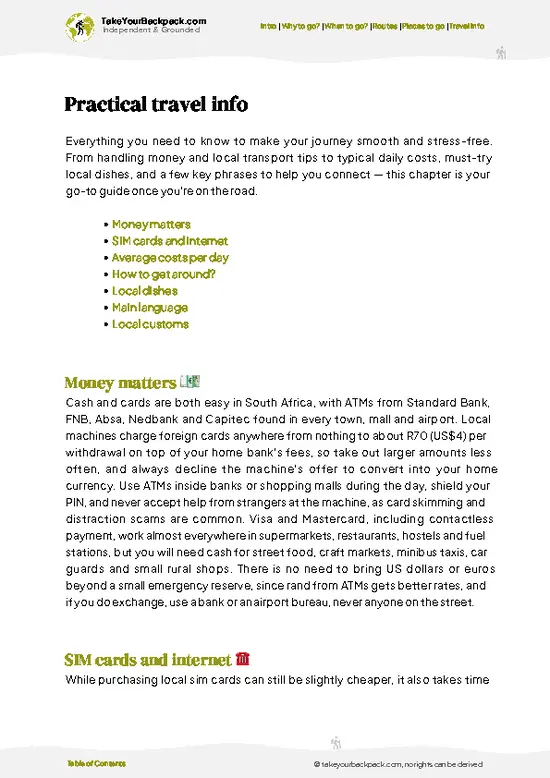
Costs and delays that catch people out: Airport transfers are a quiet drain. Taxis from major airports can cost R400 to 800 (US$22 to 45), so use official shuttles, trains where available, or a pre-ordered rideshare. Checked-bag fees on low-cost domestic airlines can nearly double a cheap fare, so travel light. Car rental looks cheap at R300 to 600 (US$17 to 33) a day, but add insurance, fuel, parking and one-way drop fees, which can be steep. Load shedding, the scheduled power cuts, can disrupt ATMs, card machines and Wi-Fi, so carry some cash and keep devices charged.
Safety in cities: Crime is the main concern, and it is manageable with discipline. Use ride-hailing after dark, even for short distances. Keep phones out of sight on the street, do not walk with a camera around your neck, and leave passports in a hostel locker, carrying a copy. Do not walk between neighborhoods you do not know, since the contrast between safe and unsafe areas can be a few blocks. Choose accommodation with secure entry and good recent reviews. At ATMs, use machines inside malls or banks. Do not accept help from strangers when withdrawing cash.
Cultural considerations: South Africa has eleven official languages, and English is widely understood in cities. A greeting before asking anything is expected and goes a long way. Tipping 10 to 15 percent in restaurants is standard, as service staff rely on it, and informal car guards expect R5 to 10. Treat township tours as paid history lessons with local operators, not photo stops: ask before photographing people, and choose community-run operators so the money stays local. Talk about apartheid with respect and listen more than you comment.

✈️ The backpacker research shortcutSouth Africa Travel Guide

An offline-friendly backpacking guide with optimized travel routes, ranked highlights, transport advice, and the best areas to stay.
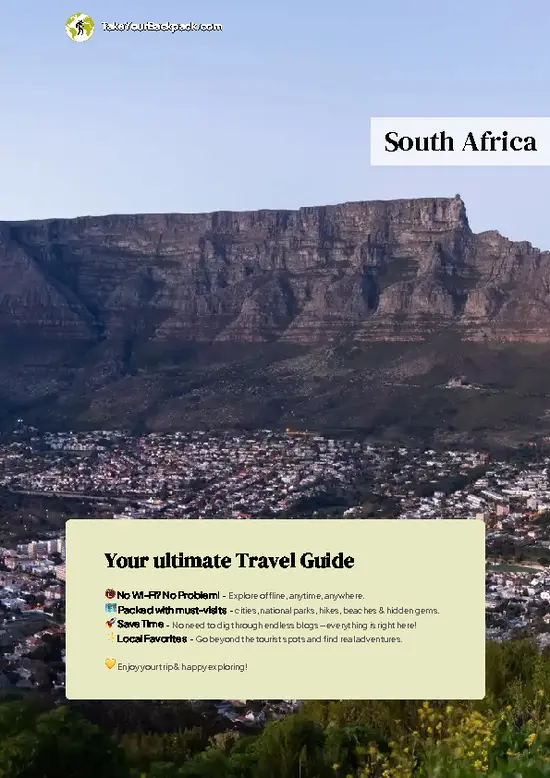
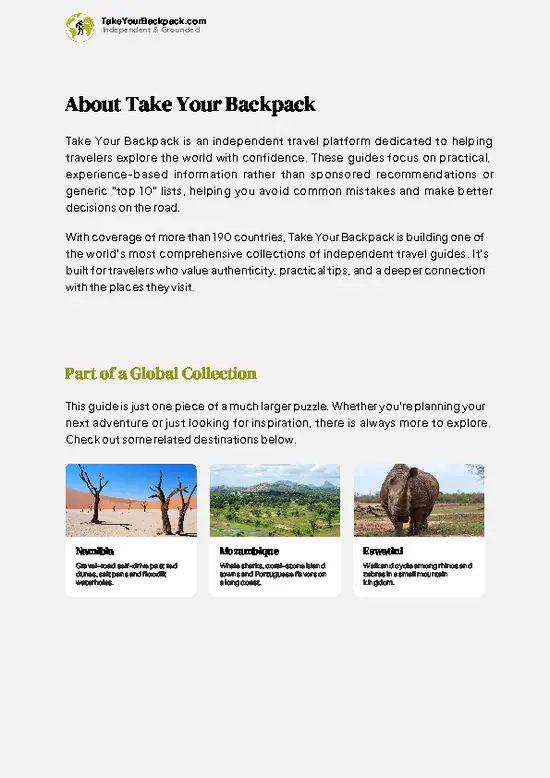
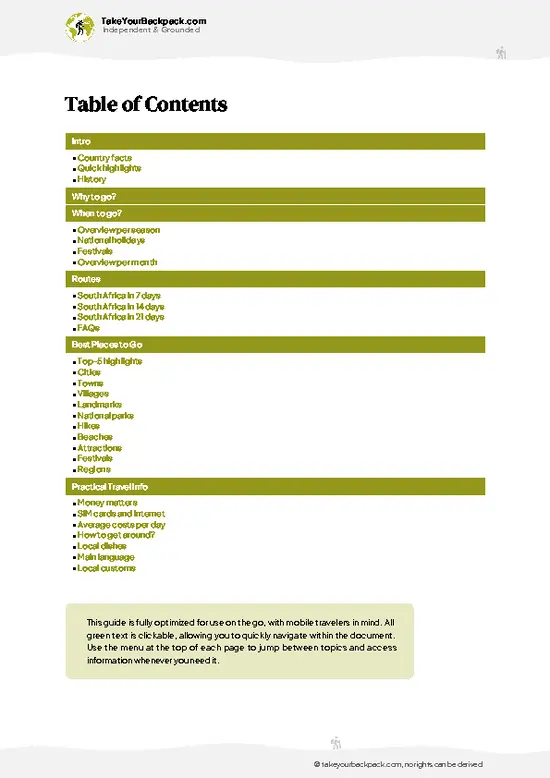
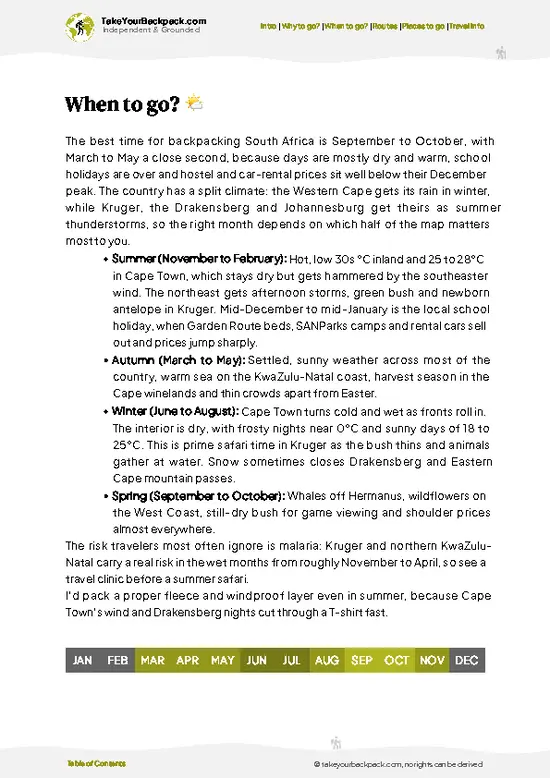
example page 0 from our offline Travel Guide for South Africa
example page 1 from our offline Travel Guide for South Africa
example page 2 from our offline Travel Guide for South Africa
example page 3 from our offline Travel Guide for South Africa
example page 4 from our offline Travel Guide for South Africa
example page 5 from our offline Travel Guide for South Africa
example page 6 from our offline Travel Guide for South Africa
example page 7 from our offline Travel Guide for South Africa
The digital guide (457 pages) contains:
✅ 125 highlights, ranked by travel appeal
✅ Optimized 7, 14 & 21-day travel routes
✅ Cities, national parks, landmarks, beaches
✅ How to get around
✅ Offline-friendly for travel without Wi-Fi
👉 Click to see all 30+ guide features

📅 Plan smarter in minutes, not weeks
✅ Month by month travel advice
✅ Festivals & national holidays
✅ Budget expectations

🗺️ Go to the right places, skip the overrated ones
✅ Honest pros & cons of destinations
✅ Top hikes, parks & viewpoints
✅ Lesser-known places most travelers miss
✅ Clear “worth it vs skip it” guidance

🛏️ Travel smoothly without rookie mistakes
✅ Best areas to stay
✅ Transport systems explained simply
✅ Common scams & safety advice
✅ SIM cards, money & practical tips

🌍 Understand the country, not just visit it
✅ Culture & traditions
✅ 52 Essential phrases & customs
✅ Festivals worth planning around
✅ Traveler-friendly historical context
✅ Insights that make places more meaningful

📱 Built for real travel conditions
✅ Fully downloadable PDF
✅ Works completely offline
✅ Optimized for phone use
✅ Useful in remote areas & buses
✅ Everything in one place
Stop searching, start planning
Get instant access to your full guide. 30‑day money-back guarantee.
+ Add another guide for just

By proceeding you agree to our terms.
Sent to your inbox immediately after payment • 100% Secure Checkout
Best Backpacking Travel Advisor 2025 tourism awardBest Backpacking
Travel Advisor
2025
What others say about Take Your Backpack Guides:
⭐⭐⭐⭐⭐
Fantastic, amazing amount of information!
⭐⭐⭐⭐⭐
My goodness this is amazing, it's what I've been looking for hats off too you!
⭐⭐⭐⭐⭐
I think this is absolutely BRILLIANT
⭐⭐⭐⭐
Very complete and informative. It's still missing places, but I gotta to commend you
⭐⭐⭐⭐⭐
This is truly amazing, thank you, can't wait to explore it with my kids!
⭐⭐⭐⭐⭐
Awesome resource, thank you!
⭐⭐⭐⭐⭐
This is amazing! Can't wait to explore the ones I haven't seen
⭐⭐⭐⭐
I love this! Well done, great idea.
⭐⭐⭐⭐⭐
Thanks for taking the time to make this gem!
⭐⭐⭐⭐⭐
This might be the best website I've ever seen.
⭐⭐⭐⭐⭐
Congratulations, and thank you so much for your work; it's incredibly valuable.
⭐⭐⭐⭐
In all seriousness I think you did a great job pointing out the important spots
⭐⭐⭐⭐⭐
10/10 very good
⭐⭐⭐⭐⭐
As someone who's only just starting to visit regularly this is awesome, thank you.
⭐⭐⭐⭐
Thank you very much! I'm going to visit my dad, it's going to be very useful!
⭐⭐⭐⭐⭐
This is really cool! We'll be travelling for the first time and this definitely come in handy.
⭐⭐⭐⭐⭐
You are now our minister of culture, congratulations 👨‍💼
⭐⭐⭐⭐⭐
Just wanted to tell you that this is a pearl! Going to follow your recommendations.
⭐⭐⭐⭐⭐
This is so cool. I'll definitely be using the resource for my travels soon.
⭐⭐⭐⭐⭐
This is very impressive! Good work.
⭐⭐⭐⭐⭐
This is an amazing and informative site. Very well done!

🛏️ Where to stay?Best Stay Options in South Africa

South Africa has a dense hostel network, with dorm beds typically running R250 to 450 (about US$14 to 25) and private doubles from roughly R700 to 1,200 (US$38 to 65), especially in Cape Town and along the Garden Route in towns like Knysna and Wilderness. In Cape Town, the City Bowl around Long Street puts you near Table Mountain trailheads and the loudest bars but gets sketchy after dark, while Sea Point trades nightlife for a seafront promenade and calmer streets with easy minibus taxi links into town. In Johannesburg, leafy Melville is the safer, low-key pick with a strip of student bars, whereas Maboneng has the street art and weekend buzz but sits in an area where you should take an e-hailing … read more 👉
South Africa has a dense hostel network, with dorm beds typically running R250 to 450 (about US$14 to 25) and private doubles from roughly R700 to 1,200 (US$38 to 65), especially in Cape Town and along the Garden Route in towns like Knysna and Wilderness. In Cape Town, the City Bowl around Long Street puts you near Table Mountain trailheads and the loudest bars but gets sketchy after dark, while Sea Point trades nightlife for a seafront promenade and calmer streets with easy minibus taxi links into town. In Johannesburg, leafy Melville is the safer, low-key pick with a strip of student bars, whereas Maboneng has the street art and weekend buzz but sits in an area where you should take an e-hailing ride at night, and in Durban the Morningside area around Florida Road offers restaurants and relative quiet a short drive from the beachfront.

If you enjoy meeting fellow travelers, consider choosing hostels with high ratings for atmosphere. On the other hand, if you prefer having your own space, a hotel might be a better option.

South AfricaWhere to Go Next

👋 Meet the founderWho’s Behind Take Your Backpack?

Johan, backpacker and founder of TakeYourBackpackHi, I’m Johan (Netherlands 🇳🇱), the creator of TakeYourBackpack. Over the past 3 decades, I’ve backpacked through 90+ countries across six continents, gaining extensive experience with independent travel, long-term trips, and overland routes.

This site is built on a combination of firsthand travel experience and carefully curated insights from other backpackers. Many guides are based on places I’ve personally visited, while others bring together tips, observations, and practical advice shared by trusted travelers I’ve met along the way.

The goal is to provide realistic, experience-driven guidance — not generic itineraries — so you can explore destinations with better context, clearer expectations, and more confidence.