×

South Africa🇿🇦 | best festivalsWhere to Find the 10 Best festivals in South Africa

Festivals in South Africa run from free township street parties to ticketed arts weeks and desert-farm music weekends that cost as much as a week of hostel beds. The country has no single festival culture, and the region you pick changes everything. The Western Cape has the polished, well-organized events: easy to reach, safe to walk between venues, and priced accordingly. Gauteng and KwaZulu-Natal offer the rawest local energy, but public transport is thin and an event at night means a ride-hailing app or a hostel shuttle. The Eastern Cape and the Karoo deliver small-town arts gatherings where a backpacker is a curiosity and prices stay low. Skip anything that needs a rental car if you are traveling independently on a tight budget, unless you can split fuel with other travelers. Back the events with a cultural or musical core, because the corporate-sponsored ones are mostly wine tents and queues.

By Johan Kruseman 🇳🇱 | Updated October 23, 2026
Explore the best regions in South Africa

Why go?Understanding Their Importance

South Africa is one of the few countries where music, politics and landscape are bound together, and that is what separates its festivals from the generic summer circuit elsewhere. Apartheid-era censorship pushed jazz, choral music, theater and poetry into churches, shebeens and township halls. Many of today's gatherings still carry that defiance, which is why live jazz, gumboot dance and protest theater sit at the center of the calendar rather than on the edges. Eleven official languages and living Zulu, Xhosa, Afrikaans, Sotho and Cape Malay traditions mean a single weekend can feel like several countries, and you hear that range on stage.

The climate helps. Most of the country gets strong sun and dry air for months, so open-air events run with little weather risk, and the festival infrastructure … read more 👉
South Africa is one of the few countries where music, politics and landscape are bound together, and that is what separates its festivals from the generic summer circuit elsewhere. Apartheid-era censorship pushed jazz, choral music, theater and poetry into churches, shebeens and township halls. Many of today's gatherings still carry that defiance, which is why live jazz, gumboot dance and protest theater sit at the center of the calendar rather than on the edges. Eleven official languages and living Zulu, Xhosa, Afrikaans, Sotho and Cape Malay traditions mean a single weekend can feel like several countries, and you hear that range on stage.

The climate helps. Most of the country gets strong sun and dry air for months, so open-air events run with little weather risk, and the festival infrastructure is far better than in most of the continent: working sound systems, regulated campsites, card payments, and reliable ticketing through Computicket and Quicket.

Know the limits before committing. Distances are huge, and public transport between festival towns is poor. Intercity buses like Greyhound, Intercape and FlixBus cover main routes, but the last stretch into a small town often needs a lift or a pre-booked shuttle. Crime is a real factor after dark in cities, so night travel is planned, not improvised. Accommodation in festival towns sells out months ahead and prices jump sharply. Do not expect Europe-style rail links or cheap last-minute beds. If you want spontaneity, choose events in large cities with plenty of hostels. If you want atmosphere, accept that planning ahead is the price.
Behind the Scenes of Selection
The list of best festivals in South Africa is created based on energy, traditions, crowd experience, activities, and overall excitement. If you feel a festival is missing in this list, please let us know.

When to go?Best Time to Visit South Africa for festivals

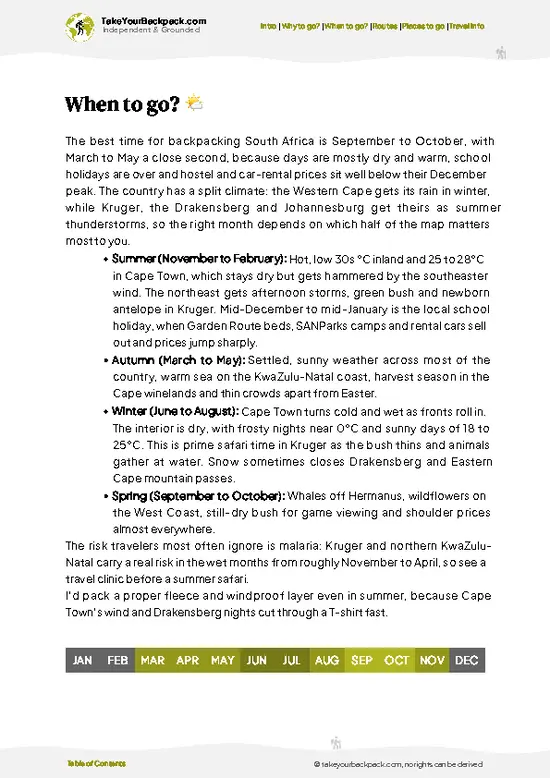
Best months for festivals: The best months are March to May and September to November, because daytime temperatures sit around 18 to 28°C, rain is light across most of the country, and the event calendar is at its fullest. Summer, from December to February, is the other major window, but it comes with higher costs and different problems.
Weather by region: The Western Cape has a Mediterranean pattern: dry, hot summers (25 to 35°C, with strong southeaster wind in Cape Town) and wet winters from June to August, when rain and 8 to 18°C days make outdoor events unpleasant. Gauteng, the Free State and Mpumalanga get summer thunderstorms, usually in the afternoon, from November to March. Their winters are dry and sunny but cold at night, often near freezing. KwaZulu-Natal is humid and hot in summer … read more 👉
Best months for festivals: The best months are March to May and September to November, because daytime temperatures sit around 18 to 28°C, rain is light across most of the country, and the event calendar is at its fullest. Summer, from December to February, is the other major window, but it comes with higher costs and different problems.
Weather by region: The Western Cape has a Mediterranean pattern: dry, hot summers (25 to 35°C, with strong southeaster wind in Cape Town) and wet winters from June to August, when rain and 8 to 18°C days make outdoor events unpleasant. Gauteng, the Free State and Mpumalanga get summer thunderstorms, usually in the afternoon, from November to March. Their winters are dry and sunny but cold at night, often near freezing. KwaZulu-Natal is humid and hot in summer (up to 30°C or more), with milder, drier winters. The Karoo is extreme: over 35°C in summer, frosty in winter, and almost no rain.
Peak periods and prices: The December to early January school holidays are the real peak. Coastal accommodation in Cape Town and along the Garden Route can cost two to three times the off-season rate, with dorm beds rising from roughly R250 to R400 or more. Easter and the late September holiday weekend also fill small festival towns quickly. Book beds three to six months ahead for those dates.
Shoulder seasons: Late April to May and September to early October give the best balance: lower prices, pleasant weather and room in hostels. Winter is worth considering only for indoor-focused or northern events. The Western Cape in July is a poor bet for outdoor plans.

festival hoppingPlanning Your Route Efficiently

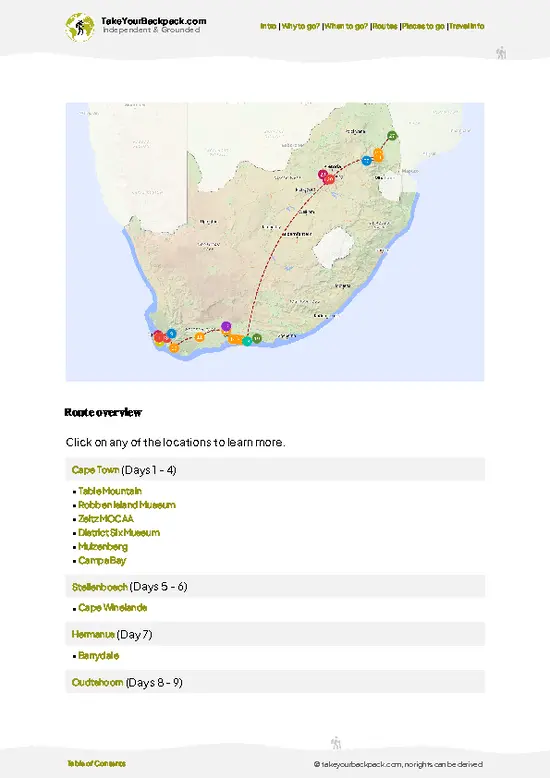
How long a multi-festival trip needs: A trip linking several festivals in South Africa needs 14 to 21 days, because distances are large and the connections between festival towns are slow. Trying to squeeze it into ten days means spending most of it on buses.
Regions that cluster well: The Western Cape works as one cluster: Cape Town, the Winelands around Stellenbosch and Franschhoek, and the Overberg are 1 to 3 hours apart by road. The Eastern Cape and Garden Route form a second chain, from Gqeberha through Plettenberg Bay to Oudtshoorn, with 2 to 4 hours between stops. Gauteng (Johannesburg and Pretoria) pairs with Mpumalanga or KwaZulu-Natal, though the Joburg to Durban leg is about 7 to 8 hours by bus. Cape Town to Johannesburg is roughly 18 hours overland, so fly (1 hour 50 minutes, often … read more 👉
How long a multi-festival trip needs: A trip linking several festivals in South Africa needs 14 to 21 days, because distances are large and the connections between festival towns are slow. Trying to squeeze it into ten days means spending most of it on buses.
Regions that cluster well: The Western Cape works as one cluster: Cape Town, the Winelands around Stellenbosch and Franschhoek, and the Overberg are 1 to 3 hours apart by road. The Eastern Cape and Garden Route form a second chain, from Gqeberha through Plettenberg Bay to Oudtshoorn, with 2 to 4 hours between stops. Gauteng (Johannesburg and Pretoria) pairs with Mpumalanga or KwaZulu-Natal, though the Joburg to Durban leg is about 7 to 8 hours by bus. Cape Town to Johannesburg is roughly 18 hours overland, so fly (1 hour 50 minutes, often US$40 to 90 one way booked ahead).
Direction of travel: Run west to east along the coast or follow the calendar, starting in the Western Cape and finishing in Gauteng, so the longest leg is a flight rather than a bus. Reversing it works too, but flights out of Johannesburg to Cape Town are busier near holidays.
Time per stop: Give a big city two to four nights. A festival town needs two to three nights, including a buffer day on each side. Small towns need less, but not under two nights, since arrival often lands late in the afternoon.
Planning mistakes: The first is stacking festivals on consecutive days in different provinces. Leave at least one full day between regions. The second is relying on buses for the last leg: pre-book shuttles or shared rides instead. The third is booking beds late. Reserve accommodation before transport, because beds vanish first. Finally, avoid driving long distances at night. Arrive in daylight, and add a day of margin around any flight.

The ListThe Best festivals of South Africa

1 AfrikaBurn

Tankwa Karoo desert, Clan burn, Temple burn, art cars, gifting culture

Build a temporary town on the stony Karoo plain, ride between lit sculptures after dark, and watch the Clan and Temple burn.

2 Cape Town International Jazz Festival

CTICC stages, Afro-fusion, two-day lineup, free community concert

Hop between five stages under one roof to hear South African jazz and international headliners, plus a free neighborhood concert beforehand.

3 National Arts Festival

Makhanda streets, Fringe gamble, Village Green Market, 1820 Settlers Monument

Walk a small university town turned into a venue, mixing Fringe gambles with curated productions and market food between shows.

4 Klein Karoo Nasionale Kunstefees

Afrikaans theater, Oudtshoorn, craft market, stand-up queues

Cross Oudtshoorn between school-hall plays, evening concerts and comedy sets, with a leather and ceramics market around the central venues.

5 Knysna Oyster Festival

Lagoon oysters, forest marathon, Thesen Island, mountain biking

Taste lagoon oysters raw or grilled, run or ride through indigenous forest, and finish evenings at the waterfront stalls.

6 Hermanus Whale Festival

Southern right whales, cliff path, Whale Crier, kelp horn

Follow the cliff path to watch whales calve close to the rocks, guided by the town crier's kelp horn.

7 Oppikoppi

Bushveld koppie, rock and metal, thornveld dust, campsite bars

Camp on a rocky Limpopo farm, watch loud local bands from the koppie, and wear sturdy shoes for the thorns and dust.

8 Splashy Fen Music Festival

Natural amphitheater, Easter weekend, Drakensberg foothills, Sani Pass

Pitch a tent on higher ground, hear folk and blues from grassy slopes, and add a 4x4 day up Sani Pass.

9 Cape Town Carnival

Green Point floats, stilt walkers, township dance troupes, drum lines

Line the Green Point route for one night of floats, brass bands and neighborhood dance crews, with Table Mountain behind the parade.

10 Franschhoek Literary Festival

Author talks, wine estate venues, Huguenot Road, book signings

Move between marquee sessions and vineyard venues along Huguenot Road, then buy signed South African titles at the festival bookshop.

11 Wacky Wine Weekend

Costumed tastings, Cap Classique, Robertson wine farms, tasting glass

Wander between Robertson wine farms in costume, sampling Chenin, Colombar and Cap Classique bubbly to live music on the lawns.

12 Robertson Wine on the River

Breede riverbank, Robertson cellars, winemaker pours, shade trees

Compare Chardonnay, Shiraz and Cabernet from Robertson cellars while sitting under shade trees beside the Breede River.

13 Ficksburg Cherry Festival

Cherry orchards, farm-gate fruit, Lesotho border, braai smoke

Pick fresh fruit at the orchards around town, then join the main street parade and stalls selling cherry jam, liqueur and pies.

14 Soweto Wine Festival

Black-owned labels, amapiano stages, kota sandwiches, Vilakazi Street

Taste wines from Black-owned producers in Soweto, dance to jazz and house sets, and add Vilakazi Street before or after.

15 Up the Creek Music Festival

River tubing, willow camping, Swellendam farm, late-night DJ sets

Float the Breede between sets, camp beneath willows, and dance to electronic sessions that run into the early hours.

16 Mieliepop Festival

Afrikaans rock, highveld camping, braai fires, bakkie tailgates

Camp among families on the Mpumalanga highveld, share braai fires, and sing along to Afrikaans acts as the evening cools.

17 Darling Wildflower Show

Labeled wildflower jars, Swartland veld, village hall, reserve footpaths

Study hundreds of identified veld species in the town hall, then walk the nearby reserve to see the same blooms growing.

Think you know South Africa?

Prove you’re a true local — uncover 7 lesser-known festivals in South Africa that locals tend to keep to themselves.
Loading the map 🌍

Expert viewTips and Advice from Travelers

How many festivals to attend: Plan on two to three festivals in a trip of two to three weeks. South Africa is too large to string together more without spending your days in transit, and each event needs a rest day afterward. One anchor event with a couple of smaller ones around it gives more atmosphere than a rushed list.
Which kind to prioritize: Travelers on a tight budget should choose free or low-cost city and township events, such as street carnivals and community arts days, which give the strongest local flavor for the least money. Music lovers should pick one multi-day camping festival and accept the bill. Culture-focused travelers do better with arts and heritage gatherings in smaller towns, where talks, theater and crafts happen within walking distance of cheap guesthouses. Skip large … read more 👉
How many festivals to attend: Plan on two to three festivals in a trip of two to three weeks. South Africa is too large to string together more without spending your days in transit, and each event needs a rest day afterward. One anchor event with a couple of smaller ones around it gives more atmosphere than a rushed list.
Which kind to prioritize: Travelers on a tight budget should choose free or low-cost city and township events, such as street carnivals and community arts days, which give the strongest local flavor for the least money. Music lovers should pick one multi-day camping festival and accept the bill. Culture-focused travelers do better with arts and heritage gatherings in smaller towns, where talks, theater and crafts happen within walking distance of cheap guesthouses. Skip large wine and food festivals if you are watching money. Entry is often R200 to R600 (about US$11 to 33) before you buy a single glass, and most of the experience is queuing.
What it costs: A realistic backpacker budget is US$35 to 60 a day: dorm bed R250 to R450 (US$14 to 25), food R150 to R300, local transport R50 to R200. Festival-day costs sit on top of that. Entry runs from free to about R300 for community events, R700 to R2,500 (US$38 to 135) for multi-day music festivals, and camping adds R200 to R600. Budget R300 to R800 for a round-trip ride-hailing fare or shuttle after dark, and plan on R100 to R200 for water and food at venues. Card payments are widely accepted, but carry some cash for small stalls.
Costs that catch people out: Buying tickets late is the most expensive mistake: early-bird prices commonly rise by 20 to 40 percent, and popular events sell out. Buy through official platforms only. Accommodation near festival sites is the next trap, with prices doubling and minimum stays of two to three nights. Book early or stay in a larger town and commute. Camp fees often exclude firewood, ice and parking, so check the listing.
Safety at festivals: Festival grounds are usually well-managed, but the journey to and from is where problems happen. Do not walk between venues and accommodation after dark in cities. Use a ride-hailing app such as Uber or Bolt, or an organizer-run shuttle, and book the return ride before the event starts. Keep phones out of sight in crowds and leave passports in the room, carrying a copy instead. Never leave drinks unattended, and in tented camps use a padlock. Sun is a hazard: UV is strong, so bring a hat and a refillable bottle.
Cultural considerations: Many events have deep roots in Black, Cape Malay, Afrikaans and Indian communities, and some gatherings are religious or commemorative. Ask before photographing people, particularly in costume or at ceremonies, and do not treat traditional dress as a prop. Dress modestly at heritage events in rural areas. Learn a greeting: a simple “Sawubona” in Zulu or “Molo” in Xhosa goes a long way. Tipping car guards R5 to R10 is normal and expected. Avoid commenting on politics unless the locals bring it up first, since it is a sensitive subject that often runs through the stage content itself.

✈️ The backpacker research shortcutSouth Africa Travel Guide

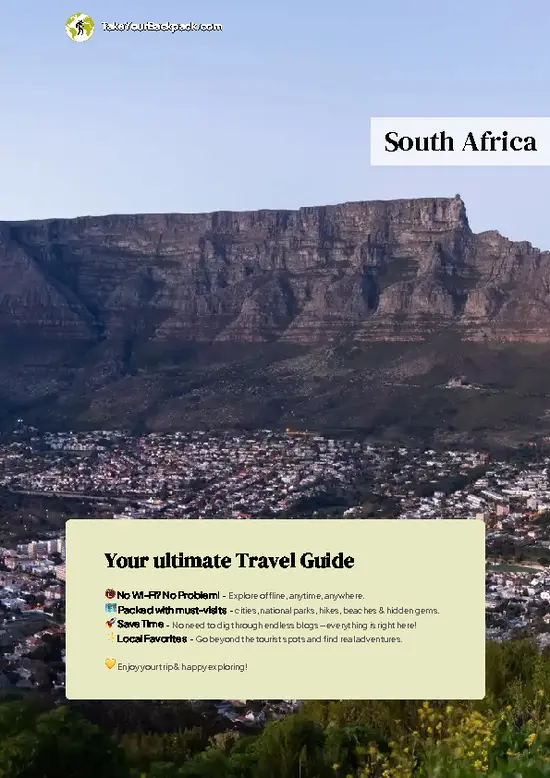
An offline-friendly backpacking guide with optimized travel routes, ranked highlights, transport advice, and the best areas to stay.
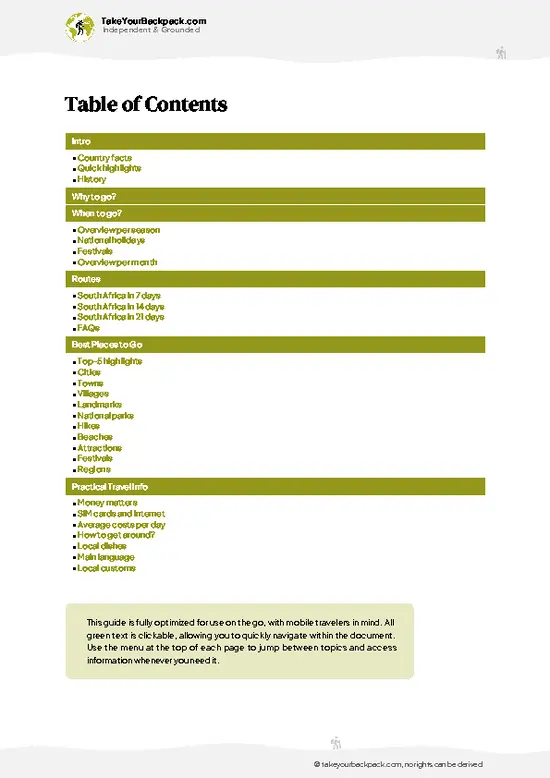
example page 0 from our offline Travel Guide for South Africa
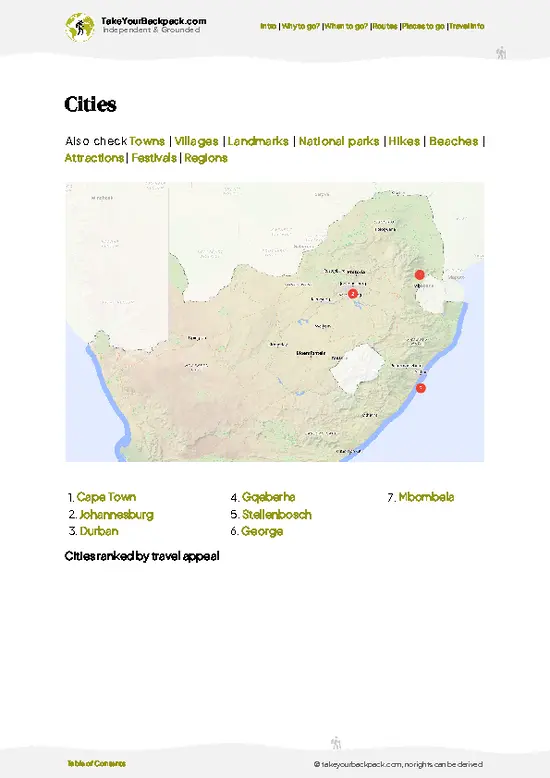
example page 1 from our offline Travel Guide for South Africa
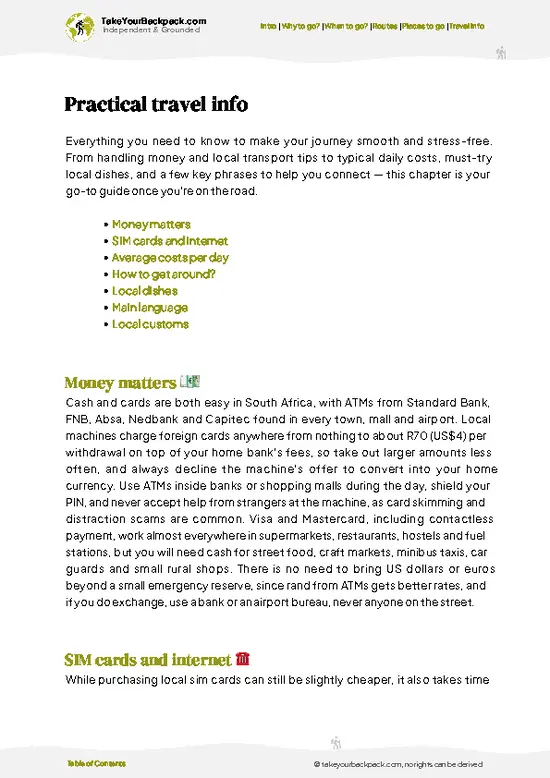
example page 2 from our offline Travel Guide for South Africa
example page 3 from our offline Travel Guide for South Africa
example page 4 from our offline Travel Guide for South Africa
example page 5 from our offline Travel Guide for South Africa
example page 6 from our offline Travel Guide for South Africa
example page 7 from our offline Travel Guide for South Africa
The digital guide (457 pages) contains:
✅ 125 highlights, ranked by travel appeal
✅ Optimized 7, 14 & 21-day travel routes
✅ Cities, national parks, landmarks, beaches
✅ How to get around
✅ Offline-friendly for travel without Wi-Fi
👉 Click to see all 30+ guide features

📅 Plan smarter in minutes, not weeks
✅ Month by month travel advice
✅ Festivals & national holidays
✅ Budget expectations

🗺️ Go to the right places, skip the overrated ones
✅ Honest pros & cons of destinations
✅ Top hikes, parks & viewpoints
✅ Lesser-known places most travelers miss
✅ Clear “worth it vs skip it” guidance

🛏️ Travel smoothly without rookie mistakes
✅ Best areas to stay
✅ Transport systems explained simply
✅ Common scams & safety advice
✅ SIM cards, money & practical tips

🌍 Understand the country, not just visit it
✅ Culture & traditions
✅ 52 Essential phrases & customs
✅ Festivals worth planning around
✅ Traveler-friendly historical context
✅ Insights that make places more meaningful

📱 Built for real travel conditions
✅ Fully downloadable PDF
✅ Works completely offline
✅ Optimized for phone use
✅ Useful in remote areas & buses
✅ Everything in one place
Stop searching, start planning
Get instant access to your full guide. 30‑day money-back guarantee.
+ Add another guide for just

By proceeding you agree to our terms.
Sent to your inbox immediately after payment • 100% Secure Checkout
Best Backpacking Travel Advisor 2025 tourism awardBest Backpacking
Travel Advisor
2025
What others say about Take Your Backpack Guides:
⭐⭐⭐⭐⭐
Fantastic, amazing amount of information!
⭐⭐⭐⭐⭐
My goodness this is amazing, it's what I've been looking for hats off too you!
⭐⭐⭐⭐⭐
I think this is absolutely BRILLIANT
⭐⭐⭐⭐
Very complete and informative. It's still missing places, but I gotta to commend you
⭐⭐⭐⭐⭐
This is truly amazing, thank you, can't wait to explore it with my kids!
⭐⭐⭐⭐⭐
Awesome resource, thank you!
⭐⭐⭐⭐⭐
This is amazing! Can't wait to explore the ones I haven't seen
⭐⭐⭐⭐
I love this! Well done, great idea.
⭐⭐⭐⭐⭐
Thanks for taking the time to make this gem!
⭐⭐⭐⭐⭐
This might be the best website I've ever seen.
⭐⭐⭐⭐⭐
Congratulations, and thank you so much for your work; it's incredibly valuable.
⭐⭐⭐⭐
In all seriousness I think you did a great job pointing out the important spots
⭐⭐⭐⭐⭐
10/10 very good
⭐⭐⭐⭐⭐
As someone who's only just starting to visit regularly this is awesome, thank you.
⭐⭐⭐⭐
Thank you very much! I'm going to visit my dad, it's going to be very useful!
⭐⭐⭐⭐⭐
This is really cool! We'll be travelling for the first time and this definitely come in handy.
⭐⭐⭐⭐⭐
You are now our minister of culture, congratulations 👨‍💼
⭐⭐⭐⭐⭐
Just wanted to tell you that this is a pearl! Going to follow your recommendations.
⭐⭐⭐⭐⭐
This is so cool. I'll definitely be using the resource for my travels soon.
⭐⭐⭐⭐⭐
This is very impressive! Good work.
⭐⭐⭐⭐⭐
This is an amazing and informative site. Very well done!

🛏️ Where to stay?Where to Base Yourself

South Africa has a dense hostel network, with dorm beds typically running R250 to 450 (about US$14 to 25) and private doubles from roughly R700 to 1,200 (US$38 to 65), especially in Cape Town and along the Garden Route in towns like Knysna and Wilderness. In Cape Town, the City Bowl around Long Street puts you near Table Mountain trailheads and the loudest bars but gets sketchy after dark, while Sea Point trades nightlife for a seafront promenade and calmer streets with easy minibus taxi links into town. In Johannesburg, leafy Melville is the safer, low-key pick with a strip of student bars, whereas Maboneng has the street art and weekend buzz but sits in an area where you should take an e-hailing … read more 👉
South Africa has a dense hostel network, with dorm beds typically running R250 to 450 (about US$14 to 25) and private doubles from roughly R700 to 1,200 (US$38 to 65), especially in Cape Town and along the Garden Route in towns like Knysna and Wilderness. In Cape Town, the City Bowl around Long Street puts you near Table Mountain trailheads and the loudest bars but gets sketchy after dark, while Sea Point trades nightlife for a seafront promenade and calmer streets with easy minibus taxi links into town. In Johannesburg, leafy Melville is the safer, low-key pick with a strip of student bars, whereas Maboneng has the street art and weekend buzz but sits in an area where you should take an e-hailing ride at night, and in Durban the Morningside area around Florida Road offers restaurants and relative quiet a short drive from the beachfront.

If you enjoy meeting fellow travelers, consider choosing hostels with high ratings for atmosphere. On the other hand, if you prefer having your own space, a hotel might be a better option.

South AfricaExpand Your Journey

👋 Meet the founderWho’s Behind Take Your Backpack?

Johan, backpacker and founder of TakeYourBackpackHi, I’m Johan (Netherlands 🇳🇱), the creator of TakeYourBackpack. Over the past 3 decades, I’ve backpacked through 90+ countries across six continents, gaining extensive experience with independent travel, long-term trips, and overland routes.

This site is built on a combination of firsthand travel experience and carefully curated insights from other backpackers. Many guides are based on places I’ve personally visited, while others bring together tips, observations, and practical advice shared by trusted travelers I’ve met along the way.

The goal is to provide realistic, experience-driven guidance — not generic itineraries — so you can explore destinations with better context, clearer expectations, and more confidence.