×

South Africa🇿🇦 | best attractionsWhere to Find the 10 Best attractions in South Africa

South Africa packs more variety into one country than most continents manage, and that is exactly why you need to pick a lane. The Western Cape is the easy, polished option: Cape Town’s mountain, coast and wine valleys sit within a two-hour drive, with good hostels and steady crowds. The Garden Route adds forest, beaches and adventure sports, but costs climb in December. Kruger and the northeast deliver the big game, yet self-drive is only cheap if you share a rental car. KwaZulu-Natal and the Drakensberg offer hiking with far fewer people. Johannesburg and Pretoria carry the heavy history of apartheid, and they are worth a full day each. Skip anything sold as a quick photo stop from a tour bus. Independent travelers get the best value by renting a car, splitting costs and choosing two or three regions, not all of them.

By Johan Kruseman 🇳🇱 | Updated October 23, 2026
Explore the best festivals in South Africa

Why go?Understanding Their Importance

South Africa suits attractions better than almost any country because geography and history overlap in a compact, well-equipped package. Three oceans’ worth of influence, from the cold Atlantic to the warm Indian Ocean, a high interior plateau and the Drakensberg escarpment create wildly different landscapes within a few hours’ drive. Few places let you see big game, walk a mountain and tour a wine estate in the same week.

The infrastructure is a real advantage. Roads between major regions are paved and well signed, national parks run organized booking systems, and the tourism sector is mature enough that guides, hostels and activity operators are easy to find and compare. Prices are low by Western standards because of the weak rand, so you get serious value on safaris, wine and adventure … read more 👉
South Africa suits attractions better than almost any country because geography and history overlap in a compact, well-equipped package. Three oceans’ worth of influence, from the cold Atlantic to the warm Indian Ocean, a high interior plateau and the Drakensberg escarpment create wildly different landscapes within a few hours’ drive. Few places let you see big game, walk a mountain and tour a wine estate in the same week.

The infrastructure is a real advantage. Roads between major regions are paved and well signed, national parks run organized booking systems, and the tourism sector is mature enough that guides, hostels and activity operators are easy to find and compare. Prices are low by Western standards because of the weak rand, so you get serious value on safaris, wine and adventure activities.

The history adds a layer that no other country matches. Apartheid, the liberation struggle and Nelson Mandela’s legacy are presented through museums, townships and former prisons, and these are worth your time far more than generic city sightseeing.

Know before you choose: public transport between regions is thin, so independent travel usually means a rental car or a coach such as Greyhound or Intercape. Distances are long, and trying to cover the whole country in two weeks wastes days on the road. Safety needs planning, with no walking after dark in most city centers and careful parking. Load shedding (scheduled power cuts) can affect some lodgings. Wildlife viewing is strongest in the dry winter months, which shapes everything else you plan.
Why These Made the Cut
The list of best attractions in South Africa is created based on cultural significance or entertainment value. If you feel a attraction is missing in this list, please let us know.

When to go?Best Time to Visit South Africa for attractions

Best months for attractions: The best months for attractions in South Africa are May to September for wildlife and November to March for the coast and Cape, because dry winter bush thins vegetation and concentrates animals at waterholes, while summer brings reliable beach and hiking weather in the south. Pick by priority rather than hoping one month works everywhere.

Regional weather: The Western Cape has a Mediterranean pattern: dry, hot summers (25 to 30°C in Cape Town from December to February) and wet, cool winters (June to August, 7 to 18°C, with most of the rain). Table Mountain cable car closes in strong wind, which is most common in summer. The Garden Route gets rain year-round, with the heaviest falls in spring and autumn.

The northeast, including Kruger, has hot, wet summers (30 … read more 👉
Best months for attractions: The best months for attractions in South Africa are May to September for wildlife and November to March for the coast and Cape, because dry winter bush thins vegetation and concentrates animals at waterholes, while summer brings reliable beach and hiking weather in the south. Pick by priority rather than hoping one month works everywhere.

Regional weather: The Western Cape has a Mediterranean pattern: dry, hot summers (25 to 30°C in Cape Town from December to February) and wet, cool winters (June to August, 7 to 18°C, with most of the rain). Table Mountain cable car closes in strong wind, which is most common in summer. The Garden Route gets rain year-round, with the heaviest falls in spring and autumn.

The northeast, including Kruger, has hot, wet summers (30 to 38°C, with afternoon storms from November to March) and dry, mild winters (daytime 22 to 27°C, cold mornings near 5°C). Winter is the better time for game drives. Summer is lush, but dense bush hides animals and malaria risk is higher. The Drakensberg has summer thunderstorms and winter snow on the high peaks, so hiking is best in autumn and spring.

Peak and shoulder seasons: Peak prices hit from mid-December to mid-January and over Easter, when South Africans take school holidays. Accommodation on the Garden Route and Cape coast can double in price and sell out weeks ahead. Shoulder months (February to April, September to November) give warm weather, fewer people and rates often 20 to 40 percent lower. July is a school holiday month in Kruger, so book early, but the Cape is quiet and cheap then. Whale season on the southern coast runs roughly June to November.

attraction hoppingPlanning Your Route Efficiently

How long you need: A trip combining several attractions in South Africa needs 10 to 21 days, and 14 is the realistic minimum for covering two regions properly. Fewer than 10 days means choosing one region and doing it well.

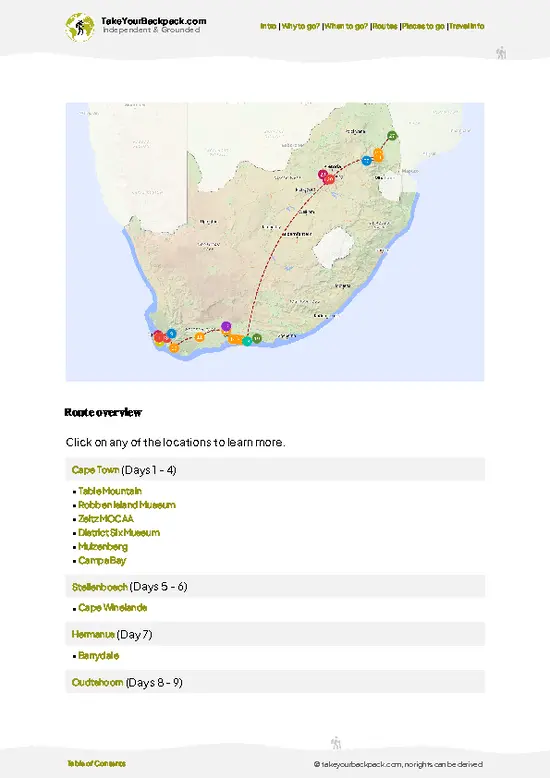
Regions that cluster well: The strongest pairing is Cape Town, the winelands and the Garden Route, which connect by a coastal drive of 5 to 8 hours total with stops. Johannesburg and Kruger also work together, with a 5 to 6 hour drive to the park gates, and Johannesburg to Pretoria is only an hour. The Drakensberg and KwaZulu-Natal sit between Johannesburg and Durban, roughly 4 hours from each. Flights link Cape Town, Johannesburg and Durban for US$50 to 120 one way if booked early.

Direction and time per stop: Fly into Cape Town, head east along the Garden Route, then … read more 👉
How long you need: A trip combining several attractions in South Africa needs 10 to 21 days, and 14 is the realistic minimum for covering two regions properly. Fewer than 10 days means choosing one region and doing it well.

Regions that cluster well: The strongest pairing is Cape Town, the winelands and the Garden Route, which connect by a coastal drive of 5 to 8 hours total with stops. Johannesburg and Kruger also work together, with a 5 to 6 hour drive to the park gates, and Johannesburg to Pretoria is only an hour. The Drakensberg and KwaZulu-Natal sit between Johannesburg and Durban, roughly 4 hours from each. Flights link Cape Town, Johannesburg and Durban for US$50 to 120 one way if booked early.

Direction and time per stop: Fly into Cape Town, head east along the Garden Route, then fly from Port Elizabeth (Gqeberha) to Johannesburg for Kruger. This avoids a long backtrack. Allow 3 to 4 days in Cape Town, 3 to 5 on the Garden Route, 3 to 4 in Kruger and 2 to 3 in the Drakensberg. Johannesburg needs 1 to 2 days for history sites.

Planning mistakes: The biggest error is trying to drive Cape Town to Kruger overland, which is about 1,600 kilometers each way and eats two full days. Fly that leg instead. Another is cramming a new town every night. Each move costs half a day, so stay two nights minimum anywhere. Many travelers also book Kruger for one night, which barely covers the drive in. Give it at least two nights, since early morning drives are when animals are active. Finally, avoid driving after dark outside cities, because livestock, potholes and pedestrians on rural roads are real hazards. Plan arrivals before 5 pm in winter, when dusk falls around 5:30.

The ListThe Best attractions of South Africa

1 Robben Island Museum

Mandela's cell, ferry crossing, lime quarry, Sobukwe's house

Cross Table Bay by ferry, then tour B Section and the quarry with a former prisoner guiding, before a bus loop past penguins.

south-africa-attraction-robben-island-museum
© Google |

2 Apartheid Museum

Randomized entry gates, pass-law documents, Mandela gallery, political executions room

Walk through separate racial entrances, then follow identity books, 1976 protest film and Mandela's letters through two to three hours of heavy, carefully built exhibits.

south-africa-attraction-apartheid-museum
© Google |

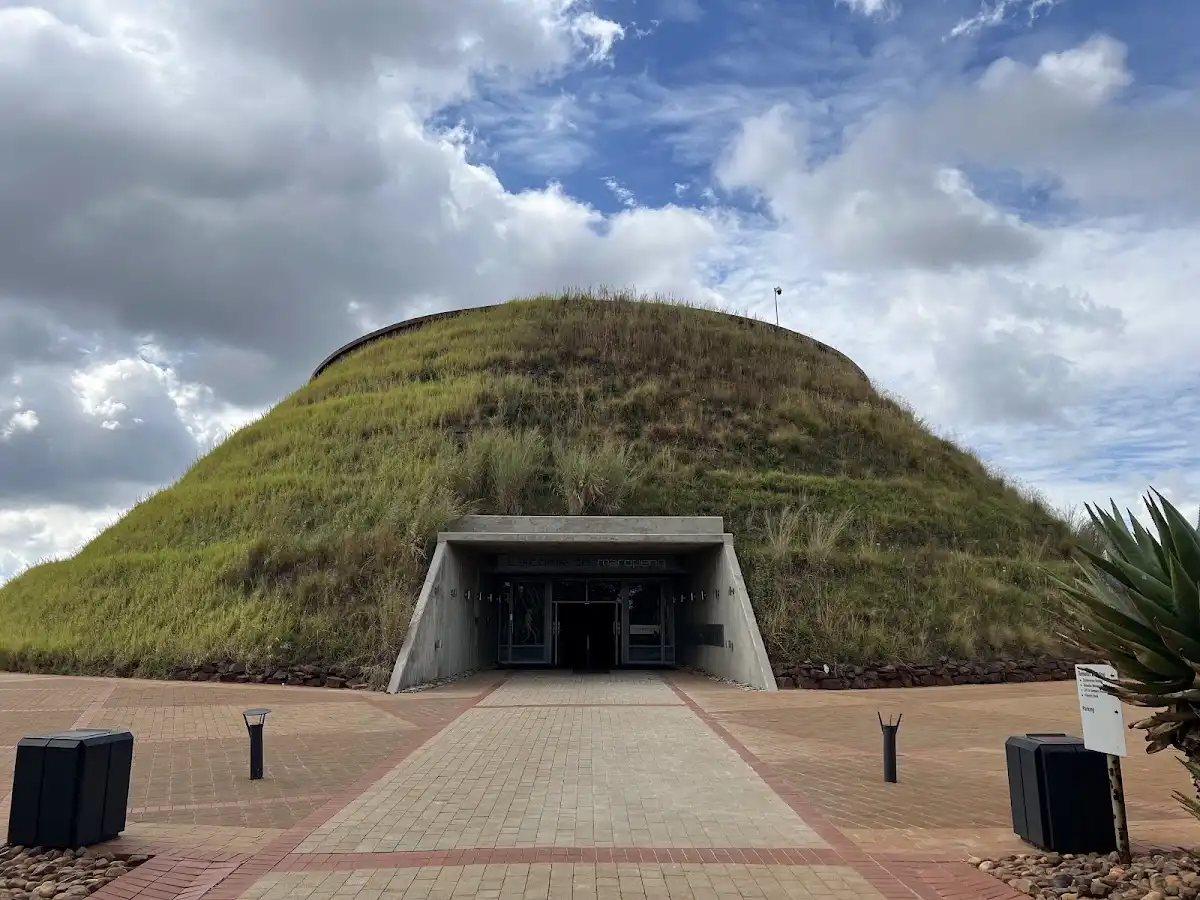
3 Maropeng

Grass-covered tumulus, underground boat ride, Homo naledi, Sterkfontein caves

Drift through elemental chambers by boat, meet Homo naledi remains, then drive to the limestone caves where Mrs Ples was found.

south-africa-attraction-maropeng
© Google |

4 Nelson Mandela Capture Site

Fifty steel columns, reveal viewpoint, R103 arrest site, Midlands grounds

Descend the slope toward scattered poles that snap into Mandela's face at one spot, then read the story of his 1962 arrest.

south-africa-attraction-nelson-mandela-capture-site
© Google |

5 Constitution Hill

Old Fort cells, Constitutional Court, Number Four, Gandhi's cell

Join a guided walk through former prison wings, then step into the courtroom foyer where the Constitution's rights are carved across the door.

6 District Six Museum

Painted floor map, salvaged street signs, ex-resident guides, converted church

Read the places where homes and mosques once stood, written onto a floor map, and hear removal-day stories from people who lived them.

south-africa-attraction-district-six-museum
© Google |

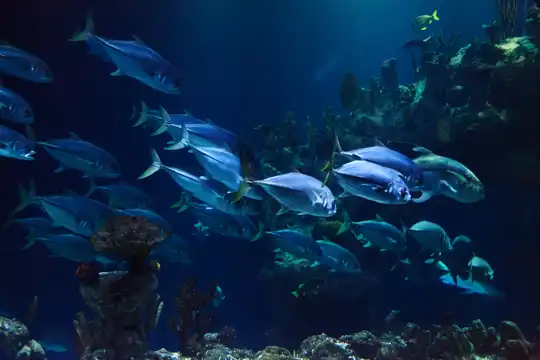
7 Two Oceans Aquarium

Swaying kelp tank, ragged-tooth sharks, penguin feedings, rescued turtles

Time your visit to the penguin feeding, then watch kelp sway in simulated surge and sharks circling a tank viewable from several levels.

South Africa - Two Oceans Aquarium

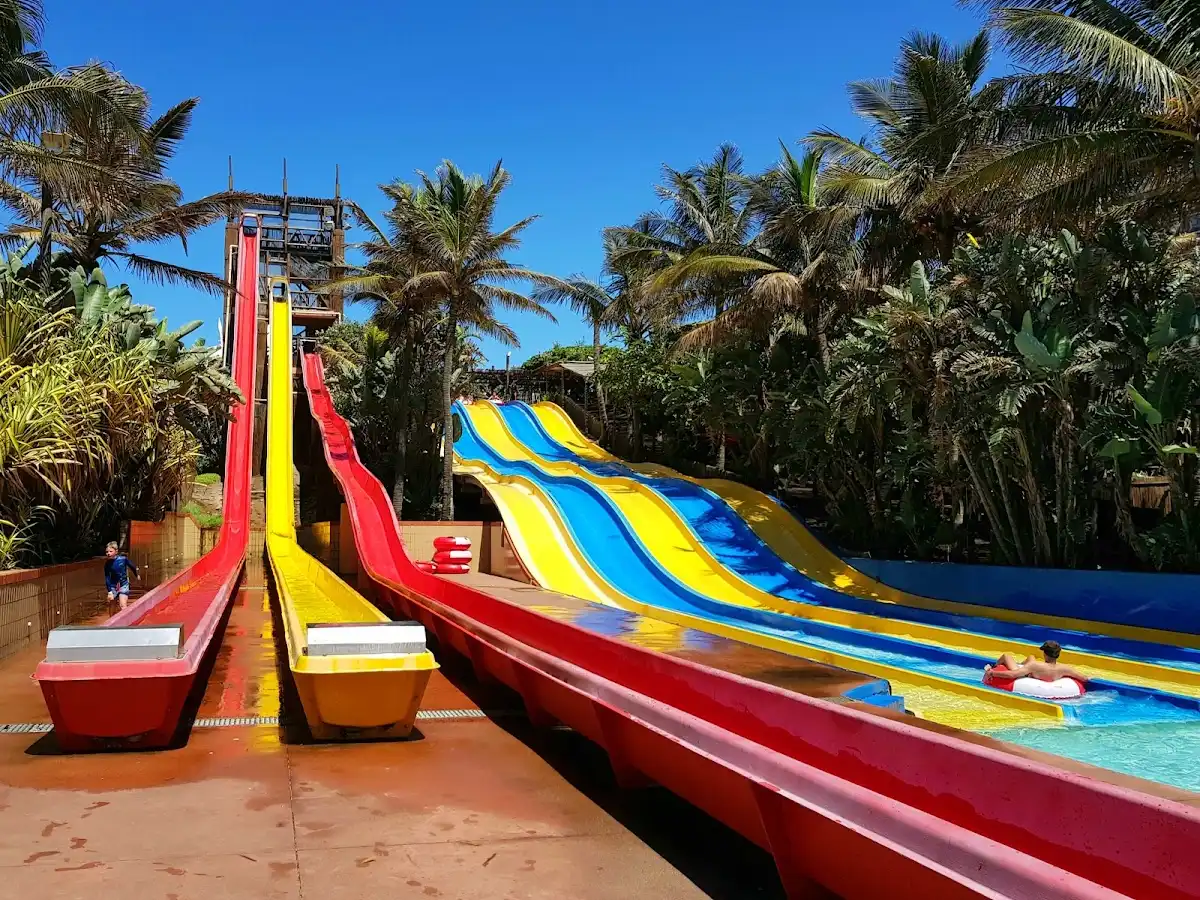
8 uShaka Marine World

Shipwreck aquarium, dolphin stadium, netted beach, water slides

Peer through portholes of a mock wreck at sharks and rays, then switch to slides, seal shows or lifeguarded sand on the Golden Mile.

south-africa-attraction-ushaka-marine-world
© Google |

9 Gold Reef City

Mine cage descent, gold pour, 1890s streets, gumboot dance

Ride a cage 75 meters underground, watch molten gold poured, then wander reconstructed Johannesburg streets before the coasters and boot dancers.

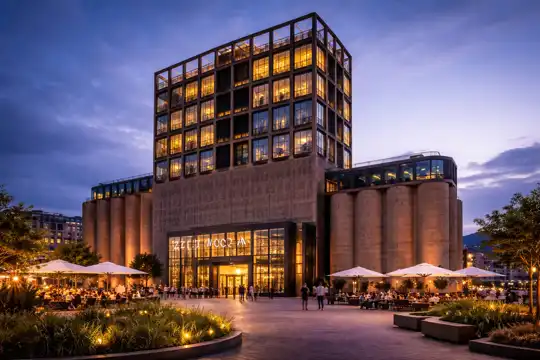
10 Zeitz MOCAA

Cut-away silo atrium, rooftop sculpture garden, African contemporary art, Waterfront

Look up into concrete grain tubes sliced into a gallery space, then climb to rooftop sculptures facing Table Mountain and the harbor.

South Africa - Zeitz MOCAA

11 Voortrekker Monument

Granite laager wall, marble frieze, 16 December sunbeam, reserve trails

Study the carved Great Trek frieze, climb to the dome for views over Pretoria, then follow trails among zebra and antelope outside.

12 Iziko South African Museum

Whale Well, Karoo fossils, San rock art casts, planetarium dome

Stand under hanging whale skeletons, then trace pre-dinosaur life through Karoo fossils and finish with the southern sky projected overhead.

15 Market Theatre

Protest-era plays, Newtown precinct, Laboratory stage, Kippies jazz

Book an evening in the converted 1913 produce market, with plays on three stages and live jazz close by afterward.

16 South African State Theatre

Five auditoriums, Pretoria Church Street, multilingual drama, Arena stage

Pick between opera, multilingual plays and cabaret across five venues in a concrete 1970s complex in central Pretoria.

17 Baxter Theatre Centre

Rondebosch stages, new South African drama, black-box Studio, foyer café

Catch fresh local plays in a mid-sized house, then try stand-up or experimental work in the Studio, a few meters from the performers.

18 Origins Centre

75,000-year-old ochre, San rock art, click languages, Wits campus

Examine engraved ochre from Blombos Cave, then learn how trance dance shaped San imagery and hear click languages at listening stations.

19 Hector Pieterson Memorial and Museum

Soweto march site, Nzima photograph, survivor testimony, Wall of Names

Stand where the 1976 student march was halted, then listen to recorded voices of those who were there in compact audio rooms.

Think you know South Africa?

Prove you’re a true local — uncover 9 lesser-known attractions in South Africa that locals tend to keep to themselves.
Loading the map 🌍

Expert viewTips and Advice from Travelers

How many attractions to plan: Plan one major attraction every one to two days, no more. Over a two-week trip that means 7 to 10 paid visits, with the rest of the time left for free coastlines, hikes and long meals. South Africa’s distances and heat eat energy, and travelers who book three activities a day end up paying for experiences they are too tired to enjoy.

Prioritizing by travel style: Budget-focused backpackers should put history and nature walks first, since many are cheap or free, and treat big-game safaris as the single splurge. A self-drive in Kruger costs far less than a guided lodge safari, and a shared rental car makes it affordable. Adventure seekers should spend on activities along the coast (shark cage diving, bungee, sandboarding), but pick one or two, since each costs … read more 👉
How many attractions to plan: Plan one major attraction every one to two days, no more. Over a two-week trip that means 7 to 10 paid visits, with the rest of the time left for free coastlines, hikes and long meals. South Africa’s distances and heat eat energy, and travelers who book three activities a day end up paying for experiences they are too tired to enjoy.

Prioritizing by travel style: Budget-focused backpackers should put history and nature walks first, since many are cheap or free, and treat big-game safaris as the single splurge. A self-drive in Kruger costs far less than a guided lodge safari, and a shared rental car makes it affordable. Adventure seekers should spend on activities along the coast (shark cage diving, bungee, sandboarding), but pick one or two, since each costs real money. Culture-minded travelers should prioritize township tours and museums with local guides. Skip wine tasting stops on tour buses that herd you through three estates in an afternoon. Pick one estate and stay for lunch.

What things cost: A realistic budget is US$40 to 70 a day (about R700 to 1,300) including dorm beds at US$10 to 20, food, local transport and one paid activity. Add US$15 to 30 a day for a shared rental car. Typical costs per visit: national park entry US$10 to 25 for foreigners (Kruger conservation fees run higher in peak season), guided township or history tours US$25 to 50, cable car or mountain tickets US$20 to 30, wine tastings US$5 to 15, and a guided safari drive US$30 to 60. Fully guided multi-day safaris run US$150 to 400 a day, which is rarely good value for backpackers compared with self-drive.

Costs and delays that catch people out: Entry fees for foreigners are higher than for residents, so carry a passport copy and expect to pay by card at most parks. Book popular things ahead: Robben Island ferry tickets often sell out days in advance, and Kruger camps fill months ahead for peak dates. Cable cars close in wind, so keep a flexible day and buy tickets online only for the morning you can confirm. Load shedding can disrupt lifts, card machines and Wi-Fi, so carry cash in small notes for tips and park gates. Tipping guides 10 to 15 percent is standard, and petrol attendants expect a small tip. Watch for tour operators who add unlisted fees for “park entry” or “lunch.” Ask for the full price in writing.

Safety and cultural considerations: Use registered guides for townships and avoid wandering in unfamiliar areas, which is advice locals give too. Never leave valuables visible in a parked car, even at attraction car parks, and pay informal parking attendants a small tip (R5 to 10). Use Uber or Bolt in cities instead of walking after dark. Do not feed baboons, which are aggressive in the Cape Peninsula, and keep windows closed near them. In game parks, stay inside the vehicle unless signs allow otherwise, and follow the speed limit of 50 km/h. Treat sites tied to apartheid with respect. Ask before photographing people in townships, and pay for guides who are from the community, since your money should reach residents. Carry malaria prophylaxis advice from a travel clinic before visiting the northeast, and wear sun protection, as UV is strong year-round.

✈️ The backpacker research shortcutSouth Africa Travel Guide

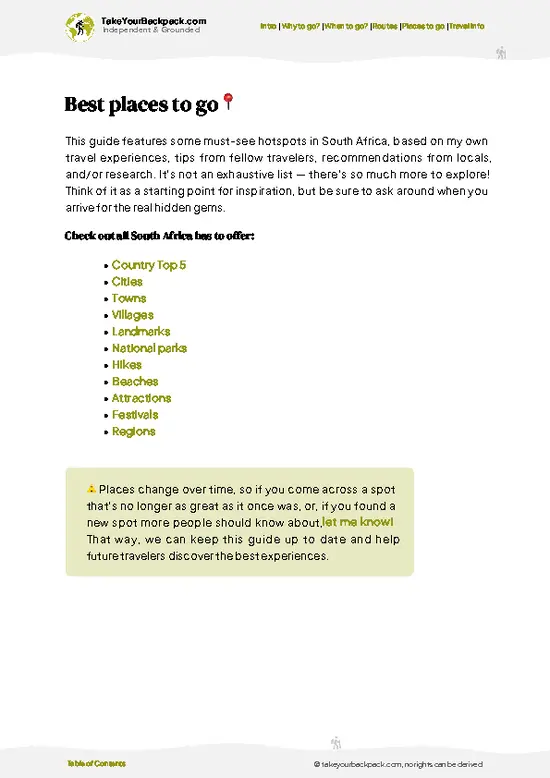
An offline-friendly backpacking guide with optimized travel routes, ranked highlights, transport advice, and the best areas to stay.
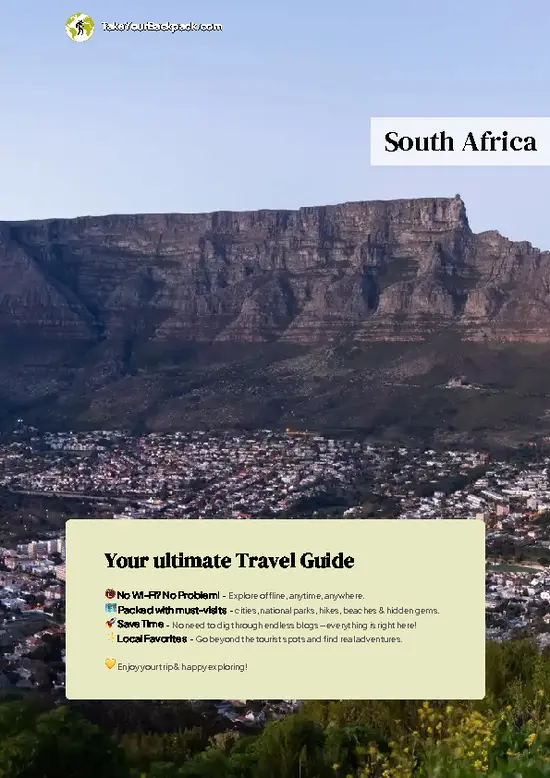
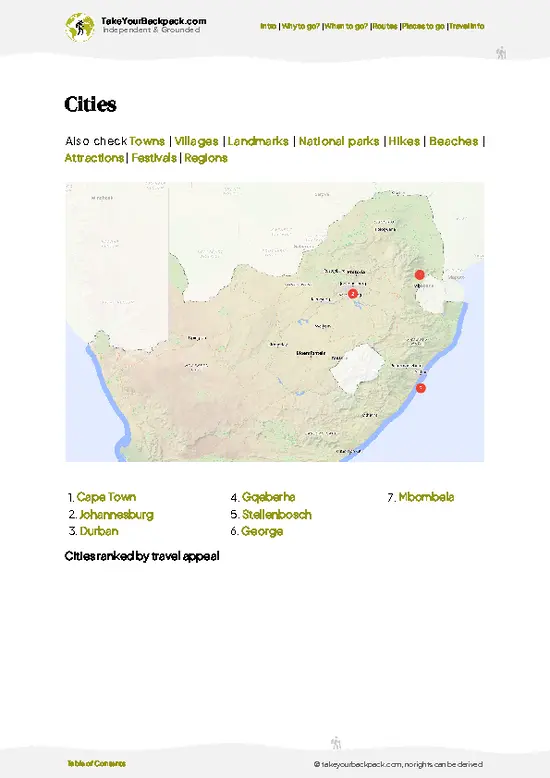
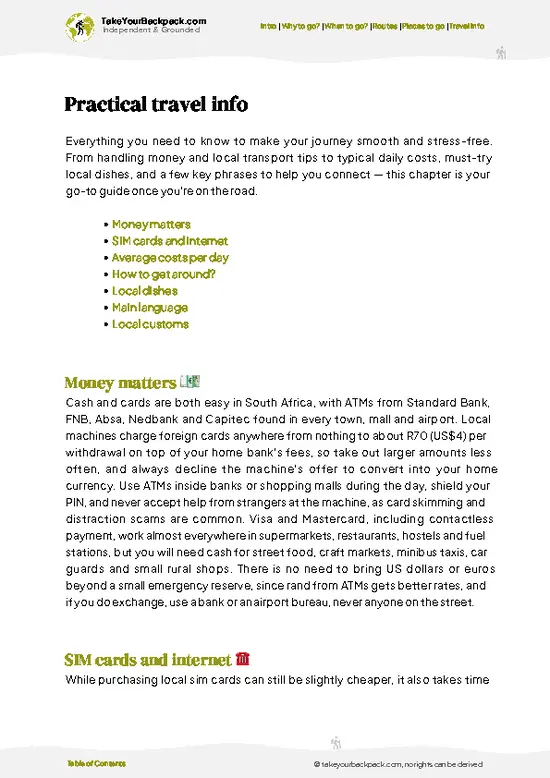
example page 0 from our offline Travel Guide for South Africa
example page 1 from our offline Travel Guide for South Africa
example page 2 from our offline Travel Guide for South Africa
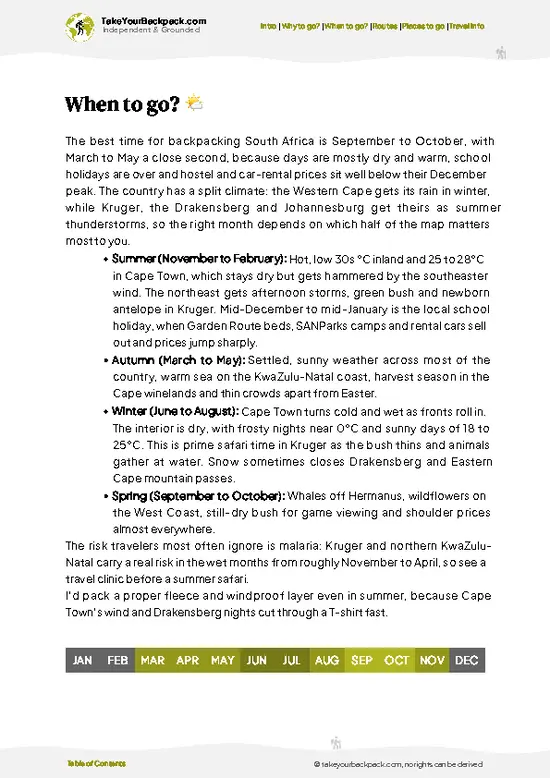
example page 3 from our offline Travel Guide for South Africa
example page 4 from our offline Travel Guide for South Africa
example page 5 from our offline Travel Guide for South Africa
example page 6 from our offline Travel Guide for South Africa
example page 7 from our offline Travel Guide for South Africa
The digital guide (457 pages) contains:
✅ 125 highlights, ranked by travel appeal
✅ Optimized 7, 14 & 21-day travel routes
✅ Cities, national parks, landmarks, beaches
✅ How to get around
✅ Offline-friendly for travel without Wi-Fi
👉 Click to see all 30+ guide features

📅 Plan smarter in minutes, not weeks
✅ Month by month travel advice
✅ Festivals & national holidays
✅ Budget expectations

🗺️ Go to the right places, skip the overrated ones
✅ Honest pros & cons of destinations
✅ Top hikes, parks & viewpoints
✅ Lesser-known places most travelers miss
✅ Clear “worth it vs skip it” guidance

🛏️ Travel smoothly without rookie mistakes
✅ Best areas to stay
✅ Transport systems explained simply
✅ Common scams & safety advice
✅ SIM cards, money & practical tips

🌍 Understand the country, not just visit it
✅ Culture & traditions
✅ 52 Essential phrases & customs
✅ Festivals worth planning around
✅ Traveler-friendly historical context
✅ Insights that make places more meaningful

📱 Built for real travel conditions
✅ Fully downloadable PDF
✅ Works completely offline
✅ Optimized for phone use
✅ Useful in remote areas & buses
✅ Everything in one place
Stop searching, start planning
Get instant access to your full guide. 30‑day money-back guarantee.
+ Add another guide for just

By proceeding you agree to our terms.
Sent to your inbox immediately after payment • 100% Secure Checkout
Best Backpacking Travel Advisor 2025 tourism awardBest Backpacking
Travel Advisor
2025
What others say about Take Your Backpack Guides:
⭐⭐⭐⭐⭐
Fantastic, amazing amount of information!
⭐⭐⭐⭐⭐
My goodness this is amazing, it's what I've been looking for hats off too you!
⭐⭐⭐⭐⭐
I think this is absolutely BRILLIANT
⭐⭐⭐⭐
Very complete and informative. It's still missing places, but I gotta to commend you
⭐⭐⭐⭐⭐
This is truly amazing, thank you, can't wait to explore it with my kids!
⭐⭐⭐⭐⭐
Awesome resource, thank you!
⭐⭐⭐⭐⭐
This is amazing! Can't wait to explore the ones I haven't seen
⭐⭐⭐⭐
I love this! Well done, great idea.
⭐⭐⭐⭐⭐
Thanks for taking the time to make this gem!
⭐⭐⭐⭐⭐
This might be the best website I've ever seen.
⭐⭐⭐⭐⭐
Congratulations, and thank you so much for your work; it's incredibly valuable.
⭐⭐⭐⭐
In all seriousness I think you did a great job pointing out the important spots
⭐⭐⭐⭐⭐
10/10 very good
⭐⭐⭐⭐⭐
As someone who's only just starting to visit regularly this is awesome, thank you.
⭐⭐⭐⭐
Thank you very much! I'm going to visit my dad, it's going to be very useful!
⭐⭐⭐⭐⭐
This is really cool! We'll be travelling for the first time and this definitely come in handy.
⭐⭐⭐⭐⭐
You are now our minister of culture, congratulations 👨‍💼
⭐⭐⭐⭐⭐
Just wanted to tell you that this is a pearl! Going to follow your recommendations.
⭐⭐⭐⭐⭐
This is so cool. I'll definitely be using the resource for my travels soon.
⭐⭐⭐⭐⭐
This is very impressive! Good work.
⭐⭐⭐⭐⭐
This is an amazing and informative site. Very well done!

🛏️ Where to stay?Top Places to Consider Staying

South Africa has a dense hostel network, with dorm beds typically running R250 to 450 (about US$14 to 25) and private doubles from roughly R700 to 1,200 (US$38 to 65), especially in Cape Town and along the Garden Route in towns like Knysna and Wilderness. In Cape Town, the City Bowl around Long Street puts you near Table Mountain trailheads and the loudest bars but gets sketchy after dark, while Sea Point trades nightlife for a seafront promenade and calmer streets with easy minibus taxi links into town. In Johannesburg, leafy Melville is the safer, low-key pick with a strip of student bars, whereas Maboneng has the street art and weekend buzz but sits in an area where you should take an e-hailing … read more 👉
South Africa has a dense hostel network, with dorm beds typically running R250 to 450 (about US$14 to 25) and private doubles from roughly R700 to 1,200 (US$38 to 65), especially in Cape Town and along the Garden Route in towns like Knysna and Wilderness. In Cape Town, the City Bowl around Long Street puts you near Table Mountain trailheads and the loudest bars but gets sketchy after dark, while Sea Point trades nightlife for a seafront promenade and calmer streets with easy minibus taxi links into town. In Johannesburg, leafy Melville is the safer, low-key pick with a strip of student bars, whereas Maboneng has the street art and weekend buzz but sits in an area where you should take an e-hailing ride at night, and in Durban the Morningside area around Florida Road offers restaurants and relative quiet a short drive from the beachfront.

If you enjoy meeting fellow travelers, consider choosing hostels with high ratings for atmosphere. On the other hand, if you prefer having your own space, a hotel might be a better option.

South AfricaMore Places Across South Africa

👋 Meet the founderWho’s Behind Take Your Backpack?

Johan, backpacker and founder of TakeYourBackpackHi, I’m Johan (Netherlands 🇳🇱), the creator of TakeYourBackpack. Over the past 3 decades, I’ve backpacked through 90+ countries across six continents, gaining extensive experience with independent travel, long-term trips, and overland routes.

This site is built on a combination of firsthand travel experience and carefully curated insights from other backpackers. Many guides are based on places I’ve personally visited, while others bring together tips, observations, and practical advice shared by trusted travelers I’ve met along the way.

The goal is to provide realistic, experience-driven guidance — not generic itineraries — so you can explore destinations with better context, clearer expectations, and more confidence.