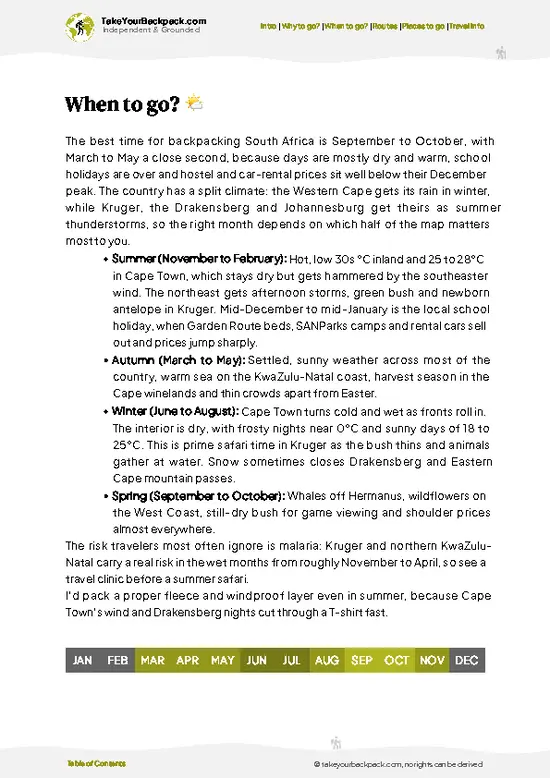
How many villages: Visit
five to seven villages on a trip of two weeks. Fewer than five leaves you without contrast between regions. More than seven turns the trip into a driving marathon, because most stops are 2 to 4 hours apart and each deserves at least one night to feel like more than a photo stop.
Which kind to prioritize: Choose by travel style. If you hike, favor
mountain villages in the Drakensberg or escarpment, where trails start at the door. If you like food and wine, the
Cape Dutch villages are worth the higher prices, but stay in one or two, not five, since they feel similar. If you want quiet and low cost, pick
Karoo towns. If you want a cultural encounter, choose a
community-led stay in the Eastern Cape or Zululand with a local guide, not a drive-through. Skip villages whose …
read more 👉 How many villages: Visit five to seven villages on a trip of two weeks. Fewer than five leaves you without contrast between regions. More than seven turns the trip into a driving marathon, because most stops are 2 to 4 hours apart and each deserves at least one night to feel like more than a photo stop.
Which kind to prioritize: Choose by travel style. If you hike, favor mountain villages in the Drakensberg or escarpment, where trails start at the door. If you like food and wine, the Cape Dutch villages are worth the higher prices, but stay in one or two, not five, since they feel similar. If you want quiet and low cost, pick Karoo towns. If you want a cultural encounter, choose a community-led stay in the Eastern Cape or Zululand with a local guide, not a drive-through. Skip villages whose main draw is a craft market aimed at tour buses.
What it costs: Budget R800 to 1,500 a day (about US$45 to 80) if you share a rental car, sleep in hostels or simple guesthouses and cook some meals. Add comfortable guesthouses and restaurant dinners and it rises to R1,800 to 3,000 (US$95 to 160). Per village, expect a room at R400 to 700 (US$22 to 38) for a dorm or budget double outside the Cape and R900 to 1,800 (US$48 to 97) in the winelands in season. Fuel runs about R22 to 25 a liter, and a small rental car costs R400 to 700 a day. Guides for hikes or community visits cost R300 to 800 per person for a half day, and nature reserve or trail permits are often R50 to 300. Wine tastings usually cost R50 to 150 each.
The cost that surprises people is one-way rental fees and long fuel stretches. Check the drop fee before booking, and fill the tank whenever it drops below half in the Karoo, where towns can be 100 km apart.
Safety: Village safety is generally better than in big cities, but avoid driving after dark. Unlit roads, livestock, unmarked speed bumps and the occasional unlit vehicle cause more trouble than crime. Never leave luggage visible in a parked car, even in a quiet village. Lock doors at traffic lights in larger towns. In mountain areas, register with the trail office or guesthouse before a hike, carry rain gear year-round, and turn back if afternoon storms build, since lightning is a real hazard in summer. On the coast, only swim at beaches with lifeguards or known safe bays, as rip currents are common.
Cultural considerations: Many villages sit beside townships or rural communities shaped by apartheid-era land policy, and treating them as sights is a mistake. Ask before photographing people, especially children. Use a local guide or community-run program, so money goes to residents, and agree on the price beforehand. Greet people before asking for help, since a quick hello matters and is expected. Dress modestly in rural Black communities and near churches. Tipping 10 percent is standard in restaurants, and a small tip of R10 to 20 is expected for informal parking attendants and fuel station attendants.
Delays and mistakes that catch travelers out: Many small villages close early. Restaurants may stop serving by 8 pm, and some shops close at 1 pm on Saturdays and all day Sunday. Fill up on cash for places that do not take cards, and use ATMs in larger towns first. Load shedding, scheduled power cuts, can switch off lights, Wi-Fi and card machines for two to four hours, so download maps in advance and ask your guesthouse for its schedule. Book rooms ahead in school holidays, as the best budget beds go first. Finally, do not trust phone-map drive times on gravel roads, which can double the estimate. Check road conditions with locals and avoid unsealed shortcuts in a standard car.

 Best Backpacking
 Hi, I’m Johan (Netherlands 🇳🇱), the creator of TakeYourBackpack. Over the past 3 decades, I’ve backpacked through 90+ countries across six continents, gaining extensive experience with independent travel, long-term trips, and overland routes.