Backpacking Syria independently is possible along the western corridor from Damascus to Aleppo and the coast, but it takes more preparation than Jordan or Turkey. Expect cash-only travel, few hostels and regular checkpoints.
Most travelers enter overland from Beirut via the Jdeidet Yabous crossing or fly into
Damascus, and carry US dollars or euros in cash, since foreign cards rarely work. Budget hotels in
Damascus,
Hama and
Aleppo run about US$15 to 35 a night. Some basic Arabic helps a lot with buses and taxis. Many Western governments still advise against travel, so keep to the main cities and sites, and avoid the northeast, Suwayda, Quneitra and rural Idlib.
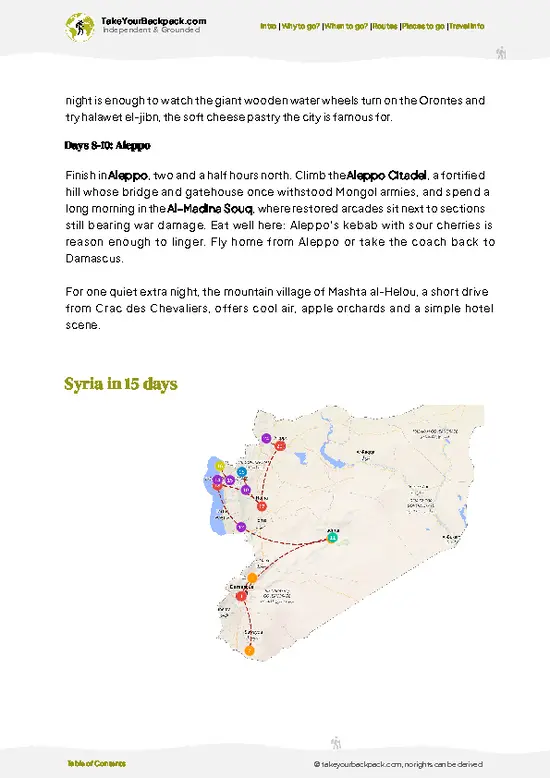
Ten days is the right amount of time for a first trip to Syria, enough to cover Damascus, Hama, Aleppo and the coast without rushing. Five days works if you stay around the capital, and 15 days lets you add the desert and the south.
With 5 days, base yourself in
Damascus and take day trips to
Maaloula (1 hour) and
Bosra (2 hours). With 10 days, add 2 nights in
Hama for
Crac des Chevaliers, 3 in
Aleppo and 2 in
Latakia. With 15 days, fit in
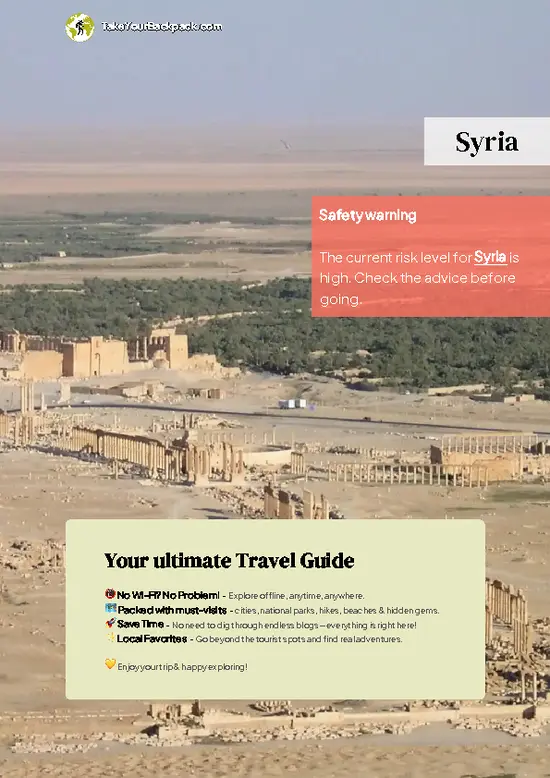
Palmyra (3 to 3.5 hours each way from Damascus),
Apamea,
Tartus and the Dead Cities near Aleppo.
Yes, you can get around Syria without a car: intercity buses link all the main cities on the western side of the country, and microbuses or shared taxis cover shorter hops. For remote castles and ruins, hiring a driver for the day is the norm.
Typical bus times are
Damascus to
Aleppo in about 5 hours,
Damascus to
Hama in 2.5 to 3 hours,
Hama to
Aleppo in about 2 hours and
Tartus to
Latakia in 1 to 1.5 hours, with fares usually around US$3 to 9. For
Palmyra,
Bosra,
Crac des Chevaliers and
Saladin Castle, a car and driver costs roughly US$80 to 150 for the day, depending on distance.
The must-visits in Syria are the old city of Damascus with the Umayyad Mosque, Aleppo Citadel, Crac des Chevaliers, Palmyra and the Roman Theatre of Bosra. Together they cover the country’s Islamic, Crusader and Roman history in about 10 to 15 days.
Give
Damascus at least 2 full days for the mosque, the souqs and the National Museum.
Aleppo needs 2 to 3 days for the citadel and the restored covered market.
Crac des Chevaliers is a half-day trip from Hama or Tartus.
Palmyra is a long day trip from Damascus, 3 to 3.5 hours each way, and
Bosra, about 2 hours south of the capital, fits into a single relaxed day.
If you are short on time in Syria, skip the northeast and the beach towns, and keep Palmyra for a longer trip. The core of Damascus, Hama, Crac des Chevaliers and Aleppo fits into about a week.
Al-Qamishli and
Al-Hasakah sit 8 hours or more from Damascus, so they eat two travel days on their own. The beaches at
Tartus,
Baniyas and
Ras al-Basit are pleasant but ordinary by Mediterranean standards.
Ugarit matters historically yet shows mostly low foundations.
Palmyra lost its Temple of Bel and its arch in the war, and the 6 to 7-hour round trip from Damascus fits better into a 15-day itinerary.
Yes, our itinerary-planner does exactly that. Set your trip length in days, give your interests and travel style, optionally give start- and end location and/or some mandatory stops you would like to include and the itinerary planner creates your personalized routes for Syria in seconds. Try it out!
Try the itinerary plannerv2.webp)
 Best Backpacking

