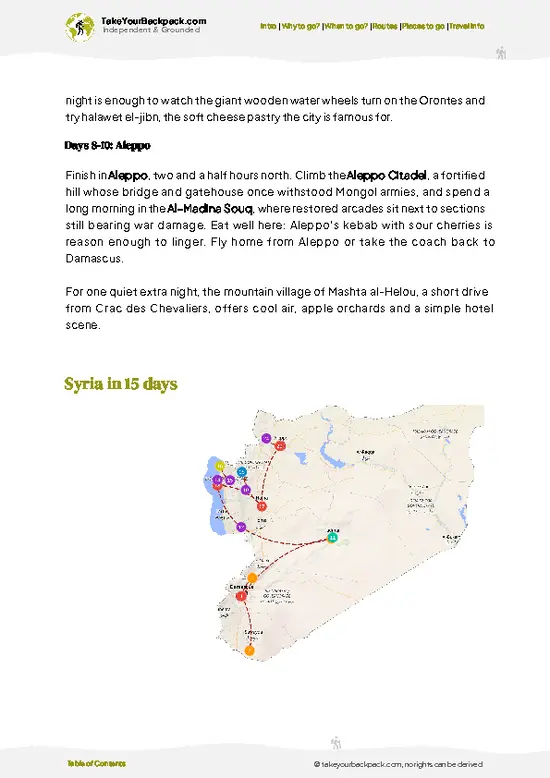
This fifteen-day loop through Syria suits travelers with some road experience who want the whole arc of the country’s history, from Roman basalt in the south to Crusader stone in the west and Byzantine ghost villages in the north. The pace is relaxed, with two or more nights at almost every base and no back-to-back long hauls. You will rely on intercity coaches between the big cities, microbuses and shared taxis for shorter hops, and a hired driver for the desert stretch to Palmyra and the scattered sites around Hama and Aleppo.
Days 1-4: Damascus and a Day in Bosra
Four nights in
Damascus sounds generous until you start walking the Old City. Spend the first day on the edges most visitors rush: the
Tekkiye Suleimaniye Complex, the Ottoman mosque and hospice designed by Sinan with its courtyard of craft workshops, then the
National Museum of Damascus next door, where the painted synagogue walls from Dura-Europos and a clay tablet from Ugarit carrying one of the earliest alphabets sit a few …
read more 👉This fifteen-day loop through Syria suits travelers with some road experience who want the whole arc of the country’s history, from Roman basalt in the south to Crusader stone in the west and Byzantine ghost villages in the north. The pace is relaxed, with two or more nights at almost every base and no back-to-back long hauls. You will rely on intercity coaches between the big cities, microbuses and shared taxis for shorter hops, and a hired driver for the desert stretch to Palmyra and the scattered sites around Hama and Aleppo.
Days 1-4: Damascus and a Day in Bosra
Four nights in Damascus sounds generous until you start walking the Old City. Spend the first day on the edges most visitors rush: the Tekkiye Suleimaniye Complex, the Ottoman mosque and hospice designed by Sinan with its courtyard of craft workshops, then the National Museum of Damascus next door, where the painted synagogue walls from Dura-Europos and a clay tablet from Ugarit carrying one of the earliest alphabets sit a few rooms apart. The second day belongs to the Umayyad Mosque and the small garden beside it holding the Mausoleum of Saladin, where his original walnut cenotaph rests next to the marble one donated by Kaiser Wilhelm II. Finish that evening east along Straight Street to Bab Touma Gate, the Christian quarter’s gateway, where the lanes fill with cafés and bars after dark.
On day three, take the road south to Bosra, about two hours away. The Roman Theatre of Bosra survived almost intact because Ayyubid builders wrapped a fortress around it, so you enter through a castle and suddenly face around 15,000 black basalt seats. Return to Damascus for the night and keep day four free for the souqs, a hammam, or simply sitting in a courtyard café with mint lemonade.Days 5-6: Maaloula and Palmyra
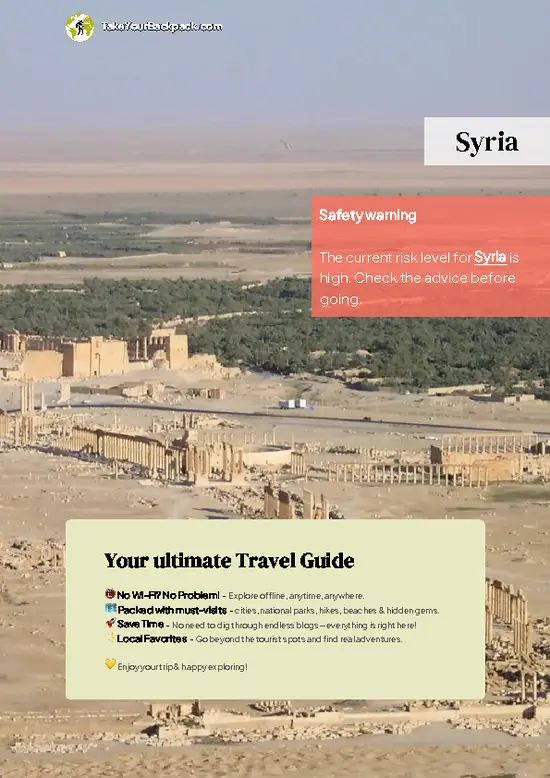
Leave Damascus early with your driver and stop at Maaloula, about an hour north, where some residents still speak a form of Western Aramaic and the Mar Taqla convent clings to the cliff above a narrow cleft you can walk through. From there it is roughly three more hours across steppe to Palmyra. Two nights here let you visit the ruins in the soft hours after sunrise and before sunset, and walk the Palmyra Oasis Trail through date palms and olive groves on a second, slower day. Much of the site was wrecked by Islamic State, including the Temple of Bel, and seeing the gaps beside the surviving colonnade is sobering. Stay on marked paths and go with a local guide, since unexploded ordnance remains a concern around the desert sites.Days 7-9: Crac des Chevaliers and the Coast
The drive west to Crac des Chevaliers takes about three and a half hours via Homs, which is why you overnight in the green valley below the castle instead of pushing on. The Hospitallers held this fortress until Baybars took it in 1271, and its concentric walls, vaulted halls and moat feel built for a siege that could start tomorrow. The next morning, drop to the coast at Latakia, roughly two hours away, for two nights of sea air and grilled fish. Use one day for the inland ruins: Ugarit, the Bronze Age port where that alphabet tablet was found, and the dramatic Saladin Castle, separated from its ridge by a channel hacked roughly 28 meters into the rock with a single stone needle left to support a drawbridge. Spend the other at Ras al-Basit Beach, an hour north, where pine-covered slopes fall into clear water.Days 10-11: Hama, Apamea and the Orontes
Cross the mountains to Hama, a calmer city where the wooden norias along the Orontes River groan as they turn, some taller than a six-story building. A half-day trip northwest takes you to Apamea, whose main colonnaded street runs for nearly two kilometers, lined with columns carved in twisting spirals. Hama’s low-key evenings by the river are a good reset before the north.Days 12-15: Aleppo and the Dead Cities
End with three nights in Aleppo, around two and a half hours north. The Aleppo Citadel rises on its mound above the old town, reached by a stone bridge and a fortified gatehouse. Below it, the vaulted lanes of the Al-Madina Souq were badly burned during the war, and restored stretches now sit beside blackened ones, with soap makers and spice sellers back at work. Walk out through Bab al-Nasr Gate on the old city’s northern side for a sense of how far the walls once reached. Give one full day to the limestone hills west of the city: the Simeon Monastery, built around the stump of the pillar where Saint Simeon lived for decades, and a section of the Dead Cities Trail through abandoned Byzantine villages with standing churches, olive presses and tombs. Fly out of Aleppo or take the coach back to Damascus on day fifteen.
On the drive out to the Simeon Monastery, I would tell a friend to have the driver stop at the lonely fifth-century basilica of Mushabbak, because you will likely have its quiet nave and arched windows entirely to yourself.
 Best Backpacking


