Yes, Togo is one of the easier West African countries to backpack on your own, thanks to its small size, one main north-south highway and friendly, French-speaking towns.
Lomé to
Kpalimé takes 2 to 2.5 hours by shared taxi (about CFA 2,000 to 3,000, US$3.50 to 5), and Lomé to
Kara is 7 to 8 hours by coach for roughly CFA 7,000 to 8,000 (US$12 to 14). Simple guesthouses run CFA 8,000 to 20,000 (US$13 to 33) a night. Basic French helps a lot outside the capital, and guides are expected at sites like
Koutammakou.
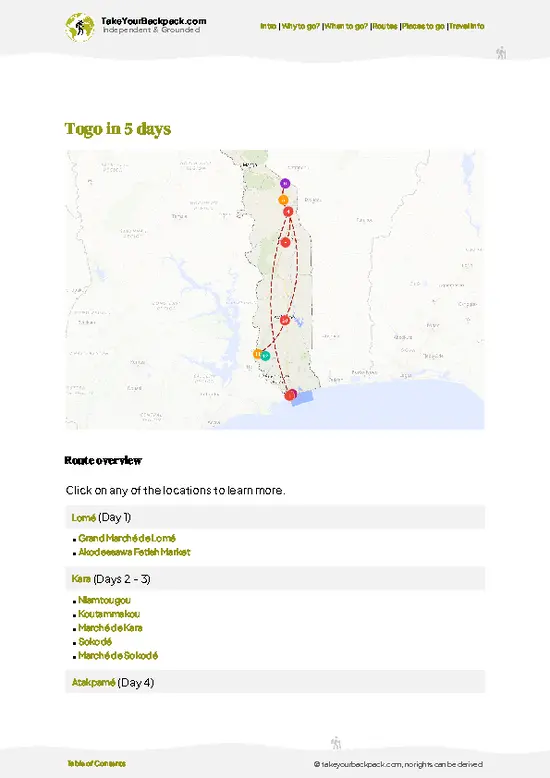
Five days covers Togo’s main highlights from the coast to the far north, while two to three days is enough for Lomé plus either Lake Togo or the Kpalimé hills.
With 2 days, pair
Lomé with
Lake Togo and
Togoville, under an hour away. With 3 days, add
Kpalimé (2 to 2.5 hours) for Mount Agou and the Kloto forest. With 5 days, ride 7 to 8 hours north to
Kara for
Koutammakou, then return via Atakpamé. A week or more lets you add Akloa Falls near Badou or the Danyi Plateau without rushing.
Yes, you can travel all of Togo without a car, using coaches on the main highway, shared bush taxis and minibuses between towns, and motorcycle taxis for everything else.
Coaches link
Lomé with
Kara in 7 to 8 hours for about CFA 7,000 to 8,000 (US$12 to 14). Shared taxis reach
Kpalimé in 2 to 2.5 hours and Agbodrafo on
Lake Togo in under an hour for CFA 500 to 3,000 (US$1 to 5). A zem ride across town costs CFA 200 to 700 (US$0.35 to 1.20). Only remote parks like Fazao-Malfakassa really need a private driver.
The essential stops in Togo are Lomé’s markets, Lake Togo with Togoville, the Kpalimé hills and the Batammariba tower houses of Koutammakou in the north.
In
Lomé, give a full day to the
Grand Marché and the
Akodessawa Fetish Market.
Togoville is a pirogue ride across
Lake Togo, under an hour from the capital.
Kpalimé, 2 to 2.5 hours northwest, is the base for climbing
Mount Agou, the country’s highest point at 986 meters.
Koutammakou, a UNESCO site about 1.5 hours beyond Kara, needs at least 2 nights in the north.
If time is short in Togo, skip the national parks and the far north around Dapaong, which eat days of travel for limited reward on a quick trip.
Fazao-Malfakassa and
Fosse aux Lions have thin wildlife and poor road access, so they suit longer trips with a hired vehicle.
Dapaong sits 10 to 12 hours from Lomé. On the coast,
Aného repeats much of what you get at Lake Togo, and the
Lomé Cathedral and Independence Monument are quick photo stops you can pass on the way elsewhere. Sokodé works better as a lunch break than an overnight.
Yes, our itinerary-planner does exactly that. Set your trip length in days, give your interests and travel style, optionally give start- and end location and/or some mandatory stops you would like to include and the itinerary planner creates your personalized routes for Togo in seconds. Try it out!
Try the itinerary plannerv2.webp)
 Best Backpacking

