×
Togo🇹🇬 | 3 days itinerary

Your 3-Day Togo Itinerary

By Johan Kruseman 🇳🇱 | Updated May 11, 2026
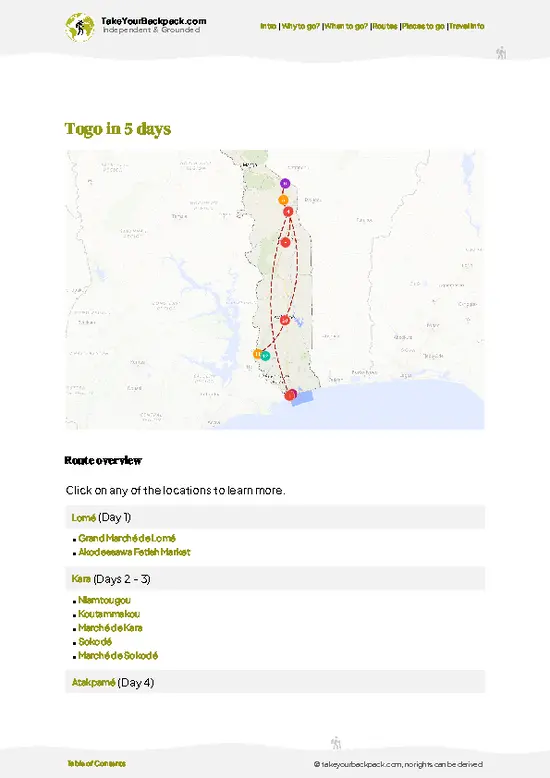
This 3-day route is for travelers who want a punchy mix of capital-city grit and lush highland cool, moving at a moderate pace with taxis, bush taxis, and short moto rides between trailheads and craft villages. You’ll split time between Lomé’s markets and shrines and the forested hills around Kpalimé, with enough breathing room to hike, linger over street food, and actually talk to people instead of just ticking boxes.

Day 1: Urban Togo in Lome

Start in Lome and give yourself a full day to understand why this city hooks so many travelers, beginning at Grand Marché de Lomé where you can wander from fabric stalls to food alleys and watch how trade and gossip flow together. From there, head to Akodessawa Fetish Market to see the spiritual side of the city, where traditional healers and ritual objects sit just a few kilometers from modern office blocks, and a good guide can help you navigate what’s respectful and what’s not. Walk or ride over to Lomé Cathedral for a visual reset and a sense … read more 👉
This 3-day route is for travelers who want a punchy mix of capital-city grit and lush highland cool, moving at a moderate pace with taxis, bush taxis, and short moto rides between trailheads and craft villages. You’ll split time between Lomé’s markets and shrines and the forested hills around Kpalimé, with enough breathing room to hike, linger over street food, and actually talk to people instead of just ticking boxes.

Day 1: Urban Togo in Lome

Start in Lome and give yourself a full day to understand why this city hooks so many travelers, beginning at Grand Marché de Lomé where you can wander from fabric stalls to food alleys and watch how trade and gossip flow together. From there, head to Akodessawa Fetish Market to see the spiritual side of the city, where traditional healers and ritual objects sit just a few kilometers from modern office blocks, and a good guide can help you navigate what’s respectful and what’s not. Walk or ride over to Lomé Cathedral for a visual reset and a sense of the city’s colonial layers, then, if you’re curious about context, drop into the National Museum of Togo (Musée National du Togo to connect the dots between the ethnic groups, crafts, and rituals you’ll encounter upcountry. As the day cools, unwind at Lome Beach, where you can watch the sun drop behind palm silhouettes, snack on grilled fish, and feel the city’s energy soften into evening.

Day 2: Into the hills - Kpalime and artisan culture

On day two, you leave the coast behind and head inland by bush taxi or shared car to Kpalime, a green, hilly town that feels instantly cooler and slower than the capital. Once you’ve checked in, wander through the Marché de Kpalimé to see how a regional town feeds itself, from piles of produce to spice sellers and fabric stands, then make time for the Village Artisanal de Kpalimé where you can meet woodcarvers, batik artists, and other craftspeople actually making the souvenirs you see in the capital. If you’re into textiles and design, continue to the Centre Artisanal de Kloto nearby, where you can watch or even try your hand at batik and other traditional techniques, and pick up pieces that feel more personal than anything in a tourist market. Evenings in Kpalimé are made for simple maquis dinners, cold beers, and planning the next day’s hike with local guides who know the trails and the weather patterns better than any map.

Day 3: Forest trails and Togo’s highest point

Day three is all about the hills, starting early to beat the heat and heading out on the Kloto Trail, which winds through forest, small farms, and viewpoints that show off the patchwork of villages and greenery below. After a late-morning break back in Kpalime, continue to Mount Agou, Togo’s highest peak, where you can hike up through plantations and forest with a guide, stopping at villages along the way and soaking in wide views from the top if the haze cooperates. The combination of the gentler Kloto Trail and the more sustained climb on Mount Agou gives you a satisfying physical challenge without turning the day into a sufferfest, and you still have time to return to Kpalimé for a shower, a final market stroll, and a relaxed dinner before heading back toward Lomé or onward the next morning.
If you ever extend this trip, sneaking a night in the tiny hill village of Kuma Konda lets you fall asleep to insect noise and wake up right on the doorstep of even quieter forest paths.
Loading the map 🌍

🛏️ Where to stay?Route Overview

✈️ The backpacker research shortcutTogo Travel Guide

An offline-friendly backpacking guide with optimized travel routes, ranked highlights, transport advice, and the best areas to stay.
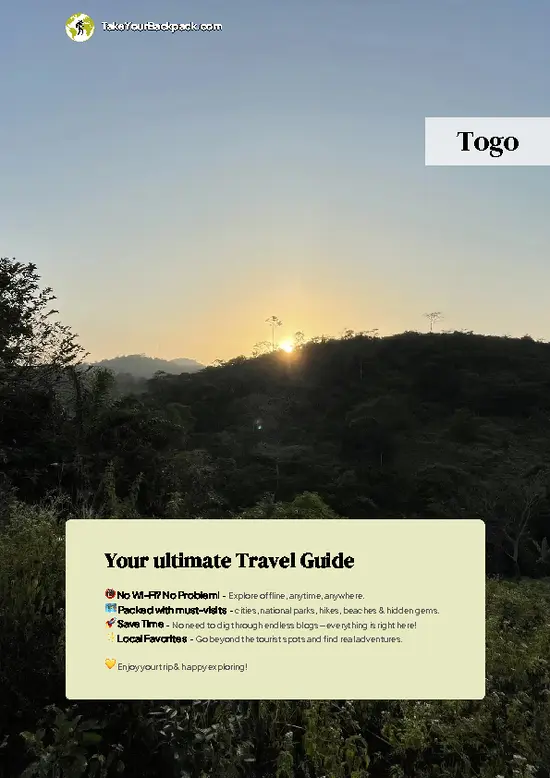
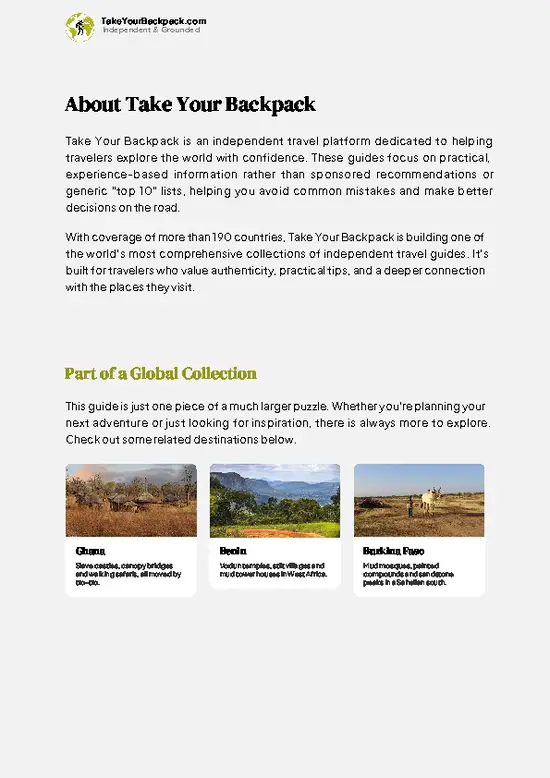
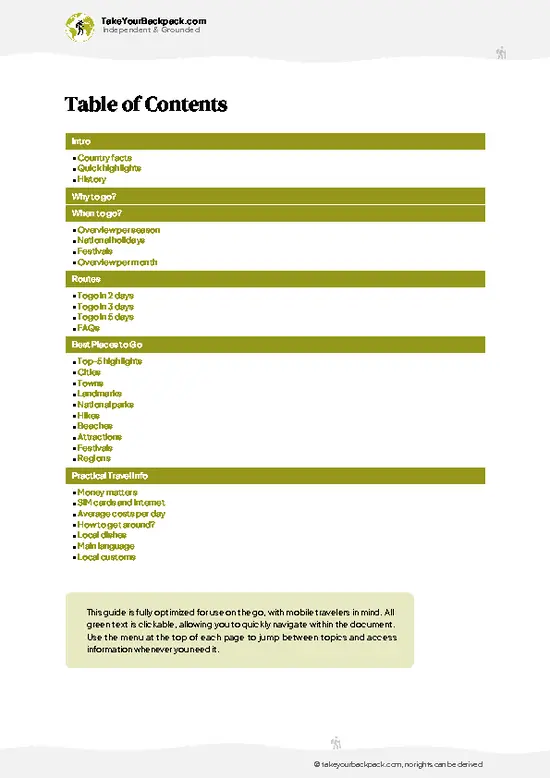
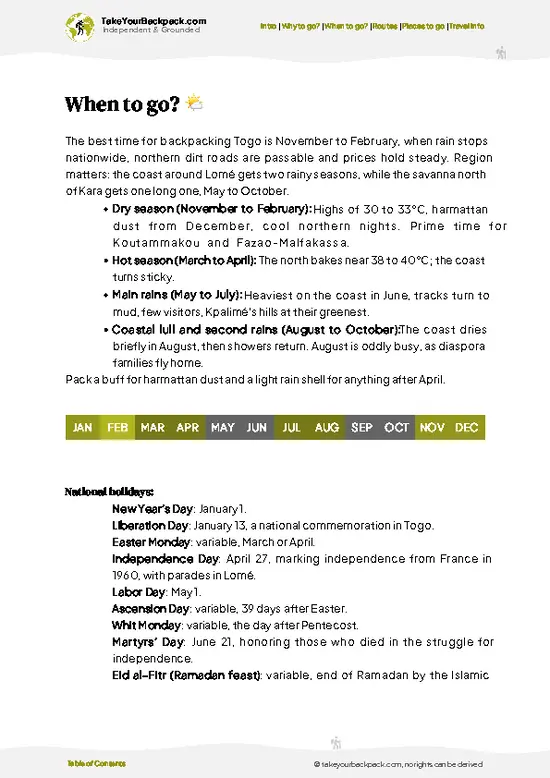
example page 0 from our offline Travel Guide for Togoexample page 1 from our offline Travel Guide for Togoexample page 2 from our offline Travel Guide for Togoexample page 3 from our offline Travel Guide for Togoexample page 4 from our offline Travel Guide for Togoexample page 5 from our offline Travel Guide for Togo
The digital guide (199 pages) contains:
55 highlights, ranked by travel appeal
Optimized 2, 3 & 5-day travel routes
Best neighborhoods to stay
How to get around
Offline-friendly for travel without Wi-Fi
👉 See all 30+ guide features

📅 Plan smarter in minutes, not weeks
Month by month travel advice
Festivals & national holidays
Budget expectations

🗺️ Go to the right places, skip the overrated ones
Honest pros & cons of destinations
Top hikes, parks & viewpoints
Lesser-known places most travelers miss
Clear “worth it vs skip it” guidance

🛏️ Travel smoothly without rookie mistakes
Best areas to stay
Transport systems explained simply
Common scams & safety advice
SIM cards, money & practical tips

🌍 Understand the country, not just visit it
Culture & traditions
52 Essential phrases & customs
Festivals worth planning around
Traveler-friendly historical context
Insights that make places more meaningful

📱 Built for real travel conditions
Fully downloadable PDF
Works completely offline
Optimized for phone use
Useful in remote areas & buses
Everything in one place
Save weeks of stressful planning
Get instant access to the full guide directly. 30-day money-back guarantee.


Sent to your inbox immediately after payment • 100% Secure Checkout
Best Backpacking Travel Advisor 2025 tourism awardBest Backpacking
Travel Advisor
2025
What others say about Take Your Backpack Guides:
⭐⭐⭐⭐⭐
Fantastic, amazing amount of information!
⭐⭐⭐⭐⭐
My goodness this is amazing, it's what I've been looking for hats off too you!
⭐⭐⭐⭐⭐
I think this is absolutely BRILLIANT
⭐⭐⭐⭐
Very complete and informative. It's still missing places, but I gotta to commend you
⭐⭐⭐⭐⭐
This is truly amazing, thank you, can't wait to explore it with my kids!
⭐⭐⭐⭐⭐
Awesome resource, thank you!
⭐⭐⭐⭐⭐
This is amazing! Can't wait to explore the ones I haven't seen
⭐⭐⭐⭐
I love this! Well done, great idea.
⭐⭐⭐⭐⭐
Thanks for taking the time to make this gem!
⭐⭐⭐⭐⭐
This might be the best website I've ever seen.
⭐⭐⭐⭐⭐
Congratulations, and thank you so much for your work; it's incredibly valuable.
⭐⭐⭐⭐
In all seriousness I think you did a great job pointing out the important spots
⭐⭐⭐⭐⭐
10/10 very good
⭐⭐⭐⭐⭐
As someone who's only just starting to visit regularly this is awesome, thank you.
⭐⭐⭐⭐
Thank you very much! I'm going to visit my dad, it's going to be very useful!
⭐⭐⭐⭐⭐
This is really cool! We'll be travelling for the first time and this definitely come in handy.
⭐⭐⭐⭐⭐
You are now our minister of culture, congratulations 👨‍💼
⭐⭐⭐⭐⭐
Just wanted to tell you that this is a pearl! Going to follow your recommendations.
⭐⭐⭐⭐⭐
This is so cool. I'll definitely be using the resource for my travels soon.
⭐⭐⭐⭐⭐
This is very impressive! Good work.
⭐⭐⭐⭐⭐
This is an amazing and informative site. Very well done!

🧭 RouteOther Route Options

Travel Togo your way — from a quick highlights trip to a slow-paced adventure.

🙋 FAQFAQ: Backpacking Togo

Short version: yes, but it’s not plug-and-play like Western Europe. Togo is very doable independently if you’re comfortable with a bit of improvising, basic French, and slow transport. It’s a narrow country with a simple north–south spine, so navigation is straightforward. The main challenges are: limited English, inconsistent transport schedules, and basic infrastructure once you leave Lomé and a few bigger towns. For a budget backpacker, that’s part of the charm: you can walk into a town, ask for the gare routière (transport station), and usually find a moto-taxi or shared taxi within an hour. Guesthouses are often informal; you may need to ask around instead of relying on booking platforms. Safety-wise, street crime is relatively low if you use normal city sense: avoid flashing valuables, don’t walk around drunk with your phone out at night, and use registered moto-taxis where possible. Police checkpoints are common on roads; keep a photocopy of your passport and visa handy and stay polite. If you’ve backpacked in other parts of West Africa, Togo will feel manageable. If it’s your first time in the region, start in Lomé, get your bearings for a couple of days, then work your way north slowly so you can adapt to the pace and learn the basic French phrases you’ll use constantly.
For a quick taste, 7–10 days is enough to hit Lomé, a bit of the coast, and one inland region. For a satisfying backpacking loop that doesn’t feel rushed, 2 weeks is ideal. That gives you time to: spend 2–3 days in Lomé (markets, beach, day trip to Agbodrafo or Togoville), 3–4 days in the Kpalimé area (waterfalls, short hikes, coffee/cocoa villages), 2–3 days around Atakpamé or Badou (more rural feel, less visited), and 3–4 days in the north (Kara region, traditional compounds, or up toward Dapaong if you want a semi-desert vibe). If you’re combining Togo with Ghana or Benin, you can compress Togo into 5–7 days by focusing on Lomé + Kpalimé + one cultural stop in the north. Anything under 5 days is basically a Lomé city break with a side trip; still fun, but you’ll miss the variety between the lush south and the drier, more traditional north. Over 3 weeks, you can slow down, revisit favorite spots, and dig into village stays or language practice, but most budget travelers feel they’ve seen the main layers of Togo in about 14–18 days.
You can absolutely get around Togo without renting a car, and most locals do. The backbone is shared taxis and minibuses (bush taxis) running along the main north–south route: Lomé – Atakpamé – Sokodé – Kara – Dapaong. They leave when full, not on strict schedules, so early starts are your friend. For shorter hops and last-mile connections, moto-taxis are everywhere and cheap; just agree the price before you hop on and wear a helmet when you can get one. On a tight budget, you’ll mostly use: moto-taxis inside towns, shared taxis between nearby towns, and minibuses for longer stretches. Travel times are longer than the map suggests because of road conditions and stops, so plan only one major move per day. In the rainy season, some smaller roads become mud pits; if a local says a track is bad, believe them and stick to the main road. Night travel between cities isn’t worth the risk: poor lighting, animals on the road, and tired drivers. If you’re patient and flexible, you won’t miss having your own car, and you’ll save a lot of money while getting a more local experience.
For a first-time backpacker in Togo, these are the places that earn their bus rides: 1) Lomé: Not just a transit hub. The beachfront is rough around the edges but great for people-watching and cheap grilled fish. The Grand Marché and smaller neighborhood markets show daily life better than any museum. The fetish market is intense and not for everyone, but it’s a very West Africa-specific experience if approached respectfully. 2) Kpalimé and surroundings: This is where Togo really hooks backpackers. Cooler air, green hills, waterfalls like Womé or Kpimé, and easy day hikes with or without a guide. You can base yourself in town and do cheap moto-taxi day trips to villages, cocoa and coffee farms, and viewpoints. It’s the best value-for-effort region in the country. 3) Togoville and Lake Togo area: A day trip or overnight from Lomé. You cross the lake by pirogue, wander a town with deep Vodun and colonial history, and get a feel for spiritual traditions that still shape daily life. 4) Kara region (and around): If you have time to go north, this is where you start to feel a different Togo: drier landscapes, traditional compounds, and more distinct ethnic cultures. It’s not as polished for visitors as some neighboring countries, but that’s exactly why it’s worth it. 5) At least one smaller inland town: Atakpamé, Badou, or Sokodé. None are headline destinations, but staying a night or two in a non-touristy town, eating at local maquis, and chatting with people is where Togo’s character really shows up for a backpacker.
If you’re short on time or cash, you can be ruthless without missing the soul of Togo. You can skip: 1) Deep north beyond Kara (like Dapaong) unless you’re specifically chasing semi-desert scenery or cross-border routes. It’s a long haul for landscapes and experiences you can find in neighboring Sahel-ish regions with better infrastructure. 2) Multiple small inland towns that feel similar: doing Lomé – Kpalimé – Atakpamé – Sokodé – Kara is overkill on a tight schedule. Pick one or two inland bases (Kpalimé plus either Atakpamé or Kara) instead of trying to tick every dot on the map. 3) Overpriced beach resorts near Lomé: the coast is more about atmosphere than perfect swimming, and you don’t need to pay top dollar to sit under a palm tree with a cold drink. A simple beach bar or budget lodge gives you the same sunset for a fraction of the price. 4) Long, guided city tours in Lomé: you can see the main markets, the seafront, and a couple of landmarks on your own or with short, targeted local guides. Save your money for experiences that actually need a guide, like rural hikes or cultural visits where translation and introductions matter. 5) Trying to do both Togo and a full loop of Ghana/Benin in under 2 weeks: you’ll spend your life in buses and border queues. If time is tight, focus on southern Togo (Lomé, Kpalimé, Lake Togo area) and leave the deep north or multi-country circuits for a future trip when you can travel slower and actually enjoy the places instead of just collecting passport stamps.

🇹🇬 TogoExpand Your Journey

Ready to build a truly unique trip? Predefined routes are perfect for first-time visitors, but there is so much more to discover. Whether you are chasing a city trip, pristine national parks, local food scenes, or quiet beaches, pick a category to design your own path.