×

Tunisia🇹🇳 | best villagesDiscover the 2 Best villages Across Tunisia

Tunisia’s villages come in three flavors, and picking the wrong one is how you end up at a hilltop at noon with no shade and one very patient goat. The northern coast has whitewashed, blue-shuttered hill towns that are easy to reach and busy with day-trippers. The Sahel and Cap Bon coast offers fishing and farming communities with cheap cafés and few tourists. The deep south holds Berber hilltop settlements and desert oases where distances are long and buses are few. For independent travel, the south pays off in character and the north in convenience, with prices staying modest almost everywhere.

By Johan Kruseman 🇳🇱 | Updated October 23, 2026
Explore the best landmarks in Tunisia

Why go?What Makes Them Special

Tunisia is small, and that is the secret. In a country roughly the size of Missouri, the Mediterranean, mountains, steppe and Sahara sit within a day’s travel of each other, so village life changes dramatically from one region to the next. Phoenicians, Romans, Arabs, Ottomans and the French each left a mark on local architecture, which is why you find Andalusian-style arches in one place and underground homes in another.

Climate shaped the buildings. In the south, troglodyte dwellings and hilltop ksour (fortified granaries) were built to beat heat and raiders. Along the coast, thick whitewashed walls reflect the sun. Oases survive only because of ancient irrigation and palm shade.

Before choosing Tunisia, know that public transport reaches regional towns far better than the villages themselves. … read more 👉
Tunisia is small, and that is the secret. In a country roughly the size of Missouri, the Mediterranean, mountains, steppe and Sahara sit within a day’s travel of each other, so village life changes dramatically from one region to the next. Phoenicians, Romans, Arabs, Ottomans and the French each left a mark on local architecture, which is why you find Andalusian-style arches in one place and underground homes in another.

Climate shaped the buildings. In the south, troglodyte dwellings and hilltop ksour (fortified granaries) were built to beat heat and raiders. Along the coast, thick whitewashed walls reflect the sun. Oases survive only because of ancient irrigation and palm shade.

Before choosing Tunisia, know that public transport reaches regional towns far better than the villages themselves. Louages (shared vans) fill up and leave when they feel like it, which is a schedule of sorts. Many smaller places have only a handful of guesthouses, and Arabic and French carry you much further than English. The reward is a country where a mint tea in a village café costs under US$1 and locals still seem pleasantly surprised you showed up.
How the List Was Created
The list of best villages in Tunisia is created based on authenticity, scenic beauty, community spirit, traditions, and overall character. If you feel a village is missing in this list, please let us know.

When to go?Timing Your Visit for the Best Experience

Best months: spring and autumn: March to May and late September to November are the best times for villages in Tunisia, because daytime highs sit around 18 to 28°C and you can climb hilltops without wilting. Spring brings green fields in the north and wildflowers on the steppe, while autumn keeps the sea warm enough for a swim after a day of walking.

Summer and winter: From June to August the coast reaches 30 to 35°C and the south regularly passes 40°C, sometimes 45°C. Midday in a desert settlement then becomes a negotiation with your own sweat. Coastal villages fill with Tunisian and European holidaymakers in July and August, and room prices rise by 30 to 50 percent in popular spots. Winter is the opposite. The north gets most of Tunisia’s rain, roughly 400 to 800 mm a year, mostly November … read more 👉
Best months: spring and autumn: March to May and late September to November are the best times for villages in Tunisia, because daytime highs sit around 18 to 28°C and you can climb hilltops without wilting. Spring brings green fields in the north and wildflowers on the steppe, while autumn keeps the sea warm enough for a swim after a day of walking.

Summer and winter: From June to August the coast reaches 30 to 35°C and the south regularly passes 40°C, sometimes 45°C. Midday in a desert settlement then becomes a negotiation with your own sweat. Coastal villages fill with Tunisian and European holidaymakers in July and August, and room prices rise by 30 to 50 percent in popular spots. Winter is the opposite. The north gets most of Tunisia’s rain, roughly 400 to 800 mm a year, mostly November to February, and nights in the interior and mountains can drop near freezing. Winter is cheap and quiet, but some guesthouses and seasonal cafés close.

Regional notes: The deep south is at its best from November to March, when days are 15 to 22°C and nights are cold enough that you will appreciate a blanket. Spring sandstorms (sirocco winds) occasionally cloud the air for a day or two. During Ramadan, daytime cafés and restaurants often close, though evenings are lively.

village hoppingSuggested Travel Strategies

How long a multi-village trip takes: A trip linking several villages in Tunisia needs 7 to 12 days, and 10 gives you room to breathe. Tunisia looks tiny on a map, which tempts people to cram it, but a 250 km drive on slow roads with a louage stop for no apparent reason can eat half a day.

Regions and direction: Three clusters work well. The north and Cap Bon group around Tunis, with short hops of 1 to 2 hours. The Sahel and center sit around Sousse, Monastir and Kairouan, 1.5 to 3 hours apart. The south links through Gabès, Medenine and Tataouine, with Tozeur and Douz further west. Going north to south is sensible: you start with easy transport and finish in the places that need patience. Between regions, Tunis to Gabès is about 6 to 7 hours by bus or louage, and Gabès to Tozeur around 3 … read more 👉
How long a multi-village trip takes: A trip linking several villages in Tunisia needs 7 to 12 days, and 10 gives you room to breathe. Tunisia looks tiny on a map, which tempts people to cram it, but a 250 km drive on slow roads with a louage stop for no apparent reason can eat half a day.

Regions and direction: Three clusters work well. The north and Cap Bon group around Tunis, with short hops of 1 to 2 hours. The Sahel and center sit around Sousse, Monastir and Kairouan, 1.5 to 3 hours apart. The south links through Gabès, Medenine and Tataouine, with Tozeur and Douz further west. Going north to south is sensible: you start with easy transport and finish in the places that need patience. Between regions, Tunis to Gabès is about 6 to 7 hours by bus or louage, and Gabès to Tozeur around 3 to 4 hours.

Time per stop and common mistakes: Allow half a day for small hilltop or coastal villages and one night for southern ones, where early morning and sunset light make the stay worthwhile. The usual errors are cramming two southern regions into one day, assuming louages run late in the afternoon (they thin out after about 3 pm), and planning long drives through the south at midday. Instead, travel early, base yourself in regional hubs, and use shared taxis or short day trips for the smaller stops.

The ListTop villages of Tunisia

1 Chenini

Ridge climb, cave homes, Seven Sleepers mosque, local guides

Climb whitewashed lanes and stone stairs to a ridge of ruined fortifications, then duck into a cave home for sweet tea.

2 Douiret

Abandoned stone houses, hilltop mosque, Dahar ridge trail, quiet guesthouse nights

Wander steep, empty lanes of vaulted stone houses, then follow the ridgeline path across open, shadeless land toward neighboring Chenini.

Loading the map 🌍

Expert viewInsights from Locals and Experts

How many villages to visit: Five to seven villages is the ideal range for a backpacker spending one to two weeks in Tunisia. Fewer leaves you chasing a single photo; more turns the trip into transport logistics. Most villages reward a few unhurried hours, and the real time sink is waiting for louages that leave only when full.

Which kind to prioritize: If you want easy and photogenic, choose the northern coastal and Cap Bon places, which have the best food and frequent transport but also tour groups between about 10 am and 3 pm. Arrive early or stay the night, when they empty and the light improves. If you want authentic and cheap, pick Sahel fishing and farming communities, where you pay local prices and nobody is performing for a camera. If you want character and landscape, go south to … read more 👉
How many villages to visit: Five to seven villages is the ideal range for a backpacker spending one to two weeks in Tunisia. Fewer leaves you chasing a single photo; more turns the trip into transport logistics. Most villages reward a few unhurried hours, and the real time sink is waiting for louages that leave only when full.

Which kind to prioritize: If you want easy and photogenic, choose the northern coastal and Cap Bon places, which have the best food and frequent transport but also tour groups between about 10 am and 3 pm. Arrive early or stay the night, when they empty and the light improves. If you want authentic and cheap, pick Sahel fishing and farming communities, where you pay local prices and nobody is performing for a camera. If you want character and landscape, go south to Berber hilltop settlements and oases. They need more time and planning, but they are the part of Tunisia you will talk about afterward.

What it costs: A budget of US$25 to 40 a day (roughly 80 to 125 TND) covers a guesthouse bed or simple room (US$10 to 25), meals at local cafés (US$3 to 8), and louages (US$1 to 8 per leg, depending on distance). Mid-range comfort in boutique guesthouses costs US$50 to 80. Village entry is usually free. Small museums and sites charge about 5 to 15 TND (US$2 to 5). Local guides for a hike, ksar visit or desert outing run US$15 to 40 for a half day, and 4x4 or camel excursions cost more. Carry cash, because card acceptance is thin outside bigger towns and ATMs are rare in small places.

Safety and cultural sense: Tunisia is generally welcoming to independent travelers, and village hospitality is real. Check current government travel advisories before heading to areas near the Algerian and Libyan borders, where some regions are restricted or require permits. Dress modestly, with covered shoulders and knees for everyone, especially away from the coast. Ask before photographing people, particularly women. Bargain in souvenir shops, but not in cafés or at fixed-price louages. Expect persistent but friendly guides at popular spots, and a calm “no, thank you” in French (“non, merci”) works. Carry water and sun protection in the south, since shade can be a mirage of its own. Learn a few Arabic greetings; a simple “salam” often turns a transaction into a tea invitation, which is worth far more than any discount.

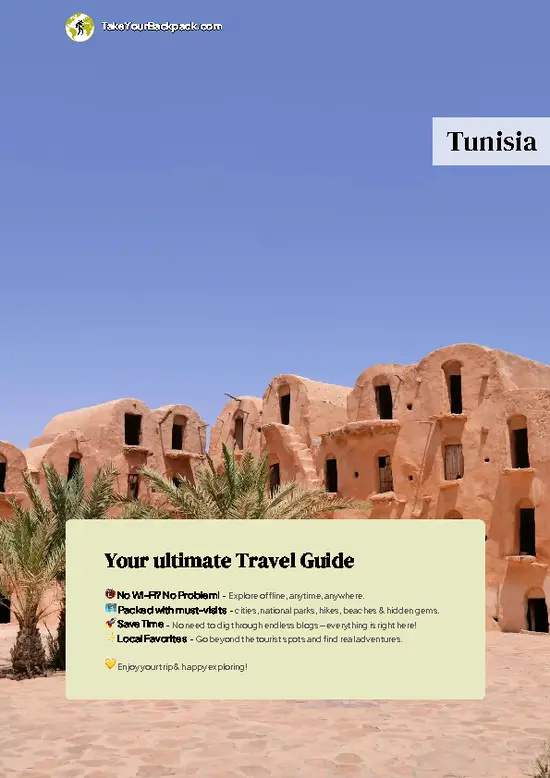
✈️ The backpacker research shortcutTunisia Travel Guide

An offline-friendly backpacking guide with optimized travel routes, ranked highlights, transport advice, and the best areas to stay.
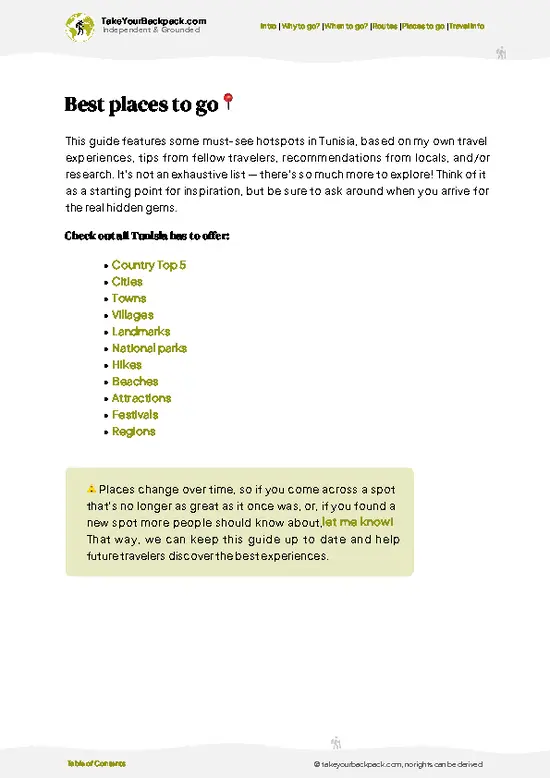
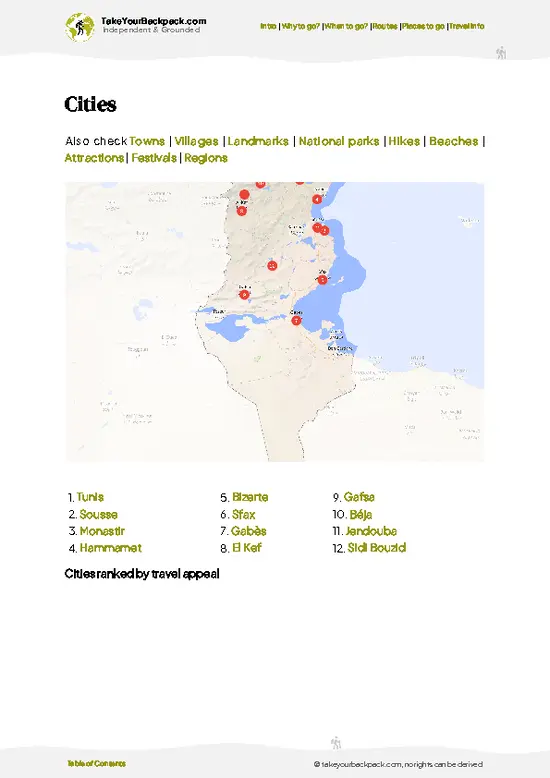
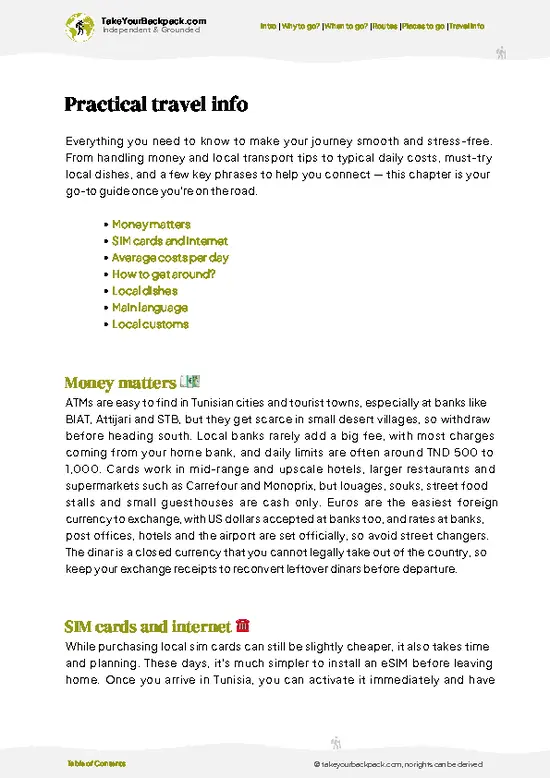
example page 0 from our offline Travel Guide for Tunisia
example page 1 from our offline Travel Guide for Tunisia
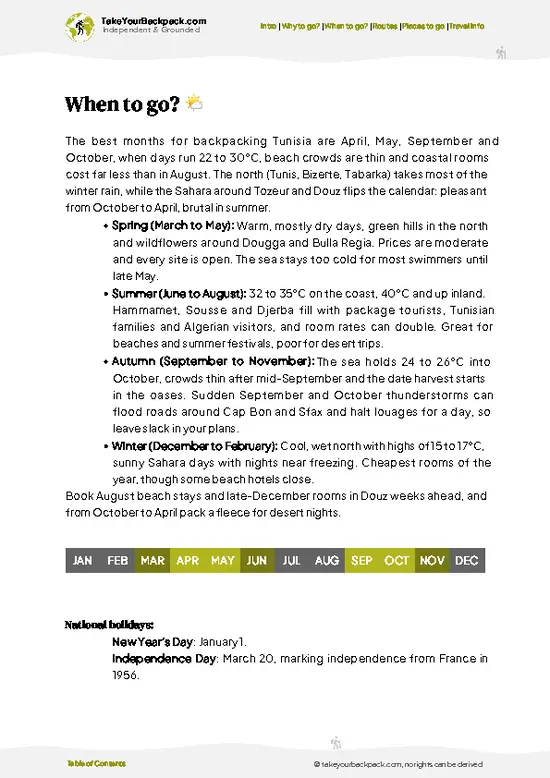
example page 2 from our offline Travel Guide for Tunisia
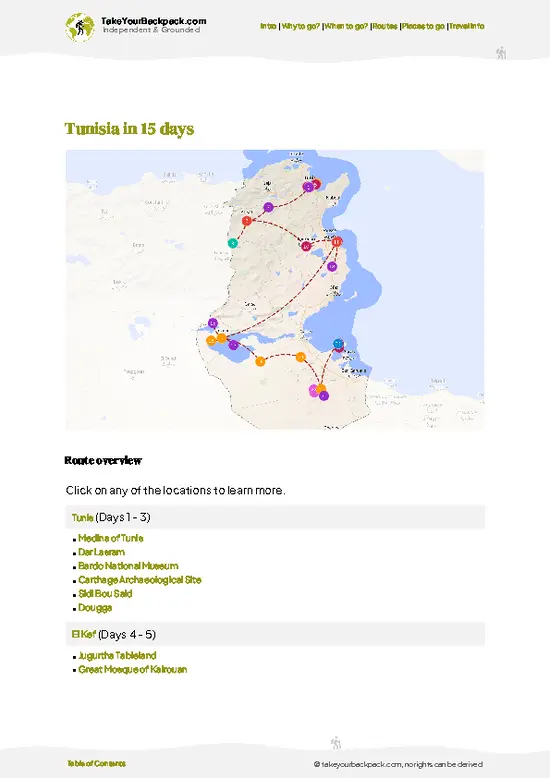
example page 3 from our offline Travel Guide for Tunisia
example page 4 from our offline Travel Guide for Tunisia
example page 5 from our offline Travel Guide for Tunisia
example page 6 from our offline Travel Guide for Tunisia
example page 7 from our offline Travel Guide for Tunisia
The digital guide (355 pages) contains:
✅ 90 highlights, ranked by travel appeal
✅ Optimized 5, 10 & 15-day travel routes
✅ Cities, national parks, landmarks, beaches
✅ How to get around
✅ Offline-friendly for travel without Wi-Fi
👉 Click to see all 30+ guide features

📅 Plan smarter in minutes, not weeks
✅ Month by month travel advice
✅ Festivals & national holidays
✅ Budget expectations

🗺️ Go to the right places, skip the overrated ones
✅ Honest pros & cons of destinations
✅ Top hikes, parks & viewpoints
✅ Lesser-known places most travelers miss
✅ Clear “worth it vs skip it” guidance

🛏️ Travel smoothly without rookie mistakes
✅ Best areas to stay
✅ Transport systems explained simply
✅ Common scams & safety advice
✅ SIM cards, money & practical tips

🌍 Understand the country, not just visit it
✅ Culture & traditions
✅ 52 Essential phrases & customs
✅ Festivals worth planning around
✅ Traveler-friendly historical context
✅ Insights that make places more meaningful

📱 Built for real travel conditions
✅ Fully downloadable PDF
✅ Works completely offline
✅ Optimized for phone use
✅ Useful in remote areas & buses
✅ Everything in one place
Stop searching, start planning
Get instant access to your full guide. 30‑day money-back guarantee.
+ Add another guide for just

By proceeding you agree to our terms.
Sent to your inbox immediately after payment • 100% Secure Checkout
Best Backpacking Travel Advisor 2025 tourism awardBest Backpacking
Travel Advisor
2025
What others say about Take Your Backpack Guides:
⭐⭐⭐⭐⭐
Fantastic, amazing amount of information!
⭐⭐⭐⭐⭐
My goodness this is amazing, it's what I've been looking for hats off too you!
⭐⭐⭐⭐⭐
I think this is absolutely BRILLIANT
⭐⭐⭐⭐
Very complete and informative. It's still missing places, but I gotta to commend you
⭐⭐⭐⭐⭐
This is truly amazing, thank you, can't wait to explore it with my kids!
⭐⭐⭐⭐⭐
Awesome resource, thank you!
⭐⭐⭐⭐⭐
This is amazing! Can't wait to explore the ones I haven't seen
⭐⭐⭐⭐
I love this! Well done, great idea.
⭐⭐⭐⭐⭐
Thanks for taking the time to make this gem!
⭐⭐⭐⭐⭐
This might be the best website I've ever seen.
⭐⭐⭐⭐⭐
Congratulations, and thank you so much for your work; it's incredibly valuable.
⭐⭐⭐⭐
In all seriousness I think you did a great job pointing out the important spots
⭐⭐⭐⭐⭐
10/10 very good
⭐⭐⭐⭐⭐
As someone who's only just starting to visit regularly this is awesome, thank you.
⭐⭐⭐⭐
Thank you very much! I'm going to visit my dad, it's going to be very useful!
⭐⭐⭐⭐⭐
This is really cool! We'll be travelling for the first time and this definitely come in handy.
⭐⭐⭐⭐⭐
You are now our minister of culture, congratulations 👨‍💼
⭐⭐⭐⭐⭐
Just wanted to tell you that this is a pearl! Going to follow your recommendations.
⭐⭐⭐⭐⭐
This is so cool. I'll definitely be using the resource for my travels soon.
⭐⭐⭐⭐⭐
This is very impressive! Good work.
⭐⭐⭐⭐⭐
This is an amazing and informative site. Very well done!

🛏️ Where to stay?Best Places to Stay in Tunisia

Proper hostels are scarce in Tunisia, so most backpackers sleep in budget hotels, family-run guesthouses and restored medina houses called “dars,” with dorm beds or simple doubles running roughly 30 to 80 TND (US$10 to 26) a night. In Tunis, the Medina puts you steps from the souks and has the most atmospheric rooms, but its lanes go quiet and dark after sunset, while the Ville Nouvelle around Avenue Habib Bourguiba has the cheapest hotels, the best transport links and the most noise, and La Marsa and Sidi Bou Said trade higher prices for calm streets, sea air and the capital’s liveliest bars and cafés. Elsewhere, the Sousse medina is the budget hub of the coast, close to the beach and the nightlife … read more 👉
Proper hostels are scarce in Tunisia, so most backpackers sleep in budget hotels, family-run guesthouses and restored medina houses called “dars,” with dorm beds or simple doubles running roughly 30 to 80 TND (US$10 to 26) a night. In Tunis, the Medina puts you steps from the souks and has the most atmospheric rooms, but its lanes go quiet and dark after sunset, while the Ville Nouvelle around Avenue Habib Bourguiba has the cheapest hotels, the best transport links and the most noise, and La Marsa and Sidi Bou Said trade higher prices for calm streets, sea air and the capital’s liveliest bars and cafés. Elsewhere, the Sousse medina is the budget hub of the coast, close to the beach and the nightlife strip, though touts work its gates hard, and Tozeur has quiet, inexpensive guesthouses that make a handy base for the desert.

If you enjoy meeting fellow travelers, consider choosing hostels with high ratings for atmosphere. On the other hand, if you prefer having your own space, a hotel might be a better option.

TunisiaExplore Tunisia

👋 Meet the founderWho’s Behind Take Your Backpack?

Johan, backpacker and founder of TakeYourBackpackHi, I’m Johan (Netherlands 🇳🇱), the creator of TakeYourBackpack. Over the past 3 decades, I’ve backpacked through 90+ countries across six continents, gaining extensive experience with independent travel, long-term trips, and overland routes.

This site is built on a combination of firsthand travel experience and carefully curated insights from other backpackers. Many guides are based on places I’ve personally visited, while others bring together tips, observations, and practical advice shared by trusted travelers I’ve met along the way.

The goal is to provide realistic, experience-driven guidance — not generic itineraries — so you can explore destinations with better context, clearer expectations, and more confidence.