×

Yemen🇾🇪 | best townsBest 8 towns in Yemen

Towns in Yemen are defined by altitude and architecture. In the northern highlands they sit at 2,000 to 2,800 meters, built in stone and baked brick, cool and dry. The Tihama coast is hot, humid and sparse. The Hadramawt valley has mud-brick towers rising from desert wadis, and Socotra has a handful of small, slow settlements. Costs are low, but access is the real filter: the conflict splits the country into zones, and backpacking on your own is not realistic. Choose highlands for density, Hadramawt for architecture, Socotra for calm. Skip the Tihama unless heat does not bother you.

By Johan Kruseman 🇳🇱 | Updated October 19, 2026
Explore the best landmarks in Yemen

Why go?Why Travelers Love These Spots

Yemen has some of the oldest continuously inhabited towns on earth, and the reasons are geographic. Mountains catch monsoon rain, so terraced farming sustained settlements for millennia, while incense and spice caravans linked the south to the Mediterranean. Builders used what the land gave them. Highland towns use stone, alabaster windows and gypsum trim. Wadi towns use sun-dried mud brick, which is why multi-story towers exist in the desert.

That heritage is the draw, but the infrastructure is weak. Since the civil war began in 2014, the country has been divided among rival authorities, with front lines, landmines, airstrikes and abrupt closures. Most governments advise against all travel, and standard travel insurance is usually void. Anything outside Socotra and a few permitted routes … read more 👉
Yemen has some of the oldest continuously inhabited towns on earth, and the reasons are geographic. Mountains catch monsoon rain, so terraced farming sustained settlements for millennia, while incense and spice caravans linked the south to the Mediterranean. Builders used what the land gave them. Highland towns use stone, alabaster windows and gypsum trim. Wadi towns use sun-dried mud brick, which is why multi-story towers exist in the desert.

That heritage is the draw, but the infrastructure is weak. Since the civil war began in 2014, the country has been divided among rival authorities, with front lines, landmines, airstrikes and abrupt closures. Most governments advise against all travel, and standard travel insurance is usually void. Anything outside Socotra and a few permitted routes can change within days.

Before choosing Yemen for its towns, accept three things. Access depends on a licensed local operator and permits, not on turning up. Services are thin: unreliable electricity, patchy internet, few ATMs. And towns here are working conservative communities, not heritage theme parks. If you need flexibility, spontaneity or guaranteed schedules, a different country serves you better.
Our Approach to Ranking
The list of best towns in Yemen is created based on charm, local culture, atmosphere, hidden gems, and visitor appeal. If you feel a town is missing in this list, please let us know.

When to go?Timing Your Visit for the Best Experience

Best months: The best window is October to March, when highland and desert towns have dry skies, clear light and tolerable temperatures. In the highlands around 2,200 meters, days run 18 to 24°C and winter nights drop to 0 to 5°C, so a warm layer matters more than people expect.
Shoulder seasons and seasons to skip: April and September to early October are workable in the highlands, but July and August bring the main summer rains, with afternoon downpours that wash out mountain roads and flatten visibility. The Tihama coastal plain is not worth visiting from May to September: 35 to 45°C with heavy humidity makes walking around unpleasant. The Hadramawt valley is similar, with summer highs of 38 to 42°C and little shade at midday.
Socotra and special periods: Socotra follows its own calendar. … read more 👉
Best months: The best window is October to March, when highland and desert towns have dry skies, clear light and tolerable temperatures. In the highlands around 2,200 meters, days run 18 to 24°C and winter nights drop to 0 to 5°C, so a warm layer matters more than people expect.
Shoulder seasons and seasons to skip: April and September to early October are workable in the highlands, but July and August bring the main summer rains, with afternoon downpours that wash out mountain roads and flatten visibility. The Tihama coastal plain is not worth visiting from May to September: 35 to 45°C with heavy humidity makes walking around unpleasant. The Hadramawt valley is similar, with summer highs of 38 to 42°C and little shade at midday.
Socotra and special periods: Socotra follows its own calendar. From roughly June to September the southwest monsoon brings strong winds, rough seas and disrupted flights, so go from October to April, with the calmest weather between November and March.
Crowds and prices: Crowds are not a factor anywhere on the mainland. Prices barely move by season. Ramadan is worth avoiding for towns, because opening hours shrink, daytime food is hard to find and local operators are less available. Eid holidays often halt transport for several days.

town hoppingHow to Combine towns Into One Trip

How many days: A trip combining several towns in Yemen needs 7 to 14 days, and it should stay inside one region. Treat the highlands, Hadramawt and Socotra as separate trips. They are separated by long distances and changing front lines, so linking them overland is unwise.
Grouping and direction: Within the northern highlands, towns cluster within 1 to 3 hours of the capital by road. Use Sanaa as the hub and make day or overnight loops outward. In Hadramawt, towns sit along the wadi within about 30 to 90 minutes of each other, so move steadily up or down the valley and avoid backtracking. Socotra needs 5 to 7 days on its own, with one or two nights near the main settlement and the rest of the time in the field.
Time per stop: Plan one night per town, two if you want mornings and evenings for … read more 👉
How many days: A trip combining several towns in Yemen needs 7 to 14 days, and it should stay inside one region. Treat the highlands, Hadramawt and Socotra as separate trips. They are separated by long distances and changing front lines, so linking them overland is unwise.
Grouping and direction: Within the northern highlands, towns cluster within 1 to 3 hours of the capital by road. Use Sanaa as the hub and make day or overnight loops outward. In Hadramawt, towns sit along the wadi within about 30 to 90 minutes of each other, so move steadily up or down the valley and avoid backtracking. Socotra needs 5 to 7 days on its own, with one or two nights near the main settlement and the rest of the time in the field.
Time per stop: Plan one night per town, two if you want mornings and evenings for photography when the light is best. Highland towns rarely justify more than half a day each. Do not stretch a stop just to fill days.
Planning mistakes: The commonest mistake is packing in too many stops. Checkpoints, permit checks and mountain roads add hours, and driving after dark is not allowed or not safe in most areas. Cap driving at 4 to 5 hours a day. The second mistake is booking rigid onward flights, since cancellations are routine. Leave one spare day before any international departure and keep the final night near the airport.

The ListThe Best towns of Yemen

1 Hadibu

dragon blood trees, island capital, endemic wildlife

Step into a town where daily routines blend with rare flora and fauna, offering a base for exploring Socotra’s otherworldly landscapes.

2 Shibam

mud skyscrapers, UNESCO site, walled old city

Walk narrow lanes between towering earthen buildings in a city renowned for its unique vertical architecture.

3 Zabid

medieval mosques, brick alleys, university town

Discover a center of Islamic learning where centuries-old mosques and narrow streets evoke Yemen’s scholarly heritage.

4 Kawkaban

clifftop town, stone ramparts, panoramic views

Ascend to a dramatic settlement perched above the plains, where defensive walls and sweeping vistas define the experience.

5 Thula

basalt walls, ancient gates, stepped alleys

Navigate a compact town where black stone fortifications and winding paths reveal layers of pre-Islamic and Islamic history.

6 Bura’a

nature reserve, cloud forest, endemic plants

Hike through protected hills where dense vegetation and rare species offer a glimpse of Yemen’s ecological diversity.

7 Hawf

monsoon forest, wildlife reserve, borderland

Walk through rare green woodlands and spot endemic species in a region where Yemen meets the lush edge of the Arabian Peninsula.

8 Tarim

minaret cluster, religious schools, domed sanctuaries

Explore a town renowned for its concentration of mosques and Islamic learning, with distinctive domes and slender towers marking the skyline.

Loading the map 🌍

Expert viewTips and Advice from Travelers

How many towns: Plan on three or four towns in a single region per trip. Permits, checkpoints and daylight-only driving mean you lose about two hours a day to formalities, and a fifth town adds fatigue and risk without adding much. Quality time in four places beats a rushed seven.
Which kind to prioritize: If architecture is your priority, choose highland stone towns or the mud-brick towns of Hadramawt. They are different enough that doing both rarely makes sense in one trip. If you want space, walking and low risk, put Socotra first, because it has the most stable access and the fewest checkpoints. Skip the Tihama coast in summer, and skip any town that your operator cannot confirm is currently open to foreigners.
What it costs: Independent budgeting does not exist here, because a licensed … read more 👉
How many towns: Plan on three or four towns in a single region per trip. Permits, checkpoints and daylight-only driving mean you lose about two hours a day to formalities, and a fifth town adds fatigue and risk without adding much. Quality time in four places beats a rushed seven.
Which kind to prioritize: If architecture is your priority, choose highland stone towns or the mud-brick towns of Hadramawt. They are different enough that doing both rarely makes sense in one trip. If you want space, walking and low risk, put Socotra first, because it has the most stable access and the fewest checkpoints. Skip the Tihama coast in summer, and skip any town that your operator cannot confirm is currently open to foreigners.
What it costs: Independent budgeting does not exist here, because a licensed operator is mandatory. Expect US$100 to 200 a day all in, covering a vehicle with driver, a guide, permits, basic hotel and meals. Alone, a guide runs about US$30 to 60 a day and a vehicle US$80 to 150. Town entry fees are small, usually US$2 to 10 for forts, towers and museums. Meals in local restaurants cost US$2 to 6. Socotra trips are priced higher because of flights and camping logistics, typically US$150 to 250 a day on organized tours. Bring clean US dollar notes in small denominations, since cards do not work and exchange rates differ sharply between authorities.
Mistakes that cost money: Do not pay the full fee up front to an operator you cannot verify. Ask for written confirmation of permits, and pay by a traceable method for any deposit. Never book a nonrefundable flight before your permit is in hand, because approvals can take weeks and sometimes fail. Insist on a written cancellation policy, since closures happen at short notice.
Safety and cultural limits: Most governments advise against all travel to Yemen, and standard travel insurance usually excludes it, so arrange specialist cover or accept the exposure before you go. Risks include landmines, unannounced checkpoints, airstrikes and kidnapping. Stay on routes your guide approves and never drive between towns after dark.

Dress conservatively: long sleeves and trousers for men, loose clothing and a headscarf for women. Alcohol is not available. Ask before photographing people, military posts or women, since a photograph taken without consent can end a visit abruptly. Many men chew qat in the afternoons, so business slows after about 1 pm and it is wise to schedule your sightseeing for the morning.

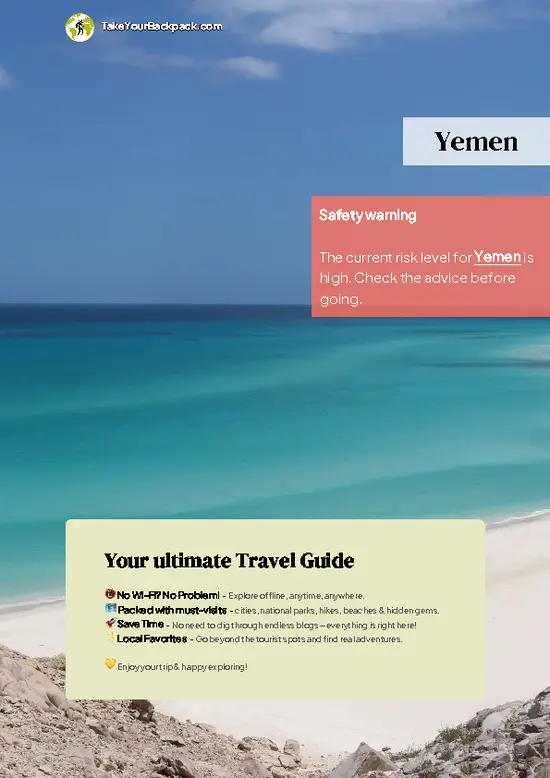
✈️ The backpacker research shortcutYemen Travel Guide

An offline-friendly backpacking guide with optimized travel routes, ranked highlights, transport advice, and the best areas to stay.
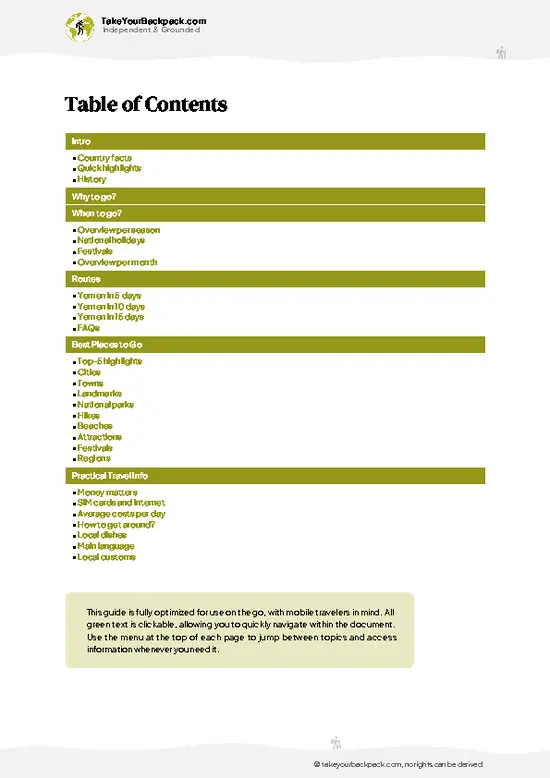
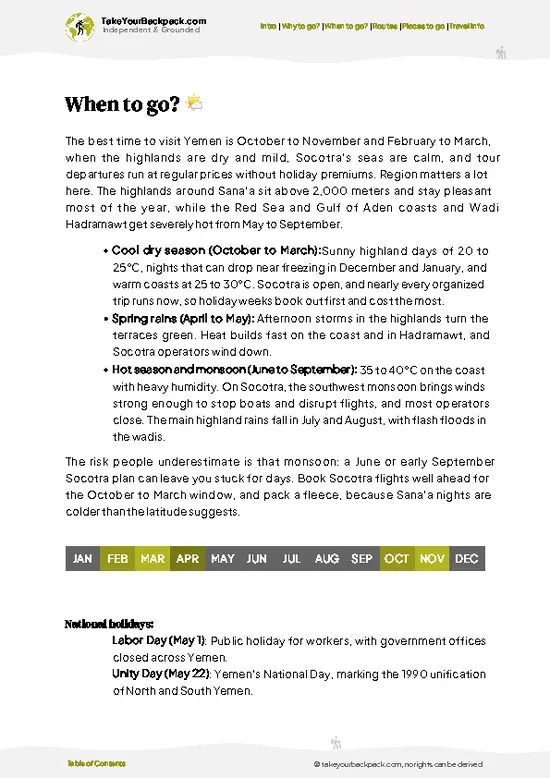
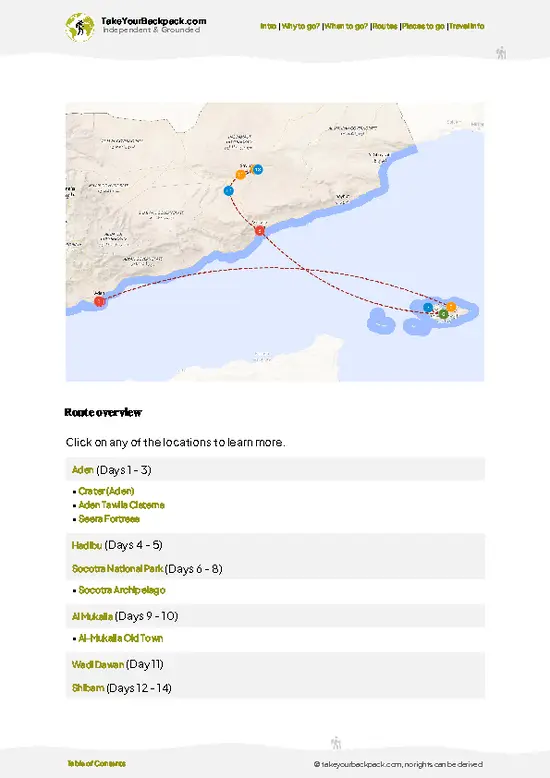
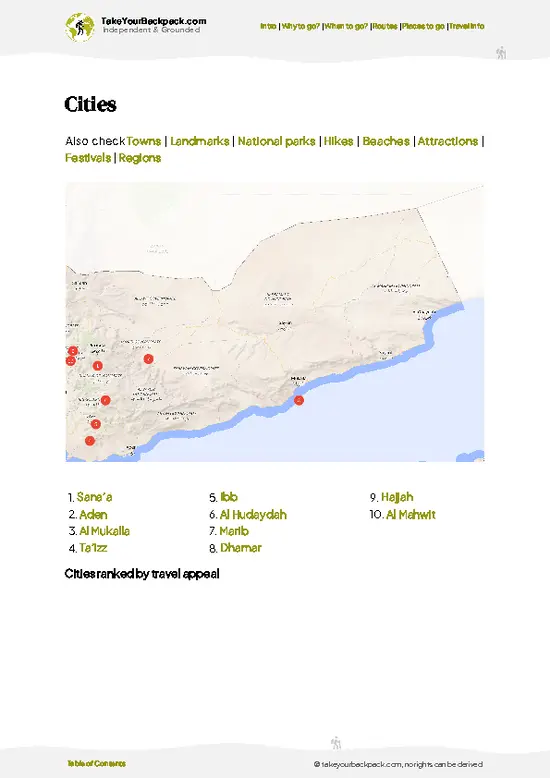
example page 0 from our offline Travel Guide for Yemen
example page 1 from our offline Travel Guide for Yemen
example page 2 from our offline Travel Guide for Yemen
example page 3 from our offline Travel Guide for Yemen
example page 4 from our offline Travel Guide for Yemen
example page 5 from our offline Travel Guide for Yemen
example page 6 from our offline Travel Guide for Yemen
example page 7 from our offline Travel Guide for Yemen
The digital guide (223 pages) contains:
✅ 54 highlights, ranked by travel appeal
✅ Optimized 5, 10 & 15-day travel routes
✅ Cities, national parks, landmarks, beaches
✅ How to get around
✅ Offline-friendly for travel without Wi-Fi
👉 Click to see all 30+ guide features

📅 Plan smarter in minutes, not weeks
✅ Month by month travel advice
✅ Festivals & national holidays
✅ Budget expectations

🗺️ Go to the right places, skip the overrated ones
✅ Honest pros & cons of destinations
✅ Top hikes, parks & viewpoints
✅ Lesser-known places most travelers miss
✅ Clear “worth it vs skip it” guidance

🛏️ Travel smoothly without rookie mistakes
✅ Best areas to stay
✅ Transport systems explained simply
✅ Common scams & safety advice
✅ SIM cards, money & practical tips

🌍 Understand the country, not just visit it
✅ Culture & traditions
✅ 52 Essential phrases & customs
✅ Festivals worth planning around
✅ Traveler-friendly historical context
✅ Insights that make places more meaningful

📱 Built for real travel conditions
✅ Fully downloadable PDF
✅ Works completely offline
✅ Optimized for phone use
✅ Useful in remote areas & buses
✅ Everything in one place
Stop searching, start planning
Get instant access to your full guide. 30‑day money-back guarantee.
+ Add another guide for just

By proceeding you agree to our terms.
Sent to your inbox immediately after payment • 100% Secure Checkout
Best Backpacking Travel Advisor 2025 tourism awardBest Backpacking
Travel Advisor
2025
What others say about Take Your Backpack Guides:
⭐⭐⭐⭐⭐
Fantastic, amazing amount of information!
⭐⭐⭐⭐⭐
My goodness this is amazing, it's what I've been looking for hats off too you!
⭐⭐⭐⭐⭐
I think this is absolutely BRILLIANT
⭐⭐⭐⭐
Very complete and informative. It's still missing places, but I gotta to commend you
⭐⭐⭐⭐⭐
This is truly amazing, thank you, can't wait to explore it with my kids!
⭐⭐⭐⭐⭐
Awesome resource, thank you!
⭐⭐⭐⭐⭐
This is amazing! Can't wait to explore the ones I haven't seen
⭐⭐⭐⭐
I love this! Well done, great idea.
⭐⭐⭐⭐⭐
Thanks for taking the time to make this gem!
⭐⭐⭐⭐⭐
This might be the best website I've ever seen.
⭐⭐⭐⭐⭐
Congratulations, and thank you so much for your work; it's incredibly valuable.
⭐⭐⭐⭐
In all seriousness I think you did a great job pointing out the important spots
⭐⭐⭐⭐⭐
10/10 very good
⭐⭐⭐⭐⭐
As someone who's only just starting to visit regularly this is awesome, thank you.
⭐⭐⭐⭐
Thank you very much! I'm going to visit my dad, it's going to be very useful!
⭐⭐⭐⭐⭐
This is really cool! We'll be travelling for the first time and this definitely come in handy.
⭐⭐⭐⭐⭐
You are now our minister of culture, congratulations 👨‍💼
⭐⭐⭐⭐⭐
Just wanted to tell you that this is a pearl! Going to follow your recommendations.
⭐⭐⭐⭐⭐
This is so cool. I'll definitely be using the resource for my travels soon.
⭐⭐⭐⭐⭐
This is very impressive! Good work.
⭐⭐⭐⭐⭐
This is an amazing and informative site. Very well done!

🛏️ Where to stay?Best Stay Options in Yemen

Yemen has no backpacker hostel scene, so budget travel here means simple local hotels and guesthouses (roughly US$20 to 50 a night for a private room) plus tour-run campsites on Socotra, where most beds sit in Hadibu, the island’s small, quiet main town and the practical base for day trips to the beaches and plateaus. In Aden, Crater puts you among the old markets and the cheapest rooms but feels cramped and noisy, while Khormaksar is calmer, closer to the airport and the seafront, and has the newer, pricier hotels. Further east, Mukalla has the widest spread of mid-range rooms along its seafront corniche, and Seiyun is the best-equipped stop in Hadramawt for reaching Shibam and Tarim, though … read more 👉
Yemen has no backpacker hostel scene, so budget travel here means simple local hotels and guesthouses (roughly US$20 to 50 a night for a private room) plus tour-run campsites on Socotra, where most beds sit in Hadibu, the island’s small, quiet main town and the practical base for day trips to the beaches and plateaus. In Aden, Crater puts you among the old markets and the cheapest rooms but feels cramped and noisy, while Khormaksar is calmer, closer to the airport and the seafront, and has the newer, pricier hotels. Further east, Mukalla has the widest spread of mid-range rooms along its seafront corniche, and Seiyun is the best-equipped stop in Hadramawt for reaching Shibam and Tarim, though nightlife anywhere in the country is limited to evening tea and seafront strolls.

If you enjoy meeting fellow travelers, consider choosing hostels with high ratings for atmosphere. On the other hand, if you prefer having your own space, a hotel might be a better option.

YemenWhere to Go Next

👋 Meet the founderWho’s Behind Take Your Backpack?

Johan, backpacker and founder of TakeYourBackpackHi, I’m Johan (Netherlands 🇳🇱), the creator of TakeYourBackpack. Over the past 3 decades, I’ve backpacked through 90+ countries across six continents, gaining extensive experience with independent travel, long-term trips, and overland routes.

This site is built on a combination of firsthand travel experience and carefully curated insights from other backpackers. Many guides are based on places I’ve personally visited, while others bring together tips, observations, and practical advice shared by trusted travelers I’ve met along the way.

The goal is to provide realistic, experience-driven guidance — not generic itineraries — so you can explore destinations with better context, clearer expectations, and more confidence.