×

Zimbabwe🇿🇼 | best beachesDiscover the 3 Best beaches Across Zimbabwe

Zimbabwe has no coastline, so its beaches are lake shores, reservoir banks and river sandbars. That shapes everything. Sand is patchy, water is fresh, and hippos and crocodiles decide where you can swim. Expect Lake Kariba in the north for big-sky sunsets and a slow, boat-and-campsite rhythm. Reservoirs near Harare and Masvingo bring weekend crowds, cheap day entry and easy buses. Hunting down actual ocean surf means pushing east into Mozambique. Independent travelers get the most out of Zimbabwe by picking one water world, packing a tent, and going where the roads thin out.

By Johan Kruseman 🇳🇱 | Updated October 23, 2026
Explore the best attractions in Zimbabwe

Why go?Understanding Their Importance

Zimbabwe sits on a high plateau about 1,000 to 1,500 meters up, which makes it a place of dams, rivers and rock, not surf. Its water comes from the Zambezi and from reservoirs built in the 20th century. The giant Kariba dam created one of the largest artificial lakes on earth, and its shoreline now works as the country’s beach scene. That is the unique angle: you swim, sunbathe and camp beside freshwater lakes ringed by wild Africa, with elephants drinking at the edge and fish eagles overhead.

Know the limits before you commit. There is no ocean, no tide and no reliable white-sand strip. Many shorelines are muddy, rocky or grassy. Crocodiles, hippos and bilharzia mean that wading is not automatic, and locals will tell you where it is sensible. Infrastructure is thin outside the main lake towns, … read more 👉
Zimbabwe sits on a high plateau about 1,000 to 1,500 meters up, which makes it a place of dams, rivers and rock, not surf. Its water comes from the Zambezi and from reservoirs built in the 20th century. The giant Kariba dam created one of the largest artificial lakes on earth, and its shoreline now works as the country’s beach scene. That is the unique angle: you swim, sunbathe and camp beside freshwater lakes ringed by wild Africa, with elephants drinking at the edge and fish eagles overhead.

Know the limits before you commit. There is no ocean, no tide and no reliable white-sand strip. Many shorelines are muddy, rocky or grassy. Crocodiles, hippos and bilharzia mean that wading is not automatic, and locals will tell you where it is sensible. Infrastructure is thin outside the main lake towns, so fuel, cash and supplies need planning. Power cuts and patchy mobile signal come with the territory.

The reward is space. Compared with packed coastal resorts elsewhere, Zimbabwe’s shores feel quiet, affordable and wild, and a sundowner on a houseboat deck or a campfire on the shore is the whole point. Anyone chasing surf, reef diving or all-day beach clubs should treat Zimbabwe as a gateway and look east to the Mozambique coast.
Why These Made the Cut
The list of best beaches in Zimbabwe is created based on beauty, vibe, water quality, activities, and surrounding scenery. If you feel a beach is missing in this list, please let us know.

When to go?Optimal Periods for Travel

Best months: May to September is the best window for Zimbabwe’s lake beaches, because the rains have stopped, skies stay clear and humidity drops. Days on Lake Kariba run roughly 27 to 32°C, while nights can fall to 12 to 16°C in June and July, so pack a fleece for the campfire.Shoulder seasons: April and October bracket the dry season. April still has green hills and fewer visitors, but roads can be soft after the rains. October is the hottest month at the lakes, with midday highs of 35 to 40°C. That suits swimming all afternoon, though shade becomes a daily mission. Prices barely swing in these months, but lodges and houseboats near Kariba often discount off-peak, sometimes by 10 to 25 percent.Rainy season: November to March brings thunderstorms and most of the 600 to 800 mm of annual rain … read more 👉
Best months: May to September is the best window for Zimbabwe’s lake beaches, because the rains have stopped, skies stay clear and humidity drops. Days on Lake Kariba run roughly 27 to 32°C, while nights can fall to 12 to 16°C in June and July, so pack a fleece for the campfire.Shoulder seasons: April and October bracket the dry season. April still has green hills and fewer visitors, but roads can be soft after the rains. October is the hottest month at the lakes, with midday highs of 35 to 40°C. That suits swimming all afternoon, though shade becomes a daily mission. Prices barely swing in these months, but lodges and houseboats near Kariba often discount off-peak, sometimes by 10 to 25 percent.Rainy season: November to March brings thunderstorms and most of the 600 to 800 mm of annual rain at the lakes and around Harare. Water levels rise, dirt roads turn to slick red mud, and some campsites and tracks close or become 4x4 only. Heat and humidity peak, and mosquitoes multiply. You get empty shores and lower rates, but fewer boat trips.Crowds: Weekends and school holidays, especially April, August and December, fill the reservoirs near Harare and Masvingo with day-trippers. Midweek visits stay calm. For the Mozambique coast, the dry season from May to October is best, and cyclone risk is highest from January to March.

beach hoppingPlanning Your Route Efficiently

Trip length and shape: A trip linking several of Zimbabwe’s lake and river beaches needs 7 to 10 days, and 12 to 16 if you extend to the Mozambique coast. Harare is the natural hub: it has the international flights, ATMs, supermarkets and long-distance buses. The sensible direction is to start with the reservoirs around the capital, push north to Lake Kariba for the longest stay, then swing south through Masvingo and finish in Mutare if the coast is on your list.Time per stop and transfers: Give the capital’s nearby reservoirs a day, Kariba 3 to 4 days, and Masvingo’s lake 1 to 2 days. Harare to Kariba takes about 4 to 5 hours by road, Harare to Masvingo 3 to 4 hours, and Harare to Mutare 3 to 4 hours. From Mutare, Beira in Mozambique is roughly 6 to 8 hours onward by bus or shared minibus, … read more 👉
Trip length and shape: A trip linking several of Zimbabwe’s lake and river beaches needs 7 to 10 days, and 12 to 16 if you extend to the Mozambique coast. Harare is the natural hub: it has the international flights, ATMs, supermarkets and long-distance buses. The sensible direction is to start with the reservoirs around the capital, push north to Lake Kariba for the longest stay, then swing south through Masvingo and finish in Mutare if the coast is on your list.Time per stop and transfers: Give the capital’s nearby reservoirs a day, Kariba 3 to 4 days, and Masvingo’s lake 1 to 2 days. Harare to Kariba takes about 4 to 5 hours by road, Harare to Masvingo 3 to 4 hours, and Harare to Mutare 3 to 4 hours. From Mutare, Beira in Mozambique is roughly 6 to 8 hours onward by bus or shared minibus, and farther beach towns take a full extra day or two.Planning mistakes: The most common error is treating the map as if lakes sit close together. Distances are large, buses leave when full, and a ferry or lake crossing can run irregularly. Build one buffer day for every two transfers. Another mistake is cramming Victoria Falls and Kariba into a single hop, which means a long, slow day. Fly or break the journey in Bulawayo or Hwange instead. Finally, arriving at a remote shore without cash, fuel or food forces costly detours, so stock up in each hub town.

The ListThe Best beaches of Zimbabwe

1 Bumi Hills Beach

Elephant shoreline, tigerfish, drowned forest, Matusadona views

Watch elephant, buffalo and hippo graze to the water's edge, then take a guided boat out among the flooded tree skeletons for tigerfish and fish eagles.

2 Mutirikwi Beach

Calm shallows, Kyle park, bass and bream, Great Zimbabwe nearby

Wade the quiet edge of the lake, cast a line from the rocks, then drive through Kyle park for giraffe, zebra and white rhino.

zimbabwe-beach-mutirikwi-beach
© Google |

3 Chivero Beach

Harare weekend braai, fish eagles, granite kopjes, viewing beach

Stroll a sandy reservoir shore southwest of Harare, scan the reeds for kingfishers and herons, and watch anglers and boaters work the evening water.

zimbabwe-beach-chivero-beach
© Google |
Loading the map 🌍

Expert viewInsights from Locals and Experts

How many to visit: Pick two or three shorelines, not more. Beach time in Zimbabwe means long transfers, slow boats and unhurried afternoons, and three stops give you the variety of one lively reservoir, one remote lake camp and one river-edge spot without turning the trip into a bus timetable. Each extra stop costs a full travel day, roughly US$15 to 40 in transport and a lost swim. Going deeper at fewer places gives a backpacker more for the money.Choosing the kind: For tight budgets, the reservoirs near Harare and Masvingo are the best value. Day entry usually costs US$3 to 10, minibuses run frequently, and you can sleep cheaply in town. They are busy at weekends and the water is not always inviting, but the comfort-to-cost ratio is hard to beat. For a wilder feel, Lake Kariba costs more … read more 👉
How many to visit: Pick two or three shorelines, not more. Beach time in Zimbabwe means long transfers, slow boats and unhurried afternoons, and three stops give you the variety of one lively reservoir, one remote lake camp and one river-edge spot without turning the trip into a bus timetable. Each extra stop costs a full travel day, roughly US$15 to 40 in transport and a lost swim. Going deeper at fewer places gives a backpacker more for the money.Choosing the kind: For tight budgets, the reservoirs near Harare and Masvingo are the best value. Day entry usually costs US$3 to 10, minibuses run frequently, and you can sleep cheaply in town. They are busy at weekends and the water is not always inviting, but the comfort-to-cost ratio is hard to beat. For a wilder feel, Lake Kariba costs more and takes longer to reach, and campsite pitches typically run US$8 to 20 per person. Its returns are elephants at dusk, sunsets over open water and room to breathe, which suits travelers who like camping and can handle basic facilities. Boat trips, fishing excursions and game cruises cost roughly US$25 to 80 each, so choose one well. Houseboats and lodges can push daily spend past US$100, which is rarely worth it on a backpacker budget unless you split a boat with four or five others. If you want surf, sand and seafood, the Mozambique coast is the better call, and the trade-off is time, visa fees and more spending. Overall, a sensible budget is US$30 to 55 a day on a camping and bus plan, or US$60 to 100 with lodge rooms and a guided outing.What to watch for: Crocodiles and hippos are real. Swim only where locals do, in the shallows of designated areas, and never at dusk or after dark. Hippos kill more people in Africa than most large predators, so keep to well-used paths and stay out of reedy water. In still freshwater, bilharzia is present, so rinse and dry off quickly, and consider a course of treatment if you have been in slow water. Pack sunscreen, a hat and a refillable bottle with a filter, since the sun is fierce at altitude.Cultural notes: Dress modestly away from tourist lodges; swimwear is for the water edge, not the market. Ask before photographing people, fishermen or their boats, and carry small US$ notes since change is often short. Cash is widely used, and card machines fail often. Carry enough for fuel, fees and food at remote camps, and keep copies of your passport. Park rangers expect you to follow rules about fires, feeding wildlife and walking at night, and following them keeps you welcome.

✈️ The backpacker research shortcutZimbabwe Travel Guide

An offline-friendly backpacking guide with optimized travel routes, ranked highlights, transport advice, and the best areas to stay.
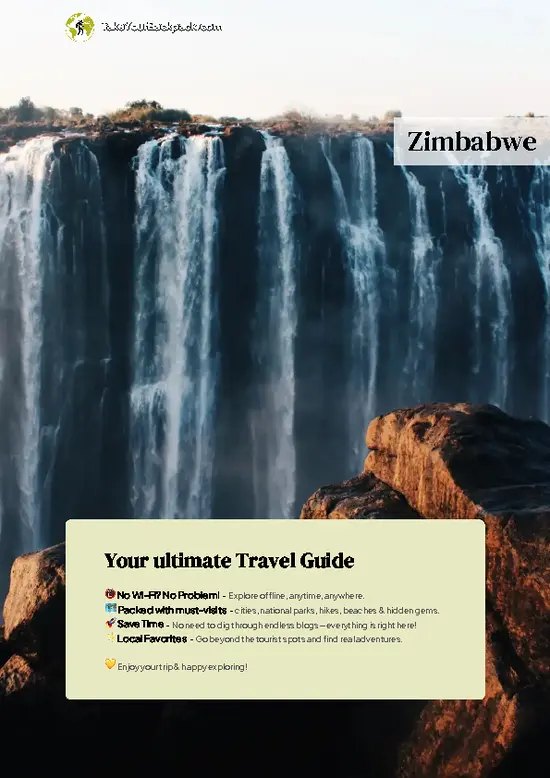
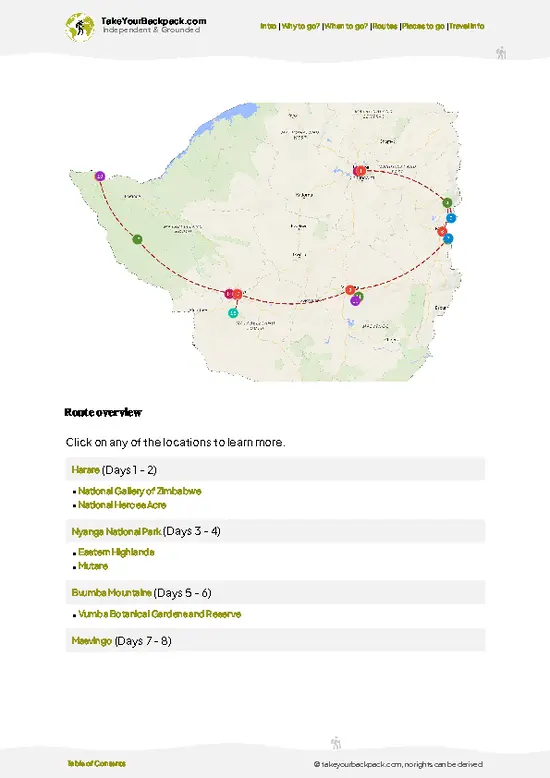
example page 0 from our offline Travel Guide for Zimbabwe
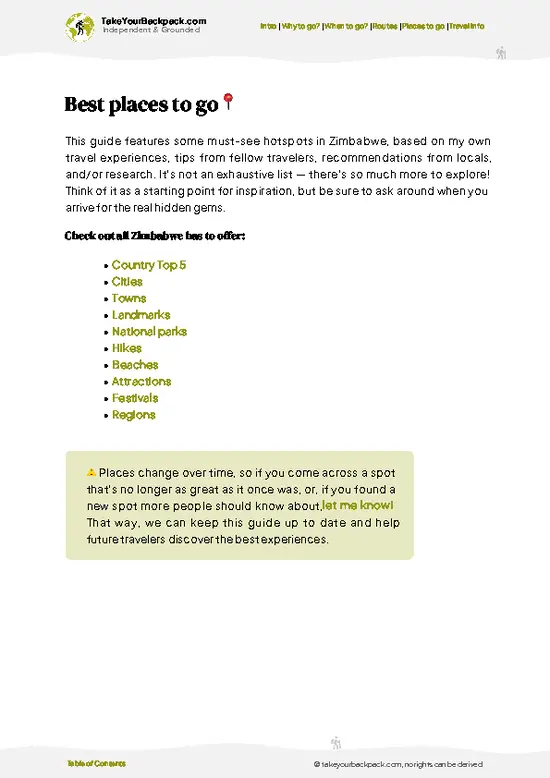
example page 1 from our offline Travel Guide for Zimbabwe
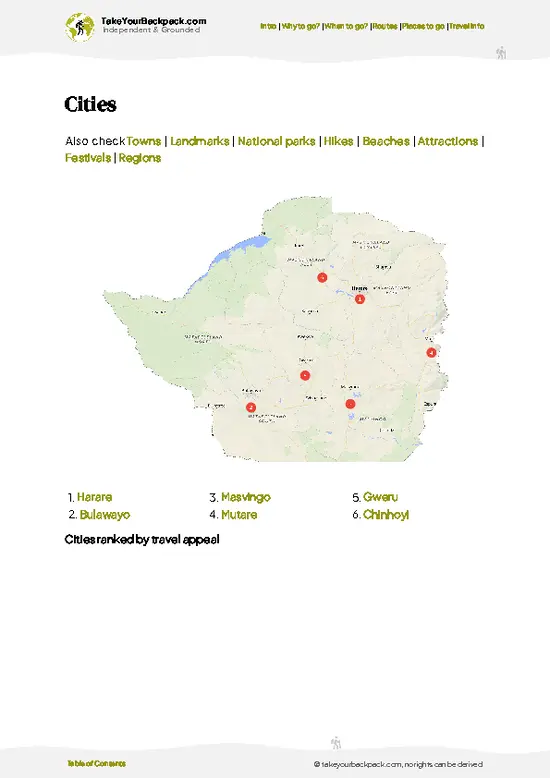
example page 2 from our offline Travel Guide for Zimbabwe
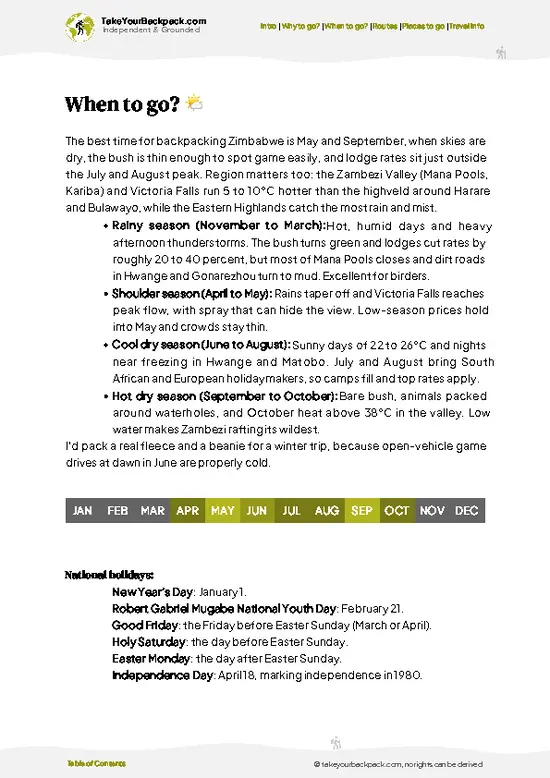
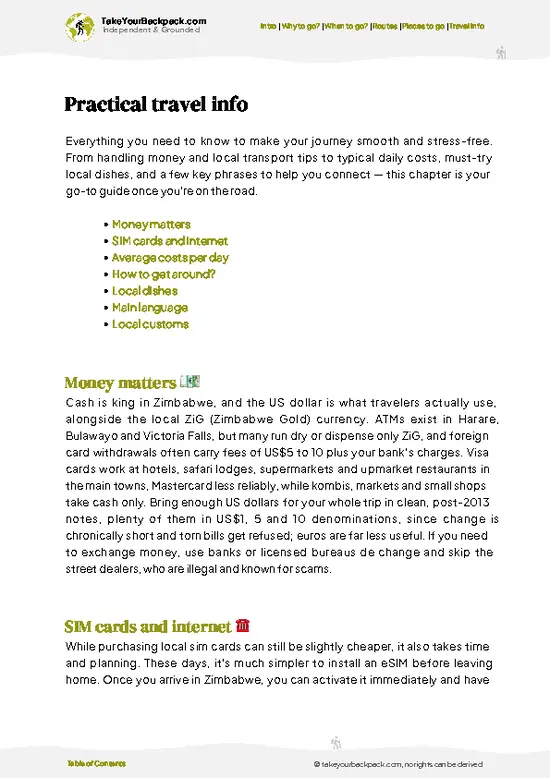
example page 3 from our offline Travel Guide for Zimbabwe
example page 4 from our offline Travel Guide for Zimbabwe
example page 5 from our offline Travel Guide for Zimbabwe
example page 6 from our offline Travel Guide for Zimbabwe
example page 7 from our offline Travel Guide for Zimbabwe
The digital guide (265 pages) contains:
✅ 67 highlights, ranked by travel appeal
✅ Optimized 5, 10 & 15-day travel routes
✅ Cities, national parks, landmarks, beaches
✅ How to get around
✅ Offline-friendly for travel without Wi-Fi
👉 Click to see all 30+ guide features

📅 Plan smarter in minutes, not weeks
✅ Month by month travel advice
✅ Festivals & national holidays
✅ Budget expectations

🗺️ Go to the right places, skip the overrated ones
✅ Honest pros & cons of destinations
✅ Top hikes, parks & viewpoints
✅ Lesser-known places most travelers miss
✅ Clear “worth it vs skip it” guidance

🛏️ Travel smoothly without rookie mistakes
✅ Best areas to stay
✅ Transport systems explained simply
✅ Common scams & safety advice
✅ SIM cards, money & practical tips

🌍 Understand the country, not just visit it
✅ Culture & traditions
✅ 52 Essential phrases & customs
✅ Festivals worth planning around
✅ Traveler-friendly historical context
✅ Insights that make places more meaningful

📱 Built for real travel conditions
✅ Fully downloadable PDF
✅ Works completely offline
✅ Optimized for phone use
✅ Useful in remote areas & buses
✅ Everything in one place
Stop searching, start planning
Get instant access to your full guide. 30‑day money-back guarantee.
+ Add another guide for just

By proceeding you agree to our terms.
Sent to your inbox immediately after payment • 100% Secure Checkout
Best Backpacking Travel Advisor 2025 tourism awardBest Backpacking
Travel Advisor
2025
What others say about Take Your Backpack Guides:
⭐⭐⭐⭐⭐
Fantastic, amazing amount of information!
⭐⭐⭐⭐⭐
My goodness this is amazing, it's what I've been looking for hats off too you!
⭐⭐⭐⭐⭐
I think this is absolutely BRILLIANT
⭐⭐⭐⭐
Very complete and informative. It's still missing places, but I gotta to commend you
⭐⭐⭐⭐⭐
This is truly amazing, thank you, can't wait to explore it with my kids!
⭐⭐⭐⭐⭐
Awesome resource, thank you!
⭐⭐⭐⭐⭐
This is amazing! Can't wait to explore the ones I haven't seen
⭐⭐⭐⭐
I love this! Well done, great idea.
⭐⭐⭐⭐⭐
Thanks for taking the time to make this gem!
⭐⭐⭐⭐⭐
This might be the best website I've ever seen.
⭐⭐⭐⭐⭐
Congratulations, and thank you so much for your work; it's incredibly valuable.
⭐⭐⭐⭐
In all seriousness I think you did a great job pointing out the important spots
⭐⭐⭐⭐⭐
10/10 very good
⭐⭐⭐⭐⭐
As someone who's only just starting to visit regularly this is awesome, thank you.
⭐⭐⭐⭐
Thank you very much! I'm going to visit my dad, it's going to be very useful!
⭐⭐⭐⭐⭐
This is really cool! We'll be travelling for the first time and this definitely come in handy.
⭐⭐⭐⭐⭐
You are now our minister of culture, congratulations 👨‍💼
⭐⭐⭐⭐⭐
Just wanted to tell you that this is a pearl! Going to follow your recommendations.
⭐⭐⭐⭐⭐
This is so cool. I'll definitely be using the resource for my travels soon.
⭐⭐⭐⭐⭐
This is very impressive! Good work.
⭐⭐⭐⭐⭐
This is an amazing and informative site. Very well done!

🛏️ Where to stay?Top Places to Consider Staying

Zimbabwe has a small but solid spread of backpacker lodges, garden hostels with dorms at roughly US$12 to 25 a night, and budget guesthouses, though you won’t find big party hostels. In Harare, the leafy northern suburbs of Avondale and Belgravia hold most budget beds, with cafés, a shopping center and the city’s best restaurants close by and a calm, walled-garden feel; Milton Park is cheaper and closer to downtown but quieter at night, while Borrowdale is safe and polished but pricey and far from the center. Victoria Falls town packs the best backpacker scene into walkable streets a short ride from the falls, with bars and adventure-booking desks on your doorstep (watch for elephants and warthogs … read more 👉
Zimbabwe has a small but solid spread of backpacker lodges, garden hostels with dorms at roughly US$12 to 25 a night, and budget guesthouses, though you won’t find big party hostels. In Harare, the leafy northern suburbs of Avondale and Belgravia hold most budget beds, with cafés, a shopping center and the city’s best restaurants close by and a calm, walled-garden feel; Milton Park is cheaper and closer to downtown but quieter at night, while Borrowdale is safe and polished but pricey and far from the center. Victoria Falls town packs the best backpacker scene into walkable streets a short ride from the falls, with bars and adventure-booking desks on your doorstep (watch for elephants and warthogs after dark), and in Bulawayo the Suburbs neighborhood offers quiet, good-value guesthouses a short taxi ride from the center and the museum.

If you enjoy meeting fellow travelers, consider choosing hostels with high ratings for atmosphere. On the other hand, if you prefer having your own space, a hotel might be a better option.

ZimbabweMore Places Across Zimbabwe

👋 Meet the founderWho’s Behind Take Your Backpack?

Johan, backpacker and founder of TakeYourBackpackHi, I’m Johan (Netherlands 🇳🇱), the creator of TakeYourBackpack. Over the past 3 decades, I’ve backpacked through 90+ countries across six continents, gaining extensive experience with independent travel, long-term trips, and overland routes.

This site is built on a combination of firsthand travel experience and carefully curated insights from other backpackers. Many guides are based on places I’ve personally visited, while others bring together tips, observations, and practical advice shared by trusted travelers I’ve met along the way.

The goal is to provide realistic, experience-driven guidance — not generic itineraries — so you can explore destinations with better context, clearer expectations, and more confidence.