×

Zimbabwe🇿🇼 | best national parksDiscover the 10 Best national parks Across Zimbabwe

Zimbabwe’s national parks run from the elephant-thick floodplains of the Zambezi Valley to the granite kopjes of the southwest and the cool, misty ridges of the Eastern Highlands. That spread changes everything. Hwange and the Victoria Falls area are the easiest to reach and draw the most visitors. The Zambezi Valley and Mana Pools feel remote, with walking safaris and few other people. The Eastern Highlands are cheaper, quieter and made for hiking. For independent travel, pick by access, fees and how much self-drive you can handle, then push on into the bush.

By Johan Kruseman 🇳🇱 | Updated October 23, 2026
Explore the best hikes in Zimbabwe

Why go?Understanding Their Importance

Zimbabwe delivers wildlife on a scale few countries match, and the reasons are structural. The country sits on high plateau between the Zambezi and Limpopo rivers, with Kalahari sand in the west, a hot low-lying valley in the north and a mountainous eastern border. Those contrasts create very different habitats within one country. Hwange holds one of Africa’s largest elephant populations, and the Zambezi corridor allows walking safaris on foot, a rarity elsewhere.

History shaped the system too. Parks were set aside decades ago and run by the Zimbabwe Parks and Wildlife Management Authority, but economic turmoil since the 2000s left infrastructure thinner than in Botswana or South Africa. Expect rough gravel roads, basic camps and patchy signage. Fees are charged in US dollars, and foreign … read more 👉
Zimbabwe delivers wildlife on a scale few countries match, and the reasons are structural. The country sits on high plateau between the Zambezi and Limpopo rivers, with Kalahari sand in the west, a hot low-lying valley in the north and a mountainous eastern border. Those contrasts create very different habitats within one country. Hwange holds one of Africa’s largest elephant populations, and the Zambezi corridor allows walking safaris on foot, a rarity elsewhere.

History shaped the system too. Parks were set aside decades ago and run by the Zimbabwe Parks and Wildlife Management Authority, but economic turmoil since the 2000s left infrastructure thinner than in Botswana or South Africa. Expect rough gravel roads, basic camps and patchy signage. Fees are charged in US dollars, and foreign visitors pay far more than residents.

Before choosing Zimbabwe, know that public transport rarely reaches park gates. Self-drive needs a high-clearance vehicle, and many backpackers join shared camping safaris or hire local guides. Fuel and cash can be unpredictable, so carry small US dollar notes. Plan for that, and you get empty tracks, close encounters and wild country that still feels like exploring.
Why These Made the Cut
The list of best national parks in Zimbabwe is created based on landscapes, wildlife, adventure opportunities, facilities, and overall experience. If you feel a national park is missing in this list, please let us know.

When to go?Optimal Periods for Travel

Best months for wildlife and walking: The best months are May to October, the dry season, when animals gather at rivers and waterholes and vegetation thins enough to spot them. Rain is almost absent from June to August, and days run 22 to 28°C. Nights in the southwest and highlands can drop to 0 to 5°C, so pack a proper warm layer.

Shoulder seasons and the heat: September and October are the hot, dusty shoulder months. Temperatures in the Zambezi Valley climb to 35 to 42°C, but game viewing peaks around the last pools of water. April and early May bring green landscapes, fewer visitors and softer light, with rains just ending.

The wet season: From November to March, rain arrives (roughly 450 to 700 mm in the main wildlife areas, more in the Eastern Highlands). Birding is excellent and lodge … read more 👉
Best months for wildlife and walking: The best months are May to October, the dry season, when animals gather at rivers and waterholes and vegetation thins enough to spot them. Rain is almost absent from June to August, and days run 22 to 28°C. Nights in the southwest and highlands can drop to 0 to 5°C, so pack a proper warm layer.

Shoulder seasons and the heat: September and October are the hot, dusty shoulder months. Temperatures in the Zambezi Valley climb to 35 to 42°C, but game viewing peaks around the last pools of water. April and early May bring green landscapes, fewer visitors and softer light, with rains just ending.

The wet season: From November to March, rain arrives (roughly 450 to 700 mm in the main wildlife areas, more in the Eastern Highlands). Birding is excellent and lodge rates drop by 20 to 40 percent. Dirt roads turn to mud, some tracks close, and the Zambezi Valley parks can be inaccessible. Mana Pools generally closes to vehicles during the rains. The Eastern Highlands stay mild and misty year-round, with the driest hiking from April to October. Peak crowds and top prices fall in July and August, so book camps early.

national park hoppingPlanning Your Route Efficiently

How many days to allow: A trip linking several national parks in Zimbabwe needs 10 to 14 days. Anything shorter turns into a blur of dusty roads.

Grouping regions and direction: Cluster by geography. The northwest pairs Victoria Falls with the Hwange corridor, linked by a paved road of about 3 hours. Matabeleland’s southwest sits a further 5 to 6 hours from the capital, Harare, by road. The Zambezi Valley is a separate undertaking, roughly 5 to 6 hours north of Harare with a rough final stretch, and the Eastern Highlands lie 4 to 5 hours east near Mutare. A sensible loop starts in Harare and heads to the valley, returns toward the east, then works west to Bulawayo, Hwange and Victoria Falls, flying out from there. Reverse it if you arrive at the Falls.

Pacing and common mistakes: Allow 2 … read more 👉
How many days to allow: A trip linking several national parks in Zimbabwe needs 10 to 14 days. Anything shorter turns into a blur of dusty roads.

Grouping regions and direction: Cluster by geography. The northwest pairs Victoria Falls with the Hwange corridor, linked by a paved road of about 3 hours. Matabeleland’s southwest sits a further 5 to 6 hours from the capital, Harare, by road. The Zambezi Valley is a separate undertaking, roughly 5 to 6 hours north of Harare with a rough final stretch, and the Eastern Highlands lie 4 to 5 hours east near Mutare. A sensible loop starts in Harare and heads to the valley, returns toward the east, then works west to Bulawayo, Hwange and Victoria Falls, flying out from there. Reverse it if you arrive at the Falls.

Pacing and common mistakes: Allow 2 to 4 nights per park. One night is a wasted drive. Travelers often cram in too much, underestimating that distances look short but gravel slows travel to 30 to 40 km an hour. Instead, cap long drives at 5 hours and leave buffer days. Another error is mixing wet-season dates with valley parks, which can close. Check road status and carry spare fuel because pumps can run dry. Where shuttles skip gate roads, book a shared transfer or guide in advance.

The ListThe Best national parks of Zimbabwe

1 Hwange National Park

Pumped waterholes, elephant herds, painted dogs, Kalahari teak

Settle at a pan or viewing platform and watch elephants, buffalo, giraffe and sable arrive, then join a night drive or guided walk.

zimbabwe-national-park-hwange-national-park
© Google |

2 Mana Pools National Park

Walking among elephants, Ana tree groves, Long Pools, Zambezi canoes

Walk with a guide beneath feeding bull elephants, paddle channels beside hippo pods, and camp on the riverbank with no fences.

3 Gonarezhou National Park

Red Chilojo Cliffs, Runde River, baobab tracks, lowveld remoteness

Drive sand tracks along the Runde beneath ochre sandstone cliffs, stopping at hippo pools and baobabs with few other vehicles in sight.

4 Nyanga National Park

Mtarazi Falls, Mount Nyangani, mist forest, trout dams

Stand at the rim of a 762-meter waterfall, hike granite ridges toward Zimbabwe’s highest peak, and cool off in forested gorges.

5 Matusadona National Park

Drowned-tree shoreline, black rhino, Sanyati Gorge, ranger walks

Reach this wild lakeshore by boat or rough track, then walk jesse bush with an armed ranger or fish the gorge for tigerfish.

6 Zambezi National Park

Upriver from Victoria Falls, river drive, sundowner cruises, sable and roan

Drive the Zambezi riverfront at first light, join a sunset cruise past hippos, and book a guided walk through mopane woodland.

7 Chizarira National Park

Great escarpment, deep gorges, Taita falcon, ranger-led hikes

Hike with a ranger to gorge rims and lookouts, where klipspringer, sable and nesting raptors share a plateau almost free of visitors.

8 Chinhoyi Caves National Park

Cobalt sinkhole, dolomite caves, cave divers, short trails

Descend the stairs to a deep blue pool with visibility around 46 meters, then explore the dark cave and the bat chamber.

9 Vumba Botanical Gardens and Reserve

Mist forest, botanical lawns, Mozambique lookouts, turaco and apalis

Wander landscaped gardens and drop into damp indigenous forest, where samango monkeys move overhead and cliff edges open onto Mozambique.

10 Kazuma Pan National Park

Seasonal grassland flat, roan and sable, black cotton soil, border tracks

Cross open pan country by 4x4 in search of roan, sable and elephant, with tracks running close to the Botswana border.

11 Lake Kariba Recreational Park

Kariba Dam wall, houseboats, tigerfish, lake sunsets

Float past hippos and shoreline elephants by boat, cast for tigerfish, and look down on the lake from the dam wall.

12 Lake Mutirikwi Recreational Park

Granite-ringed reservoir, rhino reserve, trout and bass, kopje scrambles

Circle a granite-framed lake on foot or by boat, visit white rhino at Kyle, and pair it with the ruins of Great Zimbabwe.

13 Charara Safari Area

Kariba south shore, night hippos, guided bush walks, sandy tracks

Follow rough sand tracks to a quiet stretch of lakeshore, where hippos grunt through the night and a ranger leads you on foot.

14 Chewore Safari Area

Escarpment ridges, roadless interior, wild dog tracking, fly camps

Climb mopane-covered ridges with a guide, track lions and wild dogs along dry riverbeds, and sleep at fly camps with no fences.

15 Sapi Safari Area

Sapi River sand, unfenced Mana Pools link, mopane woodland, lion spoor

Drive sandy tracks where elephants cross freely toward Mana Pools, and read lion prints in dry riverbeds beneath the escarpment.

16 Umfurudzi Park

Sable antelope, granite domes, Umfurudzi River, fenced walking

Search miombo ridges for sable, climb boulder kopjes for treetop views, and walk without worry about big predators.

17 Chipinge Safari Area

Dry miombo bush, sandy spoor, granite kopjes, no facilities

Walk quiet woodland with a guide, read fresh spoor in soft sand, and listen to hyenas and nightjars from a simple campsite.

18 Ngezi Recreational Park

Ngezi Dam, lakeshore paths, impala herds, braai spots

Stroll flat paths along the dam, watch waterbirds and grazing impala, and settle at a lakeside picnic spot under miombo shade.

Think you know Zimbabwe?

Prove you’re a true local — uncover 8 lesser-known national parks in Zimbabwe that locals tend to keep to themselves.
Loading the map 🌍

Expert viewInsights from Locals and Experts

How many parks to visit: I advise three parks on a trip of two weeks, four at most. Each needs 2 to 4 nights to be worth the effort, and the roads between them eat entire days. Fewer stops also mean fewer entry fees, which for foreigners run roughly US$15 to 30 per person per day in most parks and higher for Victoria Falls.

Choosing between park types: The big-game safari parks offer the most wildlife but cost the most and need a vehicle. A shared camping safari or a rental with a driver costs US$100 to 200 a day per person on organized options and more with private guides. They give a backpacker the most animals per dollar if you split costs. The Zambezi Valley costs more in time (a long drive and often a guide) but delivers walking on foot among elephants and lions, which is the most thrilling … read more 👉
How many parks to visit: I advise three parks on a trip of two weeks, four at most. Each needs 2 to 4 nights to be worth the effort, and the roads between them eat entire days. Fewer stops also mean fewer entry fees, which for foreigners run roughly US$15 to 30 per person per day in most parks and higher for Victoria Falls.

Choosing between park types: The big-game safari parks offer the most wildlife but cost the most and need a vehicle. A shared camping safari or a rental with a driver costs US$100 to 200 a day per person on organized options and more with private guides. They give a backpacker the most animals per dollar if you split costs. The Zambezi Valley costs more in time (a long drive and often a guide) but delivers walking on foot among elephants and lions, which is the most thrilling option if you can afford it. Guided walks add roughly US$30 to 60 per person. The Eastern Highlands are the budget winner: entry is cheap, hikes can be done solo or with an inexpensive local guide, and comfort is simple but adequate. Budget US$20 to 40 a day there.

Budget figures: A realistic backpacker budget is US$60 to 120 a day in the main wildlife parks, combining camping at about US$10 to 25 a head, park fees, food and shared fuel. Add a guide at US$20 to 50 a day where required. Carry US dollars in small notes, since card machines fail and change is scarce.

Safety and cultural points: Wildlife is the main hazard. Never walk in camp at night without a torch, never approach elephants on foot or in a vehicle, and keep food locked away from baboons and hyenas. Stay inside the vehicle in lion country unless on a guided walk. Malaria is present in the low-lying parks, so take prophylaxis and cover up at dusk. Zimbabwe is generally welcoming, but photographing officials, police and military sites is a bad idea. Roadblocks are common, so stay polite and carry passport copies. Greet people before asking questions, and ask permission before photographing villagers. Tipping guides and rangers 10 to 15 percent of the guide fee is standard and appreciated.

✈️ The backpacker research shortcutZimbabwe Travel Guide

An offline-friendly backpacking guide with optimized travel routes, ranked highlights, transport advice, and the best areas to stay.
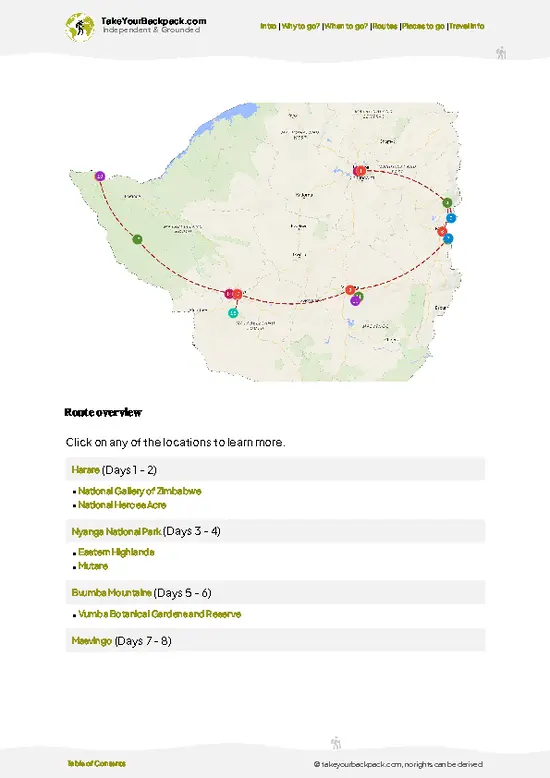
example page 0 from our offline Travel Guide for Zimbabwe
example page 1 from our offline Travel Guide for Zimbabwe
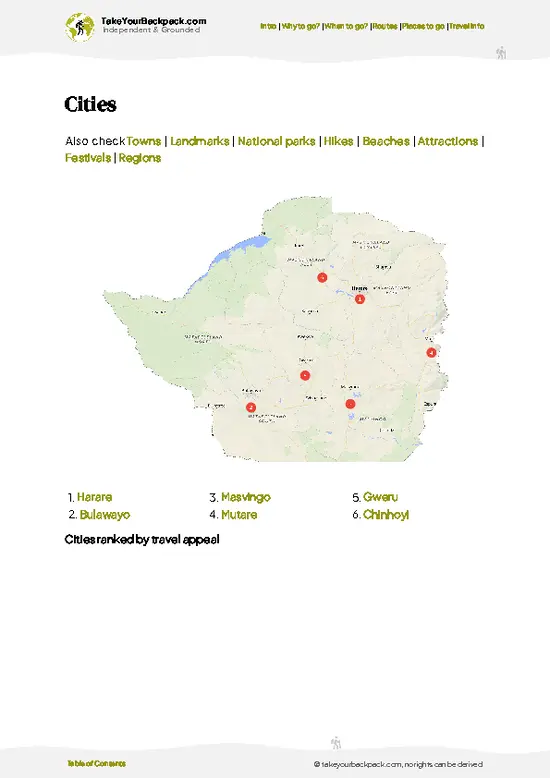
example page 2 from our offline Travel Guide for Zimbabwe
example page 3 from our offline Travel Guide for Zimbabwe
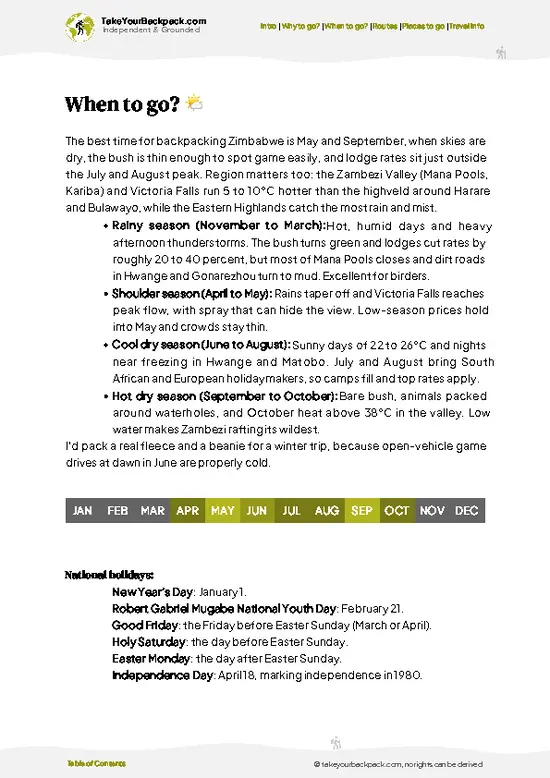
example page 4 from our offline Travel Guide for Zimbabwe
example page 5 from our offline Travel Guide for Zimbabwe
example page 6 from our offline Travel Guide for Zimbabwe
example page 7 from our offline Travel Guide for Zimbabwe
The digital guide (265 pages) contains:
✅ 67 highlights, ranked by travel appeal
✅ Optimized 5, 10 & 15-day travel routes
✅ Cities, national parks, landmarks, beaches
✅ How to get around
✅ Offline-friendly for travel without Wi-Fi
👉 Click to see all 30+ guide features

📅 Plan smarter in minutes, not weeks
✅ Month by month travel advice
✅ Festivals & national holidays
✅ Budget expectations

🗺️ Go to the right places, skip the overrated ones
✅ Honest pros & cons of destinations
✅ Top hikes, parks & viewpoints
✅ Lesser-known places most travelers miss
✅ Clear “worth it vs skip it” guidance

🛏️ Travel smoothly without rookie mistakes
✅ Best areas to stay
✅ Transport systems explained simply
✅ Common scams & safety advice
✅ SIM cards, money & practical tips

🌍 Understand the country, not just visit it
✅ Culture & traditions
✅ 52 Essential phrases & customs
✅ Festivals worth planning around
✅ Traveler-friendly historical context
✅ Insights that make places more meaningful

📱 Built for real travel conditions
✅ Fully downloadable PDF
✅ Works completely offline
✅ Optimized for phone use
✅ Useful in remote areas & buses
✅ Everything in one place
Stop searching, start planning
Get instant access to your full guide. 30‑day money-back guarantee.
+ Add another guide for just

By proceeding you agree to our terms.
Sent to your inbox immediately after payment • 100% Secure Checkout
Best Backpacking Travel Advisor 2025 tourism awardBest Backpacking
Travel Advisor
2025
What others say about Take Your Backpack Guides:
⭐⭐⭐⭐⭐
Fantastic, amazing amount of information!
⭐⭐⭐⭐⭐
My goodness this is amazing, it's what I've been looking for hats off too you!
⭐⭐⭐⭐⭐
I think this is absolutely BRILLIANT
⭐⭐⭐⭐
Very complete and informative. It's still missing places, but I gotta to commend you
⭐⭐⭐⭐⭐
This is truly amazing, thank you, can't wait to explore it with my kids!
⭐⭐⭐⭐⭐
Awesome resource, thank you!
⭐⭐⭐⭐⭐
This is amazing! Can't wait to explore the ones I haven't seen
⭐⭐⭐⭐
I love this! Well done, great idea.
⭐⭐⭐⭐⭐
Thanks for taking the time to make this gem!
⭐⭐⭐⭐⭐
This might be the best website I've ever seen.
⭐⭐⭐⭐⭐
Congratulations, and thank you so much for your work; it's incredibly valuable.
⭐⭐⭐⭐
In all seriousness I think you did a great job pointing out the important spots
⭐⭐⭐⭐⭐
10/10 very good
⭐⭐⭐⭐⭐
As someone who's only just starting to visit regularly this is awesome, thank you.
⭐⭐⭐⭐
Thank you very much! I'm going to visit my dad, it's going to be very useful!
⭐⭐⭐⭐⭐
This is really cool! We'll be travelling for the first time and this definitely come in handy.
⭐⭐⭐⭐⭐
You are now our minister of culture, congratulations 👨‍💼
⭐⭐⭐⭐⭐
Just wanted to tell you that this is a pearl! Going to follow your recommendations.
⭐⭐⭐⭐⭐
This is so cool. I'll definitely be using the resource for my travels soon.
⭐⭐⭐⭐⭐
This is very impressive! Good work.
⭐⭐⭐⭐⭐
This is an amazing and informative site. Very well done!

🛏️ Where to stay?Top Areas to Stay

Zimbabwe has a small but solid spread of backpacker lodges, garden hostels with dorms at roughly US$12 to 25 a night, and budget guesthouses, though you won’t find big party hostels. In Harare, the leafy northern suburbs of Avondale and Belgravia hold most budget beds, with cafés, a shopping center and the city’s best restaurants close by and a calm, walled-garden feel; Milton Park is cheaper and closer to downtown but quieter at night, while Borrowdale is safe and polished but pricey and far from the center. Victoria Falls town packs the best backpacker scene into walkable streets a short ride from the falls, with bars and adventure-booking desks on your doorstep (watch for elephants and warthogs … read more 👉
Zimbabwe has a small but solid spread of backpacker lodges, garden hostels with dorms at roughly US$12 to 25 a night, and budget guesthouses, though you won’t find big party hostels. In Harare, the leafy northern suburbs of Avondale and Belgravia hold most budget beds, with cafés, a shopping center and the city’s best restaurants close by and a calm, walled-garden feel; Milton Park is cheaper and closer to downtown but quieter at night, while Borrowdale is safe and polished but pricey and far from the center. Victoria Falls town packs the best backpacker scene into walkable streets a short ride from the falls, with bars and adventure-booking desks on your doorstep (watch for elephants and warthogs after dark), and in Bulawayo the Suburbs neighborhood offers quiet, good-value guesthouses a short taxi ride from the center and the museum.

If you enjoy meeting fellow travelers, consider choosing hostels with high ratings for atmosphere. On the other hand, if you prefer having your own space, a hotel might be a better option.

ZimbabweDiscover the Country

👋 Meet the founderWho’s Behind Take Your Backpack?

Johan, backpacker and founder of TakeYourBackpackHi, I’m Johan (Netherlands 🇳🇱), the creator of TakeYourBackpack. Over the past 3 decades, I’ve backpacked through 90+ countries across six continents, gaining extensive experience with independent travel, long-term trips, and overland routes.

This site is built on a combination of firsthand travel experience and carefully curated insights from other backpackers. Many guides are based on places I’ve personally visited, while others bring together tips, observations, and practical advice shared by trusted travelers I’ve met along the way.

The goal is to provide realistic, experience-driven guidance — not generic itineraries — so you can explore destinations with better context, clearer expectations, and more confidence.