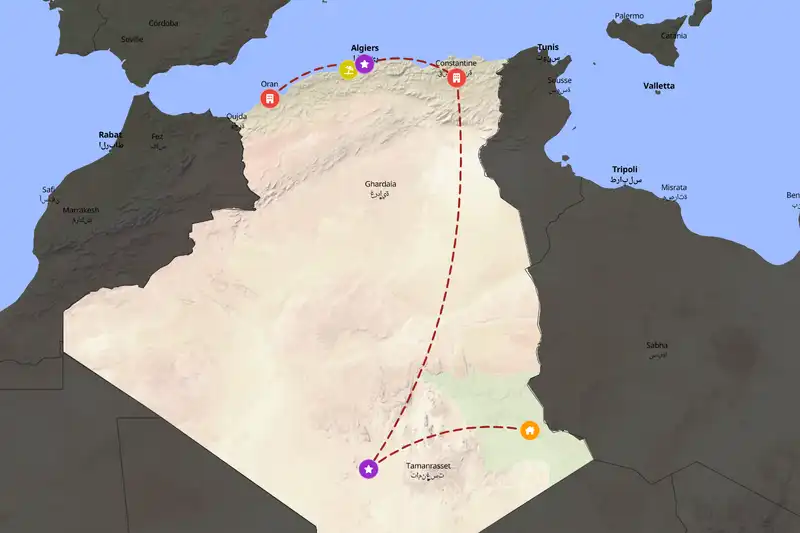
Backpacking Algeria independently is very doable in the north, where trains, buses and shared taxis link every major city, but it takes more patience than Morocco or Tunisia.
Most nationalities need a visa arranged in advance, and for the deep south (
Djanet,
Tamanrasset) you need a licensed agency, which can also arrange a visa on arrival for Saharan trips. Hostels are rare; budget hotels cost about 3,000 to 6,000 DZD (US$12 to 24) a night. English is limited, so basic French or Arabic helps a lot, and cash rules because foreign cards rarely work in ATMs. People are curious and welcoming, and police checkpoints may ask for your passport.
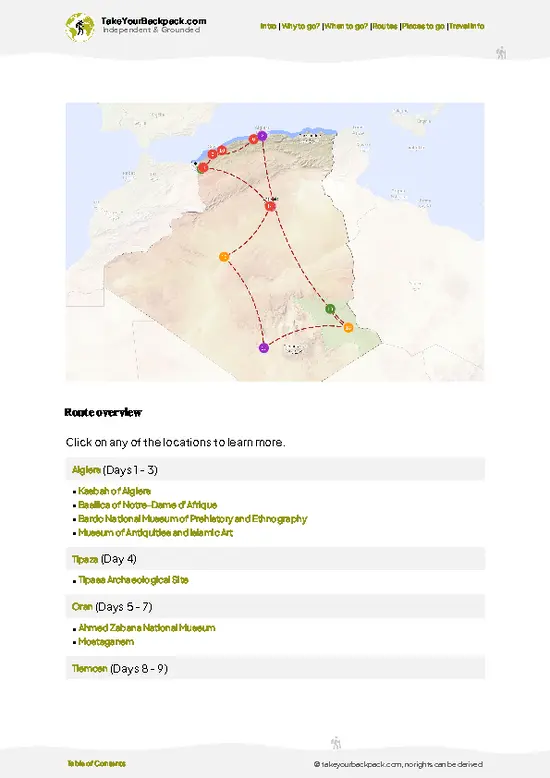
For Algeria, two weeks covers the north well, and three weeks lets you add a proper Sahara section without rushing.
A 7-day trip fits
Algiers (3 days) and
Tipaza (2 days) comfortably. With 14 days you can add
Constantine (3 days),
Timgad from Batna (2 days) and Bejaia or Tlemcen. With 21 days, include
Ghardaïa and the M’Zab (3 days) and
Timimoun (3 days). Distances are big: Algiers to Oran is 4 to 5 hours by train, Algiers to Constantine about 7 hours, so budget a travel day for every long hop and avoid stacking two in a row.
Yes, you can get around Algeria without a car, using trains along the coast, buses, shared taxis and cheap domestic flights for the Sahara.
Trains run
Algiers to
Oran in 4 to 5 hours, Oran to
Tlemcen in 2.5 to 3 hours and Algiers to
Bejaia in about 5 hours. Buses cover Algiers to
Ghardaïa in 8 to 9 hours, and shared taxis link Constantine and Batna in about 2 hours. For Timimoun, Djanet or Tamanrasset, Air Algérie flights from Algiers save one or two full days on the road. The one place a vehicle is essential is the desert itself, where a driver from a local agency handles 4x4 excursions.
The must-visits in Algeria are the
Casbah of Algiers, the Roman city of
Timgad, the
M’Zab Valley around Ghardaïa and the gorge city of
Constantine.
Add
Tipasa, Roman ruins on the sea 1 to 1.5 hours from Algiers, for an easy day trip or two nights.
Tlemcen in the west deserves 2 to 3 days for its palaces and plateau walks. For the Sahara,
Timimoun with its red ksar and dunes takes 3 days, while
Djanet and
Tassili n’Ajjer National Park, with rock art and sandstone forests, need about a week and an agency-run trek.
If you are short on time in Algeria, skip the far south around
Tamanrasset and the Hoggar, which needs flights, an agency and at least 5 to 7 days to do properly.
You can also leave out large modern cities such as
Sidi Bel Abbes,
Skikda or
Annaba, which have little for a visitor compared to Constantine or Tlemcen. Choose one Roman site rather than three:
Timgad is the most complete, so Djemila can wait. In Algiers, two days in the Casbah and the hilltop basilica cover the essentials, leaving the extra museums for a longer trip.
Yes, our itinerary-planner does exactly that. Set your trip length in days, give your interests and travel style, optionally give start- and end location and/or some mandatory stops you would like to include and the itinerary planner creates your personalized routes for Algeria in seconds. Try it out!
Try the itinerary plannerv2.webp)
 Best Backpacking