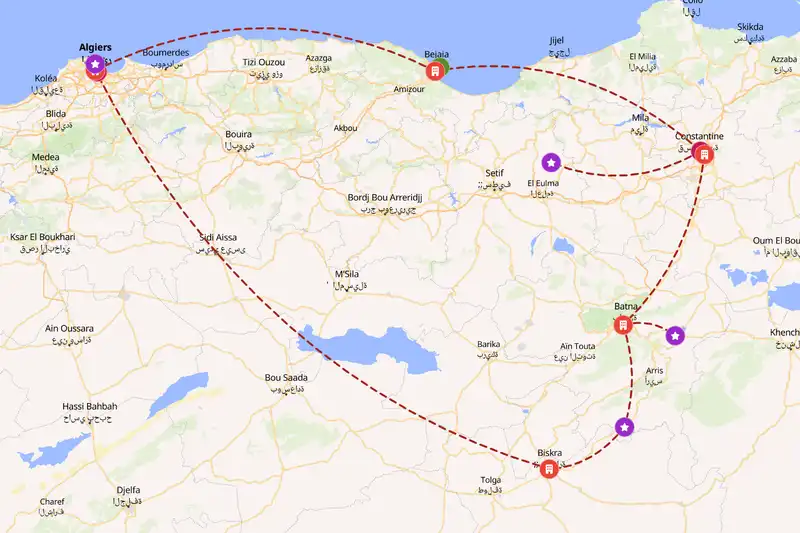
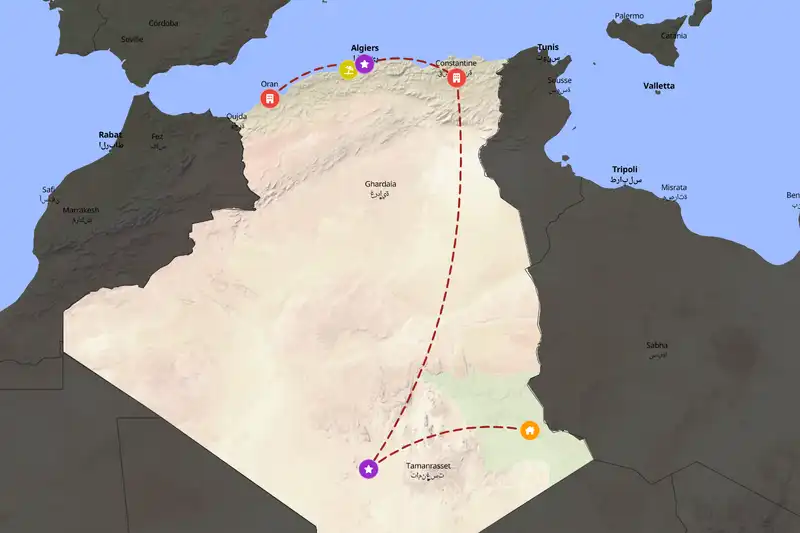
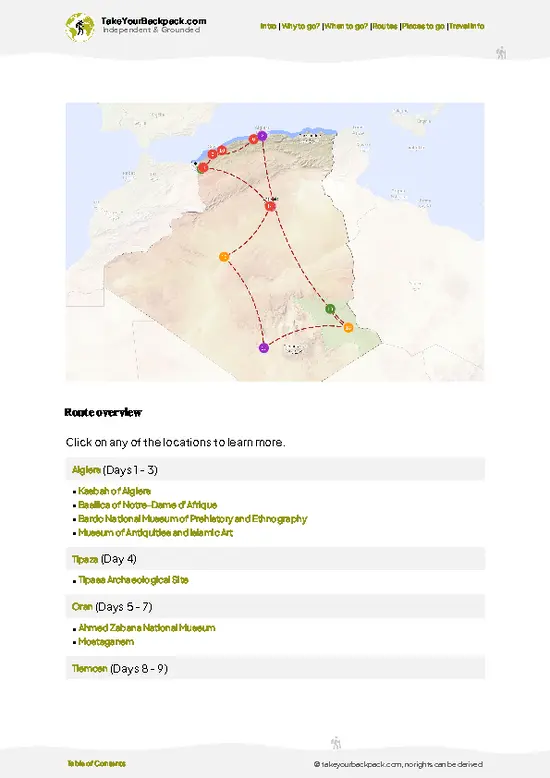
This three-week loop through Algeria suits travelers who want the full arc of the country: Ottoman alleys and French boulevards on the coast, Andalusian-Moorish heritage in the far west, then a deep drop into the Sahara for the M’Zab cities, the red oases of the Gourara and the sandstone forests of the Tassili. The pace is relaxed in the north and deliberately slower in the south, where heat and distance set the rules. You will use Algiers’ metro, tram and cable cars, intercity trains along the coast, long-distance buses into the desert, and domestic flights to reach Djanet. The deep south requires a licensed local agency for any trip into the Tassili, so book that piece before you fly.
Days 1-3: Algiers
Three nights give the capital room to breathe. Spend your first morning climbing the
Casbah of Algiers from the lower town, where stairways narrow to shoulder width and Ottoman-era houses lean toward each other over the lanes. A local guide pays for himself here, both for the history and …
read more 👉This three-week loop through Algeria suits travelers who want the full arc of the country: Ottoman alleys and French boulevards on the coast, Andalusian-Moorish heritage in the far west, then a deep drop into the Sahara for the M’Zab cities, the red oases of the Gourara and the sandstone forests of the Tassili. The pace is relaxed in the north and deliberately slower in the south, where heat and distance set the rules. You will use Algiers’ metro, tram and cable cars, intercity trains along the coast, long-distance buses into the desert, and domestic flights to reach Djanet. The deep south requires a licensed local agency for any trip into the Tassili, so book that piece before you fly.
Days 1-3: Algiers
Three nights give the capital room to breathe. Spend your first morning climbing the Casbah of Algiers from the lower town, where stairways narrow to shoulder width and Ottoman-era houses lean toward each other over the lanes. A local guide pays for himself here, both for the history and for finding the restored palaces open that day. Day two heads west along the bay to the Basilica of Notre-Dame d’Afrique, perched on a cliff above Bologhine, where the inscription above the apse asks Our Lady of Africa to pray for Christians and Muslims alike. Ride the cable car down afterward. Keep day three for museums: the Bardo National Museum of Prehistory and Ethnography fills a white Moorish villa with Tassili rock-art reproductions that set you up for the end of this trip, and the Museum of Antiquities and Islamic Art holds Roman mosaics and Islamic ceramics in a quieter corner near the Parc de la Liberté.Day 4: Tipaza
A short bus ride west lands you in Tipaza for one night by the sea. The Tipasa Archaeological Site and museum spreads Punic, Roman and early Christian ruins across headlands where umbrella pines grow between the basilica columns and the waves hit the rocks a few meters away. Stay until late afternoon, when the light goes gold on the stone and the day-trippers have left for Algiers.Days 5-7: Oran
Head back toward the capital for the coastal train to Oran, around 4 to 5 hours of olive groves and sea glimpses. Oran has a different temperament from Algiers: louder, more Spanish in its bones, and the birthplace of raï music, which you will hear spilling from cafés along the Front de Mer. Climb or taxi up to the Santa Cruz fort for the view over the harbor, and give a morning to the Ahmed Zabana National Museum, whose mix of natural history, archaeology and fine art rewards an unhurried pace. On day seven, take a day trip east to Mostaganem, about 1.5 hours away, for its old Tigditt quarter and seafront promenade, then return to Oran for dinner.Days 8-9: Tlemcen
The train inland to Tlemcen takes 2.5 to 3 hours and delivers you to the most refined city in the west. This was a capital of the Zayyanid dynasty, and the craftsmanship shows in carved stucco and green-tiled roofs. Start at El Mechouar Palace, the restored royal citadel, then walk to the Great Mosque nearby. On the second day, ride the cable car up to the Lalla Setti plateau inside Tlemcen National Park for pine forest, cooler air and a view across the whole city. The Mansourah ruins, with their single surviving minaret, make a good stop on the way back down.Days 10-12: Ghardaïa
Day ten is a long one: return to Oran and take the overnight bus, or route through Algiers by air, to reach Ghardaïa. Rest the first afternoon, because the next two days are dense. The five fortified towns of the M’Zab Valley ksour stack whitewashed and ochre houses around hilltop minarets, a layout from the 11th century that architects still come to study. Beni Isguen is the strictest and requires a local guide; dress modestly and never photograph women. Time your visit to catch the late-afternoon auction market in Beni Isguen, where goods are sold by a crier walking the square.Days 13-15: Timimoun
The bus southwest through El Menia to Timimoun runs roughly 9 to 10 hours, which is why it follows two easy days. Timimoun is built of red mud, with walls and gateways the color of the surrounding dunes. The oasis survives on foggaras, ancient underground channels that carry water to the palm gardens, and a guide can show you how the shares are measured at the outflow combs. Spend a full day at the edge of the Sahara Desert proper, where the Grand Erg Occidental dunes meet abandoned ksour, and stay out for sunset over the salt flat below the town.Days 16-19: Djanet and the Tassili
Fly via Algiers to Djanet, the gateway to Tassili n’Ajjer National Park. Four nights let your agency run a proper circuit: a mix of camping and town nights, with time among rock towers, arches and thousands of prehistoric paintings and engravings of cattle, giraffes and human figures. The dunes of Tin Merzouga glow orange at dusk, and the plateau sites around Sefar take real walking, so bring sturdy shoes and a warm layer for desert nights, which drop sharply after dark from November to February.Days 20-21: Back to Algiers
Fly north on day twenty and spend your final night near the bay. Use the last evening for a slow walk along the arcades of the French-era boulevards and a plate of grilled sardines before your departure.
If you have a spare day in the west, the oasis of Taghit near Béchar sits beneath enormous dunes and remains one of the quietest corners of the Algerian Sahara.v2.webp)
 Best Backpacking